
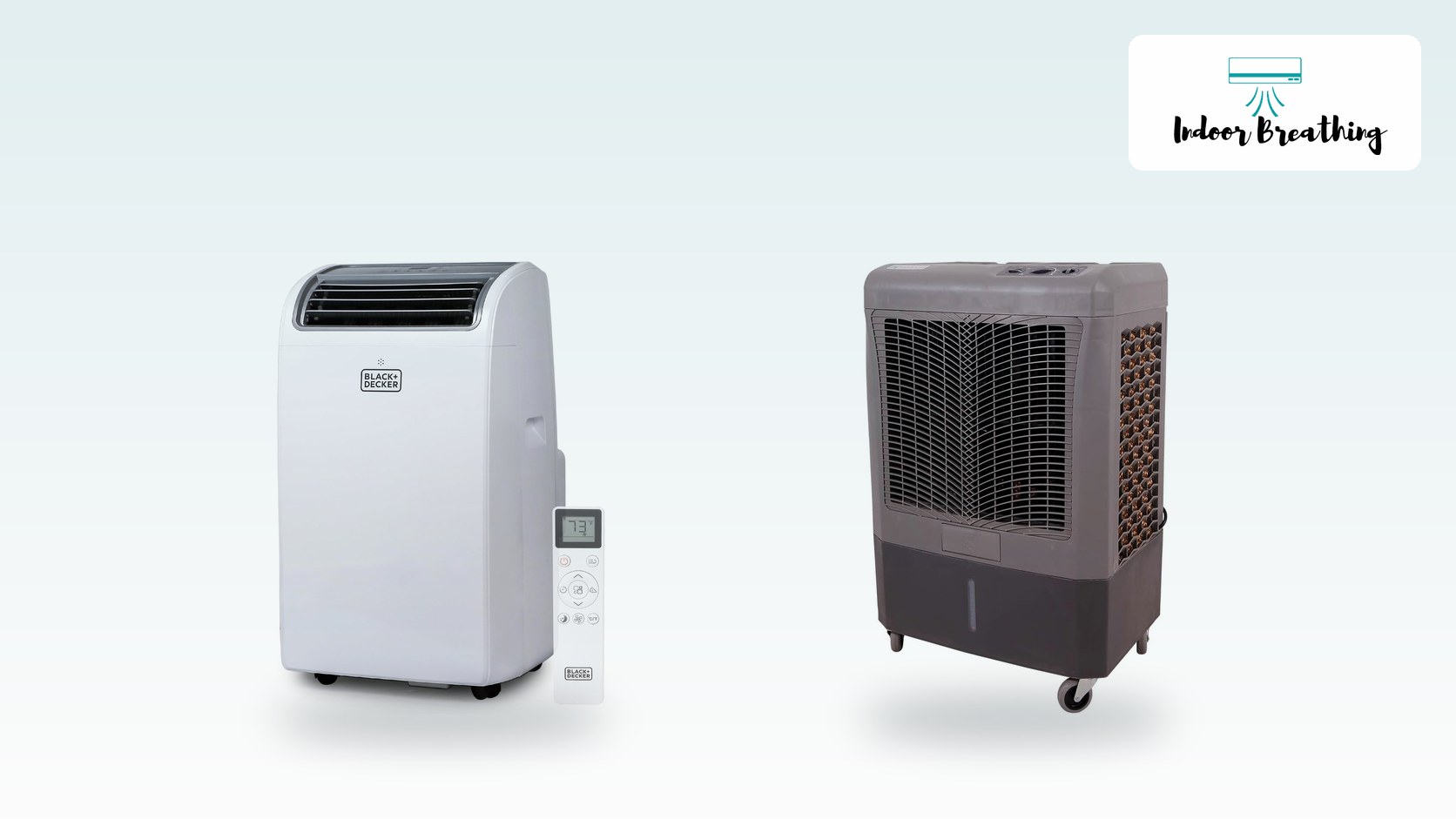
Prices and ratings were checked on Amazon on October 10, 2026. Several older picks are no longer sold, so this list now uses products with live listings.
A garage can feel like an oven in summer. Poor insulation, a big door and a hot driveway add up fast, and a regular fan only stirs hot air. A portable air conditioner is the quickest fix, but only if it is sized and vented properly. Here are four options that cover small garages, large garages and dry climates, plus the sizing rules that decide which one fits.
Table of Contents
Top Picks at a Glance
Best Portable Air Conditioners for a Garage, Reviewed
1. Best overall for two-car garages: BLACK+DECKER Smart 14,000 BTU Portable Air Conditioner (BPACT14WT)
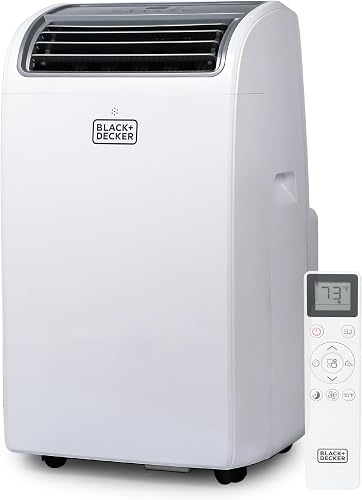
Price on Amazon: $470.35 | 3.9 stars from 9,176 ratings (checked October 10, 2026)
The BLACK+DECKER BPACT14WT is a 14,000 BTU (ASHRAE) unit, which the maker rates at 10,200 BTU under the newer DOE method (SACC), for rooms up to 700 sq. ft. It works as an air conditioner, a dehumidifier and a fan.
It is smart: connect it to Wi-Fi, use the mobile app or voice control, and the Follow Me remote acts as a thermostat wherever you leave it. A window kit is included, and the unit measures about 16.5 x 14 x 27 inches.
Pros
- Wi-Fi and voice control
- Follow Me remote
- Cools, dehumidifies and circulates
- Window kit included
Cons
- Rated 3.9 stars, lower than the other picks
- Needs a window or vent opening
Verdict: For a two-car garage or workshop where a smart, high-capacity portable makes sense, this is the pick.
2. Best dual-hose model: Whynter ARC-14S 14,000 BTU Dual Hose Portable Air Conditioner
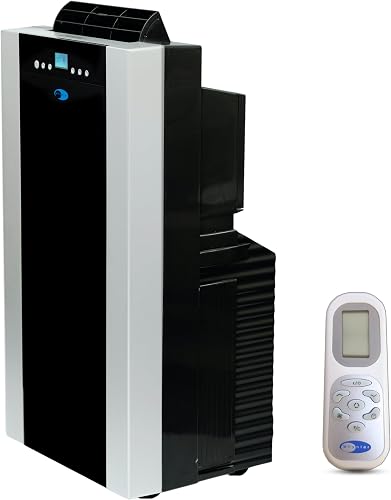
Price on Amazon: $679.99 | 4.3 stars from 12,560 ratings (checked October 10, 2026)
The Whynter ARC-14S puts out 14,000 BTU for rooms up to 500 sq. ft. and uses a second hose to feed the condenser. A dual-hose design pulls less already-cooled air out of the room, which helps in a hot garage.
It has three modes (cool, dehumidify and fan), works from the digital panel or the remote, and a built-in dehumidifier with auto drain recycles the water through the exhaust, so there is no bucket to empty in most conditions.
Pros
- Dual-hose design
- Built-in dehumidifier with auto drain
- Remote control
- 4.3 stars from 12,560 ratings
Cons
- Highest price here
- Two hoses mean more setup
Verdict: If you want the most efficient portable design and do not mind paying for it, the ARC-14S is the one.
Looking ahead, expect garage cooling to get more attention as hotter summers and home workshops, gyms and EV charging corners turn the garage into a room people actually use. Portable units are getting smarter, with app control and inverter motors that cut power use. The catch is that a portable AC in an uninsulated garage fights a losing battle, and running one all day can add a noticeable amount to the power bill.
3. Best for small garages: Frigidaire 8,000 BTU Portable Air Conditioner
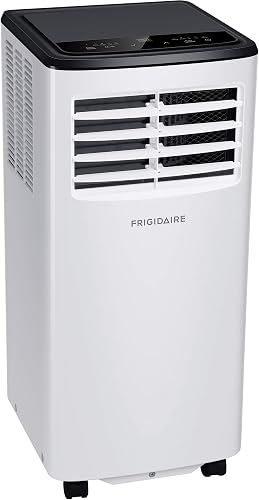
Price on Amazon: $252.52 | 3.8 stars from 806 ratings (checked October 10, 2026)
This Frigidaire is rated at 8,000 BTU (ASHRAE) or 5,500 BTU (DOE) and cools spaces up to 350 sq. ft., which fits a one-car garage with decent insulation. It has a dry mode, a sleep mode, a 24-hour timer, auto restart after a power outage and a clean-filter alert.
It rolls on casters and comes with a remote, so moving it from the garage to a bedroom in the evening is easy.
Pros
- Compact and easy to move
- Dry mode and sleep mode
- 24-hour timer and auto restart
- Lowest price here
Cons
- 3.8 stars from 806 ratings
- Too small for large or hot garages
Verdict: For a one-car garage or a smaller workshop, the Frigidaire is the budget-friendly choice.
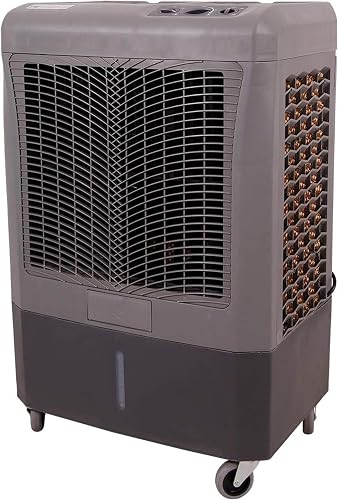
4. Best evaporative cooler for dry climates: Hessaire MC37M 3,100 CFM Evaporative Cooler
Price on Amazon: $452.18 | 4.3 stars from 4,733 ratings (checked October 10, 2026)
The Hessaire MC37M is not an air conditioner. It is an evaporative (swamp) cooler: it pulls air through water-soaked pads, which drops the temperature. It moves 3,100 CFM, has a 10.3-gallon tank and rolls on casters, so it suits open garages, patios and workshops.
Evaporative coolers work best where the air is dry. In humid climates they add moisture and cool far less, so check your local humidity before choosing one.
Pros
- No refrigerant or window hose
- Large 10.3-gallon tank
- Rolls on casters
- 4.3 stars from 4,733 ratings
Cons
- Works poorly in humid climates
- Adds moisture to the air
Verdict: In a dry climate with a garage door that stays open, the Hessaire is a low-cost way to cool a big space.
Other Ways to Cool a Garage
Portable units are the easy fix. If the garage is used all year, a ductless mini-split is the better long-term choice, because it cools and heats without a hose out the window. Our MrCool DIY mini-split review shows how that works, and our overview of ductless mini-split air conditioners covers the basics. A window unit is another option: see our picks for energy-saving window air conditioners and the 12,000 BTU window and portable units. For off-grid cooling, check battery-powered air conditioners, or try fans that cool like air conditioners for light heat.
Portable Air Conditioner for Garage Buying Guide
What Type of Air Conditioner Is Best for a Garage?
A ductless mini-split is the best long-term choice, because it needs no ductwork and can cover a whole garage with 24,000 to 30,000 BTU. For a quick, no-install fix, a portable air conditioner works: roll it in, vent the hose out a window or door panel and plug it in.
How to Make a Garage Air Conditioner Work Better
Insulation matters as much as equipment. Seal gaps around the door, windows and walls with weather-resistant barriers, and add insulation where you can. ENERGY STAR guidance treats sealing and insulation as the best return on investment before buying a bigger cooling unit. Next, size up if the garage has little insulation or high ceilings. Finally, let the hot air out first: open the door in the morning so the heat that built up overnight escapes, then close up and start cooling.
Safety note: never run a car or gas-powered tool in a closed garage while the AC is on. Exhaust contains carbon monoxide, and a portable AC does not remove it. For an attached garage, a carbon monoxide alarm is cheap insurance.
The risk is buying on BTU alone. A 14,000 BTU label on the box is the old ASHRAE number, and the newer DOE number is lower, so a garage may need more cooling than it looks like on paper. Expect more brands to print the DOE number up front, and do not be surprised if sizing advice shifts toward insulation first, then equipment.
Garage AC BTU Chart
Use this chart as a starting point, then size up if the garage is poorly insulated, faces the afternoon sun or has a high ceiling. Remember that portable AC labels often show the older ASHRAE number; the DOE (SACC) number is roughly 70% of it.
| Square feet | Garage size | BTUs recommended |
|---|---|---|
| 150 – 250 | 1 car | 8,000 |
| 250 – 350 | 1.5 cars | 10,000 |
| 350 – 450 | 2 cars | 12,000 |
| 450 – 550 | 2 or 2.5 cars | 14,000 |
| 550 – 650 | 3 cars | 16,000 |
| 650 – 750 | 3 or 3.5 cars | 18,000 |
| 750 – 900 | 3.5 or 4 cars | 20,000 |
Our guide on how many BTUs you need explains the math in more detail.
Features to Look for in a Portable Garage Air Conditioner
- Cooling capacity: match BTU to the garage size, and check both ASHRAE and DOE numbers.
- Noise: compressors and fans are loud; look for a sleep mode, a timer and the decibel rating.
- Portability: wheels or locking casters let you move the unit to another room.
- Energy use: a programmable timer and an ENERGY STAR label keep bills down. Our BTU calculator helps you size it.
- Maintenance: clean the filter at least once a summer (every two weeks in dusty garages), drain the unit before storing it and check the warranty.
What happens next: as refrigerant rules tighten, newer portables will switch to lower-impact refrigerants, and that may push prices up a little. Mini-splits and heat pumps will keep winning for garages used all year, because they cool and heat without a hose out the window. A portable unit is the easy fix; a mini-split is the long-term one.
FAQ
Can a portable air conditioner be used in a garage?
Yes. It needs a window, a vent panel or another opening for the exhaust hose, and enough capacity for the space.
How many BTUs does a garage need?
A common rule of thumb is about 20 BTU per square foot, then add more if the garage is poorly insulated. Check the chart above.
How can a garage be cooled cheaply?
Seal and insulate, use fans, close the door during the hottest hours, avoid parking a hot car inside and clear out clutter that traps heat. For more on fans, see fans that cool like air conditioners.
Will an 8,000 BTU unit cool a garage?
It can cool a one-car garage that is reasonably insulated. For two cars or poor insulation, step up to 12,000 BTU or more. See our 8,000 BTU air conditioners for more options.
Conclusion
A portable air conditioner makes a hot garage bearable without permanent installation. Check the cooling capacity, the venting setup, the extra features such as remote control and a timer, and the energy use before buying. Pick the unit that matches the garage, not the one with the biggest number on the box.