

These stoves are sold through dealers, and details come from the makers’ pages and older versions of this guide. Prices were not re-checked. Rules for vent-free gas appliances differ by state and city, so check yours before you buy.
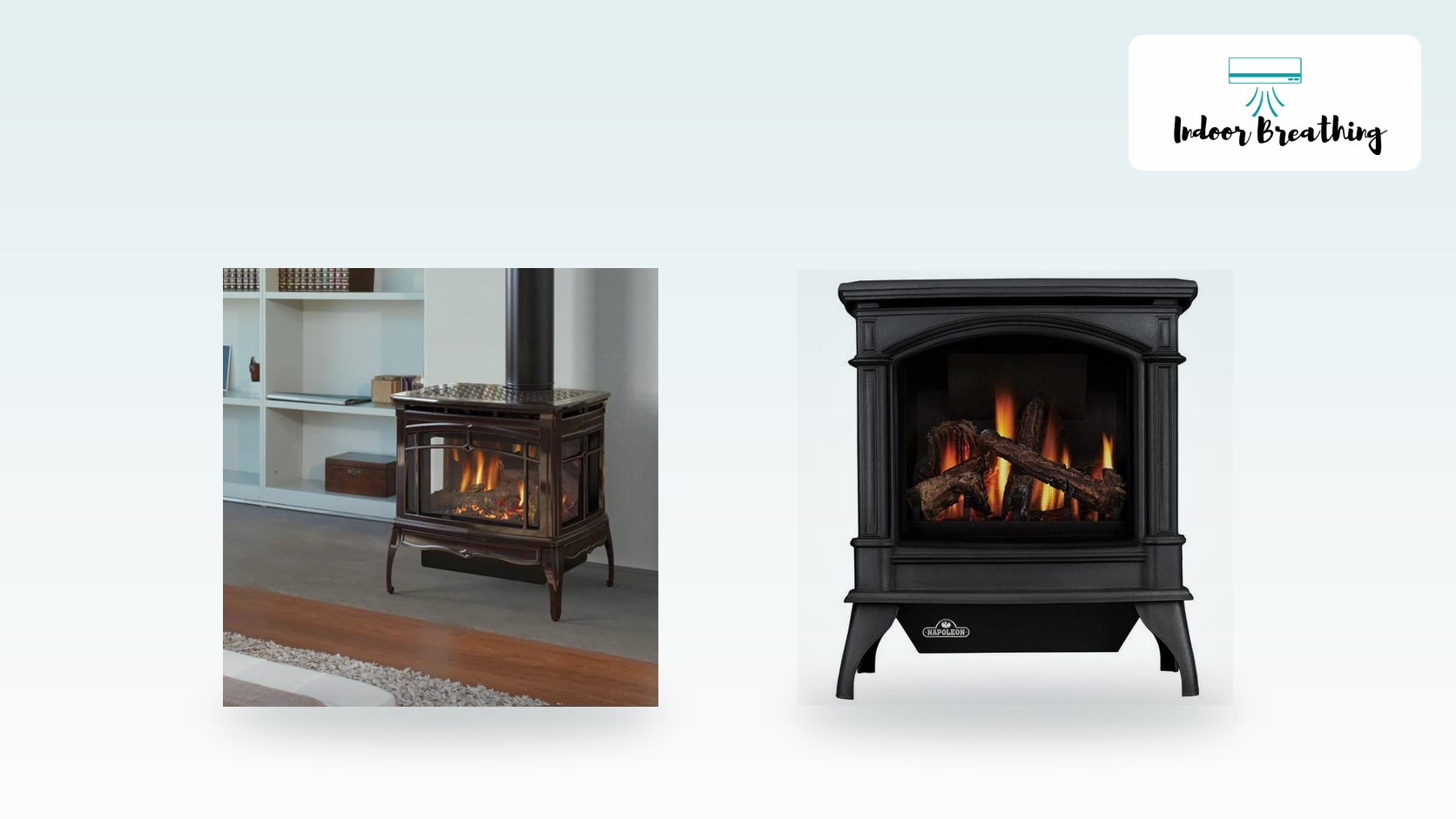
A freestanding gas stove gives you the look of a wood stove with the ease of a thermostat. There is no wood to haul and no ash to clean. Here are eight models to compare, plus the vent types, the air quality trade-offs and the care they need.
Table of Contents
8 Freestanding Gas Stoves
1. Hearthstone Waitsfield Freestanding Gas Stove
A cast-iron stove in matte black or enamel colors that the maker says suits spaces under about 1,800 square feet. A remote controls the flame and blower, with a thermostat mode and timer. It has three-side viewing and a battery backup for power outages.
- Steady-state efficiency listed at 77.4 percent
- Cast iron heat exchanger, child-safe glass
- Must be installed and serviced by qualified people
2. Napoleon GDS20 Arlington Direct Vent Gas Stove
A compact direct-vent stove that the maker says needs no electricity to light or run. It is small enough for tight spaces and is approved for mobile homes. Some accessories, such as venting parts, are sold separately.
- Direct vent, so exhaust goes outdoors
- Mobile home approved
- Venting and accessories not included
Looking ahead, gas stoves and fireplaces sit between two trends. Cities and states are limiting new gas hookups and some vent-free units, while cold winters and power cuts keep pushing people toward a heater that works without the grid. The catch is that rules vary a lot by place, and a stove that is legal in one state can be banned in the next.
3. Buck Stove Model 1110 Vent-Free Gas Stove, 22 Inch
A small vent-free stove for a bedroom or den corner, with a heat-activated variable-speed blower and a built-in thermostat that cycles the flame. Vent-free stoves are not legal everywhere, so check local rules first.
- Vent-free: burns room air
- Thermostat and blower
- Check your local rules before you buy
4. Buck Stove Model Premier T-33 Gas Stove, 26 Inch
A larger vent-free stove with a remote, a pilot that works in a power cut, and an option to use it as a fireplace insert with an arched trim panel. The maker notes that vent-free appliances are banned in some places, including parts of Canada and some U.S. areas.
- Remote control, works in a power outage
- Use as stove or insert
- Vent-free rules vary by place
5. Napoleon GDS60 Knightsbridge Direct Vent Gas Stove
A direct-vent stove with an advanced burner that gives a wood-fire look, a battery backup, a safety screen and an adjustable flame. Owners have reported that the thermostat does not last as long as they would like, so ask about the warranty.
- Direct vent
- Limited lifetime warranty per the maker
- Two color choices
6. Kingsman FVF350 Vent-Free Gas Stove
A compact vent-free stove with a dual-burner system, a safety screen and an oxygen depletion sensor, in two colors. It is made for small spaces and is on the heavy side, so moving it takes two people.
- Vent-free with an oxygen depletion sensor
- Dual burner
- Heavy for its size
7. Empire Direct Vent Gas Stove, Medium (DVP30CC)
A direct-vent stove that ships with the stove, logs, ignition system and burner, with color choices to match a room. The venting is bought separately. The maker lists UL, CSA and ANSI certification and a limited 5-year warranty.
- Direct vent
- Venting is extra
- Limited 5-year warranty
8. Kingsman FDV451 Freestanding Direct Vent Gas Stove
A modern direct-vent stove with a dual-burner system, a realistic flame pattern, ceramic glass that radiates heat and a choice of body colors. It carries a limited lifetime warranty per the maker.
- Direct vent
- Dual burner
- Limited lifetime warranty per the maker
Which Vent Type?
| Type | Where the air comes from | Where the exhaust goes | Air quality |
|---|---|---|---|
| Direct vent | Outside, through a sealed pipe | Outside, through the same pipe set | Best: sealed from the room |
| B-vent (natural vent) | Room air | Up a chimney or flue | Good if the flue draws well; uses room air |
| Vent-free | Room air | Into the room | Needs care: adds water vapor and gases |
The Air Quality Catch With Vent-Free Stoves
A vent-free stove burns gas inside your room. The maker designs it to burn cleanly, and an oxygen depletion sensor turns it off if the room air gets too low in oxygen. Even so, it releases water vapor, carbon dioxide and small amounts of carbon monoxide and nitrogen dioxide into the room. In a tight home, that means more moisture on windows, a stuffy feel and a rise in combustion gases. Protect yourself:
- Check that vent-free units are allowed where you live. Some states and cities ban them, and so do some building codes for bedrooms and bathrooms.
- Install carbon monoxide alarms near sleeping areas and test them monthly.
- Crack a window or keep a vent open when the stove runs.
- Do not run it while you sleep.
- Choose a size that fits the room. Oversizing leads to more combustion gas for the same heat.
Direct-vent models avoid these issues because the combustion is sealed from the room. They cost more to install, because they need a vent kit through a wall or roof.
The risk to watch is indoor air. A vent-free stove burns gas inside the room and releases water vapor, carbon dioxide and small amounts of other gases. In a tight, modern home with no fresh air, those build up. Expect more homes to be sealed tight in the next decade, which makes a direct-vent stove or a good CO alarm more important.
Installation
A gas stove needs a gas line, a shutoff valve and, for vented models, a vent route. A licensed gas fitter should handle it, and many places need a permit. Pick the location with care: stoves need clearance from walls, furniture and curtains, and a fireproof floor pad if the manual calls for it. Choose an exterior wall when you can, because it makes venting easier. Budget a few thousand dollars for the unit and install, and get quotes. An older estimate on this page put it at $2,750 or more.
Care and Maintenance
- Glass. Clean it when it is cool. Check the gasket for gaps.
- Logs. They are ceramic or cement. Brush gently with a dry brush, and never use sprays or damp cloths. If they change color or get sooty, call a pro.
- Vents and chimney. Check them each year. Condensation can damage a flue.
- Yearly service. Have a technician check the burner, the pilot and the safety sensors.
FAQ
Are vent-free gas stoves safe?
They have safety devices, but they put combustion products into the room. They are safest in a large, ventilated space with working CO alarms, and they are banned in some places. Direct-vent is the safer choice for air quality.
Can a gas stove work in a power outage?
Some do, with a standing pilot or battery backup. Check the model. The blower will not run without power on most.
Is a gas stove worth it?
If you have cold winters and want easy, quick heat, yes. If your climate is mild, a heat pump or an electric fireplace may suit you better.
How do you pick the size?
Match the BTU rating to the room and insulation. The maker’s coverage claim is a guide, not a promise.
Final Word
Pick the vent type first, then the size, then the style. Always hire a licensed pro and add CO alarms. For related options, see our gas fireplaces for home and indoor freestanding wood fireplaces.
What happens next: heat pumps and electric fireplaces will win more homes in mild climates, and direct-vent gas stoves will hold onto cold ones. If you buy gas, choose the type that sends combustion gases outdoors, and plan for a licensed install and a yearly check.
Related Guides
Keep going with best electric fireplace inserts and indoor wood-burning fireplaces.