

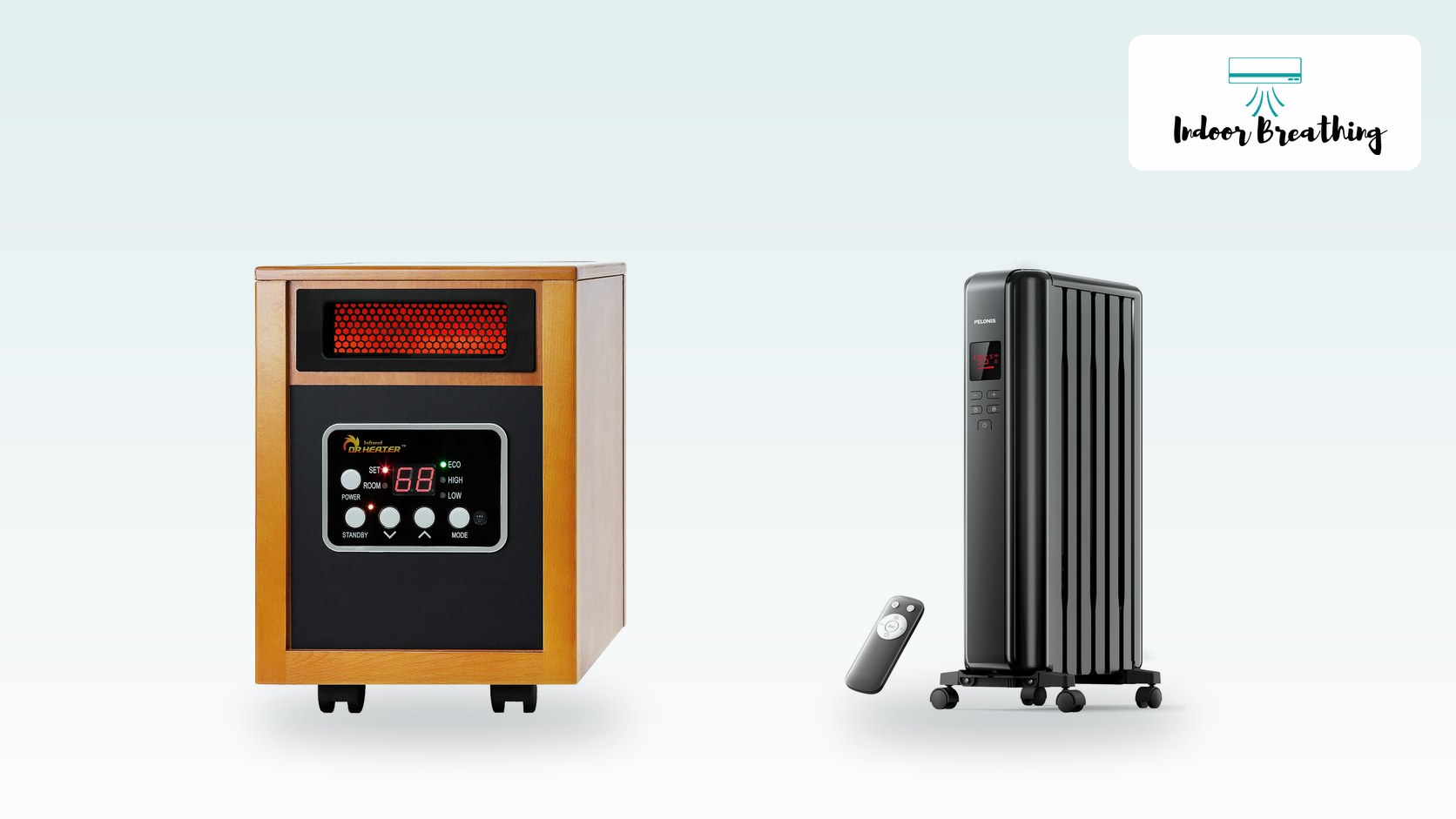
Choose the most energy efficient space heater by matching the technology to how you actually use it, not by trusting a vague “efficient” label — every resistance heater turns electricity into heat at nearly the same rate. Real savings come from a genuine low-wattage setting, radiant heat that warms you directly, or a thermostat precise enough to cut runtime automatically.
Every wattage spec and rating below is checked against each manufacturer’s product documentation. No hands-on lab testing is involved. Prices and ratings were last checked in September 2026 and can change, so confirm the live price on Amazon before you buy.
Every “most efficient space heater” list compares brands, not technology — and that’s backwards. Ceramic, infrared, oil-filled, micathermic, and convection heaters all do the same basic thing: run electricity through resistance and turn it into heat. None beats the others at that conversion; physics doesn’t allow it. What actually separates a heater that saves money from one that just runs your bill up is whether it has a real low-wattage mode, whether it delivers heat you feel directly instead of heat that drifts away in air currents, and how tightly its thermostat holds a target temperature. Five current heaters are compared here, one per major technology, to show what those differences look like in dollars.
Affiliate disclosure: IndoorBreathing may earn a commission when you buy through links on this page, at no extra cost to you. Picks are chosen for genuine efficiency features and running cost, not commission rate.
Table of Contents
Space Heater Types Compared
Every heater here tops out near 1500 watts on its highest setting — the real differences show up in the lower settings and how each one delivers heat.
| Model | Technology | Wattage Settings | Best For | Price |
|---|---|---|---|---|
| Dr Infrared Heater DR-968 | Infrared quartz + PTC | 1000W low / 1500W high | Best overall | $112.99 |
| DREO Smart Wall Heater | Ceramic (PTC) | 1500W (app/ECO scheduling) | Smart scheduling | $84.53 |
| PELONIS Oil-Filled Radiator | Oil-filled radiator | 600W / 900W / 1500W | Most wattage tiers | $119.99 |
| De’Longhi HMP1500 | Micathermic panel | 750W low / 1500W high | Dust-free / allergies | $129.95 |
| Envi Wall Panel Heater | Convection panel | 500W (fixed) | Lowest wattage / 24-7 zone heat | $199.95 |
Why “Efficiency” Doesn’t Mean What the Marketing Implies
Here’s the physics nobody puts on the box: a plug-in electric space heater converts essentially all its electricity into heat. There’s no combustion or exhaust — unlike a gas furnace, which loses some energy up the flue, an electric heater’s efficiency at turning watts into heat is already close to 100% whether it’s ceramic, infrared, oil-filled, or a panel. So when a listing brags about being “highly efficient,” it isn’t describing a real difference in how much of your electricity becomes heat.
What actually varies is threefold. First, whether a heater has a genuine lower-wattage setting — not just an “eco” label, but a real reduced power draw you’d use on a mild day. Second, whether it delivers radiant heat, which warms your skin and nearby objects directly the way sunlight does, versus convective heat, which warms the air and relies on that air staying in the room. Radiant heat lets you feel comfortable at a lower thermostat setting. Third, how tightly the thermostat holds a target temperature — a heater that cycles in a tight band uses less energy than one that overshoots in big swings.
Every heater here is capped around 1500 watts on its highest setting, same as any plug-in heater on a standard household outlet — a hard ceiling set by the 15-amp circuit, not a technology choice. Our space heater wattage calculator and sizing guide cover how that ceiling translates to real room coverage; this guide is about what happens once you’re not running flat-out on high.
Infrared/Quartz Heaters: Radiant Heat Without Warming All the Air
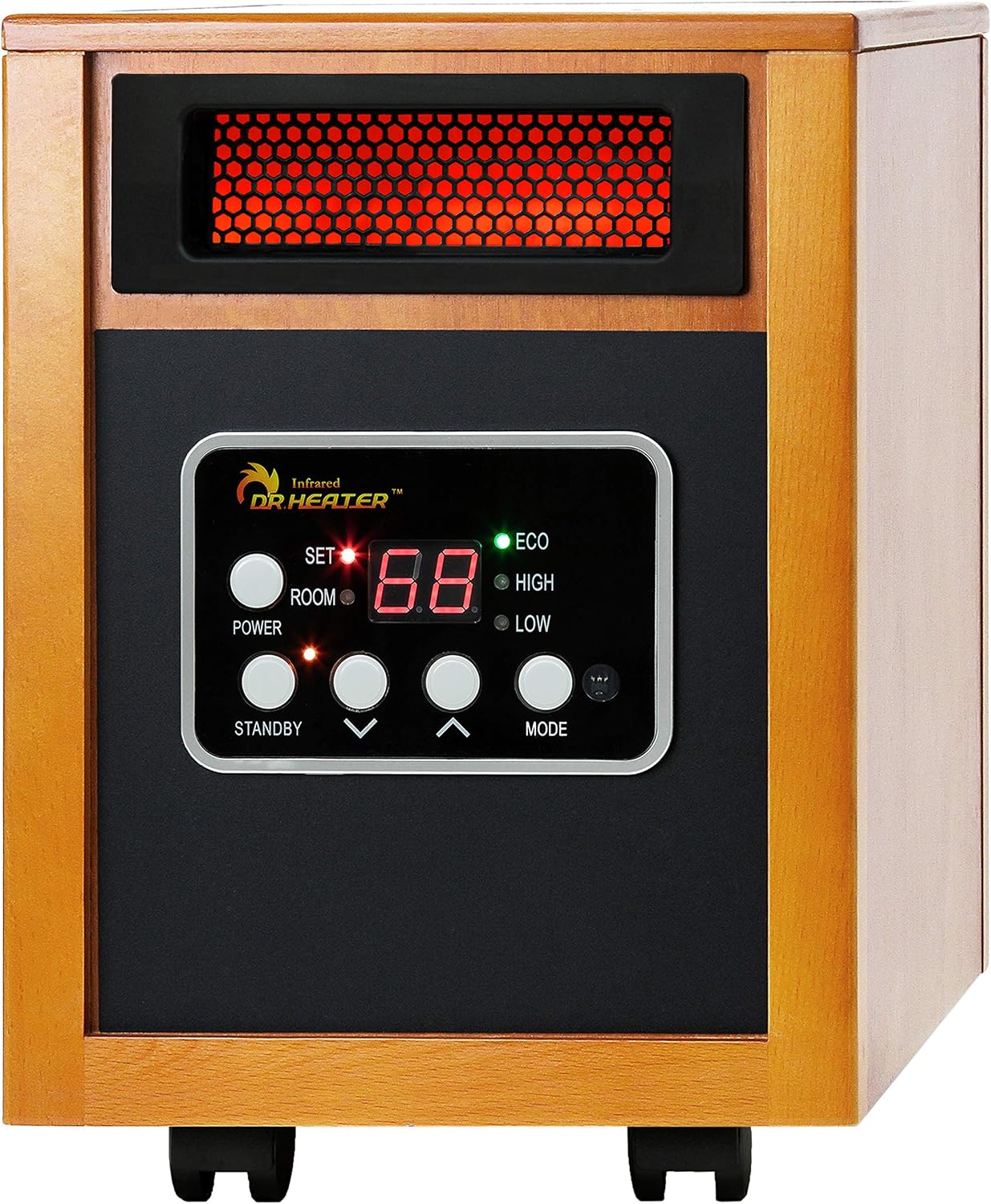
The Dr Infrared Heater DR-968 is the overall pick because it pairs the technology’s real advantage — radiant heat you feel directly — with an actual low-wattage mode, not just a label. Its dual system combines a quartz infrared tube with a PTC ceramic element, rated at 1500W on high and a genuine 1000W on low, with an Auto mode that switches between the two to hold your set temperature from 50-86°F.
Because the quartz element radiates heat toward people and furniture rather than only warming passing air, a room with this heater running can feel comfortable at a lower thermostat setting than one heated purely by convection — the same reason direct sun feels warm on a cold day even though the air temperature hasn’t changed. At 39dB, its blower is genuinely quiet, and the cherry wood cabinet on wheels suits a living room rather than a workshop.
With 4.5 stars across more than 28,000 ratings, it’s one of the most-reviewed heaters on Amazon at any price, and at $112.99 it sits mid-pack for the technology.
Pros
- Genuine 1000W low mode
- Dual quartz + PTC radiant heat
- 39dB whisper-quiet blower
- 4.5 stars across 28,000+ ratings
Cons
- Bulkier cabinet than tower heaters
- No oscillation, stays pointed one way
- Pricier than basic ceramic models
Ceramic (PTC) Heaters: Fast Heat, Smart Scheduling Cuts the Real Cost
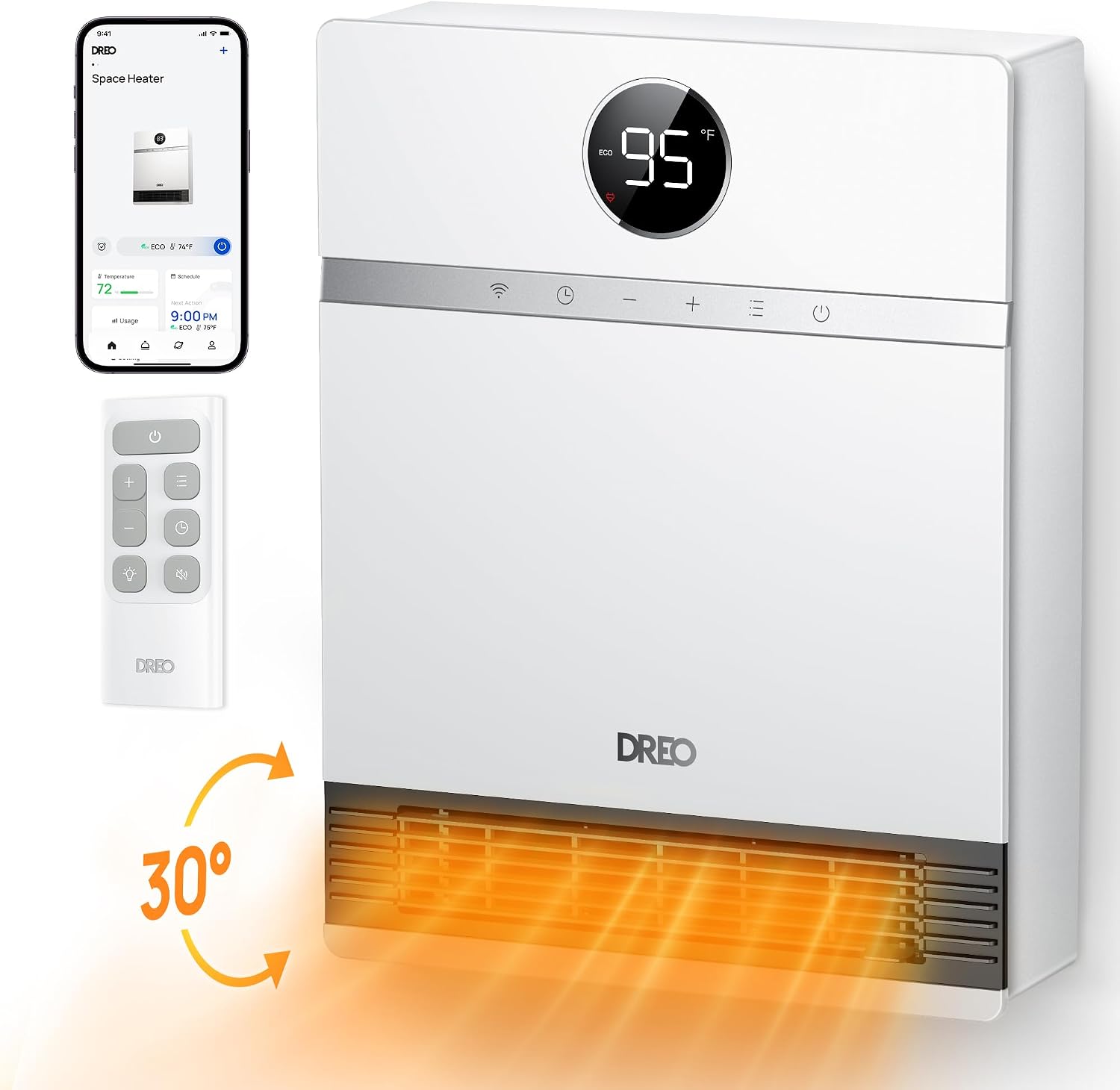
Ceramic PTC heaters use the same self-regulating element found in most fan-forced heaters, and on their own they’re not more or less efficient than anything else here — the savings come from what controls them. The DREO Smart Wall Heater is the clearest example: a standard 1500W PTC element with WiFi, an app, and Alexa voice control layered on top, letting you schedule it to run only when a room is occupied instead of leaving it on by habit.
Its ECO mode holds a set room temperature via the app’s thermostat rather than running the element continuously — that’s where the real savings happen, not from the element itself being different, but from the control loop cutting runtime automatically. At 28dB and rated IP24 for splash resistance, it’s quiet enough for a bedroom and rugged enough for a bathroom, and its wall-mounted design keeps it off the floor entirely.
At $84.53 with 4.5 stars across more than 3,100 ratings and an Amazon’s Choice badge, it’s the least expensive heater here with smart features — the tradeoff is a fixed wall mount and no separate low-wattage tier like the infrared and radiator picks below.
Pros
- WiFi, app, and Alexa control
- ECO mode auto-cuts runtime
- Wall-mounted, saves floor space
- IP24 rated for humid rooms
Cons
- No separate low-wattage tier
- Fixed wall mount, less flexible
- 30° oscillation, narrower than towers
The risk to watch is cheap, unsafe heaters. Winter spikes bring a flood of no-name units with no safety listing, and space heaters are a leading cause of home heating fires. Buy only models listed by a safety lab such as UL or ETL, with tip-over and overheat protection.
Oil-Filled Radiators: Slow, Steady, and the Most Wattage Tiers
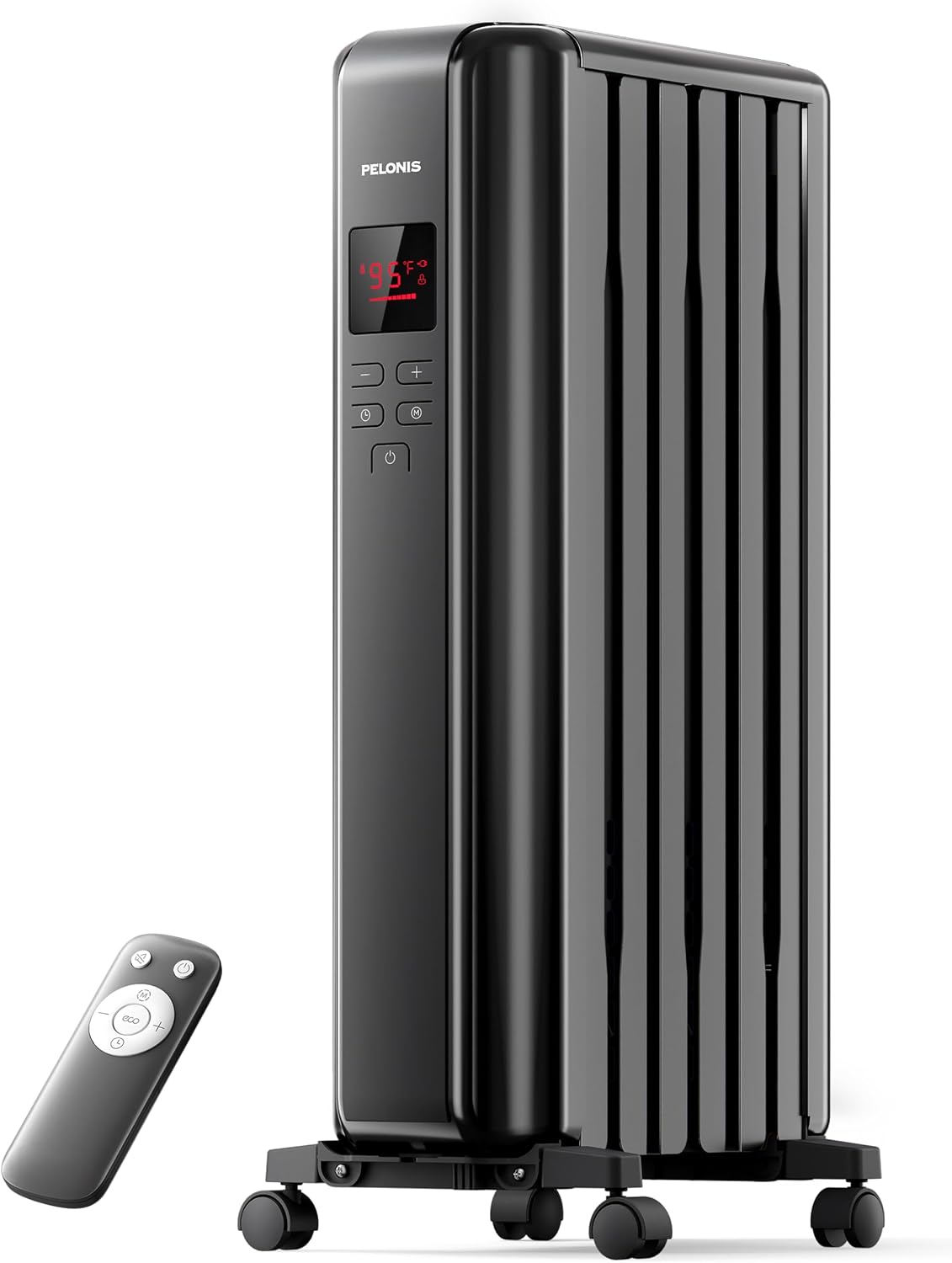
An oil-filled radiator heats a sealed reservoir of oil inside finned panels instead of blowing air across a coil, so it has no fan and holds heat longer after shutoff — the metal stays warm and keeps radiating for a while. The PELONIS Oil-Filled Radiator gives you the most granular control here: three real wattage levels at 600W, 900W, and 1500W, plus a thermostat adjustable from 41-95°F in 1-degree increments.
That range matters more than it sounds. Instead of picking between “on” and “off” at 1500W, you can match the setting to how cold the room actually is — 600W to hold an already-warm room steady overnight, 1500W to recover from a cold start. Its ECO mode layers on top of that, optimizing power draw in real time rather than just running whichever fixed level you picked.
Being fanless, it runs at close to 0dB, one of the quietest heaters here, and at $119.99 with 4.3 stars it’s a newer listing with far fewer ratings (274) than the more established picks in this guide.
Pros
- Three real wattage tiers (600/900/1500W)
- Near-silent fanless design
- ECO mode plus 24H timer
- Doesn’t dry out room air
Cons
- Slower to warm a cold room
- Heavier than tower heaters
- Fewer ratings than established picks
Micathermic Panel Heaters: Dust-Free Radiant Heat for Allergies
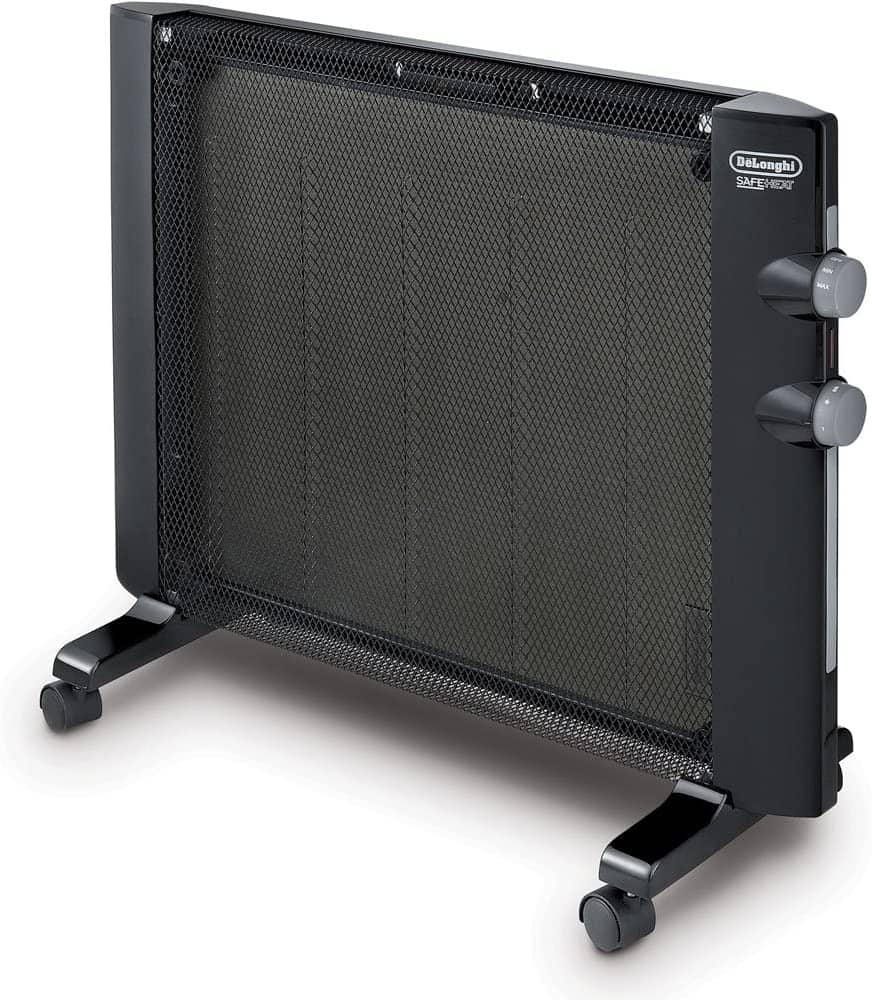
Mica panel heaters sandwich a resistive element between thin sheets of mica, radiating heat evenly across a flat panel with no fan and no exposed coil. The De’Longhi HMP1500 markets this as converting “100% of the electricity used into heat” — true of nearly every heater here, but the real advantage is that with no fan, it doesn’t stir up dust, pollen, or pet dander the way a blower-driven heater can.
It offers two heat settings — 750W and 1500W — with an adjustable thermostat between them, plus a standby setting that turns the heater on automatically if the room drops below 41°F, aimed at preventing frozen pipes in an unheated space. At just 10.1 pounds and 9.84 inches deep, it’s slim enough to wall-mount with the included kit or stand freestanding with its carry handle.
With an Amazon’s Choice badge, 4.3 stars, and more than 5,100 ratings, it’s a well-established pick at $129.95 — the tradeoff for dust-free, silent operation is a slower warm-up than a fan-forced heater, similar to the oil radiator above.
Pros
- No fan, no stirred-up dust
- Two real settings: 750W/1500W
- Slim, wall-mountable or freestanding
- Anti-freeze standby setting
Cons
- Only two heat settings
- Slower warm-up than fan-forced heat
- Pricier than basic panel heaters
Convection Panel Heaters: The Lowest Wattage, Built to Run All Day
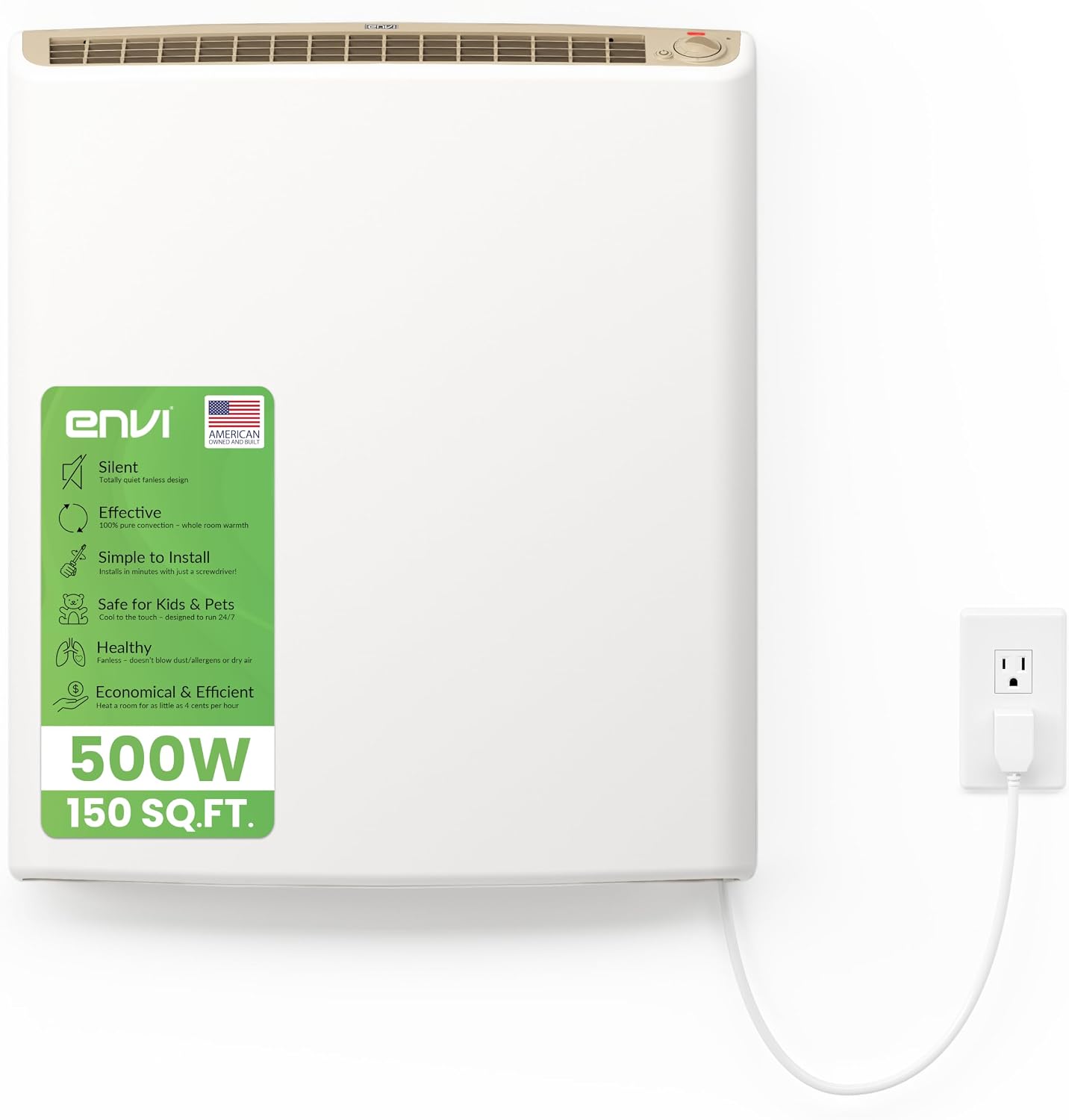
Convection panel heaters take a different approach: instead of a burst of high-wattage heat, they run continuously at a low, steady draw, warming air near the wall that rises and circulates on its own — what Envi calls “Stack Convection.” The Envi Wall Panel Heater is rated at just 500 watts, roughly a third of every other heater here, and it’s the only one genuinely designed to be left running around the clock in one chronically cold room rather than switched on for a few hours at a time.
That’s a different use case than the other four picks, and it’s worth being honest about the math: left running 24 hours a day, a 500W heater costs about the same per month as a 1500W heater run 8 hours a day — the wattage advantage only pays off if it’s replacing a much larger heat source in that one room, not stacking on top of your existing heat. Its wall-sense safety sensor cuts power the instant it’s unmounted, and at 90°F its surface stays cool enough to touch safely.
At $199.95, it’s the most expensive heater here, and with 4.1 stars across 3,200 ratings, the slimmest review margin over the alternatives. It’s a genuinely different tool for a specific problem — a cold basement office or a chilly bathroom — not a drop-in replacement for the others.
Pros
- Lowest wattage here at 500W
- Silent, zero moving parts
- Wall-sense safety shutoff
- Made in USA, 3-year warranty
Cons
- Most expensive heater here
- Won’t heat a large room
- Permanent wall mount, not portable
Looking ahead, space heaters are likely to get smarter, with better thermostats, timers, tip-over and overheat cutoffs, and some with Wi-Fi so a room is warm before you walk in. The catch is that nearly every heater turns all its power into heat, so smarts save money by cutting run time, not by being more efficient.
Running-Cost Math: Finding the Most Energy Efficient Space Heater in Dollars
At the current U.S. average residential electricity rate of roughly 18 cents per kilowatt-hour (per the EIA — it runs under 12 cents in the cheapest states and over 40 cents in Hawaii), every heater here costs almost exactly the same on its highest setting: about $2.16 for 8 hours, or roughly $65 across a 30-day month of daily use, since they’re all close to 1500 watts at full power. On high, the “most energy efficient space heater” is a myth — they’re all the same appliance at that point.
The real savings show up on the lower settings. The DR-968’s 1000W low mode drops that same 8-hour run to about $1.44, or $43 a month — nearly a third less. The De’Longhi’s 750W setting cuts it to about $1.08 a day, or $32 a month, half of running on high. The PELONIS radiator’s lowest 600W tier is cheaper still at roughly 86 cents a day, or $26 a month. The Envi panel, run the same 8 hours at its fixed 500W, costs about 72 cents a day, or $22 a month — but that’s not how it’s designed to be used.
The DREO Wall Heater has no separate low-wattage number to point to, since its savings come from app scheduling rather than a lower power draw — harder to put a single dollar figure on, but real if you’d otherwise leave a heater running in an empty room.
Zone Heating vs. Heating the Whole House
This math only pays off if a space heater replaces heat you’d otherwise pay for elsewhere — running one in the room you’re using while turning your central thermostat down, the idea behind “zone heating.” Run one in addition to a furnace that’s already keeping the whole house warm, and you’re just adding a second bill on top of the first.
If the room is large rather than just chronically cold, the math changes since a single 1500W heater realistically covers about 130-150 square feet in an average climate — our space heaters for large rooms guide covers picks sized for bigger spaces, and our older large-room heater roundup has more options. For a room that’s cold every day all winter, it’s worth comparing any of these against a more permanent fix — a ductless mini-split heat pump moves existing heat rather than generating it and can cost a fraction as much per BTU, though the upfront cost is far higher; our mini-split buying guide breaks down that tradeoff.
Dust and blocked vents cut efficiency and are a real safety issue on fan-forced models — our guide to cleaning a space heater covers that upkeep. None of these five are rated for damp locations beyond the DREO’s IP24 splash resistance, so a full bathroom install needs a dedicated unit — see our bathroom heater guide. An uninsulated garage is a different problem, covered in our garage heater guide, and for more radiant options beyond the DR-968, see our infrared heater reviews. Running any of these for hours dries the air — our humidifier guide covers picks sized to match. Everything here is indoor-only; an unheated garage or uninsulated shed needs a heater built for that environment, not one of these five.
FAQ
Are infrared heaters really more energy efficient than ceramic heaters?
Not in terms of converting electricity to heat — both are close to 100% efficient at that. Infrared heaters can feel more efficient because radiant heat warms you directly, letting you feel comfortable at a lower thermostat setting, and some models like the DR-968 pair that with a genuine low-wattage mode.
Why do all space heaters seem to cost about the same to run?
Because nearly every plug-in heater sold for a U.S. household outlet tops out at 1500 watts — a limit set by the standard 15-amp circuit, not the technology inside. On their highest setting, they all draw roughly the same power and cost roughly the same to run.
What’s the real difference between an oil-filled radiator and a ceramic heater?
An oil radiator has no fan, heats more slowly, and keeps radiating warmth after it shuts off since the oil and metal stay hot. A ceramic heater with a fan warms a room faster but stops producing heat the instant it’s switched off.
Do micathermic panel heaters dry out the air?
Less than fan-forced heaters, since there’s no blower pushing air across a hot coil — but any electric resistance heater lowers relative humidity somewhat simply by raising air temperature. A humidifier sized to the room offsets this if it’s noticeable.
Is a low-wattage heater like the Envi panel actually cheaper to run?
Only if you’re using it to replace a bigger heat source in one specific room. Run continuously for 24 hours, its 500W draw costs about the same per month as a 1500W heater run 8 hours a day — the savings come from scale of use, not the wattage number alone.
How much does it cost to run a space heater for a full winter?
At roughly 18 cents per kWh, a 1500W heater run 8 hours a day for a 4-month heating season costs in the neighborhood of $260. A heater with a genuine 750-1000W low mode used the same way runs closer to $130-175 for the same season.
Which space heater technology is safest around kids and pets?
Oil-filled radiators and mica panel heaters have no exposed coil and no blower, so there’s less to touch and less dust circulated. Every heater here includes tip-over and/or overheat protection, but a sealed radiant surface is inherently harder to get burned on.
Related Guides
Keep going with how much electricity space heaters use and infrared heaters.
What happens next: power prices and cold snaps will keep people looking to heat one room instead of the whole house, and heat pumps will take over whole-house heating in more places. A space heater stays the cheap fix for one cold room, but one that runs all day can cost more than it saves.
Bottom Line
There’s no space heater technology that’s objectively “most efficient” — they’re all close to 100% efficient at turning electricity into heat, full stop. What separates a heater that actually saves you money is a genuine low-wattage setting, radiant heat you feel directly, or smart scheduling that cuts wasted runtime. The Dr Infrared DR-968 combines the first two and is where to start for most rooms. Want automatic scheduling? The DREO Smart Wall Heater. Want the most control over wattage? The PELONIS radiator. For dust-free radiant heat, the De’Longhi HMP1500. And for one chronically cold room heated around the clock, the Envi panel’s 500W draw is unmatched for that specific job.
Editorial note: Prices, review counts, and availability change after publication — confirm the current listing before buying.