

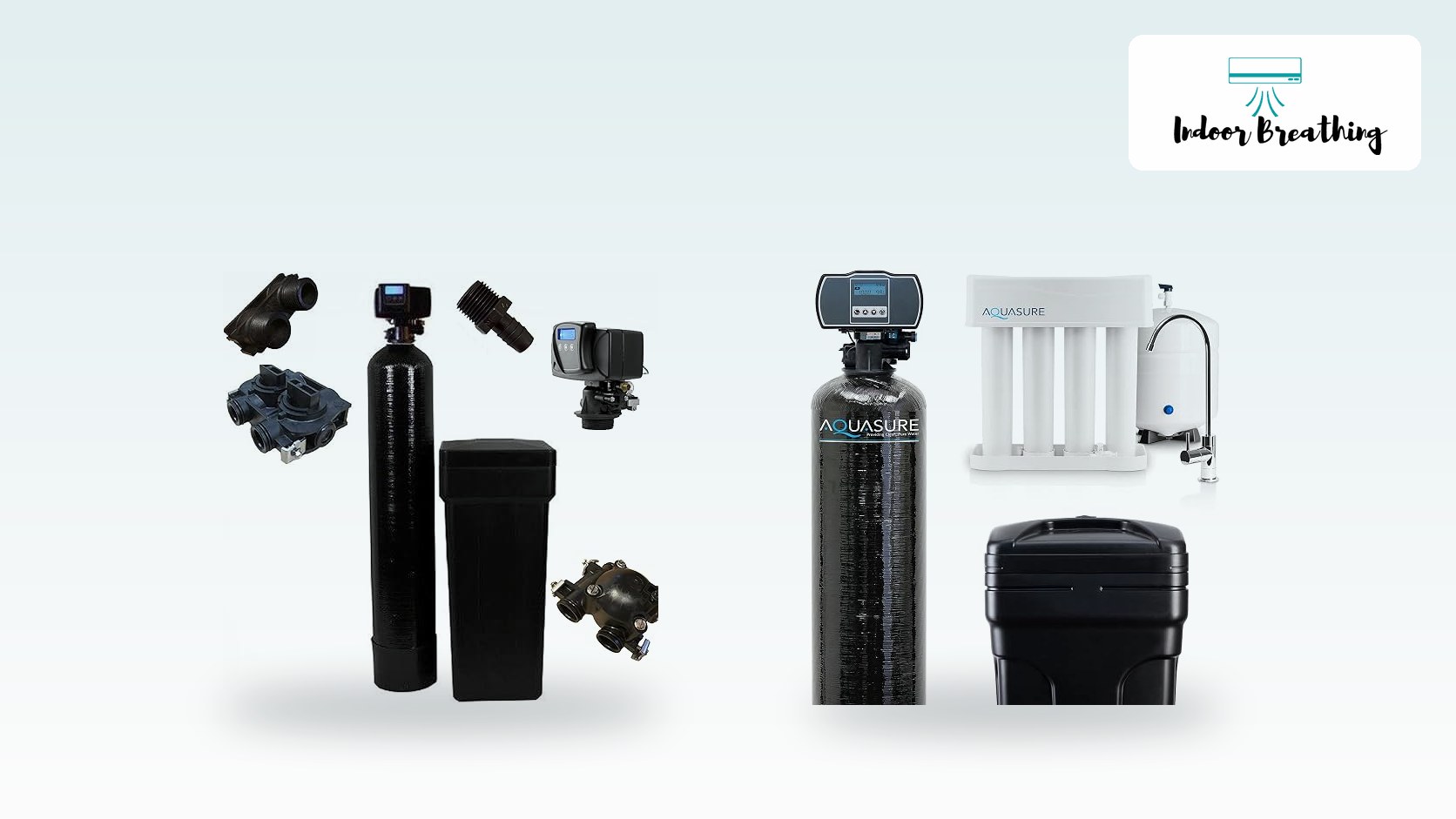
Specs below come from the makers’ own pages and from older versions of this guide. Prices were not re-checked because these brands sell on their own sites, so confirm size, price and guarantee before you order. Salt-free systems are conditioners, not true softeners.
Hard water leaves spots on glass, scale in pipes and dry skin and hair. A softener fixes it, but not every house has a spot for a big tank. If yours does not, outside is an option, with some rules.
Table of Contents
What Is an Outdoor Water Softener?
There is no special outdoor machine. It is the same softener you would put in a basement or garage, set outside the house where your water line enters. The tanks sit on a level pad or inside an enclosure, and the pipes run into the house. The key is protection:
- Freezing. Resin, water and the control head can crack below 32 degrees F. In cold climates, use an insulated, heated enclosure or choose a garage.
- Sun and heat. UV makes plastic brittle, and heat can shorten the life of the electronics. Shade or a cabinet helps.
- Rain and pests. The control head and wiring need a dry, sealed space. Keep animals out of the brine tank.
- A drain. The softener flushes brine during regeneration. It needs a legal drain line, per local code.
- Power. A GFCI-protected outdoor outlet is needed for the control head.
Looking ahead, more homes are moving water treatment outdoors as basements shrink and slab homes spread. Weatherproof cabinets, metered valves that regenerate less often and app-linked softeners are getting easier to find. The catch is that freezing weather, summer sun and heat age the tank and the control head faster than a utility room does, so an outdoor setup needs a plan, not just a pad.
Salt-Based vs Salt-Free
| Type | How it works | Removes hardness? | Needs salt? |
|---|---|---|---|
| Salt-based softener | Ion exchange swaps calcium and magnesium for sodium or potassium | Yes | Yes |
| Salt-free conditioner | Changes scale crystals so they do not stick | No, it conditions | No |
| Whole-house filter | Carbon and other media remove chlorine and some metals | No | No |
For deeper detail, see our guide to salt-free water softeners. A filter such as the Aquasana Rhino is not a softener at all. It handles chlorine and some contaminants, and many people pair it with a softener.
6 Systems to Compare
Hardness is measured in grains per gallon. Most softeners come in sizes from 24,000 to 110,000 grains. Capacity and a metered valve matter more than the brand name.
1. SpringWell Salt-Based Water Softener
Type: Salt-based softener
A whole-house ion-exchange softener sold by home size, with a lifetime warranty on tanks and valves and a 6-month money-back guarantee per the maker. Upgrades include UV and RO add-ons. The maker lists app control. Expect a small drop in water pressure if you size it too small.
2. SoftPro Elite Water Softener
Type: Salt-based softener
Comes assembled with capacities from 24,000 to 110,000 grains and quick-connect hoses from 3/4 to 1 inch. The maker lists a high-flow valve and a self-cleaning feature that cuts salt and water use. It has no smart features. Add a KDF55 or alkalizer upgrade if you need them.
3. FilterSmart Filter-Softener Combo Pro Series (FS1500)
Type: Salt-free conditioner plus filter
A salt-free combo with a carbon filter stage for chloramines and a pre-filter that you change every 6 to 9 months. It uses no electricity and no salt. As a conditioner, it reduces scale and does not remove the hardness minerals. It costs more than many conditioners.
4. SpringWell FutureSoft
Type: Salt-free conditioner
A salt-free scale-prevention system with a lifetime warranty on tanks and valves. The maker claims up to 99.6 percent scale reduction, which is a maker figure from its own testing. It makes no brine and no wastewater, and does not use electricity. It does not soften water.
5. Fleck 5600SXT 48K Grain Softener
Type: Salt-based, metered
A classic metered Fleck valve that regenerates on demand, in capacities from 24,000 to 64,000 grains. Options include a chlorine filter, KDF55 and an RO add-on. There are no smart controls. This is a solid pick for most homes.
6. Aquasana Rhino 1,000,000 Gallon Whole-House Filter
Type: Whole-house filter
This is a filter, not a softener. It is rated by the maker for up to 1,000,000 gallons or about 10 years, with a sequence of stages that reduce chlorine and some contaminants. Owners have reported weak fittings, so keep spares. Add a softener for hardness.
The risk to watch is salt-free marketing. Systems sold as salt-free “softeners” do not remove hardness. They change how scale forms. Expect more of them to be sold in hard-water areas next to bold scale-reduction numbers, and expect some homeowners to be let down when the white spots stay on the glass.
How to Choose
- Test the hardness. A kit or a lab test gives grains per gallon. Also test iron, because iron needs extra care. See our water softener grain calculator.
- Size by use. Multiply people in the home by about 75 gallons a day, then by the hardness (add 4 to 5 grains for each ppm of iron). Aim for a regeneration every week or so. Our sizing guide walks through it.
- Pick a metered valve. It regenerates by use, which saves salt and water.
- Plan the site. Level pad, drain, power, freeze protection, shade.
- Check the guarantee and the warranty. Read the terms for outdoor use.
- Check local rules. Some areas limit brine discharge or require permits.
Outdoor Install Tips
- Build or buy an insulated enclosure with a vent. In freezing climates, add a thermostat-controlled heater.
- Insulate and heat-trace exposed pipes.
- Use a bypass valve so you can service the unit without shutting off the house.
- Keep the brine tank lid closed and the salt dry.
- Check the unit after the first hard freeze and before summer.
FAQ
Can a water softener stay outside in winter?
Only if it is protected from freezing. Unprotected tanks and valves can crack.
Is salt-free as good as salt-based?
No. Salt-free units reduce scale buildup but leave hardness in the water. If you want soft water, choose a salt-based unit.
How much salt does a softener use?
It depends on size, hardness and use. A metered unit uses less than a timer unit. Check the maker’s salt-efficiency number.
Final Word
An outdoor softener can work well if you protect it from cold and sun. Test the water, size by use and pick a metered valve. For a wider look, see our guide to water softeners.
What happens next: rising salt and water costs and tighter local rules on brine discharge will push buyers toward metered, efficient units, and some towns already limit salt-based softeners. Check local rules, size by your water test, and treat extreme weather as a design input.
Related Guides
Keep going with dual-tank water softeners, how to size a water softener, salt-free water softeners and water softener grain calculator.