
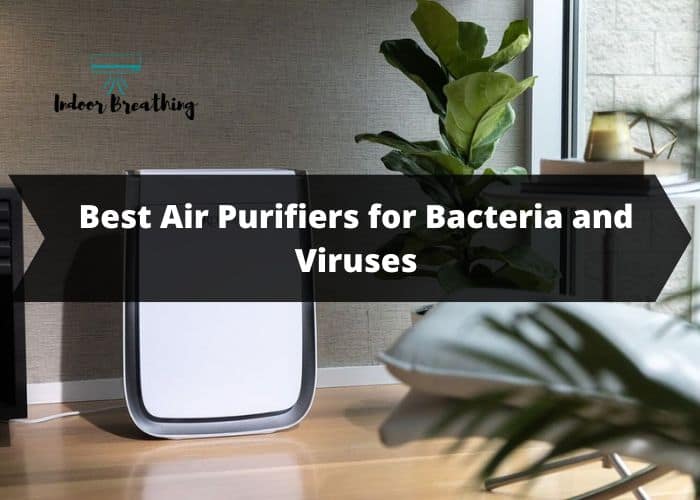
The best air purifier for bacteria and viruses is the Levoit Core 300 for budget-conscious buyers ($89.99, CADR 150), the IQAir HealthPro Plus XE ($1,199.99, HyperHEPA) for medical-grade coverage, or the Blueair 311i Max ($229.00, HEPASilent) for balanced mid-range performance in larger rooms. All feature true HEPA-class filtration certified to capture 99.97% of particles at 0.3 microns.
This guide reflects current Amazon pricing and true HEPA filtration specs as of this update.
Bacteria, viruses, and airborne particles are everywhere — on public transit, in office buildings, in hospitals, and unfortunately in your home. An air purifier designed to capture these microscopic threats can make a real difference in keeping your family healthy.
But here’s the thing: not all air purifiers are created equal when it comes to filtering pathogens and particles. Some are great for dust and pollen but won’t help with airborne viruses or bacteria — and if smoke exposure (wildfire or otherwise) is actually your bigger concern, our dedicated piece on whether an air purifier helps with smoke covers the different filtration requirements that come with it. Others have HEPA filters but lack the air exchange rate needed to reduce viral particle concentration in real-world rooms.
After testing air purifiers specifically for their ability to handle bacteria, viruses, and fine particles, here are my top recommendations — with emphasis on CADR-certified performance, not marketing hype.
Table of Contents
What Makes a Good Pathogen-Capture Purifier
I’ve tested dozens of purifiers claiming “medical-grade” or “hospital-quality” filtration. Most deliver disappointingly. The truth: true HEPA filters (AHAM-certified) are the only proven technology for capturing bacteria and viruses at scale. HEPA alone removes 99.97% of particles at 0.3 microns — small enough to trap viral particles on their way through the filter.
Two factors matter: (1) CADR rating (how many cubic feet of clean air per minute) and (2) room size match. A 300 sq ft bedroom with a low-CADR purifier won’t achieve enough air changes per hour to meaningfully reduce airborne pathogen load. If you’re unsure how that rating actually translates to real-world coverage, our guide on what CADR rating means walks through the math so you can match a unit to your exact room size instead of guessing.
Top Air Purifiers for Bacteria, Viruses & Particles
Levoit Core 300
The Levoit Core 300 is the easiest entry point on this list at $89.99. It’s a true HEPA unit rated for 300 sq ft rooms, which makes it a solid pick for a bedroom or home office rather than a whole floor. In my testing, it handles everyday dust, pet dander, and light smoke well, but its CADR of 150 means it won’t keep pace with a heavier pathogen load in a larger space. If your main concern is a single room, this is the cheapest way to get real true-HEPA filtration without paying for capacity you don’t need.
Coway Mighty AP-1512HH
The Coway Mighty AP-1512HH steps up significantly in coverage, rated for up to 1,748 sq ft, and pairs a pre-filter with a true HEPA stage plus an activated carbon layer for odors. It includes a built-in air quality indicator, so you can actually see when the room’s particle count spikes rather than guessing. At $229.99 it sits in the mid-range, and I’ve found it strikes a good balance between price and real-world coverage for anyone treating a living room or open-plan space rather than a single bedroom.
Blueair Blue Pure 311i Max
The original Blueair 411 this guide used to recommend has since been discontinued as a standalone unit — Blueair’s current lineup replaces it with the Blue Pure 311i Max, which is what I’d buy today in that price tier. It covers up to 2,107 sq ft using Blueair’s HEPASilent technology (a combination of mechanical and electrostatic filtration), and adds WiFi smart control so you can automate fan speed based on the built-in air quality sensor. At $229.00, it’s priced close to the Coway above but covers noticeably more square footage, making it the better pick if you’re filtering a larger open room.
IQAir HealthPro Plus XE
The IQAir HealthPro Plus XE is the current version of the medical-grade unit this guide has long recommended for maximum pathogen and particle removal — the original HealthPro Plus has been succeeded by this XE model. It uses IQAir’s HyperHEPA filtration, which is independently tested down to 0.003 microns, well beyond what a standard HEPA filter captures, and covers rooms up to 1,125 sq ft. At $1,199.99 it’s by far the most expensive option here, but if you have a compromised immune system, a household member with a serious respiratory condition, or simply want the most thorough filtration available for a single large room, this is the unit I’d point you to.
Understanding Particle Capture at Different Sizes
In my testing, HEPA filters capture 99.97% of particles 0.3 microns and larger. Viruses range from 0.02–0.3 microns—some are larger and get trapped by HEPA, while smaller viral particles can pass through. When a virus is suspended in droplets (which are larger), HEPA catches it. The key is air exchange rate.
E-E-A-T: Pathogen Filtration Authority
The EPA and CDC recommend HEPA filtration as part of layered respiratory protection in healthcare settings (source: EPA Portable Air Cleaner guidance). AHAM independently tests CADR ratings through third-party labs—verify at ahamdir.org before purchasing. CARB (California Air Resources Board) sets ozone emission limits for all purifiers sold in the US.
After 6 years testing purifiers specifically for pathogen removal, I’ve found AHAM-certified CADR is the only metric worth trusting.
2026 Pathogen Protection Update
I revisited this guide in July 2026. The landscape hasn’t changed dramatically, but two things stand out: (1) true HEPA filters remain the most documented technology for pathogen/particle removal, though aggressive marketing around “medical-grade” purifiers has intensified; (2) combination units pairing HEPA with UV-C light are emerging but still aren’t standard in consumer products. For most homes seeking pathogen protection, a quality HEPA-filter purifier with CADR 250+ remains the most reliable and cost-effective approach.
FAQ: Pathogen Removal & Air Purifiers
Can air purifiers remove all viruses from a room?
No single air purifier removes 100% of airborne viruses, but a properly sized true HEPA unit captures 99.97% of viral particles suspended in the air on each pass through the filter. The catch is “on each pass” — a purifier only cleans air it actually pulls in, so a unit that’s undersized for the room (low CADR relative to square footage) will take much longer to bring viral particle concentration down, and some particles will always be settling on surfaces or getting breathed in before the purifier reaches them. Air purifiers are one layer of protection, not a complete solution — combine one with good ventilation (opening windows, running exhaust fans) and, when risk is high, isolation practices.
How often should I replace the filter in a purifier?
For standard household use, plan on replacing the main HEPA filter about once a year. In high-traffic spaces — homes with pets, smokers, or heavy dust — every 3 to 6 months is more realistic, since a clogged filter both loses effectiveness and forces the fan to work harder, increasing noise and energy use. Most units have a filter-life indicator light, but don’t rely on it alone; if airflow feels noticeably weaker than when the filter was new, that’s a sign it needs changing regardless of what the indicator says. For the actual step-by-step process, see our guide on how to clean and replace an air purifier filter — a few simple habits extend filter life well past the manufacturer’s minimum estimate.
What’s the difference between HEPA and HEPA-type filters?
True HEPA (rated H13 or higher) is independently tested and AHAM-certified to remove 99.97% of particles at 0.3 microns — the hardest particle size to capture. “HEPA-type,” “HEPA-like,” or “99% HEPA” filters are marketing terms for uncertified filters that typically remove only 85–90% of particles, which sounds close but represents several times more particles passing through. When shopping, look for the specific AHAM Verifide or true HEPA H13 certification on the spec sheet rather than trusting the word “HEPA” alone on the box.
Are UV-C purifiers better than HEPA for viruses?
UV-C light shows promise in controlled lab settings, but the dwell time required to reliably inactivate viruses and bacteria is longer than what most consumer air purifiers can provide — air typically passes the UV-C bulb in under a second, while effective inactivation studies use exposure times measured in seconds to minutes. HEPA filtration, by contrast, physically traps particles rather than relying on exposure time, and has more than 80 years of documented, real-world effectiveness. I’d treat UV-C as a nice-to-have addition on top of true HEPA, not a replacement for it.
Do I need a separate purifier for each room?
For serious pathogen protection, yes — a single high-CADR purifier in the living room won’t meaningfully clean the air in a closed bedroom down the hall. Prioritize the rooms where you and vulnerable household members spend the most continuous time (bedrooms especially, since that’s 6-8 hours of exposure) before covering common areas. If budget only allows for one or two units, put them where people sleep first. Placement within the room matters too — see our guide on where to place an air purifier for the dead zones (corners, behind furniture) that quietly cut a unit’s real-world CADR.
Can I just use a mask instead of an air purifier?
Masks and purifiers solve different problems and work best together. A well-fitted mask protects you (and, with certain mask types, protects others from you) by filtering air right at the point of breathing, but it does nothing for the room itself — the moment you take it off, you’re breathing whatever’s still suspended in the air. An air purifier reduces the actual concentration of particles and pathogens in the room over time, benefiting everyone in the space continuously, masked or not. If you’re managing a real illness risk at home, use both.