
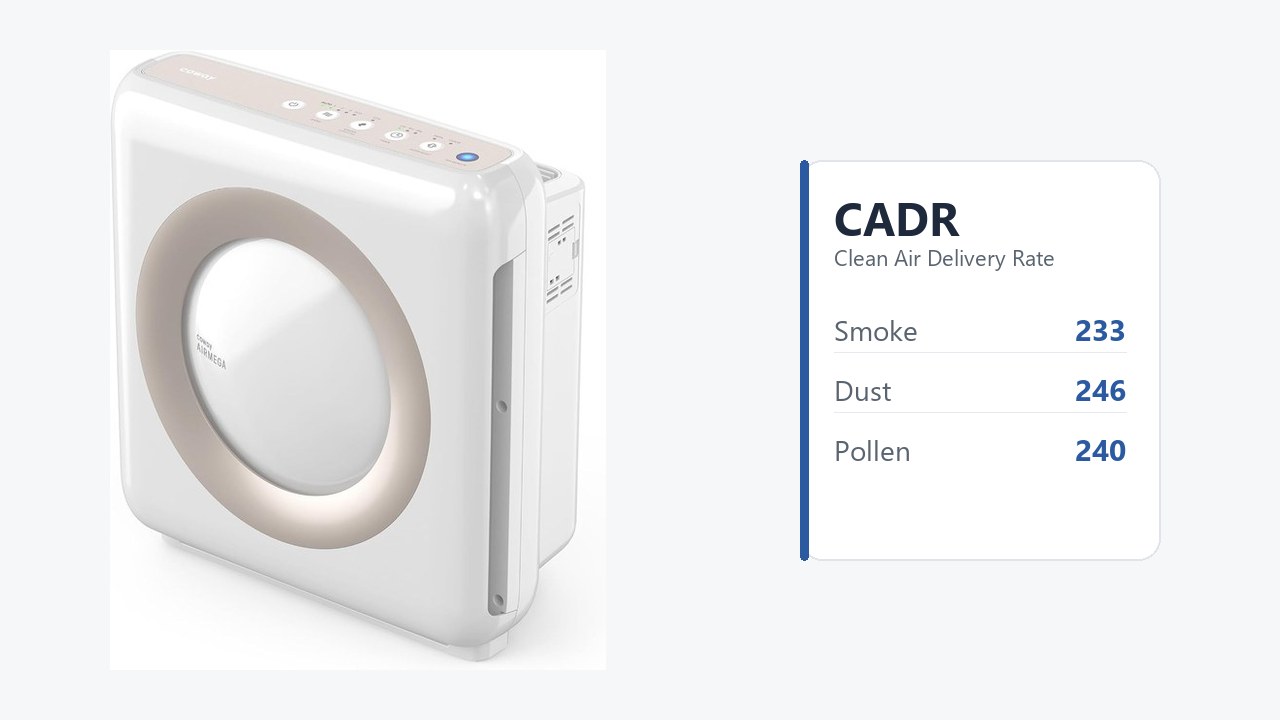
CADR (Clean Air Delivery Rate) measures how many cubic feet of clean air a purifier delivers per minute, tested separately for smoke, dust, and pollen under AHAM’s AC-1 standard. AHAM recommends a smoke CADR of at least two-thirds of your room’s square footage. Look for the AHAM Verifide seal; without it, the number may be an unverified claim.
Every AHAM AC-1 test detail, CADR figure, and product spec below is checked against AHAM Verifide’s own published standards, ENERGY STAR’s product criteria, and current Amazon listings. No in-house lab testing is involved here — the CADR numbers are the independent lab’s own verified figures, not a marketing claim.
I used to gloss right over the CADR number on an air purifier’s box — just one more spec to skim past on the way to the price tag. Then I read the AHAM testing standard behind it and realized it’s the one number that’s independently verified in a lab, not written by a marketing team.
That matters because almost everything else on the box is a manufacturer claim: “covers 1,000 square feet,” “removes 99.9% of particles,” “whisper quiet.” CADR comes from a standardized test run by an accredited lab under rules the manufacturer doesn’t control. This guide covers what that test measures, how the “two-thirds rule” math works, why a HEPA filter doesn’t guarantee a high CADR, and how to tell a verified CADR number from an inflated one.
Affiliate disclosure: IndoorBreathing may earn a commission when you buy through the Amazon links on this page, at no extra cost to you. Products are included here to illustrate real CADR numbers across the size range, not ranked as picks.
Table of Contents
What Is CADR Rating? What the Number Actually Measures
CADR stands for Clean Air Delivery Rate. It’s expressed in cubic feet per minute (CFM), and it tells you how much filtered air a purifier is actually pushing out — not how much air it moves in total, but how much of that air comes out measurably cleaner than what went in. A purifier with a smoke CADR of 200 is delivering the cleaning equivalent of 200 cubic feet of particle-free air every minute it runs at full speed.
The standard behind that number is ANSI/AHAM AC-1, maintained by the Association of Home Appliance Manufacturers (AHAM), which also administers the CADR verification program. Manufacturers can self-report a CADR number without ever submitting to this test — nothing legally requires it. The ones that do submit and pass get to display the AHAM Verifide seal, the actual proof the number is real. I’ll come back to why that seal matters more than the number itself later in this guide.
It’s worth separating CADR from a purifier’s room-size coverage claim right away, since the two get conflated constantly. CADR is a lab-measured airflow-and-filtration number; coverage is a recommendation derived from it using an assumption about how many times per hour the air turns over — and manufacturers don’t all use the same assumption, as the coverage section below shows.
Inside the AHAM AC-1 Test: How a CADR Number Gets Made
The AC-1 test happens inside a sealed chamber roughly 1,008 cubic feet in volume — about the size of a 10.5-by-12-foot room with an 8-foot ceiling, built with minimal air leakage so outside air doesn’t skew the result. A technician runs the purifier at full speed for a warm-up period, then the real test begins.
A fan disperses one of three challenge particle types into the chamber until concentration hits a stable starting level, then the mixing fan shuts off. Electronic particle counters then track how fast concentration falls in two separate runs: once with the purifier off, to measure natural decay from particles settling on surfaces, and once with the purifier running at full speed. The gap between those two decay curves — how much faster particles disappear with the unit running versus just sitting there — is what gets converted into the CADR figure, using the chamber’s known volume as the multiplier.
That’s why CADR isn’t purely a filtration-efficiency number. A purifier with a phenomenal filter but a weak fan can post a mediocre CADR, because the test captures the whole system — fan speed, airflow path, and filter media — not just how well the filter catches particles that reach it. I’ll unpack that HEPA-vs-CADR gap further down; it trips up more buyers than any other part of this spec.
For verification, AHAM sends units to accredited independent labs, and a passing unit must stay within tolerance on retest — roughly ±10 CFM for smoke and dust CADR, and ±25 CFM for pollen, which is naturally noisier to measure given how much larger pollen particles are. Certified results are published in AHAM’s public AHAM Verifide directory, searchable by brand and model, so you can look up any unit’s official numbers yourself rather than trusting a box.
Three Numbers, Not One: Smoke, Dust, and Pollen CADR
Here’s the part most listings bury: CADR isn’t a single score. AC-1 tests three separate particle categories, because they behave differently in the air, and a purifier’s fan-and-filter combination doesn’t perform identically against all three:
- Smoke CADR — tested with particles between 0.09 and 1.0 micron, the smallest of the three. This is the hardest category for most purifiers, and it’s the number that matters most for wildfire and cigarette smoke, since combustion particles fall in this same ultra-fine range.
- Dust CADR — tested with particles between 0.5 and 3 microns, a middle range that also captures a lot of what settles out of household air onto surfaces. It’s the figure I’d weight most heavily for a generally dusty home.
- Pollen CADR — tested with particles between 5 and 11 microns, the largest and generally the easiest for any purifier to catch, which is why pollen CADR is almost always the highest of the three numbers on a spec sheet.
That ordering — smoke lowest, pollen highest — is close to universal across AHAM-verified purifiers, since it tracks particle size rather than brand or price. A listing where pollen CADR is dramatically lower than smoke CADR is a red flag worth double-checking against the AHAM directory.
Which number should drive your decision depends on what you’re filtering for. Pet dander sits mostly in the dust-to-pollen range, so our guide to air purifiers for pets weighs dust and pollen CADR more than smoke. Seasonal allergy sufferers should care almost exclusively about pollen CADR — enough that we built an entire piece around that one spec. Wildfire and secondhand smoke both live in smoke CADR’s territory, covered in our wildfire smoke buying guide.
The Two-Thirds Rule: Matching CADR to Your Room
AHAM’s own sizing guidance, confirmed in its published white paper on air changes per hour, is that a purifier’s smoke CADR should equal at least two-thirds of the room’s square footage to meaningfully improve air quality at a normal fan speed. A 300-square-foot bedroom needs a smoke CADR of at least 200; a 450-square-foot living room needs at least 300.
That ratio isn’t arbitrary — it’s built around a target of roughly 4.8 air changes per hour at an 8-foot ceiling, which AHAM treats as the practical floor for a cleaner to keep up with normal air movement in a room. The EPA’s own wildfire smoke guidance uses this identical calculation, down to the same worked example: a 10-by-12-foot (120-square-foot) room needs a smoke CADR of at least 80.
Here’s that math laid out by room size, using the standard two-thirds threshold:
| Room Size | Minimum Smoke CADR (2/3 rule) | Approx. Air Changes/Hour |
|---|---|---|
| 150 sq ft (small bedroom) | 100 | ~4.8 |
| 250 sq ft (bedroom) | 167 | ~4.8 |
| 350 sq ft (living room) | 233 | ~4.8 |
| 500 sq ft (large living room) | 333 | ~4.8 |
| 750 sq ft (open-plan floor) | 500 | ~4.8 |
| 1,000 sq ft (whole small home) | 667 | ~4.8 |
Dust and pollen CADR run higher than smoke CADR on the same unit, so if allergies or dust are your main concern rather than smoke, you have a bit more headroom than this table implies — check the specific pollutant CADR that matches your problem, not just the smoke figure. And for anyone weighing multiple rooms or a whole floor at once, our room-size guide and CADR calculator run this same math for your exact square footage.
Why CADR Isn’t the Same as the “Coverage” Printed on the Box
This is where a lot of buyers get misled, and it’s rarely intentional deception — it’s a difference in assumptions. AHAM’s two-thirds rule targets roughly 4.8 air changes per hour. Plenty of manufacturers instead print a “coverage area” based on just one air change per hour — a single pass of the room’s air through the unit in sixty minutes. That’s a real number, but it describes far less thorough cleaning than AHAM’s recommendation, and the two shouldn’t be compared as if they mean the same thing.
The gap shows up clearly against real listings. A Winix 5510 with a smoke CADR of 253 has an AHAM-based room size of about 380 square feet — but its own Amazon listing advertises coverage “up to 1,881 sq ft in 1 hour.” Divide 1,881 by 380 and you get almost exactly 5, matching the gap between a 1-ACH marketing claim and AHAM’s ~4.8-ACH standard. Same purifier, same CADR, two very different numbers depending on which cleaning threshold is being sold.
A Coway Airmega 450 shows the same pattern: a smoke CADR of 445 puts its AHAM-based room size at roughly 670 square feet, but Coway’s own packaging states coverage “up to 3,285 sq ft” — again close to a 4.9x gap. Neither number is fabricated; both are calculated from the same CADR figure using different assumptions about how clean you want the air. The AHAM-based number assumes the purifier keeps the room meaningfully cleaner than doing nothing; the 1-ACH box number just means the air technically passed through once.
My practical rule: when a coverage claim looks unusually generous relative to its CADR, divide the claimed square footage by 1.5. If that lands close to the CADR number, you’ve reverse-engineered the two-thirds rule and found the room size that actually matters.
CADR vs. ACH: The Math That Actually Matters
Air changes per hour (ACH) is the number of times a purifier can theoretically replace all the air in a room with filtered air, in one hour. It’s the bridge between a raw CADR number and how clean your actual room gets, and it’s calculated like this:
ACH = (CADR × 60) ÷ Room Volume (cubic feet)
Room volume, not room area, is the detail people skip. A 300-square-foot room with an 8-foot ceiling holds 2,400 cubic feet. Run a purifier with a 200 CFM smoke CADR there: (200 × 60) ÷ 2,400 = 5 ACH, right in line with AHAM’s ~4.8 target — expected, since 200 is almost exactly the two-thirds threshold for 300 square feet. Put that same purifier under a 12-foot ceiling instead — 3,600 cubic feet — and the math drops to 3.3 ACH, meaningfully below target, even though the floor space and CADR number never changed.
That’s the practical lesson: two rooms with identical square footage but different ceiling heights need different CADR numbers to hit the same real-world cleaning rate. High-ceilinged rooms, lofts, and open-plan spaces need more CADR than flat square-footage math suggests. Some public-health settings push further — a 2022 study of a K-5 school running portable HEPA cleaners targeted 5 ACH as an enhanced-protection benchmark during respiratory illness season, useful if you want more margin than the AHAM minimum.
HEPA Filter ≠ High CADR: The Airflow Problem No One Explains
This is the single most underexplained relationship in air purifier shopping, and it trips up genuinely careful buyers: a HEPA filter and a high CADR are not the same claim, and one does not guarantee the other.
“HEPA” (High-Efficiency Particulate Air) is a filtration-efficiency standard — a true HEPA filter captures at least 99.97% of particles at 0.3 microns that actually pass through the media. That’s a statement about what happens to air once it’s forced through the filter. CADR is a statement about the whole system: how much air the fan can push through that media per minute and out into the room, measured against a decay curve in a real chamber.
Here’s the mechanical catch: denser, more restrictive filter media — often what makes a filter excellent at trapping ultra-fine particles — creates more static pressure for the fan to push against. A small, underpowered fan paired with a dense true-HEPA filter can end up moving very little total air, capping CADR low regardless of filtration efficiency. Conversely, a bigger fan, larger filter surface area, and a more open housing can post a high CADR even with media that’s HEPA-grade but not maximally dense. Filtration quality and airflow quantity are separate engineering variables, and a spec sheet that only advertises “True HEPA” without a CADR number is telling you half the story.
This is why the AHAM Verifide seal matters more than either spec alone: it accounts for the fan-and-filter system working together, not a filtration claim in isolation. Comparing two “True HEPA” purifiers, the CADR gap between them tells you about real airflow through the whole machine — something the HEPA label alone can’t. And if dust mites specifically, not airborne particles, are the concern, CADR doesn’t measure that at all; it’s an airborne-particle spec, which is why removing dust mites from fabric and carpet is a sealed-HEPA-vacuum job, not an air purifier job.
Real Purifiers by CADR Rating
Numbers are abstract until you see them next to real, currently listed products. Here are five AHAM-relevant purifiers spanning a compact bedroom unit to a large-room unit, plus one popular model that illustrates the unverified-claim problem covered next. Specs were checked against current Amazon listings and AHAM Verifide data; confirm the live listing before buying, since prices move.
| Model | Smoke CADR | Dust CADR | Pollen CADR | AHAM Verifide | 2/3-Rule Room Size | Price |
|---|---|---|---|---|---|---|
| Levoit Core 300S-P | 141 | 156 | 175 | Yes | ~210 sq ft | $149.99 |
| Coway Airmega AP-1512HH (Mighty) | 233 | 246 | 240 | Yes | ~350 sq ft | $229.99 |
| Winix 5510 | 253 | 252 | 247 | Yes | ~375 sq ft | $179.99 |
| Coway Airmega 450 | 445 | 439 | 450 | Yes | ~670 sq ft | $499.00 |
| Medify MA-112 | ~950 (mfr. claim) | Not published | Not published | Not listed | Unverified | $594.99 |
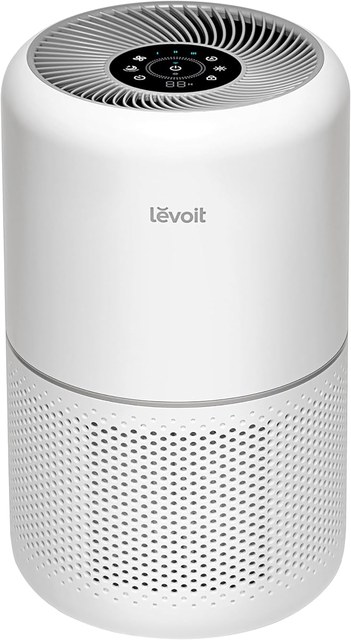
The Levoit Core 300S-P is a good baseline for a compact, AHAM-Verifide bedroom unit: a 141 smoke CADR puts its real two-thirds-rule room size around 210 square feet — a bedroom or small office, not the “large room” language sometimes used loosely at this price tier.
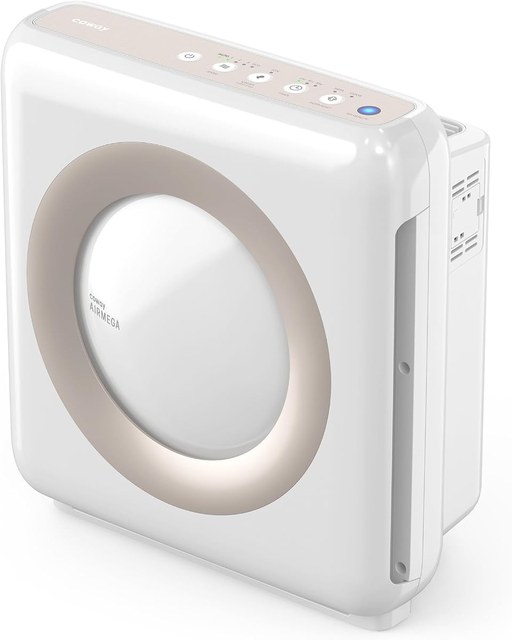
The Coway AP-1512HH is one of the longest-running AHAM-Verifide models on the market and a recurring pick in our own best air purifiers for home guide; its 233/246/240 spread is a clean example of the smoke-lowest, pollen-highest pattern this test standard almost always produces.
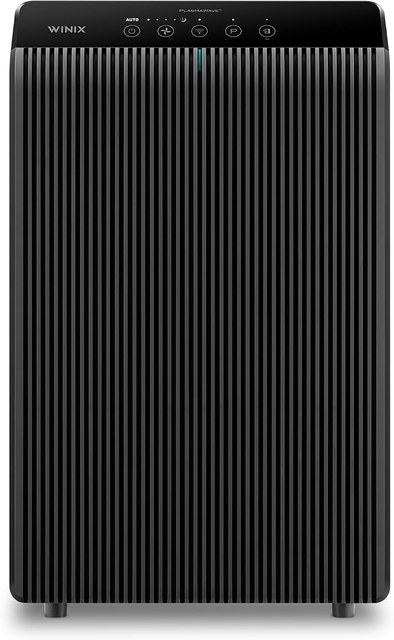
The Winix 5510 is the model used in the coverage-vs-CADR section above — a genuinely capable AHAM-Verifide unit whose own “1,881 sq ft” box claim is nearly five times its real, two-thirds-rule room size.
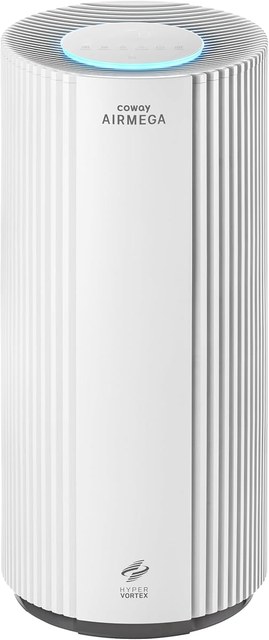
At the large-room end, the Coway Airmega 450 posts a 445 smoke CADR — enough for roughly 670 square feet by the two-thirds rule, matching our large-room air purifier guide, which treats it as a genuine whole-floor contender, not a single-room unit stretched thin.
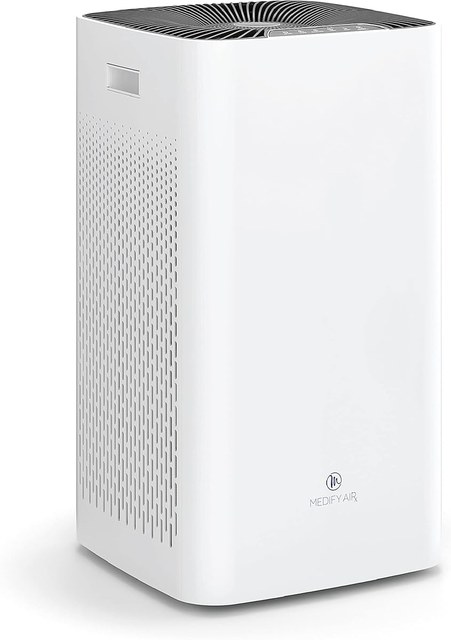
The Medify MA-112 is included specifically because it isn’t in the AHAM Verifide directory. Medify advertises a roughly 950 CFM smoke figure, but that’s the manufacturer’s own claim, not an independently tested number — a real example of the exact gap the next section covers.
How to Spot an Inflated or Unverified CADR Claim
A CADR number with no independent verification isn’t automatically fake, but it isn’t proof of anything either — it’s a manufacturer’s assertion, the same category of claim as “covers 1,000 square feet.” Here’s how I check one before trusting it:
- Look for the AHAM Verifide seal on the box or listing image, not just the word “CADR” in the bullet points. A number without the seal wasn’t necessarily lab-tested.
- Cross-check the model at ahamdir.com. A match confirms it; if the model isn’t listed, treat the number as an unconfirmed claim.
- Check for all three numbers, not just one. A listing that only quotes a single flattering figure, without breaking out smoke, dust, and pollen, is a mild warning sign — real AHAM data always reports all three.
- Be skeptical of round, unusually high numbers with no dust or pollen figures alongside them, the way the Medify MA-112 example above advertises only a smoke figure.
- Watch for ozone-generating devices marketed as “air purifiers.” These aren’t CADR-tested under AC-1 at all, and the EPA has published a direct warning that ozone is a lung irritant, not a purification method.
- Remember ENERGY STAR certification requires CADR reporting — ENERGY STAR’s product page confirms certified units must report smoke, dust, and pollen CADR alongside power draw, so an ENERGY STAR badge is a secondary signal of outside scrutiny.
None of this means an unverified purifier is a bad product — some strong units, including a few premium brands, simply don’t submit to AHAM’s program. Treat their CADR-equivalent claims as a starting point for research, not a settled fact.
FAQ
What is a good CADR rating for an air purifier?
It depends entirely on your room size and what you’re filtering. Using the two-thirds rule, a good smoke CADR is at least two-thirds of your room’s square footage — roughly 200 for a 300-square-foot room. There’s no single “good” number across all rooms; a 100 CADR unit is excellent for a small bedroom and badly undersized for an open living area.
Is a higher CADR always better?
A higher CADR means faster, more thorough air cleaning for a given room, but past the point where CADR already exceeds your room’s two-thirds threshold, you’re mostly paying for margin, not a meaningfully different result. A much higher CADR than you need also usually means a bigger, louder, more expensive unit with a pricier filter.
Does CADR measure viruses or bacteria?
Not directly. AC-1 testing uses smoke, dust, and pollen particles, which range from about 0.09 to 11 microns. Many viruses are smaller than the smoke particle range, though most travel attached to larger respiratory droplets that fall closer to it. A high smoke CADR is a reasonable proxy for fine-particle performance generally, but it isn’t a pathogen-specific certification.
Why does the same purifier have three different CADR numbers?
Because smoke, dust, and pollen particles are different sizes, and a fan-and-filter system doesn’t perform identically against all three. Smoke particles (0.09–1 micron) are hardest to capture and produce the lowest CADR; pollen particles (5–11 microns) are largest and easiest, producing the highest. Dust falls in between.
Do all air purifiers get AHAM Verifide tested?
No, and it’s not legally required. AHAM Verifide is a voluntary, paid certification program that many major brands join, but some manufacturers — including a number of premium and budget brands alike — publish their own CADR-style numbers without independent testing. Checking the AHAM directory at ahamdir.com is the only way to know for certain.
How is CADR different from ACH (air changes per hour)?
CADR is a fixed number describing the purifier itself, in cubic feet per minute. ACH describes what that CADR number actually accomplishes in a specific room, factoring in the room’s full volume, not just its floor area. The same purifier produces a different ACH in a room with a 12-foot ceiling than in one with an 8-foot ceiling, even though its CADR never changes.
Bottom Line
CADR is the one spec on an air purifier’s box that’s actually been lab-tested against a real chamber and a real decay curve, rather than written by a marketing team — but only when it carries the AHAM Verifide seal. Match the smoke, dust, or pollen CADR that fits your actual problem to your room’s real square footage using the two-thirds rule, not the inflated “coverage” number on the front of the box, and don’t assume a HEPA label alone tells you anything about airflow. If you’re shopping by room type or pollutant next, our air purifier buying guide, our picks organized by CADR tier, and the room- and pollutant-specific guides linked throughout this piece put these same numbers to work on real picks.
Editorial note: Prices, ratings, and availability change after publication — confirm the current listing before buying. Always check a specific model against the AHAM Verifide directory rather than relying on box copy alone.