

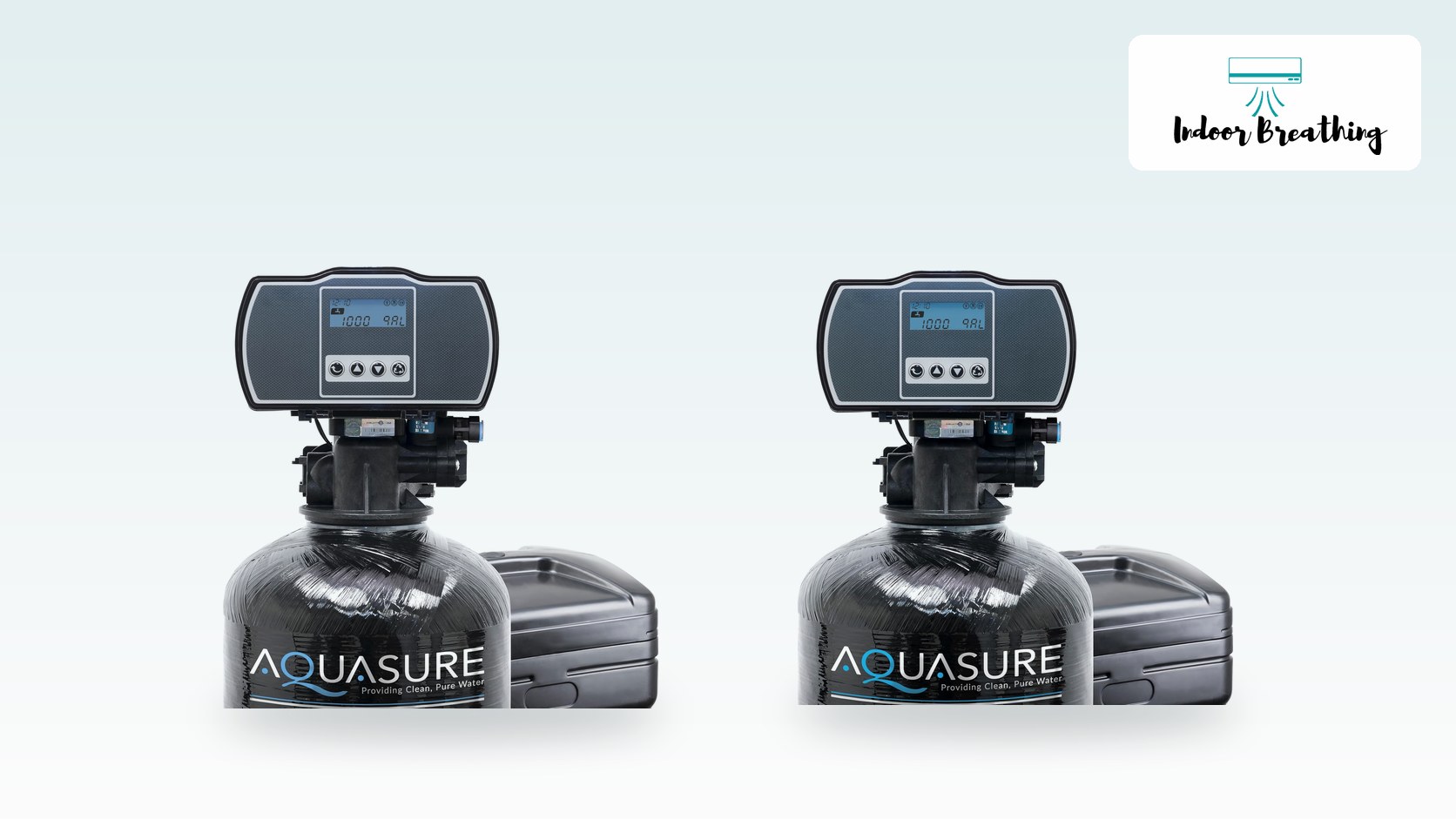
The calculator gives a sizing estimate. Test your water and check the maker’s capacity chart before you buy.
The right softener size depends on how many people use water and how hard it is. Use the calculator below to find your grain number.
Iron is common on well water and adds real softening load even in small amounts. A longer regeneration interval needs more capacity but uses less salt and water overall.
Softener capacity you need
Daily softening load
2,400 grains
Effective hardness
8 GPG
Regeneration interval
7 days
Table of Contents
Real water softeners that clear this grain capacity
How This Water Softener Grain Calculator Works
Softener size is measured in grains, the amount of hardness the resin can remove before it needs to regenerate. The calculator multiplies the daily water use for your household by the hardness of your water, then by the number of days you want between regenerations.
Formula: grains = people × 80 gallons × (hardness in GPG + iron ppm × 4) × days between regenerations
The answer rounds up to the next 1,000 grains. Each person is assumed to use 80 gallons a day, and every part per million of iron counts as 4 extra grains of hardness.
Here is where water softening is heading: metered units that regenerate only when needed, smaller brine tanks and more salt-saving designs. More cities and states are also watching how much salty wastewater softeners send down the drain.
Hardness Settings in the Calculator
- Slightly hard: 2 grains per gallon (GPG).
- Moderately hard: 5 GPG.
- Hard: 8 GPG.
- Very hard: 15 GPG.
Find your real number on your water utility report, with a test kit or from a lab. Well water needs its own test, and iron should be tested at the same time.
Worked Examples
- Family of 4, hard water (8 GPG), no iron, 7 days. 4 × 80 × 8 = 2,560 grains a day. Times 7 days is 17,920, rounded to 18,000 grains. A 24,000 grain unit has room to spare.
- Two people, moderate water (5 GPG), 7 days. 2 × 80 × 5 = 800 a day, or 5,600 over a week, rounded to 6,000 grains. A small unit is plenty.
- Five people, very hard water (15 GPG) with 1 ppm iron, 7 days. Effective hardness is 19 GPG. 5 × 80 × 19 = 7,600 a day, or 53,200 over a week, rounded to 54,000 grains. A 64,000 grain unit fits with little headroom, so also consider a shorter regeneration gap or an iron pre-filter.
Regeneration Days Matter
A softener that regenerates every day needs less capacity than one that goes a week. Many people choose a bigger tank so it regenerates less often. Others pick a smaller tank and let it regenerate more often to keep resin fresh. The calculator lets you choose the gap. A gap of about 3 to 7 days is a common range.
Rated Capacity Is Not Always Real Capacity
A softener rated 32,000 grains reaches that number only at a high salt dose. At lower, more efficient salt doses, usable capacity is lower. Check the maker’s capacity chart before you buy and pick a size with some headroom.
Also Think About Flow and Iron
Grain size is only half the picture. Your peak water flow, in gallons per minute, must fit the valve and tank. Iron above a trace amount can foul resin and may need a pre-filter. Read how to choose the right size water softener for flow rates, and see water softeners for well water if you use a private well.
The downside is salt and waste. Every regeneration cycle uses salt and water and sends brine to the drain, and some areas limit or ban salt-based softeners. Over-sizing makes this worse, since a softener that is too big regenerates less often but may sit with stale resin, and one that is too small regenerates all the time. Expect more rules and more choices such as salt-free conditioners that do not truly remove hardness. Size by your real numbers and test your water once a year.
Other Routes
Do not want salt? Compare salt-free water softener systems, which condition water but do not remove hardness. Browse all water softeners or pair a softener with the best whole-house water filters for hard water.
FAQ
How many grains do you need in a water softener?
Multiply people by 80 gallons by your hardness (plus iron adjustment) by days between regenerations, then round up.
What is GPG?
Grains per gallon, a measure of water hardness.
How does iron change the size?
Iron counts as extra hardness. This calculator adds 4 grains for each part per million of iron.
Is a bigger softener better?
Not always. A bigger tank regenerates less often but costs more, and oversizing can leave resin sitting.
Final Word
Test the water, run the numbers and buy a size with some headroom. A right-sized softener saves salt and water.
What comes next: smart valves that learn your use, better resin and more rebates for efficient units. Start with a water test, enter the result here and buy the size you need.
Related Guides
Keep going with how to choose the right size water softener, water softeners, salt-free water softener systems, water softeners for well water and best whole-house water filters for hard water.