
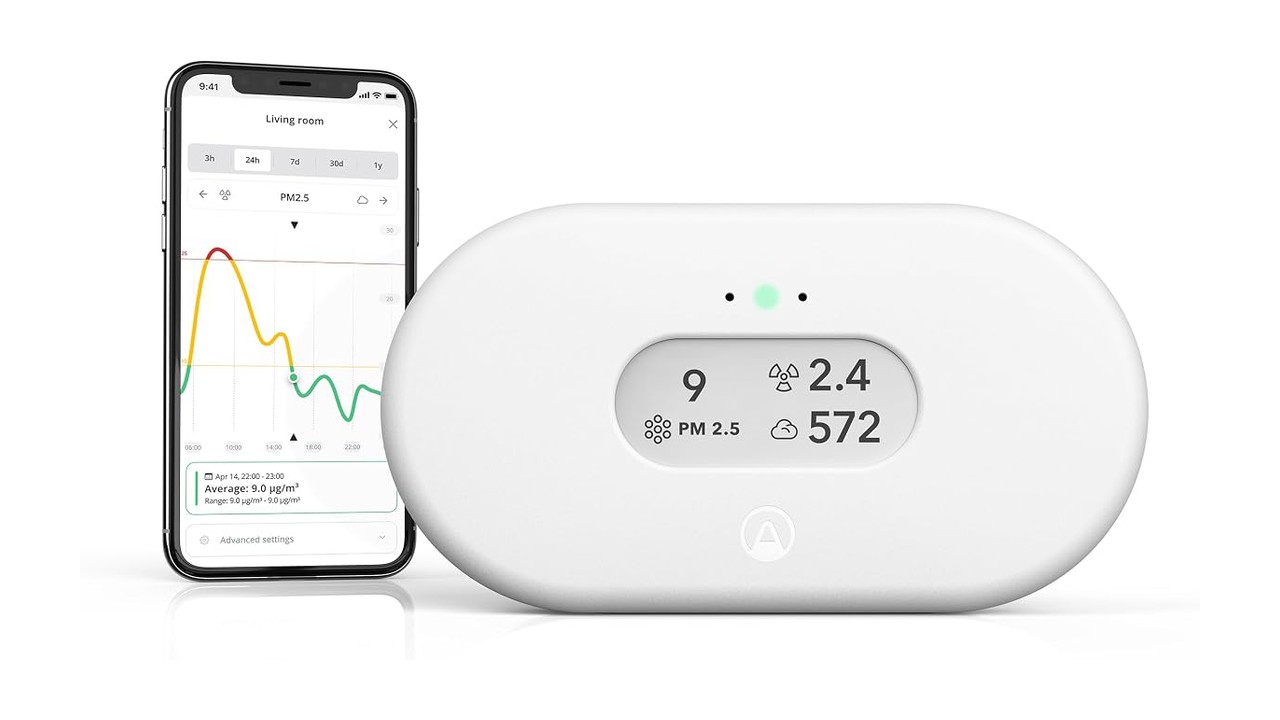
The best indoor air quality monitor for most homes is the Airthings View Plus, because it tracks the pollutants that matter, radon, fine particles, carbon dioxide, and VOCs, on one screen with a real NDIR sensor. If you only care about stuffy rooms and ventilation, the Aranet4 Home is more accurate for carbon dioxide and lasts years on batteries.
Every pick here is checked against verified manufacturer specs, sensor documentation, current Amazon listings, and buyer feedback. Health thresholds are drawn from EPA, ASHRAE, and WHO guidance. This guide does not involve hands-on lab testing.
You cannot manage what you cannot see. Carbon dioxide from your own breathing, fine particles from cooking and traffic, radon seeping up from the soil, and gases off-gassing from furniture and cleaners are all invisible and mostly odorless. An indoor air quality monitor puts a number on each one so you know when to open a window, run the range hood, switch on an air purifier, or call a radon pro.
The catch is that these devices vary wildly. A $70 monitor and a $330 monitor can show you very different numbers in the same room, and the gap usually comes down to the sensors inside and whether the readings drift over time. Some units give you a bright screen you can read from across the room; others hide everything in a phone app and, in a few cases, behind a subscription.
This guide ranks six monitors that are actually worth owning, explains what each pollutant reading means for your health, and shows you how to match a monitor to what you are trying to find out. For a wider look at testing your home, including lab kits and one-time checks, see our guide to air quality testing at home.
Affiliate disclosure: IndoorBreathing may earn a commission when you buy through links on this page, at no extra cost to you. Picks are chosen for sensor quality, useful features, and value, not commission rate.
Table of Contents
How These Air Quality Monitors Were Picked
The sensors came first. Carbon dioxide is only trustworthy from a true NDIR (nondispersive infrared) sensor; cheaper “eCO2” readings are estimated from VOC levels and can be off by hundreds of parts per million. For particles, the goal was a real laser scattering sensor rather than a vague “air quality” light. Then came a look at what the monitor measures against what a normal household needs to know, whether you can read it without picking up your phone, how it is powered, whether calibration is automatic, and the ongoing cost, since a couple of these lock history or alerts behind a paid plan. Every unit here is currently sold at a real price on Amazon, and every reading it claims is one its hardware can actually support. If you are also shopping for cleanup gear, our best air purifiers for home guide pairs naturally with a monitor.
Best Indoor Air Quality Monitors: Comparison Table
Here is how the six picks compare on the numbers that matter. Prices and ratings are current Amazon figures at the time of writing and will move.
Airthings View Plus — Best Overall
The View Plus is the one monitor here that answers almost every question a homeowner has in one glance. It reads radon, fine particles down to PM1, carbon dioxide from a real NDIR sensor, VOCs, humidity, temperature, and air pressure, and it shows a rotating summary on a low-power e-ink screen you can actually read across a room. The Airthings app keeps the history and lets you set alerts, and unlike the older Wave line, you do not need a separate hub for the data to sync over Wi-Fi.
Radon is the reason to spend this much. It is the only common indoor pollutant you cannot sense at all, it is the top cause of lung cancer in people who have never smoked, and a continuous reading beats a one-time kit because levels swing with weather and season. Give the View Plus about a week for its first radon estimate and a month before you trust the trend. The trade-offs: readings update on a slower cycle when it runs on batteries rather than USB, the app is the only way to see long-term graphs, and at close to $320 it is a real purchase. For the background on the gas itself, see our radon fact sheet.
Pros
- Reads radon plus particles, CO2, and VOCs
- True NDIR carbon dioxide sensor
- E-ink screen readable across a room
- Wi-Fi sync with no separate hub
- Runs on batteries or USB
Cons
- Around $320
- Long-term graphs live only in the app
- Slower refresh on battery power
- Radon needs weeks for a reliable trend
Looking ahead, expect air quality monitors to add more sensors at lower prices, with VOC, formaldehyde and CO readings becoming common. The catch is that more sensors do not mean more accuracy.
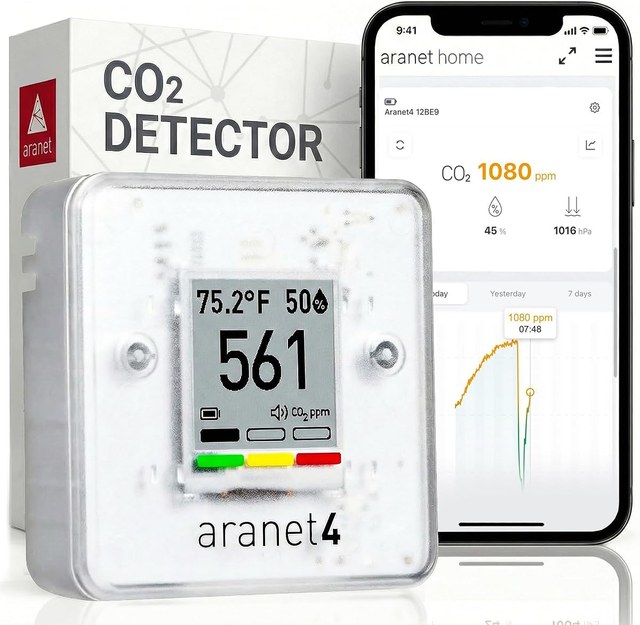
Aranet4 Home — Best for CO2 and Ventilation
The Aranet4 does one job and does it better than anything else in its price range: it tells you when a room has gone stale. Its NDIR carbon dioxide sensor is the same type used in commercial building controls, and the big e-ink number is easy to glance at from a desk or a bed. It also shows temperature, humidity, and pressure, but carbon dioxide is the headline, and a rising number is the earliest sign that a room needs more fresh air before anyone notices a headache or a foggy afternoon.
What makes it easy to live with is the power setup. Two AA batteries last up to about four years, it works entirely over Bluetooth with no Wi-Fi or account required, and all your data stays on the device and your phone. If you later want cloud logging or several sensors on one dashboard, Aranet sells an optional base station. The limits are obvious from the spec sheet: no particle sensor, no VOC sensor, and no radon, so it is a specialist, not a whole-home monitor. Carbon dioxide also tracks closely with sleep quality, which our piece on indoor air quality and sleep gets into.
Pros
- Commercial-grade NDIR CO2 accuracy
- Up to ~4 years on 2 AA batteries
- Works offline, no account needed
- Large, glanceable e-ink number
- Optional base station for cloud data
Cons
- CO2, temp, humidity, and pressure only
- No particle, VOC, or radon sensing
- Around $189 for a single-purpose device
- Bluetooth range is short
Specifically shopping for a bedroom? Our dedicated guide, Best CO2 Monitors for Bedrooms: Ventilation, Sleep & Accuracy Compared, compares the Aranet4 Home against five other bedroom-friendly picks, with a closer look at nighttime display behavior and sleep-specific research.
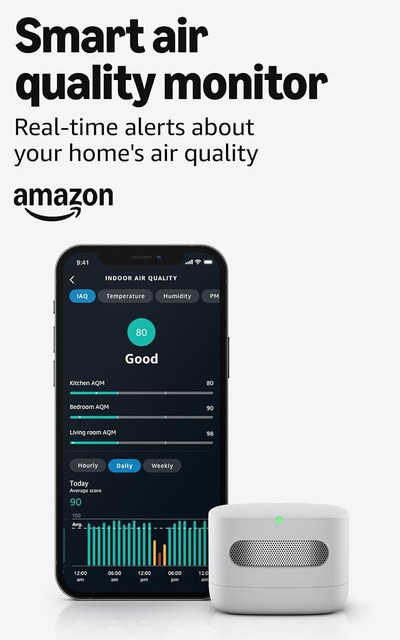
Amazon Smart Air Quality Monitor — Best Budget Pick
At around $70, this is the cheapest monitor worth trusting for the basics. It measures fine particles, VOCs, carbon monoxide, humidity, and temperature, rolls them into a single indoor air quality score, and sends a phone alert when that score drops. If you already own an Echo, you can ask Alexa for the current reading or have a routine turn on a smart-plug air purifier when particles spike, which is genuinely useful during cooking or wildfire season.
The compromises are real. There is no screen at all, so every reading lives in the Alexa app or comes out of a speaker. It has no true carbon dioxide sensor, so it cannot tell you when a bedroom is short on fresh air, and it needs to stay plugged in. Think of it as a smoke-and-cooking early warning rather than a complete health picture. We cover it in more depth in our Amazon Smart Air Quality Monitor review.
Pros
- Lowest price of any pick here
- Particles, VOCs, and carbon monoxide covered
- Alexa routines can trigger a purifier
- Simple single-score alerts
Cons
- No display at all
- No true CO2 sensor
- Must stay plugged in
- Data is tied to the Amazon account
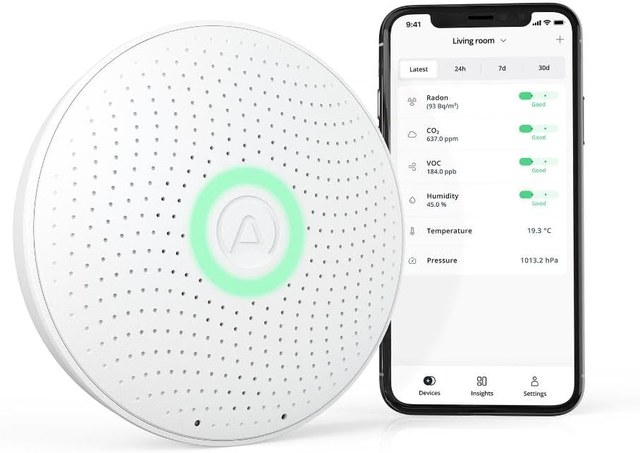
Airthings Wave Plus — Best for Radon on a Budget
The Wave Plus gets you continuous radon monitoring for less than the View Plus by leaving out the particle sensor and the always-on screen. It still covers radon, carbon dioxide on an NDIR sensor, VOCs, humidity, temperature, and pressure, which is most of what affects a basement or a bedroom. A quick wave of your hand lights a colored ring, green, yellow, or red, for a fast status check, and the full numbers and history live in the Airthings app.
This is the pick for someone whose main concern is radon and stuffy air rather than cooking smoke. It runs on two AA batteries, sits quietly on a shelf, and gives you the same radon data that matters for deciding whether to seal a basement or install a mitigation fan. If you have never tested, pair it with a cheap one-time check first; our PRO-LAB radon kit review covers that route, and reducing radon in a basement covers what to do about a high number.
Pros
- Continuous radon for less than the View Plus
- NDIR CO2 plus VOC sensing
- Wave-for-status colored light ring
- Runs on 2 AA batteries
Cons
- No particle (PM2.5) sensor
- No always-on numeric display
- Needs the app for real readings
- Older units may want a hub for Wi-Fi
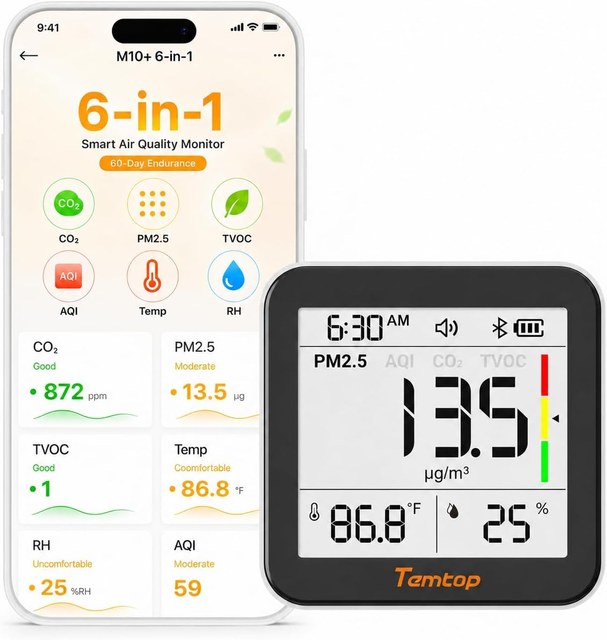
Temtop M10+ — Best Simple Desktop Display
The M10+ is for people who want a number on a screen and nothing to sign up for. It shows carbon dioxide from an NDIR sensor, fine particles, TVOCs, temperature, and humidity on a small e-ink panel, and the energy-efficient display stretches battery life to around 60 days between charges. There is a Temtop app for history and calibration over Bluetooth, but you never have to open it to use the device.
It is compact enough for a nightstand or a desk, the alarm can be silenced completely for a bedroom, and at about $95 it undercuts every other NDIR monitor here. Accuracy is good rather than lab-grade, the review count is still small, and it has no radon sensor, so treat it as a everyday comfort-and-ventilation tool rather than a health instrument. For a bedroom where you mostly want to catch stale air and a humidity problem, it is plenty.
Pros
- Real NDIR CO2 in a low-cost unit
- Readable e-ink screen, no app required
- About 60 days per charge
- Mutable alarm for bedrooms
Cons
- No radon sensor
- Accuracy is good, not reference-grade
- Smaller track record than rivals
- Bluetooth only, no Wi-Fi
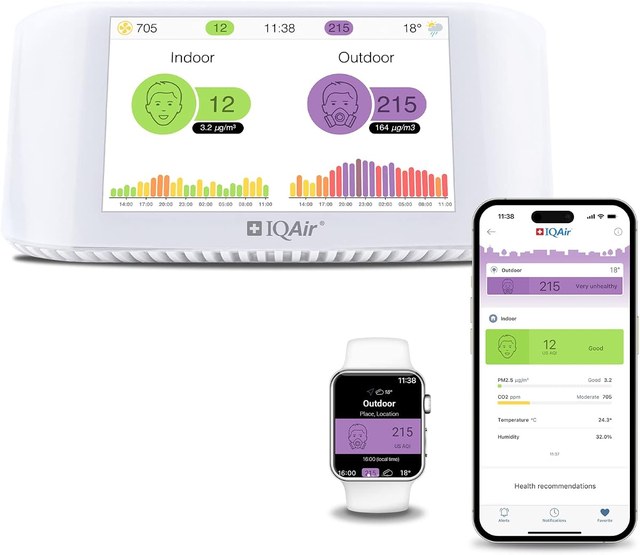
IQAir AirVisual Pro — Best for Particulate and Outdoor Comparison
The AirVisual Pro is built around particle pollution. Its laser sensor tracks PM2.5 closely, it adds an NDIR carbon dioxide sensor, and the color screen shows both your indoor number and the current outdoor air quality for your area, pulled from the nearest public station or your own IQAir outdoor unit. That side-by-side view is the point: it tells you whether closing the windows and running a purifier is actually helping, or whether your indoor air is already worse than the air outside.
It also forecasts the next several hours of outdoor air quality, keeps long-term history, and gives plain-language health advice tied to your readings. The downsides are the price, close to $330, the need to keep it plugged in for continuous use, and the lack of a radon sensor. If wildfire smoke, traffic, or a nearby industrial source is your main worry, this is the monitor that makes the case for a purifier clearest. Pair it with a unit from our air purifiers for dust guide for the particle side of the problem.
Pros
- Accurate laser PM2.5 sensor
- Shows indoor and outdoor air side by side
- NDIR CO2 plus air quality forecasting
- Clear color screen and health advice
Cons
- Around $330
- No radon or VOC sensor
- Needs to stay plugged in
- Outdoor data depends on a nearby station
What Each Reading Actually Means
A monitor is only useful if you know which numbers to worry about. Here is the short version for the five readings you will see most.
Carbon dioxide (CO2). Outdoor air sits near 420 ppm. Indoors, ASHRAE’s guidance works out to keeping rooms below roughly 1,000 to 1,100 ppm. A number that climbs past 1,000 ppm and stays there means the room is not getting enough fresh air, and studies link sustained high levels to slower thinking and poorer sleep. The fix is free: open a window or run a fan.
Fine particles (PM2.5). These are specks 2.5 microns and smaller that reach deep into the lungs. In 2024 the EPA tightened its annual outdoor limit from 12.0 to 9.0 micrograms per cubic meter, and its 24-hour limit is 35. Indoors you want the number as low as it will go; cooking, candles, and smoke are the usual spikes, and that is when a purifier earns its keep.
Radon. A radioactive gas from soil that you cannot see or smell. The EPA action level is 4.0 pCi/L, it suggests considering a fix between 2 and 4, and radon is linked to about 21,000 lung cancer deaths a year in the United States. Only a few monitors on this page read it at all.
VOCs. Gases released by paint, new furniture, cleaners, and air fresheners. There is no home standard, so monitors show a relative scale. A brief rise after you clean is normal; a reading that never comes down points to a source worth removing. Our explainer on VOC compounds found in homes lists the common culprits.
Humidity. Aim for 30 to 50 percent. Below that, you get dry skin, static, and cracked wood; above it, you invite mold and dust mites. Most monitors here track it, and the reading tells you whether to run a humidifier or a dehumidifier.
How to Choose an Indoor Air Quality Monitor
Five questions sort the field quickly.
Which pollutants do you actually need? If your home has a basement or sits in a radon-prone area, buy a monitor that reads radon; most do not. If your worry is stuffy bedrooms and focus, a carbon dioxide monitor is enough. If it is cooking smoke or wildfires, prioritize a good particle sensor.
NDIR or nothing, for CO2. Only a true NDIR sensor measures carbon dioxide directly. Budget units often list “eCO2,” which is a guess derived from VOC readings and can be badly wrong. Every CO2 number in this guide except the Amazon monitor comes from an NDIR sensor.
Screen or app? A monitor you can read at a glance gets acted on. One that hides everything in an app gets ignored after the first week. If you want history and alerts on your phone too, that is a bonus, not a substitute for a display.
Power and placement. Battery units go anywhere but refresh more slowly; plug-in units give faster data but need an outlet. Pick based on where the monitor has to sit.
Ongoing cost. Check whether history, alerts, or export sit behind a subscription before you buy. None of the six picks here require a paid plan for their core readings, but several competitors do.
Where to Put Your Monitor
Place it in the room where you spend the most time, usually the bedroom or a home office, at about breathing height, two to six feet off the floor. Keep it a few feet from windows, exterior doors, and supply vents so it reads the room and not a draft, and away from the stove, since cooking will peg the particle and VOC readings and skew your averages. For radon, the lowest lived-in level of the house is the right spot, since that is where the gas concentrates. If you buy more than one monitor, put the second in the kitchen or the basement rather than next to the first.
What a Monitor Can and Cannot Do
A monitor is a dashboard, not a treatment. It will show you that particles spike every time you sear a steak, that the bedroom hits 1,600 ppm of carbon dioxide by morning with the door closed, or that a new couch pushed VOCs up for two weeks. What it does next is up to you: run the range hood, crack a window, move an air purifier into the room, or bring in a professional for a persistent radon result. Consumer monitors also drift over months and are not a substitute for a lab test when you are buying a house or acting on a health concern. Used realistically, though, a good monitor turns vague worry into a specific, fixable list, and that is worth the price of one device.
The downside of cheap monitors is drift. Expect more brands to add auto-calibration and published accuracy, and do not be surprised if paid plans lock history behind a subscription. One more thing to expect: calibration claims will get louder, so look for a stated accuracy range.
FAQ
Are cheap air quality monitors accurate?
The better budget units are accurate enough to spot trends and spikes, which is most of what a homeowner needs. Where cheap monitors fall down is absolute precision and long-term stability: the particle count may read 20 percent off, and a fake “eCO2” sensor can be off by hundreds of ppm. Spend more only if you need a specific sensor, like radon, or reference-grade numbers.
Is a monitor that measures radon needed?
If your home has a basement or ground-floor bedrooms, or you live in a radon-prone region, yes, at least for a testing period. Radon is the one pollutant you cannot detect any other way, and levels vary too much for a single kit to be the whole story. The View Plus and Wave Plus are the two picks here that read it.
What is a good CO2 level for a bedroom?
Under about 1,000 ppm through the night. Many closed bedrooms climb to 1,500 ppm or higher by morning, which is enough to affect sleep quality. Cracking a window or a door, or running a fan, usually brings it back down.
Does an air quality monitor replace a carbon monoxide alarm?
No. Some monitors, including the Amazon one, read carbon monoxide, but they are not certified life-safety alarms and may not alert loudly enough to wake you. Keep a proper CO alarm on every level of the home regardless of what your air quality monitor shows.
Where should an air quality monitor not go?
Not next to the stove, not on a windowsill, not directly under a supply vent, and not tucked inside a cabinet or behind a curtain. Any of those gives you a reading of a micro-environment rather than the room you are breathing in.
Do these monitors need Wi-Fi or a subscription?
None of the six require a subscription for their main readings. The Aranet4 and Temtop work over Bluetooth with no Wi-Fi at all; the Airthings and IQAir units use Wi-Fi for cloud history but still show numbers on the device. Always check the current listing, since brands do change their app policies.
What happens next: expect more schools, offices and regulators to talk about CO2 and PM2.5 data, and expect home monitors to feed into ventilation and purifier controls. That helps only if the readings stay honest.
Bottom Line
For a complete view of your home’s air, the Airthings View Plus is the monitor to buy: radon, particles, carbon dioxide, and VOCs on one readable screen, with no hub and no subscription. If ventilation is the whole question, the Aranet4 Home gives you the most trustworthy carbon dioxide reading and four years of battery life. To spend as little as possible, the Amazon Smart Air Quality Monitor covers particles and VOCs for about $70 and plugs into an Alexa routine. Whichever you pick, put it where you sleep, give it a week to settle, and treat its numbers as a to-do list, not a verdict.
Editorial note: Prices, ratings, and availability change after publication — confirm the current listing before buying.