
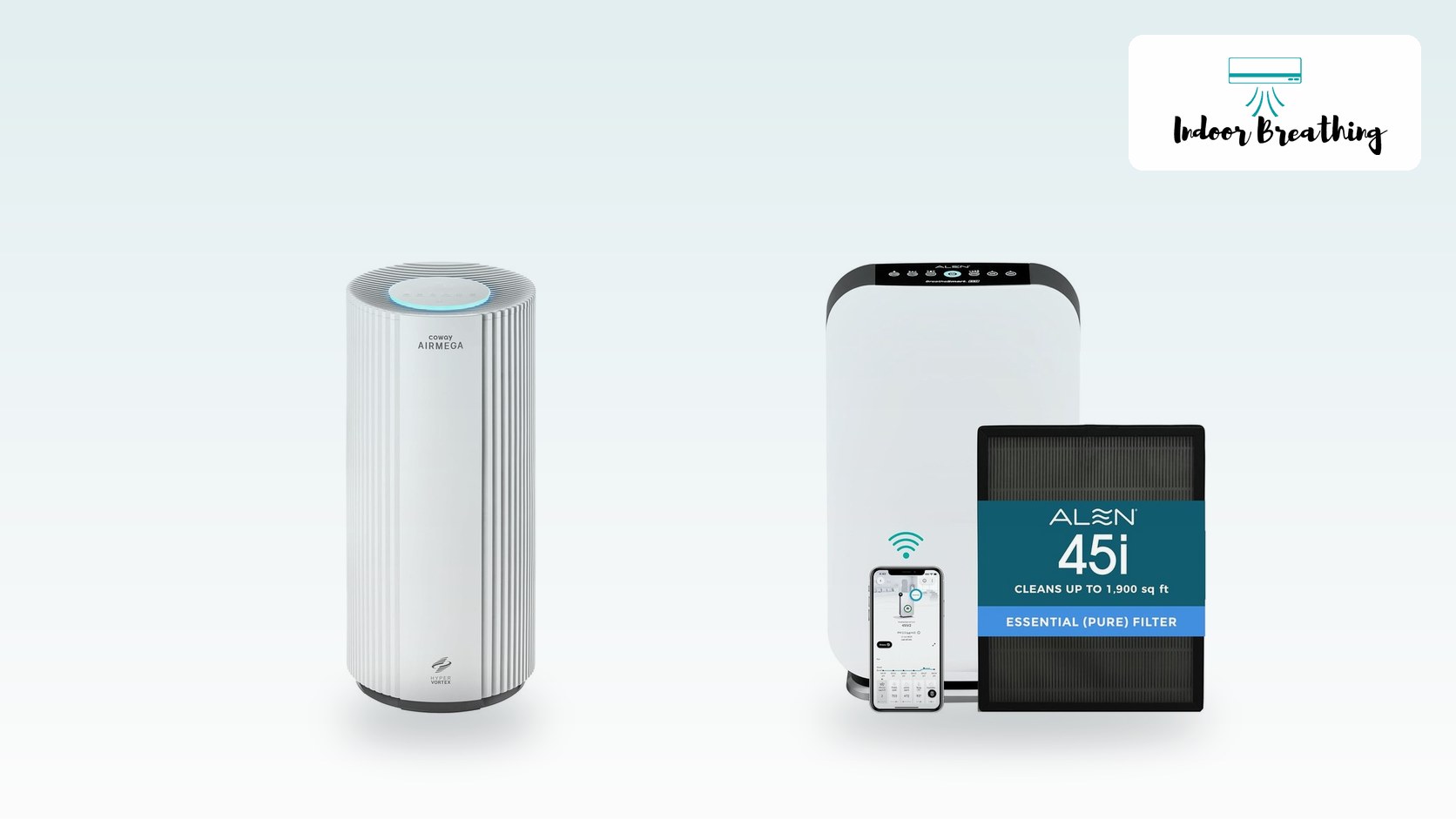
The best large room air purifier for most homes is the Coway Airmega 450, which has verified CADR near 445 and stays quiet on auto. For the largest open-plan spaces, the Medify MA-112 moves far more air. Just know that a purifier’s advertised square footage assumes one weak air change per hour, so plan on roughly half that number for a genuinely clean big room.
Every pick here is checked against verified CADR figures, manufacturer coverage claims, and buyer feedback. Sizing math follows AHAM and EPA guidance. No hands-on lab testing is involved. Prices and ratings were last checked in September 2026 and can change, so confirm the live price on Amazon before you buy.
Shopping for a large room air purifier is where marketing and physics part ways. A box will promise “cleans up to 3,000 square feet,” and technically that is true, but only if you accept one full air change per hour, which barely counts as cleaning. Run the same unit at the rate an allergy sufferer needs and that number drops to a few hundred square feet.
So the job here is not to find the machine with the biggest coverage claim. It is to find one with enough real airflow, measured as clean air delivery rate, to turn over the air in your actual room four or five times an hour without sounding like a hair dryer. That is a much shorter list.
Below are five air purifiers that have the airflow to back up their size claims, ranked for different big-room situations, plus the simple math to match one to your space. If you want the full picture on the number that drives all of this, our explainer on what CADR rating means is the place to start.
Affiliate disclosure: IndoorBreathing may earn a commission when you buy through links on this page, at no extra cost to you. Picks are chosen for measured airflow, noise, and value, not commission rate.
Table of Contents
What “Large Room” Actually Means
There is no legal definition, but in practice a large room is anything over about 350 square feet: a main living room, a great room, a finished basement, a big primary bedroom, or an open kitchen-and-living space with no wall between them. Most air purifiers sold as “large room” units are built for the 350 to 700 square foot range once you size them honestly. A true open floor plan of 1,000 square feet or more usually needs the biggest single unit on this list or two mid-size ones. Several of these models are compared on all-around value in our main best air purifiers for home guide.
The Air-Change Math That Changes Everything
Air changes per hour, or ACH, is how many times a purifier can filter a room’s entire volume of air in one hour. It is the single most useful number for sizing, and almost no box prints it.
Manufacturers quote coverage at 1 ACH. That means the unit filters the room’s air once in 60 minutes, which is not enough to keep up with cooking, pets, pollen coming through the door, or dust you stir up walking around. Independent guidance, including from the EPA, points to 4 to 5 ACH for people with allergies, asthma, or wildfire smoke, and 2 ACH as a sensible floor for everyone else.
Here is the shortcut. Take the square footage printed on the box and divide it by two for a genuinely clean room, or by four or five if health is the reason you are buying. A purifier rated for “3,000 square feet” is really a 1,500 square foot machine for normal use and a 600 to 750 square foot machine for an allergy household.
The cleaner way to shop is by clean air delivery rate. CADR is measured in cubic feet per minute and tested by an independent lab. The AHAM two-thirds rule says your purifier’s CADR should be at least two-thirds of the room’s floor area, which lands you near that 4.8 ACH target with a standard 8-foot ceiling. A 500 square foot room wants a CADR around 330; a 900 square foot room wants roughly 600. You can run your own numbers with our CADR calculator, and our roundup of the best air purifiers by CADR rating sorts models by that figure.
A worked example makes it concrete. Say you have a 24-by-28-foot open living room, 672 square feet, with a 9-foot ceiling. Add about 12% for the taller ceiling and you are effectively sizing for 750 square feet. For allergy-level cleaning at 4.8 air changes, two-thirds of 750 is a CADR of 500. Only the Coway Airmega 450 and the Medify MA-112 clear that on their own; anything smaller means running the unit on a higher, louder speed or adding a second purifier. For everyday cleaning at 2 air changes you would need a CADR near 250, and most units on this list qualify.
Top 5 Large Room Air Purifiers: Comparison Table
“Rated area” is the manufacturer’s own figure at 1 ACH. “Real large-room area” is that number halved, for honest 2 ACH cleaning. Prices and ratings are current Amazon figures and will move.
| Model | Best for | CADR / airflow | Rated area (1 ACH) | Real area (2 ACH) | Noise (low) | Price |
|---|---|---|---|---|---|---|
| Coway Airmega 450 | Best overall | CADR ~445 / 439 / 450 | 3,285 sq ft | ~1,640 sq ft | ~22 dB | ~$499.00 |
| Levoit Core 600S | Best value | CADR 391 CFM | 2,933 sq ft | ~1,470 sq ft | ~24 dB | ~$259.99 |
| Medify MA-112 | Largest / open-plan | CADR ~1,009 CFM | 4,455 sq ft | ~2,230 sq ft | ~46 dB | ~$594.99 |
| Blueair Blue Signature | Quiet, low upkeep | ~705 sq ft in 12.5 min | 3,385 sq ft | ~1,690 sq ft | ~23 dB | ~$337.49 |
| Alen BreatheSmart 45i | Large bedrooms | CADR ~245 CFM | 1,900 sq ft | ~950 sq ft | ~24 dB | ~$449.00 |
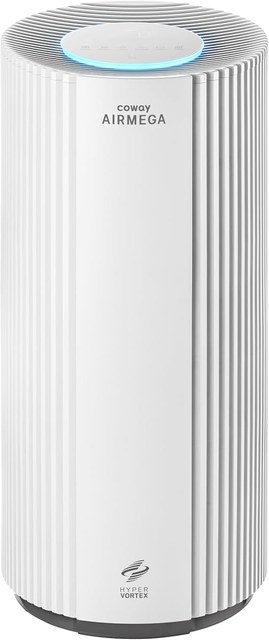
Coway Airmega 450 — Best Overall Large Room Air Purifier
The Airmega 450 is the one to put in a typical large living room without a second thought. Its clean air delivery rate is rated near 445 for dust, 439 for smoke, and 450 for pollen, which are among the highest verified figures you can get in a single home unit, and it holds those numbers while staying close to silent on its lower speeds, around 22 decibels. A real-time air quality sensor runs the fan in auto mode, so it sits quietly most of the day and ramps up only when you cook or the pollen count jumps.
Filtration is a three-stage stack: a washable pre-filter for hair and lint, an activated carbon layer for odors and VOCs, and a true HEPA filter for 99.97% of fine particles. Applying the two-thirds rule to that CADR, the 450 comfortably handles a 600 to 660 square foot room at the 4.8 air changes an allergy household wants, or a room closer to 1,600 square feet if you only need general cleaning. The downsides are the price, close to $500, the large footprint, and full-speed noise that most owners avoid by leaving it on auto. It is Energy Star certified, so running costs stay low.
Pros
- Very high verified CADR (~445)
- Near-silent on auto and sleep
- Washable pre-filter plus carbon and HEPA
- Real-time air quality sensor and auto mode
- Energy Star certified
Cons
- Around $500
- Large, heavy cabinet
- Loud at full speed
- Replacement filter sets are not cheap
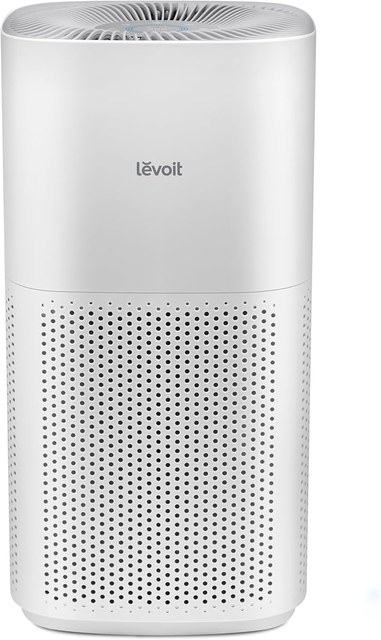
Levoit Core 600S — Best Value for Big Spaces
The Core 600S gives you most of the Airmega’s real-world performance for roughly half the money. Levoit lists its CADR at 391 CFM and its own honest figure of one clean pass over 606 square feet every 12.5 minutes, which works out to about 4.8 air changes an hour in that size room. That is exactly the rate you want, and it lines up with the two-thirds rule for a room around 580 square feet.
You get a three-stage filter with a true HEPA layer, a smart app with scheduling, an auto mode driven by a particle sensor, and genuinely quiet operation on sleep mode. It is AHAM Verifide, so the numbers are third-party checked. The trade-offs are minor: the all-plastic build feels less solid than the Coway or Blueair, the app is the only way to see history, and Levoit’s headline “2,933 square feet” claim is the usual 1 ACH marketing, so treat its real ceiling as about 1,400 square feet for general use. For the price, it is the easiest large-room unit to recommend.
Pros
- Best airflow per dollar here
- AHAM Verifide CADR of 391 CFM
- Quiet on sleep mode
- App scheduling and sensor-driven auto mode
Cons
- Plastic build feels less premium
- History and controls live in the app
- Headline coverage figure is 1 ACH marketing
- No washable main filter
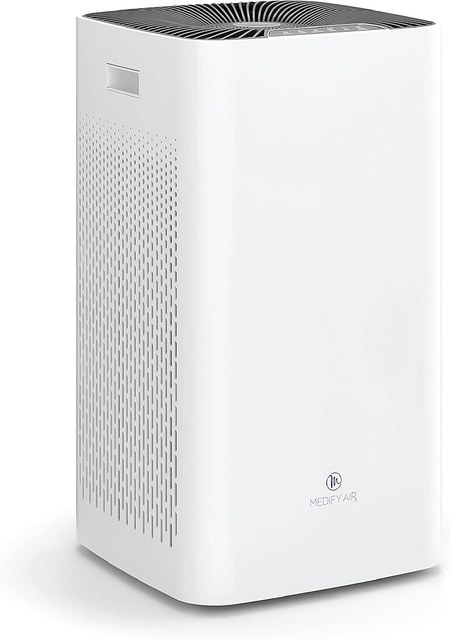
Medify MA-112 — Best for the Largest and Open-Plan Spaces
When the space is genuinely huge, an open kitchen-living-dining area, a vaulted great room, a small studio or shop, the MA-112 is the only unit here with the airflow to match. Its clean air delivery rate is rated at roughly 1,009 CFM, more than double the Coway, achieved with two H13 HEPA filters running in parallel. That is enough to hit 2 air changes an hour in a room over 2,000 square feet, or 4 to 5 changes in a room around 900 to 1,000.
H13 is a tighter grade than the usual H11 or “True HEPA,” capturing finer particles, and Medify backs the unit with a lifetime warranty. The cost of that power is noise and upkeep: even the low speed sits near 46 decibels, full speed is loud enough to raise your voice over, and you are buying two filters at a time, roughly every six months. If your room is under about 800 square feet, a quieter unit will serve you better. If it is bigger than that, nothing else on this list will keep up. It is also our top pick for wildfire smoke in a large space.
Pros
- Highest airflow here by far (CADR ~1,009)
- Dual H13 HEPA, finer than standard HEPA
- Genuinely covers 900+ sq ft at 4-5 ACH
- Lifetime warranty
Cons
- Loud even on low (~46 dB)
- Two filters to replace, about every 6 months
- Overkill and noisy in a normal room
- Large and utilitarian looking
Blueair Blue Signature — Best for Quiet, Low-Maintenance Running
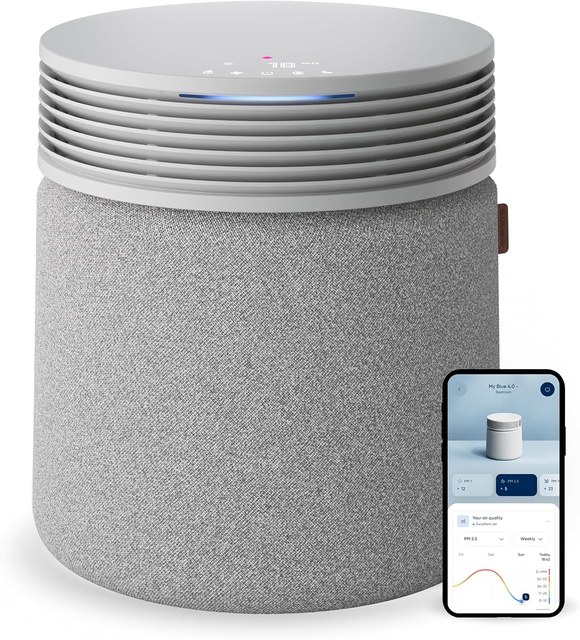
Blueair’s HEPASilent approach pairs a mechanical filter with a light electrostatic charge, which lets the fan move a lot of air at a low speed and a low noise level, as quiet as 23 decibels. The Blue Signature is rated to clean 705 square feet in about 12.5 minutes, an honest near-5 air changes an hour for that size, and it wraps the whole thing in a fabric-sided design that genuinely passes for a side table.
Upkeep is the lightest here. The washable fabric pre-filter goes in the laundry, and the main filter runs about six to nine months. A colored light on the air outlet shows current air quality, Wi-Fi and an app handle the rest, and auto mode is reliable. Two cautions: Blueair does not publish an AHAM CADR for this model, so you are trusting its stated clean-air time rather than a third-party lab figure, and the electrostatic stage produces a trace of ozone, well under the safety limit but worth knowing if you are sensitive. For a room up to about 700 square feet where quiet and looks matter, it is the pick.
Pros
- Extremely quiet for the airflow (23 dB)
- Washable pre-filter, low ongoing upkeep
- Furniture-style design
- Reliable Wi-Fi app and auto mode
Cons
- No published AHAM CADR
- Electrostatic stage emits trace ozone
- Proprietary filters only
- Headline 3,385 sq ft figure is 1 ACH
Alen BreatheSmart 45i — Best for Large Bedrooms
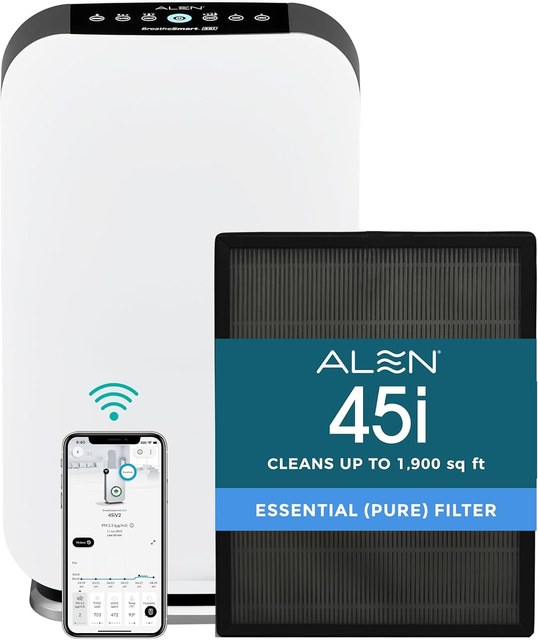
The 45i is the pick when the “large room” is a bedroom and sleep comes first. It runs as low as 24 decibels and produces a soft pink noise across all speeds that many people find easier to sleep through than a typical fan hum, a claim Alen backs with a SleepScore Labs study. A color-changing ring and an app show air quality, and auto mode adjusts the fan while you sleep.
Be realistic about its size, though. Alen advertises 1,900 square feet, but the 45i’s clean air delivery rate is about 245 CFM, which by the two-thirds rule is a 370 square foot room at 4.8 air changes and roughly 900 square feet at a gentle 2 changes. That is plenty for a large primary bedroom, a nursery, or a home office, and not enough for a great room. Filters last 9 to 12 months, and Alen’s lifetime warranty requires an active filter subscription and product registration, which is worth factoring into the cost. Within its real range, it is the most restful unit here. If allergies are the main issue, cross-check our guide to the one spec that matters for allergy air purifiers.
Pros
- Very quiet, sleep-tuned pink noise
- Color air quality ring plus app
- Long 9-12 month filter life
- Lifetime warranty (with filter subscription)
Cons
- Modest CADR (~245) for the price
- Advertised 1,900 sq ft is very optimistic
- Warranty tied to a subscription
- Not enough air for a great room
Looking ahead, large-room purifiers are getting smarter and cheaper to run. More models pair a true HEPA filter with an auto mode that reads dust and gases, and prices for big units have eased. The catch is that auto modes can run loud when you cook or spray a cleaner, and louder usually means faster filter wear.
How to Size an Air Purifier for a Big Room
Three steps get you a purifier that actually works in a large space.
1. Measure the floor area, then adjust for the ceiling. Multiply length by width. If your ceiling is higher than 8 feet, add 25% for a 10-foot ceiling and up to 50% for a vaulted or cathedral ceiling, because the purifier has to move that extra volume too.
2. Pick your air-change target. Use 2 ACH for general dust and odor control, or 4 to 5 ACH if anyone has allergies or asthma, if you have pets, or if wildfire smoke reaches your area.
3. Match the CADR. For 4.8 ACH with a standard ceiling, your purifier’s CADR in CFM should be about two-thirds of the adjusted square footage. For a gentler 2 ACH, one-third is enough. A 700 square foot living room aimed at allergy-level cleaning wants a CADR near 460, which points straight at the Coway or the Medify.
Our CADR calculator does this arithmetic for you if you would rather not.
One Big Unit or Two Smaller Ones?
For an open floor plan, two mid-size purifiers often beat one large one. Splitting the airflow between two locations clears the air more evenly, gives you a quieter result because neither unit has to run flat out, and adds redundancy when one is down for a filter change. One big unit wins when the space is a single open box with no partial walls, when you want one thing to maintain instead of two, or when floor space and outlets are tight. As a rough rule, if the room has any divider, a peninsula, an island, a half-wall, a wide cased opening, put a purifier on each side.
Running Costs: Filters and Electricity
The purchase price is the smaller number over five years. Plan on a replacement HEPA filter every 6 to 12 months at roughly $60 to $130 for these models, with the dual-filter Medify at the high end and the Coway’s washable pre-filter stretching its HEPA life. Electricity is modest if you use auto mode: a large purifier draws 5 to 25 watts sitting quietly and 50 to 100 watts on high, which is somewhere between $15 and $50 a year in most of the country. The Energy Star models on this list, the Coway and the Levoit, sit at the low end. Our filter replacement cost guide breaks the numbers down by brand.
The risk to watch is the hidden bill. Big purifiers move a lot of air, so filters clog sooner, and replacement filters for popular models can cost as much as a small purifier. Expect more app reminders and filter subscriptions, and check the filter price before the unit price.
Placement in a Large or Open Room
Give the unit at least a foot of clearance on every side and keep it off the wall if the air intake is on the back. In a large room, put it near where people actually sit or sleep and near the main source of particles, the kitchen doorway, the pet bed, the entry where outdoor air and pollen come in, rather than in a far corner. Keep it away from large furniture that blocks airflow, and do not tuck it behind a couch. If the room connects to a hallway or another space, aim the outlet toward that opening so cleaned air circulates instead of pooling.
Mistakes to Avoid
The big one is trusting the box. A “cleans 3,000 square feet” label on a unit with a 350 CADR is describing 1 ACH, which will not keep a real room clean. The second is buying for a whole house: air purifiers are room devices, and one cannot pull air through walls and hallways fast enough to matter elsewhere. The third is running a large unit only on its quietest setting, which can cut its real airflow by half or more, then wondering why the air still feels stuffy. The fourth is ignoring the pre-filter, which clogs first and quietly strangles the whole machine if you never vacuum or wash it. And the fifth is skipping a way to measure results; a simple monitor, covered in our air quality monitor guide, tells you whether the purifier is actually keeping up.
FAQ
What size air purifier do you need for a large room?
Match the clean air delivery rate to the room. For a 500 square foot room with a standard ceiling, aim for a CADR of at least 165 for light cleaning or about 330 for allergy-level cleaning. Double those targets for a 1,000 square foot open space. Ignore the square-footage number on the box unless you halve it first.
Can one air purifier cover an open floor plan?
Only if it is one of the highest-airflow units, like the Medify MA-112, and even then the layout matters. If the open plan has an island, a peninsula, or any partial wall, two mid-size purifiers on opposite sides will clean the air more evenly and run more quietly than a single large one.
Is a higher CADR always better?
For a large room, more CADR gives you headroom to run the unit on a lower, quieter speed and still hit your air-change target. The only downsides are price, size, and the noise if you do run it flat out. For a small room, a very high CADR is wasted money.
How loud are large room air purifiers?
On their lowest speeds, the quietest here sit in the low 20-decibel range, softer than a whisper. On full power, most large units reach 50 to 60 decibels, like steady rain, and the high-airflow Medify is louder still. The practical fix is a model with a good auto mode so it only gets loud when the air needs it.
Do large air purifiers use a lot of electricity?
No. On auto or eco mode they draw about as much as a couple of LED bulbs, 5 to 25 watts. Even on high, 50 to 100 watts is less than a ceiling fan. Yearly running cost is usually $15 to $50, lowest on the Energy Star models.
Should you leave a large room air purifier running all the time?
Yes. Particles settle and get stirred back up constantly, so continuous running on auto keeps levels low with almost no energy cost. Turning it off for hours lets the room load back up, and then the unit has to work harder to catch up.
Are Blueair and other electrostatic purifiers safe?
The Blueair HEPASilent system uses a small electrical charge to help the filter grab particles, and it does release a trace of ozone as a side effect. Independent testing puts that output well below the limits set by CARB and other agencies, so it is considered safe for normal use. If you have asthma or are ozone-sensitive, a purely mechanical HEPA unit like the Coway, Levoit, or Medify avoids the question entirely.
Related Guides
Keep going with running a purifier all the time.
What happens next: open-plan homes and smoke seasons will keep demand for big units high. Where you can, buy one purifier sized for the room instead of three small ones, and run it on low all day rather than on high for an hour. It is quieter, cheaper and works better.
Bottom Line
For most large living rooms, the Coway Airmega 450 is the right buy: high verified airflow, near-silent on auto, and enough real capacity for a 600 to 800 square foot room at the air-change rate that matters. The Levoit Core 600S does most of the same job for around $260 and is the value pick. For a true open floor plan or a vaulted great room, the Medify MA-112 is the only unit here with the airflow to keep up, as long as you can live with the noise. The Blueair Blue Signature wins on quiet and low upkeep, and the Alen BreatheSmart 45i is the one for a large bedroom. Whatever you choose, size it by clean air delivery rate, not by the number on the box, and run it on auto around the clock.
Editorial note: Prices, ratings, CADR figures, and availability change after publication — confirm the current listing before buying.