
Not all air purifier filters are created equal. The difference between a HEPA filter and an activated carbon filter is huge—and most people don’t understand it until they’ve already bought the wrong purifier.
Filter type determines what your air purifier actually removes from the air. Pick the wrong one, and you’ll be filtering for smoke but not dust, or removing dust but leaving odors behind.
Here’s a breakdown of the main filter types, what each one does, and which problems they solve.
Table of Contents
Air Purifier Filter Types Explained
HEPA Filters (High-Efficiency Particulate Air)
HEPA is the gold standard for particle removal. A true HEPA filter removes 99.97% of particles 0.3 microns and larger—that includes dust, pollen, pet dander, and smoke particles.
HEPA filters don’t remove gases or odors, just particles. So if you need to eliminate cooking smells or chemical fumes, HEPA alone won’t cut it. But for allergies and general air quality, HEPA is what you want.
How long it lasts: 6–12 months depending on air quality and how much you run the purifier.


Activated Carbon Filters
Carbon filters remove gases, odors, and volatile organic compounds (VOCs). They’re what you need if you want to eliminate smoke smell, cooking odors, pet smells, or chemical fumes.
Carbon doesn’t remove particles—it only works on gases and odors. So a carbon-only purifier won’t help much with dust or pollen. Most air purifiers use HEPA + carbon together to handle both particles and gases.
How long it lasts: 3–6 months typically, since carbon gets saturated faster than HEPA.
Combination Filters (HEPA + Carbon)
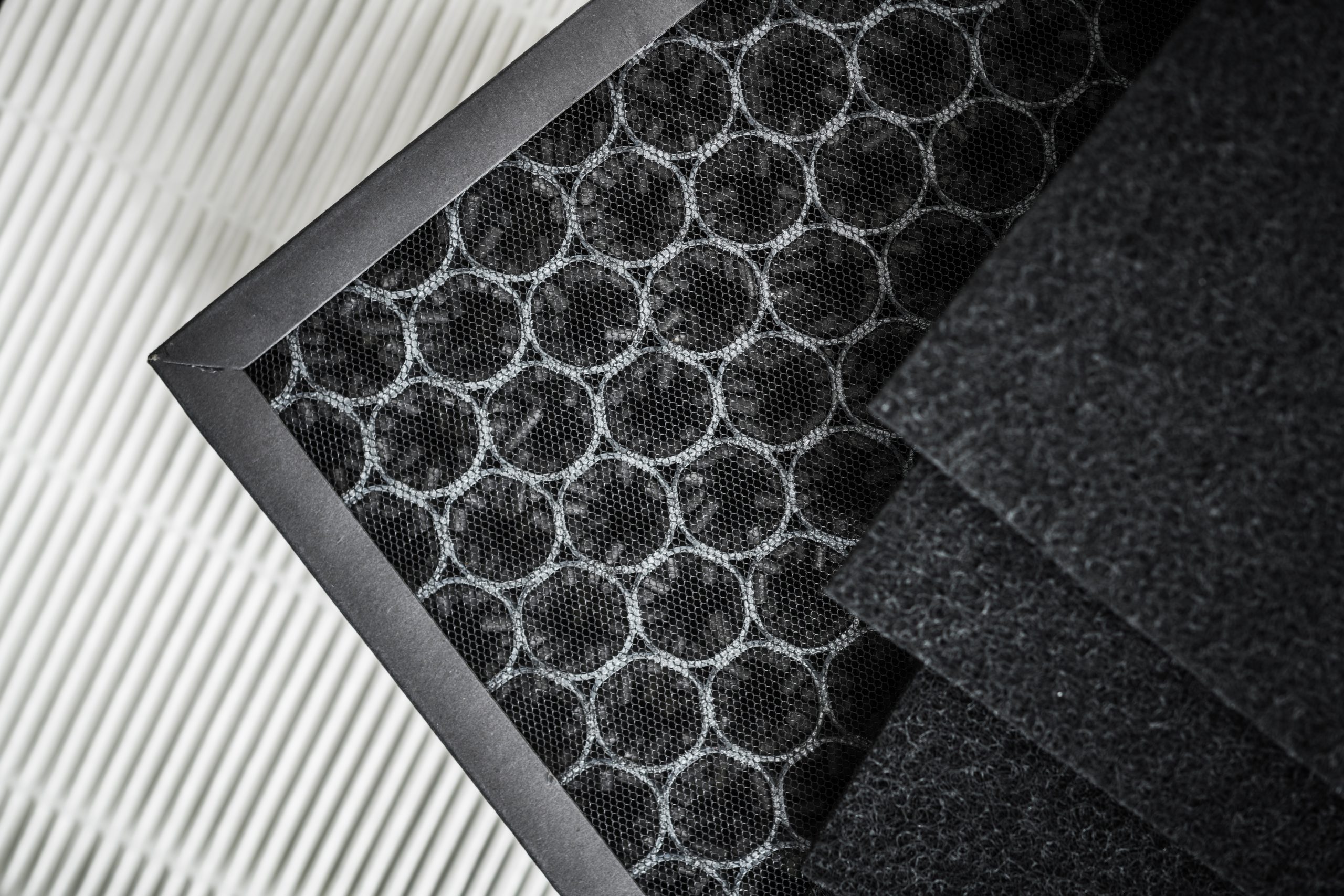
Most good air purifiers combine HEPA and carbon in one filter or use separate cartridges. This gives you particle removal AND odor/gas removal in one unit.
This is the best approach for most homes. You get comprehensive air cleaning without needing two separate machines. Look for purifiers that use combination filters—it’s simpler and often cheaper than dual-cartridge systems.
Pre-Filters
Most purifiers have a coarse pre-filter (usually mesh or washable fabric) before the HEPA stage. It catches large particles like pet hair and dust before they clog the expensive HEPA filter.
Pre-filters are washable and reusable—don’t throw them away. Cleaning your pre-filter every month extends HEPA life and keeps your purifier running efficiently.
Final Word
For most situations, a HEPA + carbon combination is the right choice. It handles dust, pollen, and odors without requiring two separate machines. Make sure any purifier you buy has a true HEPA filter (not “HEPA-like”), and check whether the carbon is combined or separate—combined is usually better for cost and convenience.
For detailed comparisons of specific models and their filter types, see our air purifier buying guide.