
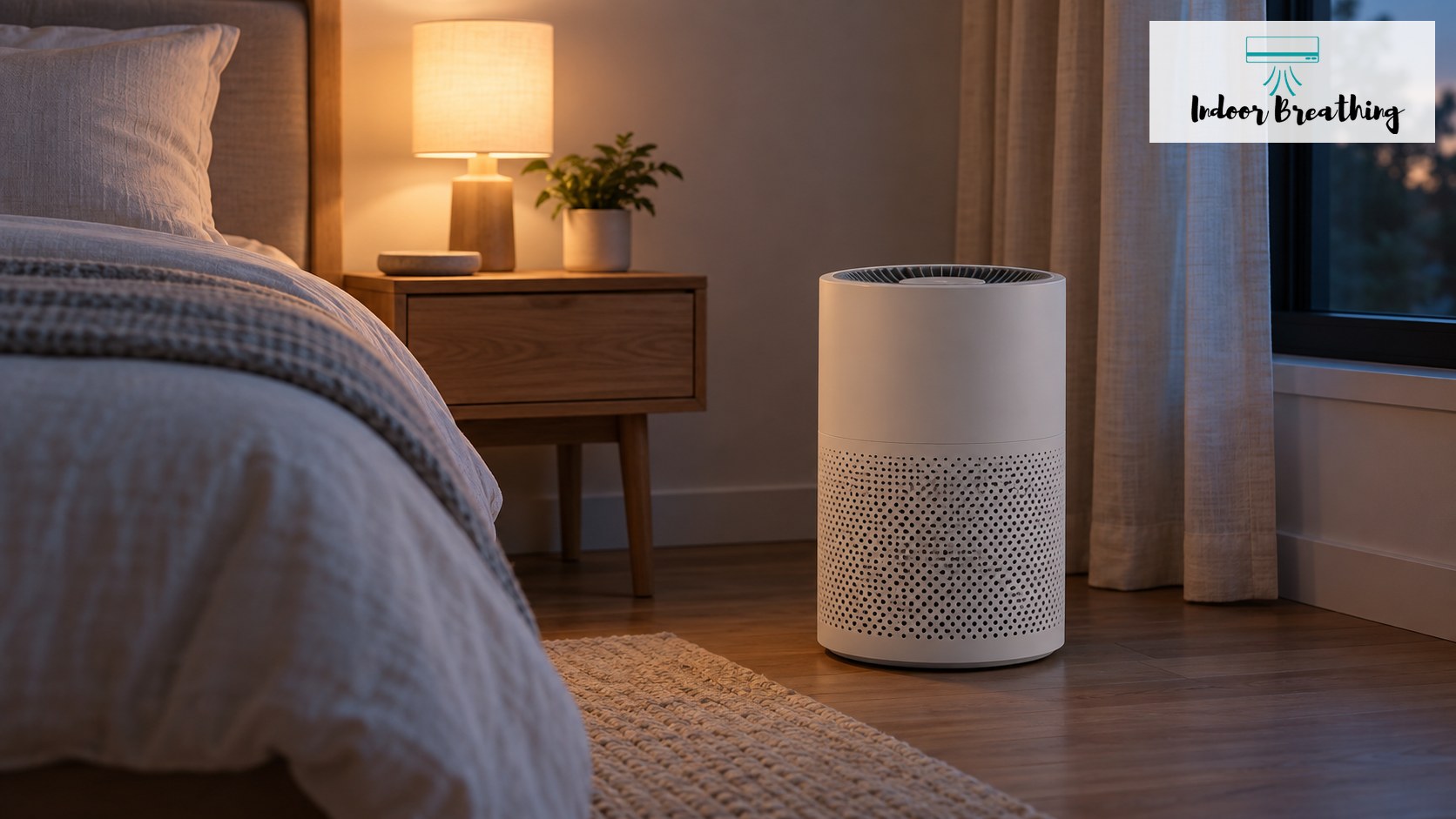
For a small bedroom, the Blueair Blue Pure 511i Max is my quiet-first pick. The Levoit Vital 200S is a practical alternative for pet households, while the Blueair Blue Signature Large offers substantially more airflow at quieter settings. The compact Levoit Core 300S belongs on the shortlist when space is tight.
The best air purifiers for bedrooms move enough filtered air at the speed you can actually sleep beside. A whisper-quiet label tells only half the story. Match quiet airflow to your room before choosing by the lowest decibel claim.
Research note: IndoorBreathing did not perform these sound tests. “dB Tested” refers to independent measurements published by RTINGS, identified below. Manufacturer ratings are shown separately. Noise and airflow results apply to the tested models, not automatically to every later revision sold under a similar name.
Table of Contents
Quick Answer: Which Bedroom Air Purifier Should You Buy?
Choose the Blueair 511i Max for a smaller room and a low-noise priority. Consider the Vital 200S when its washable pre-filter and pet-friendly intake matter more. For a large primary bedroom (see also our large-room air purifier guide), start with the Signature Large because its measured quiet-setting airflow is much stronger. Pick the Core 300S when its compact cabinet fits your layout and the price makes sense.
None is silent at full power. Buy for your overnight fan speed, turn off distracting lights, and leave the intake open. An impressive maximum room rating does not describe what happens in the quietest sleep mode.
Bedroom Air Purifiers Compared: Measured Noise and Quiet Airflow
The following figures come from the same independent testing outlet. That makes them more useful together than a collection of unrelated marketing numbers. The lowest-noise column and quiet-airflow column describe different settings: do not assume the stated airflow is delivered at the minimum dBA reading.
| Model tested | Measured low / high noise | PM1.0 CADR at ≤45 dBA | Tester’s room estimate at that setting | Best reason to consider it |
|---|---|---|---|---|
| Blueair Blue Pure 511i Max | 30.8 / 53.9 dBA | 95 CFM; app-adjusted Speed 3 | 149 sq ft | Small bedroom; quiet-first choice |
| Levoit Vital 200S | 32.7 / 55.6 dBA | 87 CFM; Speed 2 | 135 sq ft | Pets and washable pre-filter |
| Levoit Core 300S | 32.5 / 55.6 dBA | 80 CFM; Speed 2 | 126 sq ft | Compact footprint |
| Blueair Blue Signature Large | 31.2 / 58.2 dBA | 213 CFM; Speed 2 | 332 sq ft | Larger bedroom; strong quiet airflow |
Sources: [1], [2], [3], [4]. These are RTINGS’ PM1.0 test results, not AHAM smoke CADR ratings. The ≤45 dBA threshold is a testing category, not a promise of comfortable sleep for everyone.
How These Quiet Air Purifiers Were Selected
I prioritized models with published independent noise measurements, useful particle-cleaning data at quieter speeds, and bedroom-friendly controls. A dark display and a predictable fan matter because an appliance that annoys you will eventually get switched off.
The recommendations are editorial judgments based on that evidence. They are not a claim that these four models beat every air purifier available. The 511i Max has the lowest minimum reading among this shortlist, but a fraction of a decibel should not decide a purchase. Room size and practical airflow deserve more weight.
Manufacturer specifications help identify the product, but the independent test unit may predate the exact version now on Amazon. Levoit’s current listings use names such as Vital 200S-P and Core 300S-P. Check the model label, manual, voltage, and included filter before treating an older test as a perfect match.
1. Blueair Blue Pure 511i Max: Quiet-First Pick for Small Bedrooms
The 511i Max makes the strongest quiet-first case for a small sleeping space. Its measured minimum was 30.8 dBA, and RTINGS obtained 95 CFM within its low-noise limit using finer app controls. Its Night Mode switches off the display. [1]
Blueair’s current specification table lists 19–48 dB and 237 square feet at 4.8 air changes per hour. Those manufacturer figures describe a different measurement basis from the table above; the 237-square-foot rating is not its minimum-speed coverage. Its HEPASilent system combines mechanical and electrostatic filtration. [5]
Choose it if: You want a compact unit for a modest bedroom and are comfortable using an app to fine-tune the fan. Skip it if: Your room is large enough that you would need to keep pushing the speed higher. Quiet minimum operation cannot make up for insufficient overnight airflow.
Check Blueair 511i Max buying options on Amazon.
2. Levoit Vital 200S: Practical Pick for Bedrooms With Pets
The Vital 200S suits buyers who value a washable pre-filter and an intake designed for pet hair (more in our pet air purifier guide). RTINGS measured 32.7 dBA at the lowest setting and 87 CFM at Speed 2 within its quiet-testing threshold. The larger cabinet needs more floor space than the compact options. [2]
Levoit’s current Vital 200S-P page lists 250 CFM, 388 square feet at 4.8 air changes per hour, and 23–54 dB. It also describes smart controls and a Sleep Mode filtration claim. Treat those as specifications for the currently listed product, separately from the independently tested Vital 200S. [6]
Choose it if: Pet hair maintenance is a recurring chore and the cabinet fits your room. Skip it if: You need the strongest quiet-setting airflow for a large bedroom. Its higher maximum capacity does not mean it delivers that capacity while you sleep.
Check Levoit Vital 200S-P buying options on Amazon.
3. Levoit Core 300S: Compact Pick When Space Is Tight
The Core 300S is worth considering when you need a smaller cabinet rather than maximum airflow. The tested unit measured 32.5 dBA at minimum and delivered 80 CFM in RTINGS’ quieter configuration. It has app scheduling and a night setting that turns off display lights. [3]
The current Core 300S-P manufacturer page lists 141 CFM, 219 square feet at 4.8 air changes per hour, and 22–50 dB. These published ratings do not establish how well the shipping revision performs at the tested unit’s quiet settings. Confirm the specific model when ordering. [7]
Choose it if: Your bedroom is small, space is scarce, and the current buying price is attractive. Skip it if: Your room is larger or you need rapid particle cleanup. Compare the total price with the 511i Max before assuming the smaller Levoit is the better deal.
Check Levoit Core 300S-P buying options on Amazon.
4. Blueair Blue Signature Large: Strongest Quiet Airflow Here
The Signature Large is the standout for a bigger sleeping space. RTINGS measured 213 CFM at Speed 2 within its low-noise threshold, considerably more than the other three picks. Its lowest setting registered 31.2 dBA, and its night mode turns off the display. [4]
Blueair identifies the Large as the SP4i and publishes 455 CFM smoke CADR, 705 square feet at 4.8 air changes per hour, and 23–55 dB. The cabinet is broader than a small cylindrical purifier, so measure your available floor area. [8]
Choose it if: You want useful airflow in a larger bedroom without running at maximum speed. Skip it if: You prefer purely mechanical filtration: RTINGS reports that its ionization system cannot be disabled. It is also an unnecessary size upgrade when a smaller unit already fits your needs. [4]
Check Blueair Signature SP4i buying options on Amazon.
Why Advertised Decibels and Tested Decibels Differ
A manufacturer might advertise a reading taken under different conditions from an independent reviewer. Distance, room acoustics, background noise, meter settings, and the chosen fan speed all affect the result. A headline that says “19 dB” is not a guarantee that you will measure 19 beside your pillow.
Decibels also use a logarithmic scale. A ten-decibel increase represents ten times the sound intensity; it does not mean a ten-percent increase. A-weighted readings, written dBA, account for the ear’s sensitivity across frequencies. Keep those distinctions in mind rather than comparing every number as if it were measured identically. [11]
Sound character matters too. You might tolerate a steady rush of air but dislike a faint whine or repeated speed changes. During a return window, listen from the bed with your usual fan and heating system running. Then try the purifier alone. That tells you more about comfort than an online “whisper quiet” label.
Choose Room Coverage at the Speed You Will Use
CADR means clean air delivery rate (our CADR explainer covers how to read it). The EPA explains that the rating is typically measured at the highest fan speed, so a large coverage claim can coexist with weak sleep-mode airflow. Higher ceilings and open adjoining spaces also increase the volume the purifier must serve. [9]
For a planning estimate, use this relationship: required CADR in CFM equals room area in square feet, multiplied by ceiling height in feet, multiplied by desired air changes per hour, divided by sixty. This is airflow arithmetic, not a guarantee of health outcomes or perfectly mixed room air.
A 150-square-foot bedroom with an eight-foot ceiling needs about 96 CFM for 4.8 air changes per hour. A 250-square-foot room needs about 160 CFM on the same basis. Those examples explain why maximum coverage can be a poor guide to overnight use.
Compare those requirements with the quiet-airflow column, not just the minimum-noise column. Remember that the tester’s room estimates use its own PM1.0 measurements. They should not be relabeled as manufacturer-certified bedroom coverage, and the airflow values do not describe the quietest fan setting.
If you are between sizes, extra capacity can give you more options. It lets you choose a lower setting while still targeting useful airflow. But do not assume that every large purifier is efficient at low speed. Seek actual low-noise cleaning measurements whenever they are available.
Sleep Mode, Auto Mode, and Lights: What Actually Matters?
Sleep mode usually trades airflow for quieter operation. Auto mode reacts to sensor readings and may change speed unexpectedly. Neither is automatically the best choice for overnight use. A fixed manual setting is often the easiest way to keep the sound predictable.
Check whether you can darken the display without forcing the lowest fan speed. Otherwise, choosing a dark bedroom could also mean choosing less airflow than you need. Look for persistent settings, convenient physical controls, and schedules that still make sense if your bedtime changes.
For everyday particle control, try a stronger setting while getting ready for bed, then use an overnight setting matched to the room. This initial run does not replace continued filtration or guarantee that new particles will stop entering. Adjust the plan when outdoor pollution or indoor sources change.
Do not confuse a low particle reading with a complete air-quality assessment. A purifier’s sensor does not tell you everything about ventilation, gases, moisture, or odors. Buy the app for convenience rather than treating its colored display as a complete report on your bedroom. A dedicated bedroom CO2 monitor or one of the best indoor air quality monitors fills that gap.
Where to Put an Air Purifier in a Bedroom
Choose a stable location with the clearance required in the manual. Keep bedding, curtains, furniture, and laundry away from the intake and outlet. A purifier tucked tightly behind a dresser may fit neatly, but that placement can interfere with circulation.
You do not have to place it right beside your head. Start farther from the pillow while keeping its airflow unobstructed, and listen from your sleeping position. Avoid directing a strong draft at your face if that makes you uncomfortable.
Before the first run, remove any protective packaging from the filter. Keep the cord out of walking routes and avoid putting drinks where a spill could enter the appliance. If you use a dresser or shelf, check its stability and the manufacturer’s placement instructions.
During wildfire smoke events, the EPA recommends continuous operation at the highest setting, unobstructed airflow, and closed doors and windows when safe. A routine quiet-night compromise may be unsuitable during heavy smoke; see our smoke-focused purifier picks. Source control and filtration should work together. [10]
Filter Costs and Maintenance Can Change the Best Value
Before ordering, find the replacement filter (our filter replacement guide explains intervals) for the exact model and see whether you can buy it easily. Compare its price, expected replacement interval, and any specialty filter options. A cheap purifier can become expensive if its replacement cartridges cost more than you expected.
Use this simple budget example: a forty-dollar filter replaced twice a year costs eighty dollars annually. At an assumed average draw of ten watts, continuous operation uses about 87.6 kilowatt-hours per year. At twenty cents per kilowatt-hour, that is about $17.52. These are examples, not verified costs for a listed model.
Clean a removable pre-filter as the manual directs. Do not wash the main particle filter unless its instructions explicitly permit it. Calendar reminders and a quick visual check make maintenance easier than waiting until the purifier looks neglected.
Keep a record of the first replacement date and your usual speed. That gives you a more realistic household budget for the next year. Avoid assuming a filter lasts a full advertised year under every condition, especially when it handles frequent smoke or heavy dust.
Common Bedroom Buying Mistakes
The biggest mistake is combining the quietest advertised noise level with the largest advertised room size. Those figures generally describe different speeds. A second mistake is choosing on star ratings alone, especially when a retailer groups several models or revisions under one listing.
Also avoid buying a fragrance feature to cover a persistent odor problem. Identify the source first. A purifier is not a substitute for fixing damp materials, removing smoke sources, or addressing inadequate ventilation. The EPA advises avoiding air cleaners that intentionally produce ozone. [9]
Finally, buy within a return policy you understand. The sound that bothers one sleeper may be acceptable to another. Keep the packaging until you have checked the lights, controls, actual floor space, and overnight fan setting.
Frequently Asked Questions
Which air purifier is quietest for a bedroom?
Among these four tested models, the Blueair 511i Max had the lowest minimum noise reading. That makes it a reasonable small-bedroom starting point, not a universal winner. For a larger room, useful airflow at a tolerable speed is the better deciding factor.
Can I leave an air purifier running all night?
Follow the unit’s operating instructions. Continuous filtration can be part of a bedroom routine, provided the appliance is maintained and placed correctly. Use a speed that fits your room rather than selecting the lowest setting simply because it is labeled Sleep.
Will it help me sleep better?
This guide compares noise and particle-cleaning performance; it does not establish a medical sleep benefit. Cleaner air and fewer appliance distractions may make your bedroom more comfortable, but a purifier is not a treatment for insomnia or a guarantee of allergy relief. If allergies are the main concern, read this allergy purifier spec check first.
Is a tiny purifier enough for a large bedroom?
Not simply because the listing mentions a large square-foot figure. Check how many air changes that figure represents and which speed delivers them. If quiet-mode airflow is unavailable, avoid making a firm promise about overnight coverage.
Which One Would I Choose?
For a small bedroom, I would start with the Blueair 511i Max. I would compare the Vital 200S for pets and the Core 300S for a tighter layout, while checking the exact shipping revisions. For a larger bedroom, the Signature Large offers the strongest measured quiet airflow here.
The best bedroom air purifier is the one that cleans enough air at a speed you leave running. Measure the room, compare quiet-setting performance, darken the display, and budget for filters. Those steps matter more than the smallest decibel number printed on a box.
For broader comparisons, see our home air purifier guide and air purifier buying guide.
As an Amazon Associate, IndoorBreathing earns from qualifying purchases.
Sources
- RTINGS: Blueair Blue Pure 511i Max
- RTINGS: Levoit Vital 200S
- RTINGS: Levoit Core 300S
- RTINGS: Blueair Blue Signature Large
- Blueair: Blue Pure 511i Max specifications
- Levoit: Vital 200S-P specifications
- Levoit: Core 300S-P specifications
- Blueair: Blue Signature Large SP4i specifications
- EPA: Guide to Air Cleaners in the Home
- EPA: Indoor Air Filtration
- CDC/NIOSH: About Occupational Hearing Loss
Research reviewed October 5, 2026. Retailer listings and manufacturer specifications can change.