
Choose a CO2 monitor for a bedroom by prioritizing a true NDIR sensor over a cheaper eCO2 estimate, a display that won’t glow in your face at 3 a.m., and battery or plug-in power that fits your nightstand. Everything else — radon, PM2.5, app polish — is a bonus, not the job.
Every spec below is checked against the current Amazon listing, the manufacturer’s own product sheet, and published sleep/ventilation research. No hands-on lab testing is involved.
A closed bedroom door does something most people never think about: it turns the room into a slowly filling tank of your own exhaled breath. Two adults sleeping eight hours with the door and windows shut can push a small bedroom well past 1,500 parts per million of carbon dioxide by morning — more than triple what you’d measure outdoors. You wake up groggy, blame a bad night’s sleep on stress or a late dinner, and never once suspect the air itself.
A dedicated CO2 monitor is the only way to actually know. I’ve already covered multi-pollutant monitors that track CO2 alongside PM2.5 and radon in our indoor air quality monitor buying guide, but a bedroom has narrower needs: you care almost entirely about ventilation and CO2 buildup, not wildfire smoke or basement radon, and you need a device that won’t light up your room like a phone screen every time you roll over. This guide is about finding that specific device.
Affiliate disclosure: IndoorBreathing may earn a commission when you buy through links on this page, at no extra cost to you. Picks are chosen for sensor accuracy, bedroom-friendly design, and value, not commission rate.
Table of Contents
Best CO2 Monitors for Bedrooms: Comparison Table
Sensor type is the column that matters most — it’s the difference between a real reading and a guess. Display behavior at night is the column most buying guides skip entirely.
| Model | Best for | Sensor | Display at night | Power | Price |
|---|---|---|---|---|---|
| Aranet4 Home | Best overall / most accurate | NDIR | E-ink, no backlight (truly dark) | 2 AA, ~4 years | $189.00 |
| Airthings Wave Enhance | Built for sleep tracking | NDIR | Dark; touch to glow briefly | 2 AA | $134.43 |
| GoveeLife H5140 | Best for light sleepers | NDIR (SCD4x) | Auto-dims on schedule | AC/USB-C only, no battery | $89.99 |
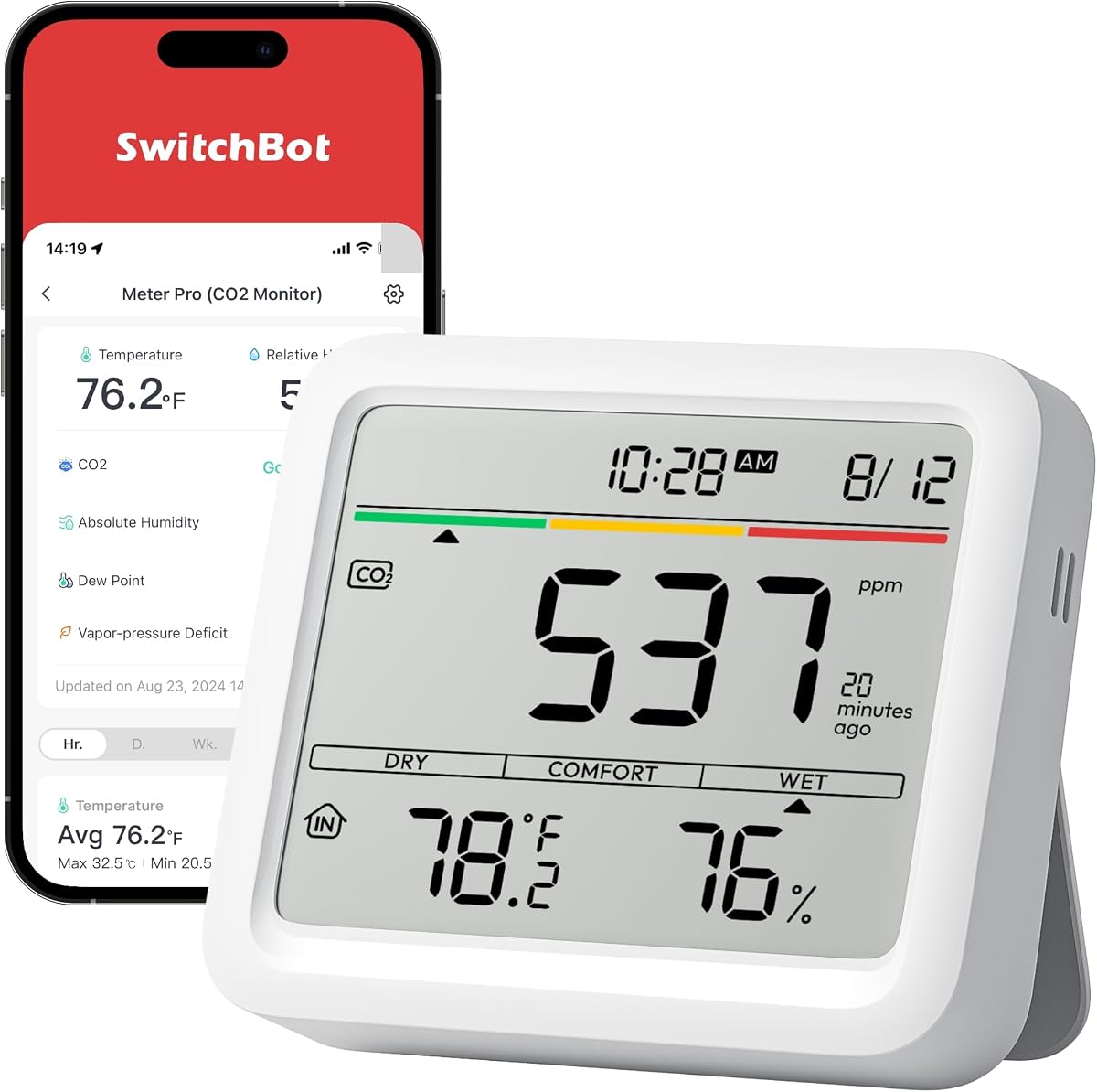
| SwitchBot Meter Pro CO2 | Best compact / long battery | NDIR | LCD, no backlight | Built-in, ~12 months | $59.49 |
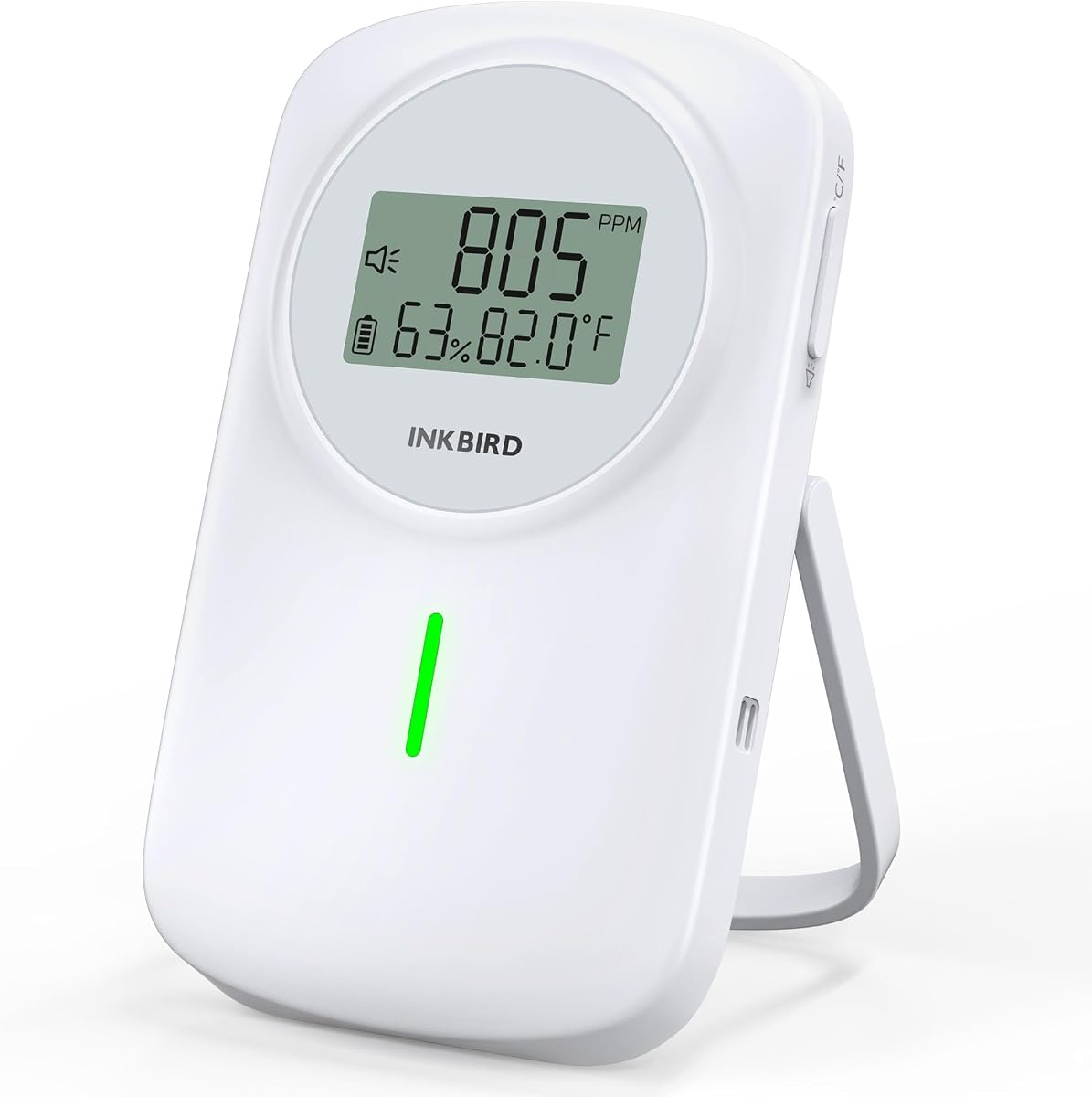
| INKBIRD IAM-O2 | Best budget | NDIR | Backlit LCD | Rechargeable, months | $46.74 |
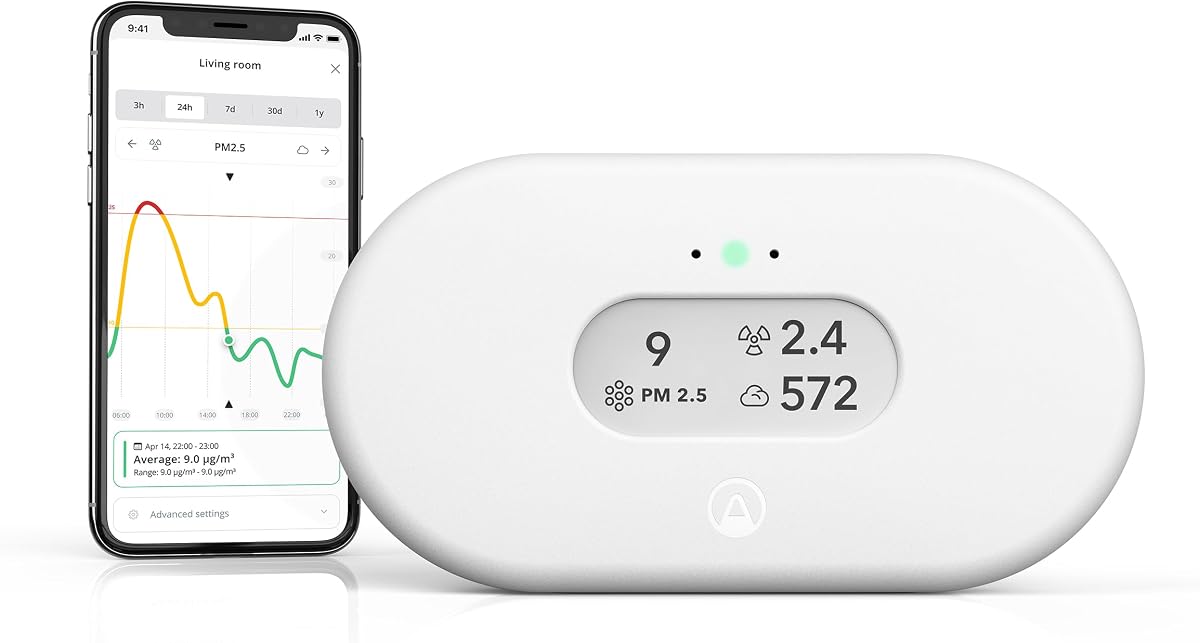
| Airthings View Plus | Most comprehensive | NDIR + radon + PM2.5 | Customizable e-ink | Battery + WiFi | $329.99 |
Why Bedroom CO2 Matters: Ventilation, Grogginess & Sleep Quality
Outdoor air runs around 420 parts per million (ppm) of CO2. A closed bedroom with one sleeping adult can climb past 1,000 ppm within a couple of hours; with two people or a shut door, 1,500 to 2,000 ppm by morning is common. That number matters because carbon dioxide isn’t just a proxy for “stale air” — at high enough concentrations indoors, it’s linked directly to worse sleep and worse thinking the next day.
A widely cited Harvard T.H. Chan School of Public Health study found that cognitive scores dropped meaningfully as CO2 rose from 600 to 1,000 ppm — a range plenty of closed bedrooms sail through every single night. Separately, ventilation researchers running field studies in real bedrooms found that a night spent averaging 1,000 ppm CO2 reduced sleep efficiency and increased time spent awake, compared with a night held closer to 750 ppm. Our own guide to how indoor air quality impacts sleep covers the broader picture — allergens, humidity, particulates — alongside this CO2-specific research.
ASHRAE, the industry body that writes ventilation standards, used to publish a flat 1,000 ppm indoor limit; that hard number was pulled from later editions because it got misread as a health threshold rather than a ventilation-adequacy marker. Current ASHRAE guidance instead targets indoor CO2 no more than roughly 700 ppm above whatever the outdoor air is running, which lands most homes in the neighborhood of 1,100 to 1,120 ppm as a practical ceiling. Either way you slice it, the takeaway for a bedroom is the same: under 1,000 ppm through the night is the goal, and much of the country’s housing stock quietly blows past that as soon as the door closes.
NDIR vs. eCO2: The Sensor Spec That Actually Matters for Accuracy
Not every “CO2 monitor” measures CO2 the same way, and the spec sheet rarely spells this out in plain English. NDIR — non-dispersive infrared — sensors shine an infrared light through a sample of air and measure exactly how much of it gets absorbed at the wavelength CO2 molecules absorb. That’s a direct physical measurement of actual CO2 molecules, and it’s the same underlying technology used in commercial building-control sensors.
eCO2 or “estimated CO2” sensors work differently: they measure a related gas (usually a mix of volatile organic compounds) and back-calculate a CO2 estimate from that reading using an algorithm. That estimate can drift substantially, and it can drift for reasons that have nothing to do with how stuffy the room actually is — a spritz of perfume, a scented candle, or even a cleaning product used earlier in the day can send an eCO2 reading climbing while the real carbon dioxide level hasn’t moved at all. That’s the opposite of what you want from a bedroom monitor meant to tell you when to open a window. Every pick in this guide uses a true NDIR sensor instead, since a bedroom is exactly the room where a false alarm — or worse, a false all-clear — matters most.
One more mix-up worth flagging directly: CO2 (carbon dioxide, the gas you exhale) is not CO (carbon monoxide, the gas produced by combustion that requires its own dedicated, UL-listed alarm). Several popular “smart air quality monitors” measure carbon monoxide, temperature, humidity, and particulates, but not CO2 at all — our review of the Amazon Smart Air Quality Monitor is a good example of a well-reviewed device built around a different set of sensors entirely. Read the spec list carefully before assuming a monitor tracks the gas you actually care about.
How to Choose a CO2 Monitor for Bedrooms
Once NDIR accuracy is a given, the decision that actually separates these six monitors is how they behave once the lights go off. A monitor with a bright, always-on numeric display is genuinely useful on a desk and genuinely annoying six inches from your face at 2 a.m. Look specifically at whether the screen dims, times out, or requires a deliberate touch or tap to light up — that single detail decides whether a monitor lives on your nightstand or gets banished to a hallway.
Power source matters more in a bedroom than anywhere else in the house. Battery-powered monitors can sit anywhere, including the far side of the bed away from an outlet, but you’ll eventually swap batteries. Plug-in monitors never run out of power but tie you to outlet placement and add a cable to a nightstand that’s usually already crowded with a lamp and a phone charger. Neither is wrong — it’s about what fits your actual room.
Footprint and noise round out the list. Every monitor here is silent in normal operation (no fans, no compressors), so “quiet” really means no audible alarm beeping you awake over a routine reading — check whether the buzzer/alarm is optional and adjustable before you buy, not after the first 2 a.m. false alarm. A monitor the size of a paperback novel dominates a small nightstand; the more compact picks in this guide fit around a lamp and a glass of water without a redesign.
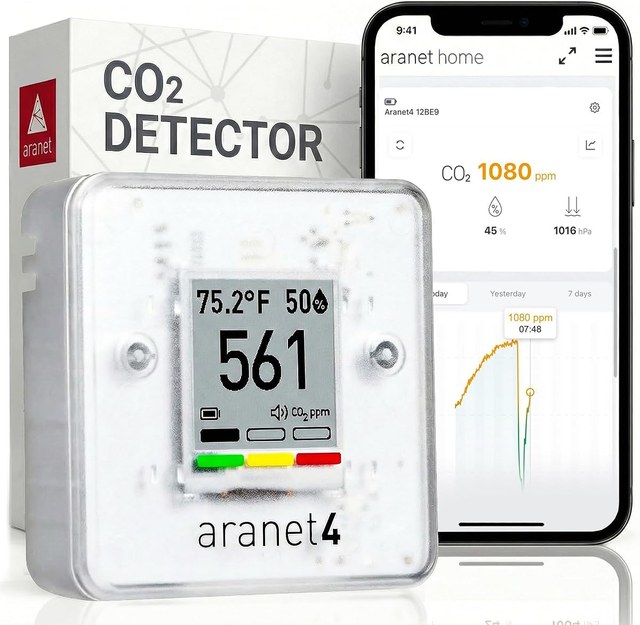
Aranet4 Home — Best Overall / Most Accurate
The Aranet4 Home is the CO2 monitor most frequently recommended by people who’ve actually tested several, and for a bedroom specifically it earns that reputation twice over. Its NDIR sensor is the same class used in commercial ventilation controls, and Amazon reviewers with years of side-by-side use report it staying within 10-40 ppm of reference-grade instruments after an initial calibration. The e-ink screen has no backlight at all — which sounds like a downside until you realize what it means for a bedroom: the display is genuinely, completely dark unless a light source is already in the room, so it never glows on its own overnight. You’ll need a phone flashlight or a lamp to check the exact number in the dark, but it will never wake you up by lighting itself. Two AA batteries last roughly four years.
It’s Bluetooth-only — no WiFi, no cloud account required — which some buyers prefer for privacy and others find limiting if they want remote monitoring while away. At $189.00 with 4.7 stars across 1,868 ratings, it’s priced like the category leader it is.
Pros
- True NDIR sensor, commercial-grade accuracy
- No backlight means zero glow overnight
- 4-year battery life on 2 AA cells
- 4.7 stars across 1,868 ratings
Cons
- Need a light source to read it in the dark
- Bluetooth only, no WiFi
- Premium price for a CO2-only device
Airthings Wave Enhance — Best Built for Sleep Tracking
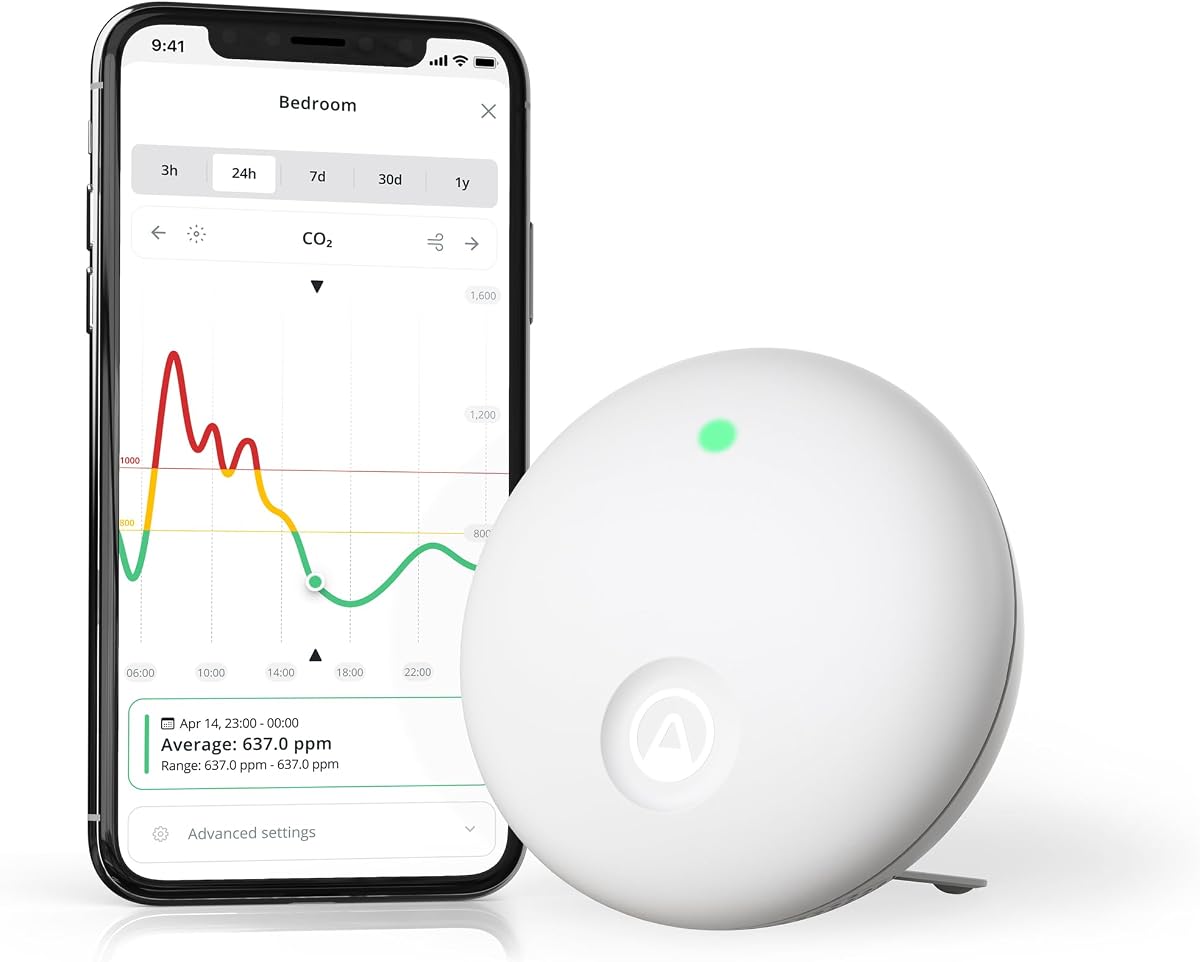
Most CO2 monitors get bedroom-friendly features as an afterthought. The Wave Enhance was designed around the bedroom brief directly: alongside its NDIR CO2 sensor, it also tracks ambient noise and light levels, so the app can show you not just CO2 but the two other environmental factors most likely to be wrecking a night’s sleep. There’s no always-on numeric display at all — instead, you tap the unit and a color-coded light briefly glows to show air quality at a glance, then goes dark again. That makes it, along with the Aranet4, one of the two genuinely lights-out options in this guide; the tradeoff is that getting an exact ppm number means opening the app rather than glancing at a screen.
Setup takes minutes over Bluetooth, and it runs on two AA batteries. At $134.43 with 4.2 stars across a smaller 43-rating sample, it’s a newer entrant than the Aranet4 with less of a track record, but the sleep-specific sensor combination is genuinely differentiated.
Pros
- NDIR CO2 sensor plus noise & light tracking
- Touch-to-glow display, dark otherwise
- Purpose-built for bedroom/sleep use cases
- Battery powered, no cables
Cons
- No numeric display; need the app for an exact ppm
- Smaller review sample (43 ratings)
- No WiFi/remote monitoring
GoveeLife H5140 — Best for Light Sleepers
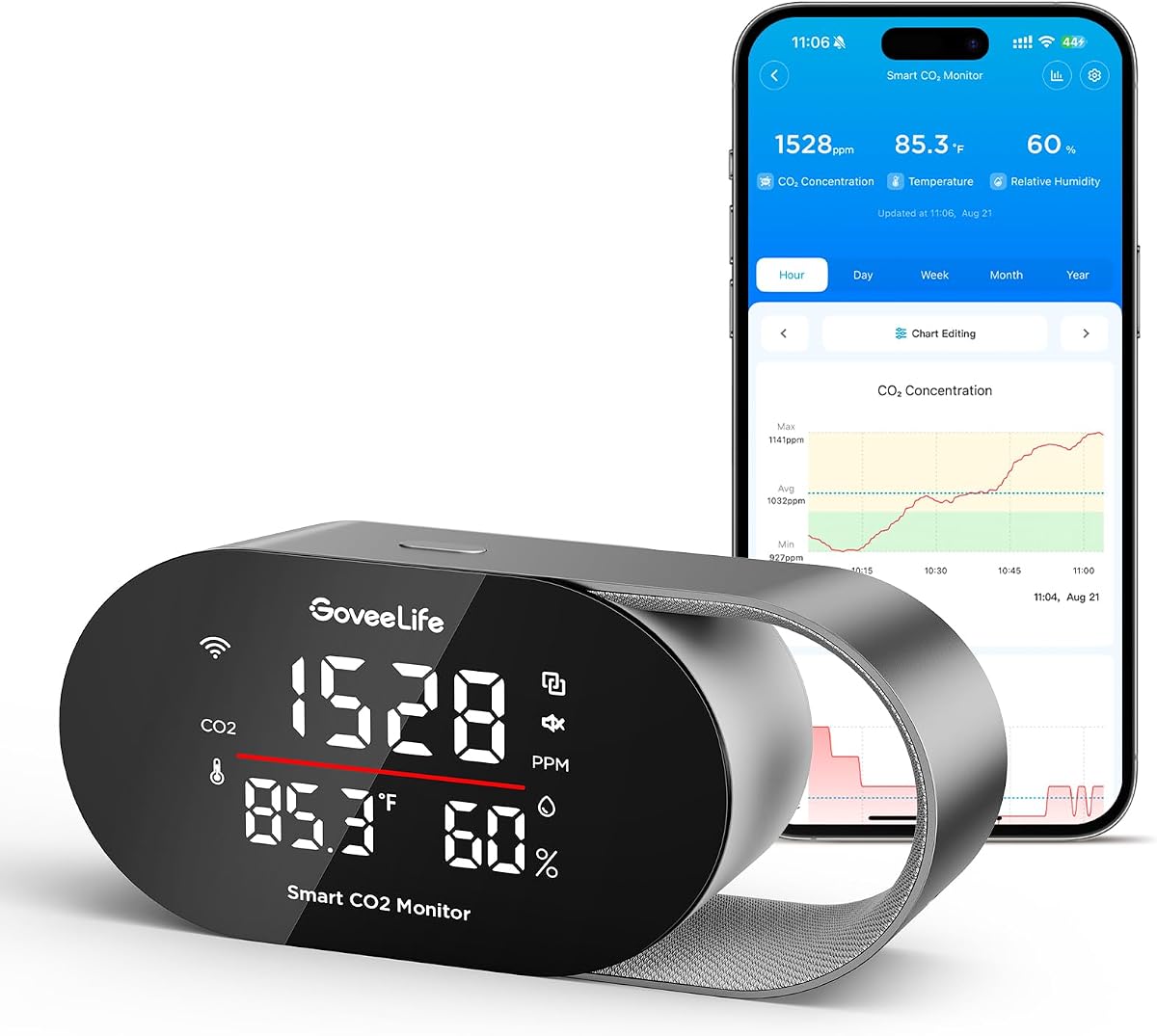
The GoveeLife H5140 solves the “glowing gadget” problem more directly than anything else in this guide. Its display and tri-color light bar are fully programmable on a day/night schedule through the app, so you can have a bright, easy-to-read screen during the day and a dark, non-disruptive display overnight. Inside is a genuine SCD4x NDIR sensor — the same photoacoustic NDIR principle used in lab-grade equipment — rated to ±(40ppm + 5%).
Unlike every other pick here, it has no internal battery — it’s AC-powered via an included USB-C cable, which means continuous 24/7 monitoring with nothing to recharge, but also means it has to live within cable reach of an outlet rather than sitting anywhere on the nightstand you like. At $89.99 (frequently discounted with an on-page coupon) and 4.4 stars across 229 ratings, it’s the strongest pick specifically for anyone sharing a bed with someone sensitive to light.
Pros
- Auto-dimming display on a day/night schedule
- Real NDIR (SCD4x) sensor, ±(40ppm+5%)
- Never needs recharging, always-on power
- Clock, CO2, temp & humidity in one glance
Cons
- No battery; must stay near an outlet
- WiFi setup can be fiddly per reviews
- No radon or particulate sensing
SwitchBot Meter Pro CO2 — Best Compact Pick with Long Battery Life
If your nightstand is already crowded, the SwitchBot Meter Pro CO2 is built to disappear into it. At roughly 3.6 x 3.6 x 1 inches, it’s smaller than every other pick here, and its Swiss-made NDIR sensor samples CO2 once a second with a claimed accuracy of ±50 ppm. A single charge is rated for around 12 months of use — the longest runtime of any rechargeable pick in this guide.
Full app notifications and remote alerts need the optional SwitchBot Hub, so out of the box it functions as a standalone display rather than a connected device. At $59.49 with 4.3 stars across 321 ratings, it’s a strong value for anyone who wants a real NDIR sensor without paying for app polish they won’t use.
Pros
- NDIR sensor under $60
- ~12-month battery life
- Compact footprint for crowded nightstands
- Wall-mountable
Cons
- Full app alerts need optional Hub
- Smaller screen than pricier picks
- No radon or PM2.5 sensing
INKBIRD IAM-O2 — Best Budget Pick
The INKBIRD IAM-O2 is the cheapest way into this guide without giving up a real NDIR sensor. Its Swedish-made sensor measures CO2 from 0-9,999 ppm, and the backlit LCD makes it easy to read even with the room lights off. Reviewers report a few months of runtime per charge on its internal battery, and the whole unit can sit flat on a nightstand or hang on a wall.
The one bedroom-specific quirk worth knowing: its status indicator light runs noticeably bright for a dark room, and more than one owner review mentions covering it with a bit of tape rather than living with the glow. At $46.74 with 4.4 stars across 65 ratings, it’s still the best real-NDIR value in this lineup.
Pros
- Cheapest true NDIR sensor in this guide
- Backlit LCD, readable in the dark
- Rechargeable battery lasts months
- 4.4 stars across 65 ratings
Cons
- Status LED runs bright for a dark room
- No long-term app history
- Smaller brand review base
Airthings View Plus — Most Comprehensive
If you want one device covering the full picture — CO2, radon, PM2.5, and VOCs — the Airthings View Plus is the only monitor in this guide that does all four with an NDIR CO2 sensor. It’s built for whole-home awareness as much as bedroom-specific use, with a customizable e-ink display and WiFi connectivity that reports directly to the Airthings app without requiring your phone to be nearby. No app or account is needed to read the basics straight off the display.
That breadth comes at a price: $329.99 is nearly double the next-most-expensive pick here, and 4.0 stars across 1,962 ratings reflects a mixed-but-large review base. For a bedroom that also doubles as a nursery, a guest room over an older basement, or simply a household that wants radon coverage without buying a second device, the added sensors justify the cost.
Pros
- NDIR CO2 plus radon, PM2.5 & VOC sensing
- Customizable e-ink display
- WiFi reporting to the Airthings app
- Covers a whole home, not just one room
Cons
- Priciest pick in this guide by far
- 4.0-star average across a large sample
- Overkill if you only care about CO2
What to Actually Do When Your Bedroom CO2 Reads High
A CO2 monitor is only useful if it changes your behavior. Under 800 ppm, don’t worry about it. Between 800 and 1,000 ppm, it’s worth cracking a window or door before bed. Above 1,000 ppm consistently, treat it as a ventilation problem, not a one-off: either the room is too sealed, too small for how many people sleep in it, or the HVAC isn’t cycling enough outdoor air through it overnight.
Opening a window is the simplest fix, but it isn’t always available — wildfire smoke season, winter cold, or street noise can all rule it out. On those nights, a bedroom’s cooling and air handling system does double duty: a window air conditioner with a fresh-air vent option or a mini-split system can help move air even with the window shut, though neither one actively lowers CO2 the way outdoor air exchange does. If outdoor air quality itself is the reason you’re keeping windows shut, our guide to air purifiers for wildfire smoke covers the tradeoff between filtering particulates and needing fresh-air ventilation for CO2 specifically — a purifier alone won’t touch a CO2 reading, since it filters particles, not gas exchange.
Humidity control matters here too. A stuffy, high-CO2 bedroom is very often also a humid one, especially in tighter, less-ventilated homes; our dehumidifiers for damp homes guide covers pulling moisture out of a room that also needs better air exchange. And if you’re testing a bedroom’s air seriously for the first time, it’s worth checking whether the home has ever been tested for radon — our radon testing guide explains why that’s a separate, EPA-tracked gas a CO2 monitor won’t catch, and our broader home air quality testing overview walks through where CO2 fits into a full testing plan.
FAQ
What is a good CO2 level for a bedroom?
Under 1,000 ppm through the night, ideally closer to 800 ppm. Outdoor air runs around 420 ppm, so anything consistently above 1,000 ppm in a closed bedroom points to a real ventilation gap.
Can high CO2 in my bedroom actually affect my sleep?
Yes. Field studies on real bedrooms have found that nights averaging around 1,000 ppm CO2 show measurably reduced sleep efficiency and more time spent awake compared to nights closer to 750 ppm, independent of noise or temperature.
What’s the difference between a CO2 monitor and a general air quality monitor?
A dedicated CO2 monitor focuses its sensor budget on one accurate NDIR reading. A general air quality monitor often spreads sensors across PM2.5, VOCs, humidity, and sometimes CO2, which is useful for a whole-home picture but can mean a less precise CO2 reading than a purpose-built device.
Do I need an NDIR sensor, or is a cheaper eCO2 monitor good enough?
For a bedroom, get NDIR. It’s a direct physical measurement of CO2 rather than an estimate from other gases, and every monitor in this guide uses one.
Where should I place a CO2 monitor in my bedroom?
On a nightstand or shelf at roughly head height when lying down, a few feet from the bed and away from a direct window draft or an open door, which can both skew readings toward outdoor air.
Will a CO2 monitor’s display keep me awake at night?
Not if you choose one built for it. Look for a screen that dims automatically, times out, or requires a touch to light up rather than staying on and bright all night.
Bottom Line
Bedroom CO2 monitoring comes down to two things most spec sheets bury: sensor type and nighttime display behavior. The Aranet4 Home gets both right and remains the safest overall pick. The Airthings Wave Enhance is the one purpose-built around sleep specifically, the GoveeLife H5140 is best if you share a bed with someone sensitive to light, and the SwitchBot Meter Pro CO2 and INKBIRD IAM-O2 both prove you don’t need to spend $150+ for a real NDIR reading. The Airthings View Plus is there if your bedroom air questions go beyond CO2 alone.
Editorial note: Prices, review counts, and availability change after publication — confirm the current listing before buying.