
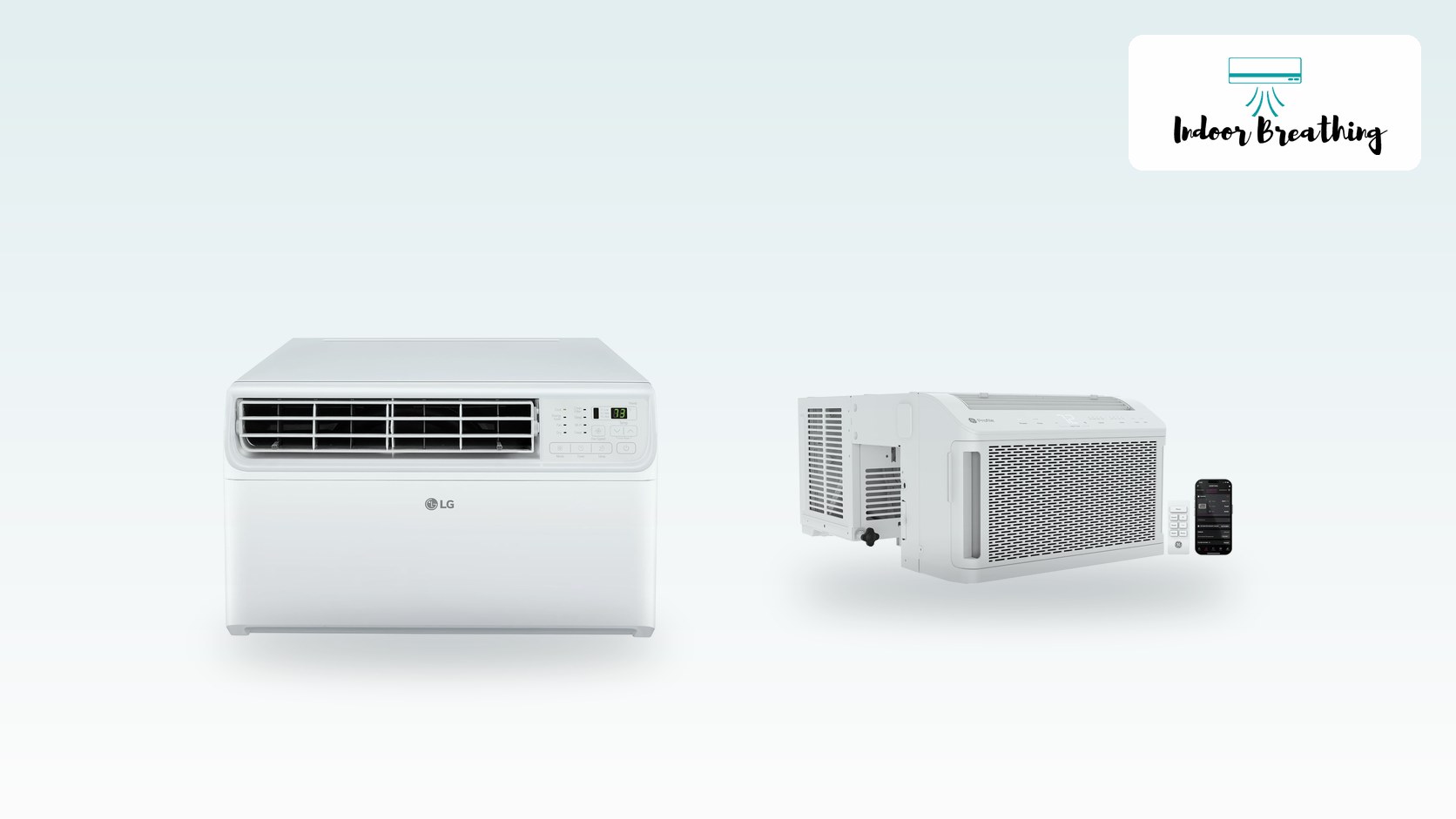
To choose a window air conditioner, size it using square footage plus real adjustments for sun exposure, ceiling height, and how many people use the room — not just a flat 20 BTU per square foot. Then check the decibel rating at the fan speed you’ll actually run it on, not the lowest one on the spec sheet. The overall pick is the LG LW1022FVSM 10,000 BTU.
Every spec below is checked against the manufacturer’s listing, DOE guidance on room air conditioner sizing, and buyer reviews. No in-house lab testing is involved. Prices and ratings were last checked in September 2026 and can change, so confirm the live price on Amazon before you buy.
A window air conditioner that’s rated for your square footage can still keep you up at night, and one that’s whisper-quiet on the spec sheet can turn into a rattling nuisance once it’s screwed into a slightly warped window frame. Those are two separate problems, and most buying guides flatten them into one BTU number and call it done.
This guide is built around the two things that actually decide whether you’re happy with a window AC three weeks in: whether it’s sized to your real room — not just square footage, but sun, ceiling height, and occupancy — and how loud it is once it’s working to cool that room, not sitting on its lowest fan speed in a lab. Energy cost matters too, and it is covered below, but here it’s the third factor, not the first.
If cutting your power bill is the main goal rather than fitting a specific room, our efficiency-focused guide to the best window air conditioners for energy savings covers CEER ratings and inverter compressors in more depth. And if you’re still deciding between a window unit, a portable air conditioner, a mini-split, or just a fan that cools like an AC, those guides cover when each format makes more sense than a window box.
Affiliate disclosure: IndoorBreathing may earn a commission when you buy through links on this page, at no extra cost to you. Picks are chosen for verified sizing accuracy, documented noise levels, and value, not commission rate.
Table of Contents
Window Air Conditioner Sizing: The BTU Chart Most Guides Get Wrong
The standard baseline is about 20 BTU per square foot. A 300-square-foot bedroom wants roughly 6,000 BTU; a 450-square-foot living room wants about 9,000. That’s a fine starting point, and it’s also where most window air conditioner sizing charts stop — which is the problem, since it’s only a starting point.
Adjust for the room you actually have. Add 10 percent for strong, unshaded afternoon sun; subtract 10 percent for heavy shade. Add roughly 10 percent per 2 feet of ceiling height above the standard 8 feet, since you’re cooling a volume of air, not a floor plan. Add 4,000 BTU flat for a kitchen, and about 600 BTU per person who regularly spends time in the room beyond the first two.
Example: a 350-square-foot living room with a 10-foot ceiling, a west-facing window, and three regular occupants needs roughly 9,000 BTU once those adjustments stack on the 7,000 BTU baseline — a full size class above the flat chart’s answer. When your number lands between two sizes, size up: an undersized unit never catches up on the hottest day of the year.
Manufacturer room-size ratings, like the ones in the table below, already assume decent insulation and a standard ceiling — treat them as a ceiling, not a floor, once you’ve run your own adjustments. Our BTU calculator and AC sizing guide walk through the same math for any room.
Looking ahead, window units are getting quieter and smarter. Inverter compressors, which speed up and slow down instead of switching on and off, are moving from premium models into mid-priced ones, and noise and power use fall with them. The catch is a higher price up front, with the savings showing up over a few summers.
The Truth About Window AC Noise Ratings
Decibels are logarithmic, not linear, and that trips people up constantly. A jump of 10 dB sounds roughly twice as loud to the human ear, so a unit rated 50 dB doesn’t sound 25 percent louder than one rated 40 dB — it sounds about twice as loud.
The bigger issue is which fan speed that number describes. LG’s own listing for the LW1022FVSM states its 44 dB rating is measured in “sleep mode,” the lowest setting, not the speed you’d actually use to cool a warm room. That’s typical of the category, not a knock on LG: almost every spec sheet quotes its best-case number. Run the same unit on medium or high, and the real number is often 6–10 dB higher — which, per the doubling rule above, can sound meaningfully louder than the box implies.
Fan noise is only half the story. An inverter compressor runs continuously at a low, steady level instead of cycling loudly on and off, trading periodic bursts for a constant low-frequency hum. Some sleepers tune that out easily; others notice a steady hum more than a cycling one. Test a unit for a few nights, if returns are allowed, before deciding it’s a keeper. Even the paperwork disagrees sometimes — see the ROVSUN listing below, where the spec field and the marketing copy quote two different dB numbers for the same unit.
Best Window Air Conditioners: Comparison
BTU and the manufacturer’s room-size rating set the space this unit fits. Noise is the lowest fan-speed figure from each listing — read the section above before assuming that’s what you’ll hear day to day. Prices and review counts are current and will move.
*ROVSUN’s spec sheet lists 48 dB; its own product description claims 42 dB in sleep mode. See the noise section above.
LG LW1022FVSM 10,000 BTU — Best Overall
For a bedroom or living room up to about 450 square feet, the LG LW1022FVSM is the pick for most people. It pairs a dual-inverter compressor with a brushless DC fan motor, and LG’s room-size rating lines up with real 400–450 square foot rooms rather than an optimistic number. At 4.1 stars across 209 ratings, it’s well-reviewed without the mixed baggage competitors here carry — our older LG LW1016ER review shows how far this lineup has come.
The 44 dB figure is explicitly a sleep-mode number on LG’s listing — expect low-50s dB on medium. It’s a fixed-chassis flush-mount unit for a double-hung window 22–36 inches wide, with the ThinQ app, Alexa and Google, and a washable filter. At 63 pounds, plan on a two-person lift.
Pros
- Room-size rating matches real-world results
- Dual-inverter, steady temperature
- 4.1 stars across 209 ratings
- ThinQ app, Alexa and Google
- Washable filter
Cons
- 44 dB is sleep mode, not real running noise
- 63 lbs, two-person install
- Fixed chassis, double-hung windows only
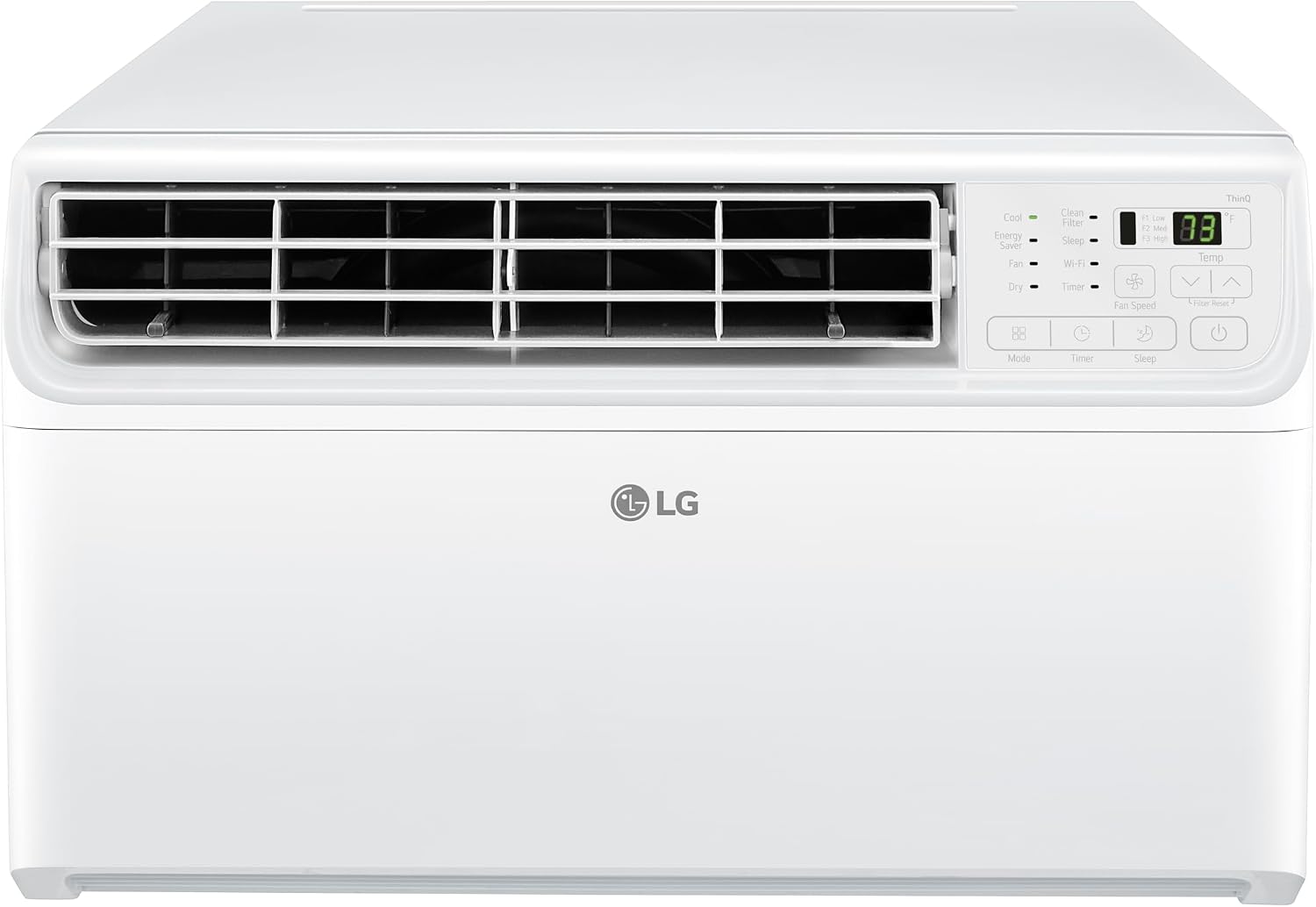
Verdict: the most reliably-sized, well-reviewed all-rounder here — the noise is honest for the category, not class-leading.
Midea U 8,000 BTU — Quietest
Nothing else here touches the Midea U for raw quiet. Its saddle shape wraps around the window sash with the compressor outside and the cold half inside, so the noisiest part sits physically on the other side of the glass. Midea rates it at 32 dB, and at 4.4 stars across 299 ratings for the current 2026 run, owners back that up.
One thing worth knowing: Midea recalled about 1.7 million U and U+ window units in June 2025, sold under the Midea, Frigidaire, Insignia, Keystone, and other store brands, after reports that pooled condensate could drain too slowly and grow mold. The fix was a redesigned drain plug and bubble level, and current 2026-production units, including the listing linked here, ship with the corrected part. Owners of an older unit bought before mid-2025 should check CPSC.gov for the free repair kit — and on any unit, get the level right (see the installation section below), which is exactly what the recall was about.
Pros
- 32 dB, the quietest unit here
- Compressor sits outside the window
- 4.4 stars across 299 ratings
- Window still opens above the unit
- Wi-Fi, Alexa and Google
Cons
- Subject to a 2025 mold recall (fixed in 2026 stock)
- Bracket install takes real effort
- No fit for casement or narrow windows
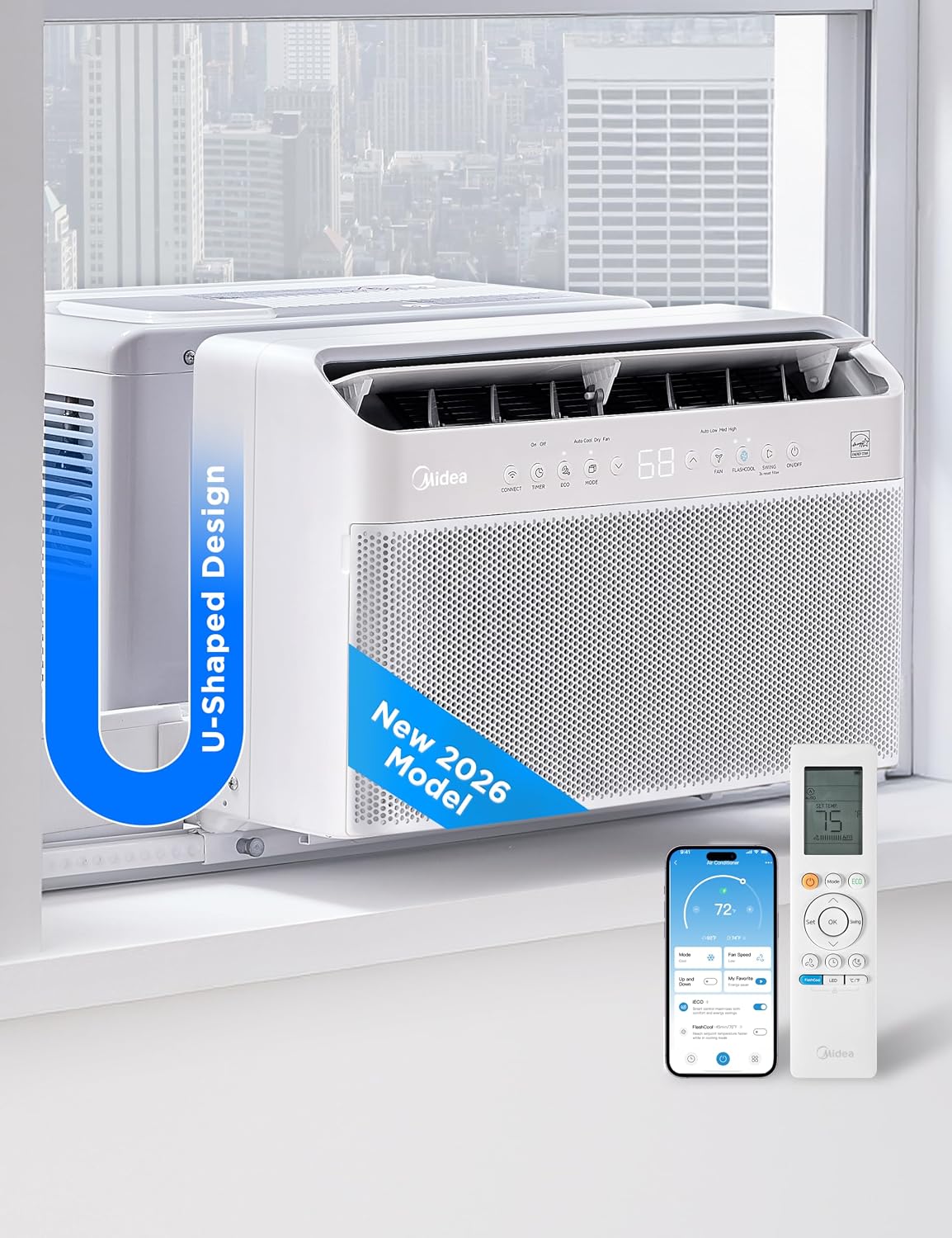
Verdict: the quietest window AC you can buy, if your window fits it and you level the install properly.
Frigidaire 5,000 BTU — Best for a Small Room or Budget
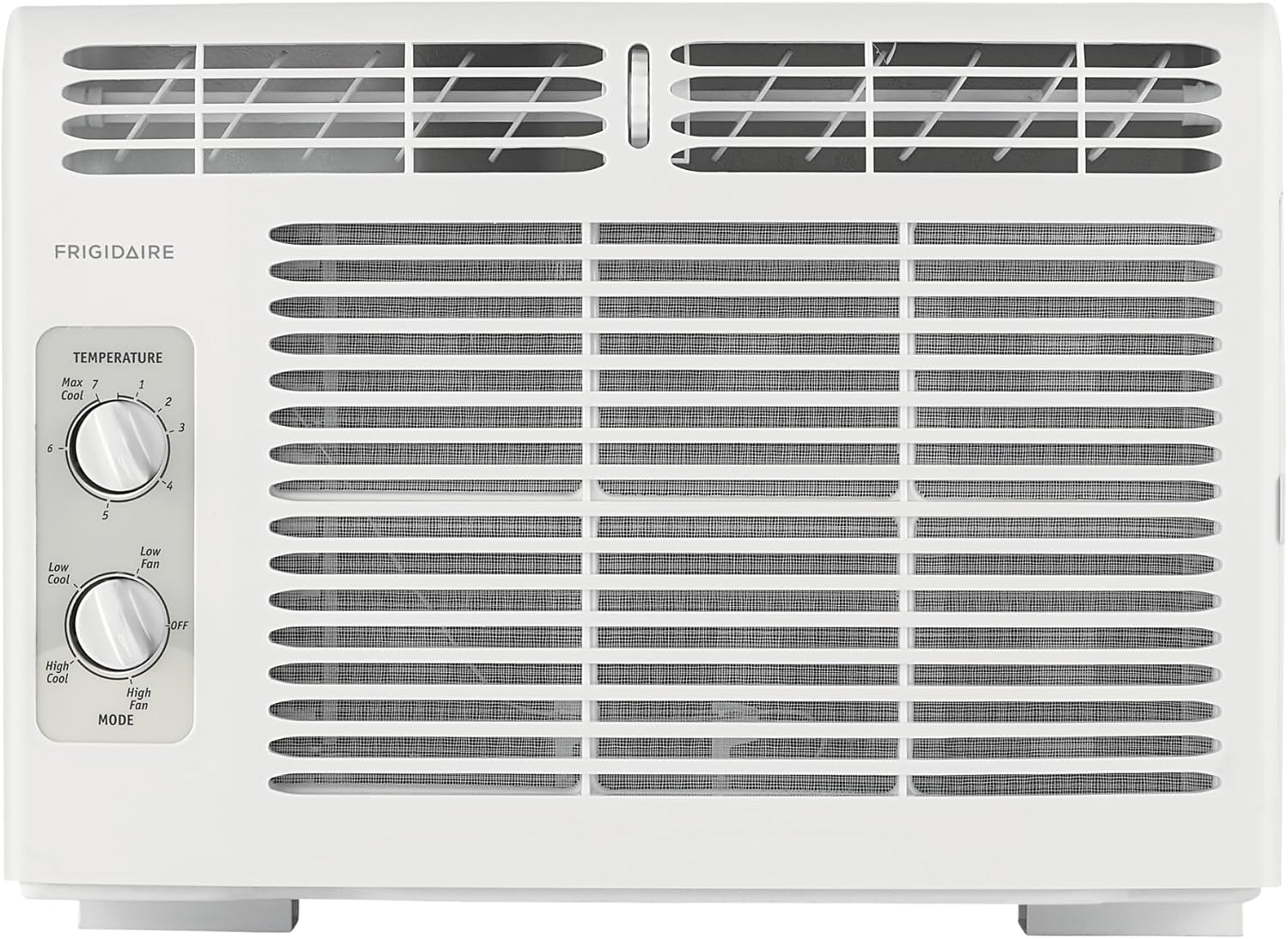
For a room up to about 150 square feet — a small bedroom, nursery, or home office — the Frigidaire 5,000 BTU is the cheapest unit here worth buying, backed by an enormous review count: 4.3 stars across 17,646 ratings. It’s a basic mechanical-dial unit with two fan speeds, a washable filter, and auto restart — no app or smart features.
Be honest about the noise: at 52 dB it’s louder than every inverter unit here, and with no low-noise inverter mode, that figure is close to what you’ll hear whenever it runs, not a best-case sleep number. A light sleeper in a small room may find the Midea U worth the extra cost instead.
Pros
- Cheapest unit here at $169
- 4.3 stars across 17,646 ratings
- Simple mechanical controls
- Washable filter, auto restart
Cons
- 52 dB, no low-noise inverter mode
- No app or voice control
- Only 2 fan speeds
Verdict: the right call for a small room on a tight budget, as long as you don’t need it whisper-quiet.
ROVSUN 8,000 BTU WiFi — Best Value with Smart Features
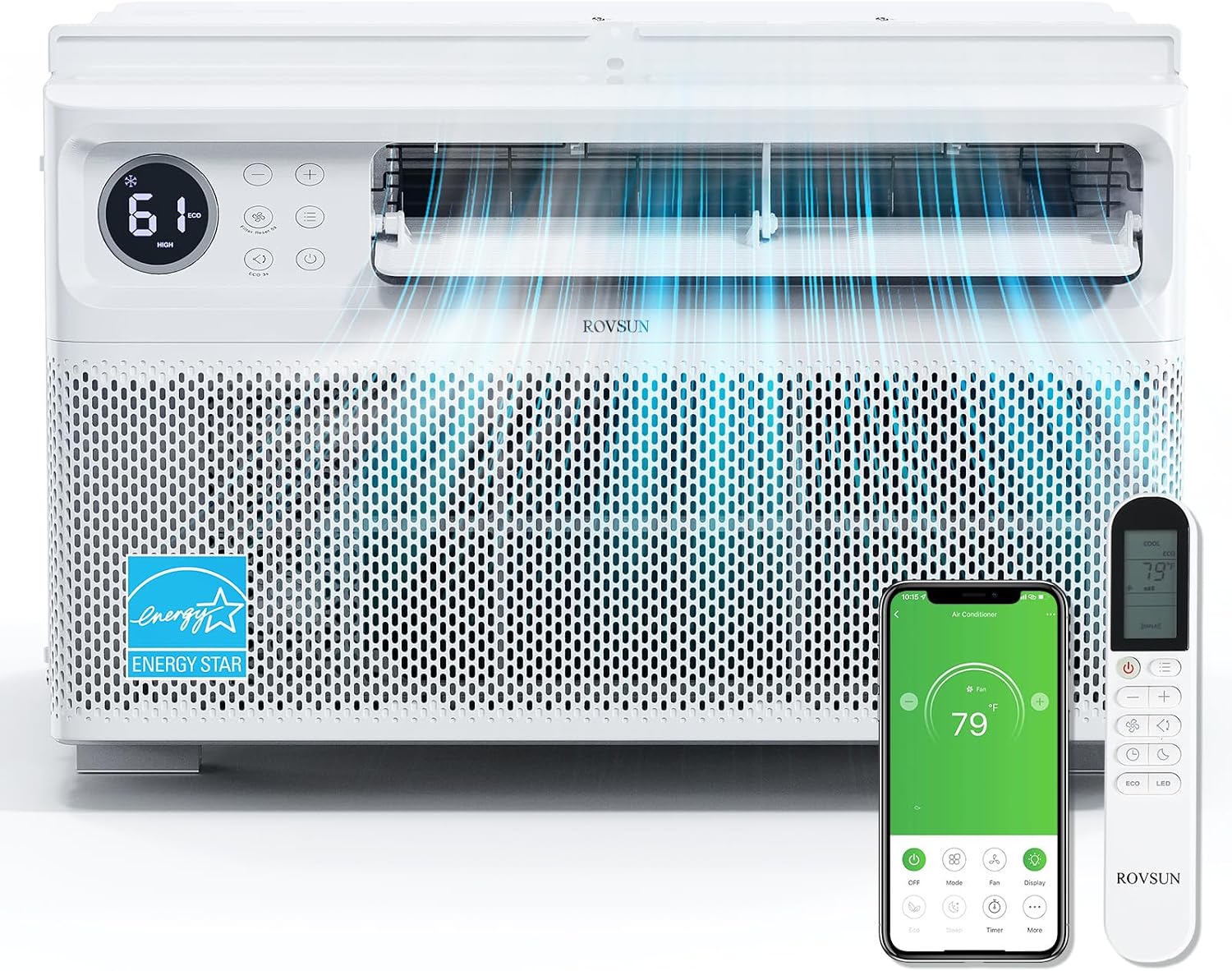
The ROVSUN 8,000 BTU undercuts the Midea U by more than $100 while still offering an inverter compressor, Wi-Fi and app control, and a 350-square-foot room rating. Its review base is smaller (61 ratings) than the bigger brands here, but 4.4 stars and a genuine Amazon’s Choice badge aren’t nothing.
Pay attention to the noise figures: Amazon’s structured spec field says 48 dB, while ROVSUN’s own bullet copy claims “42dBA in sleep mode.” Plan around the higher, spec-sheet number rather than the marketing claim.
Pros
- Over $100 cheaper than the Midea U
- Inverter compressor, Wi-Fi and app
- 4.4 stars, Amazon’s Choice
- 350 sq ft room-size rating
Cons
- Spec sheet and listing copy disagree on dB
- Smaller review sample (61 ratings)
- Newer brand, shorter track record
Verdict: strong value if you plan around the 48 dB number, not the more optimistic 42 dB marketing claim.
GE Profile ClearView 10,300 BTU — Full Window View
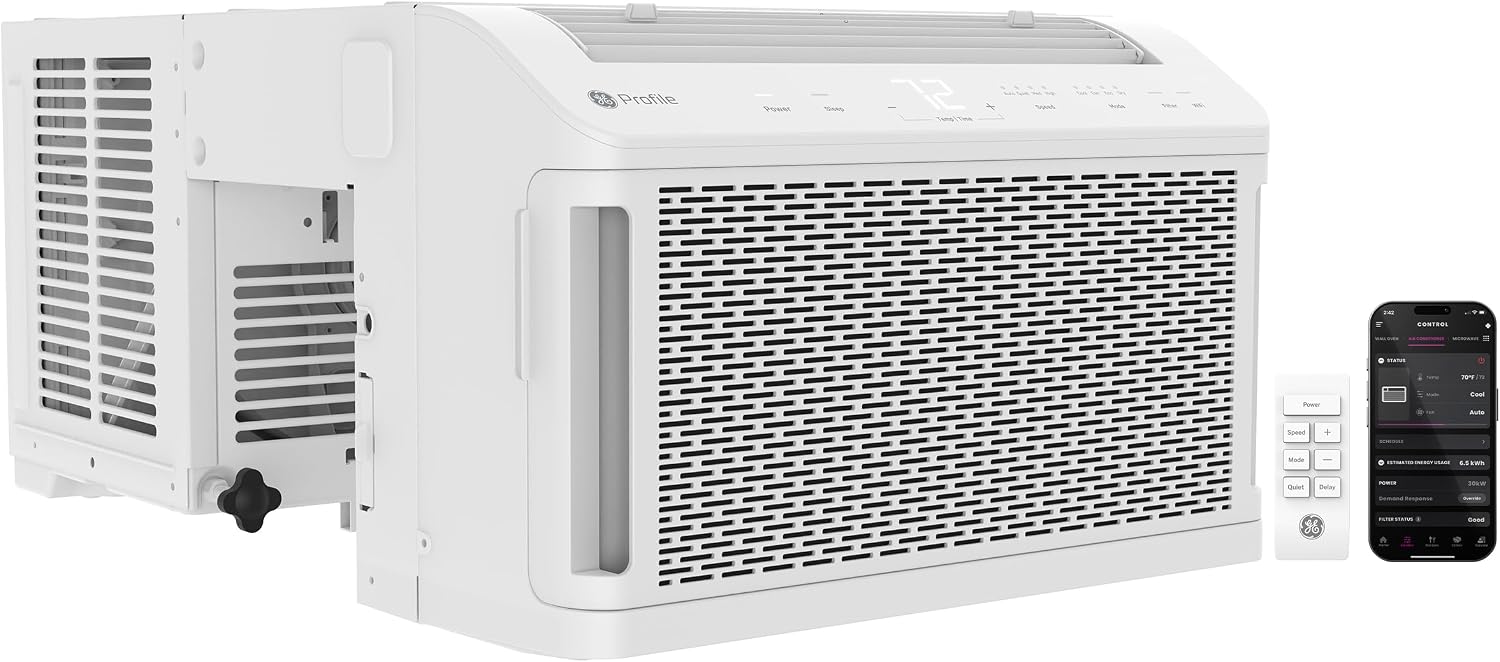
The GE Profile ClearView uses the same saddle-style approach as the Midea U — the window still opens above the unit — but GE’s flex-depth design adjusts to fit walls from 4.5 to nearly 14 inches thick, which the fixed-length Midea U can’t do. GE states a 40 dB rating and backs its “Quietest Window AC Brand” claim with an inverter compressor built to minimize vibration into the sash.
The reviews need a plain look: at 3.5 stars across 467 ratings, this is the most mixed record on this list, with recurring complaints about installation difficulty. The spec sheet is genuinely good; ownership experience is less consistent than the Midea U’s. Worth it if the flex-depth fit solves a real problem, skip it if you want the safest bet.
Pros
- Flex-depth fits walls 4.5″–13.75″
- 40 dB, real inverter quiet design
- Full window view preserved
- WiFi, SmartHQ app
Cons
- 3.5 stars, mixed install reviews
- Pricier than the Midea U
- Least consistent ownership record here
Verdict: a real engineering answer to thick walls, but read the reviews before you commit.
Midea 14,000 BTU — Best for a Large Room
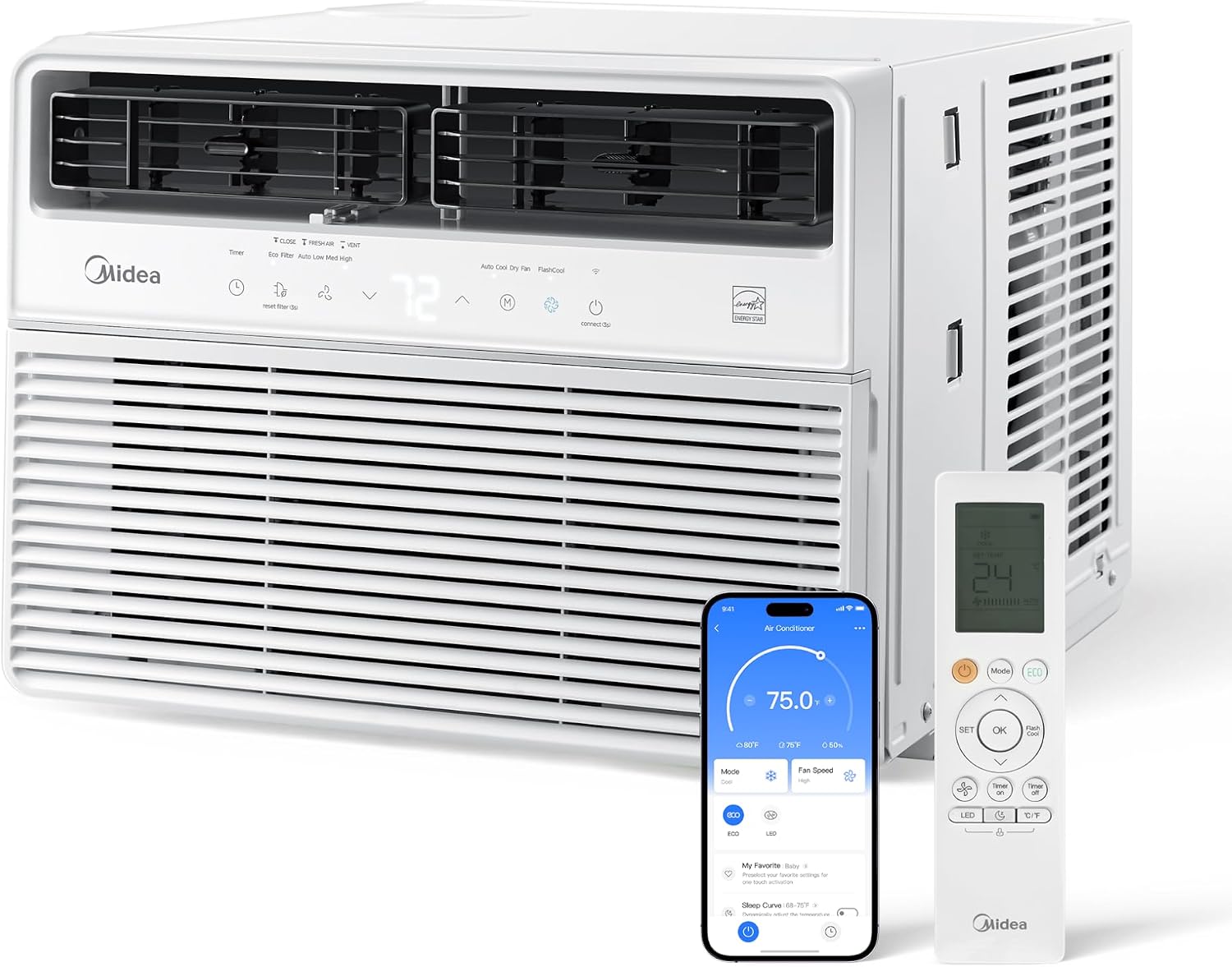
Most 12,000-BTU-and-up window units need a dedicated 230-volt circuit, ruling them out for anyone who can’t run new wiring to a window. The Midea 14,000 BTU is the exception: it runs on a standard 115-volt outlet and still covers up to 700 square feet, one of the few realistic single-unit answers for a great room or finished attic without an electrician visit. Our 12,000 BTU roundup covers the size class just below this one, across window and portable formats.
Midea states a 41 dB rating with the inverter compressor, and at 4.0 stars across 138 ratings it’s solidly reviewed. Bigger units work harder, so treat 41 dB like every figure here — best-case, not what a 700-square-foot room’s fan speed sounds like. Unsure an outlet can handle the draw? A basic HVAC multimeter confirms the amperage first.
Pros
- Covers up to 700 sq ft
- Runs on a standard 115V outlet
- Inverter compressor, 41 dB rated
- 4.0 stars across 138 ratings
Cons
- Large, heavy unit to lift and mount
- 41 dB is best-case, not full-load
- Priciest unit in this guide
Verdict: the large-room pick that doesn’t require an electrician, as long as you can lift it into place.
Installation Noise: The Rattle Isn’t Always the AC’s Fault
Some noise complaints have nothing to do with the compressor. A loose mounting screw vibrating against a metal frame, or side panels resting against the sash instead of screwed down, can turn a genuinely quiet unit into an annoying one. Thermal cycling loosens screws over the first few weeks, so check them once after break-in, not just on install day.
Level matters for more than comfort: every window AC needs a slight outward tilt, about a quarter inch, so condensate drains away from the room instead of pooling inside. An unlevel install is both a rattle risk and, as the Midea U’s 2025 recall showed, a real mold risk. Screw the accordion side panels to the sash rather than letting them rest under their own tension — a panel that’s just resting will buzz in a breeze; a secured one won’t.
If the window faces afternoon sun, an exterior awning or a light-blocking shade above the unit reduces how hard the compressor works, cutting both noise and energy cost. A few dollars of foam pipe insulation at any metal-to-metal contact point stops a surprising amount of buzz owners blame on the unit itself.
The risk to watch is buying too big in a panic. A unit that is too large cools fast, shuts off early and leaves the room cold and damp. Expect price jumps and thin stock in heat waves, and do not let a rushed purchase override the sizing chart above.
What These Units Cost to Run
Sizing and noise are the focus here, but cost is part of the decision. An 8,000 BTU inverter unit like the Midea U or ROVSUN, run about eight hours a day, averages roughly 90–100 kWh a month, or about $15–$17 at the U.S. average rate near 17 cents per kWh. The non-inverter Frigidaire 5,000 BTU costs less per month in raw dollars on the same schedule simply because it’s smaller, even though it’s less efficient per BTU — size moves the bill more than efficiency rating does. For CEER ratings and exactly how much an efficient unit saves over an inefficient one the same size, our window air conditioner energy savings guide covers that math in full. The short version: get the BTU size right first — an oversized unit wastes more money short-cycling than an inefficient but correctly-sized one ever will.
FAQ
How many decibels is a quiet window air conditioner?
At or below about 42 dB on the lowest fan speed counts as quiet for this category; the Midea U’s 32 dB is close to the best available. That figure is almost always the lowest speed, not what you’ll run on a hot afternoon, which is typically 6–10 dB louder.
Why is your window AC louder than the noise rating on the box?
Because the rating is almost always measured on the lowest fan speed, and most rooms need medium or high to actually cool down. Loose mounting, an unlevel install, or side panels resting instead of screwed down can add rattle and vibration that has nothing to do with the compressor rating.
Does a bigger BTU window AC cool a room faster?
Only up to the point where it matches the room’s real load. An oversized unit cools the air fast, shuts off before it removes much humidity, and short-cycles, wasting energy and leaving the room feeling clammy. A correctly sized unit runs longer, gentler cycles instead.
Can you fix a noisy window air conditioner without buying a new one?
Often, yes. Check that mounting screws are tight, that side panels are screwed to the sash rather than resting, and that the unit tilts slightly outward for drainage. Foam pipe insulation at any metal-to-metal contact point fixes a lot of buzz that has nothing to do with the compressor.
Is a U-shaped window air conditioner actually quieter?
Yes, measurably. Putting the compressor outside the glass instead of inside the room is a real physical noise reduction — it’s why the Midea U rates 32 dB against the low-40s most box-style inverter units manage. The tradeoff is a more involved bracket install and fewer window sizes it fits.
How is this guide different from your window AC energy savings guide?
That guide ranks by CEER and inverter efficiency — which unit saves the most on your power bill. This one ranks by BTU sizing accuracy and real-world noise — which unit fits your room and won’t keep you up. The picks and reasoning differ, even where the products overlap.
Related Guides
Keep going with the window AC basics.
What happens next: efficiency rules keep tightening and refrigerants are changing, which may nudge prices up over the next few years. If your window unit is old and loud, a new one will earn back part of its cost on the power bill. Buy in spring, not in the first heat wave.
Bottom Line
Get the BTU size right first, using your room’s real load, not just its square footage, then check the noise rating at a fan speed you’d actually use, not the lowest one on the box. For most rooms, the LG LW1022FVSM 10,000 BTU gets both right without a premium price tag. If quiet is the priority above all else, the Midea U 8,000 BTU is the quietest window AC sold today, now that current production ships with the recall fix. For a small room on a budget or a large room on a standard outlet, the Frigidaire 5,000 BTU and Midea 14,000 BTU cover the ends of that range. Whatever you buy, level the install and screw down the side panels — the cheapest noise fix in this guide.
Check the LG LW1022FVSM on Amazon
Editorial note: Prices, ratings, and availability change after publication — confirm the current listing before buying. Anyone with a Midea U or U+ window AC bought before mid-2025 should check CPSC.gov for the 2025 recall.