
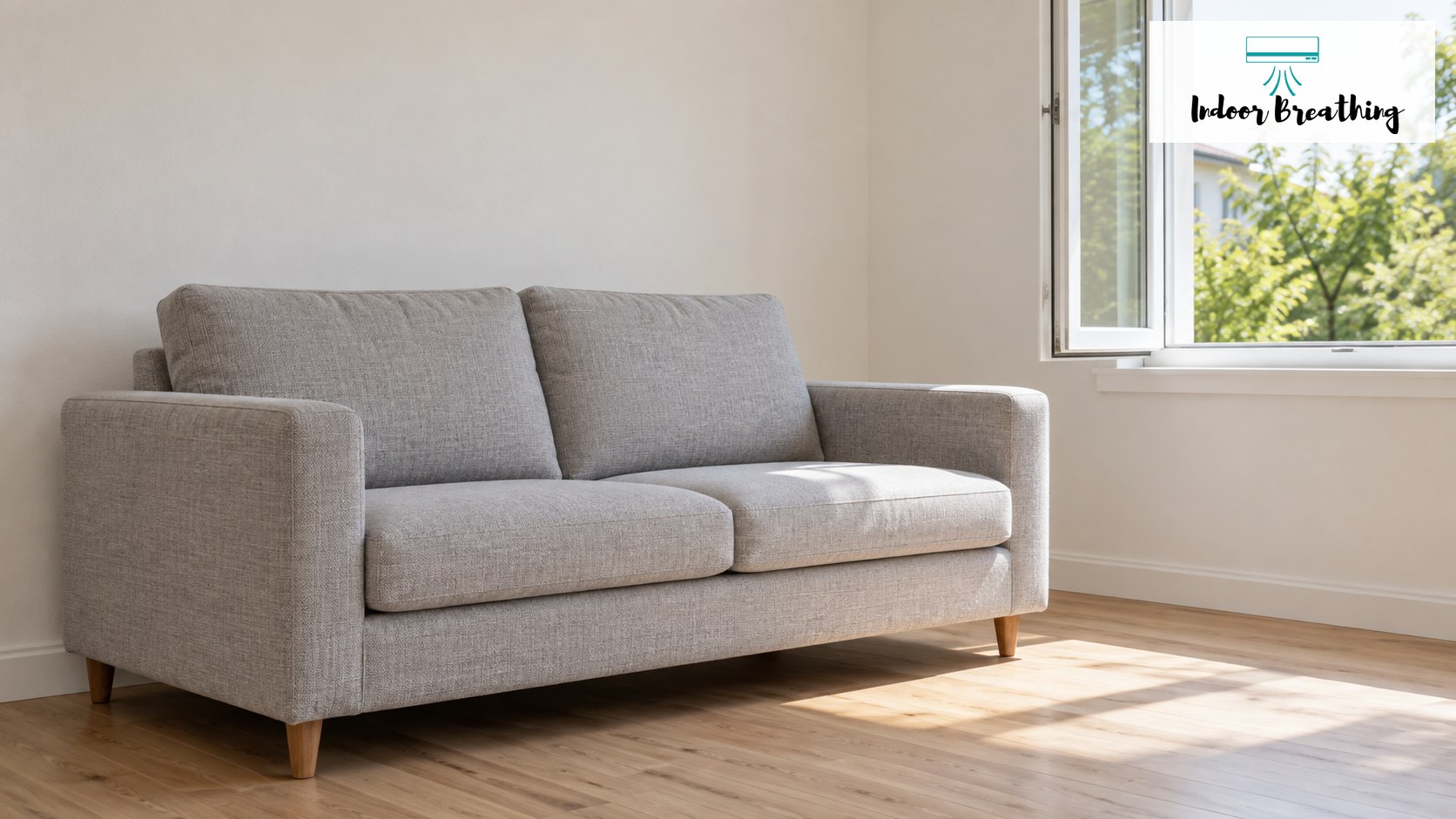
You paid good money for that new couch. Nobody mentioned it would arrive with a “new sofa” smell strong enough to clear the room.
Quick answer: there is no single finish date. The smell often fades before the chemicals stop coming off, and different materials release different things. Health Canada says formaldehyde from some wood products can take weeks, months, or even years to disappear completely. That does not mean every new sofa stinks for years. It means a fading smell is not a lab test.
The smart move is simple: cut your exposure, get fresh air moving, and talk to the seller before the return window closes. Here is what changes the timeline, and what actually helps.
Table of Contents
How Long Does New Furniture Off-Gassing Last?
Off-gassing and smell are not the same thing. Your nose notices an odor. A lab measures chemicals. One cannot stand in for the other.
| Question | Honest answer |
|---|---|
| How long will the smell last? | It depends on the product, the room, and the ventilation. No reliable universal deadline. |
| Does a weaker smell mean it is getting better? | Often yes for comfort. It does not prove a safe level. |
| Can chemicals keep coming off after the smell fades? | Yes. Some VOCs have no smell at all. |
| Should you wait out symptoms? | No. Cut exposure and get proper medical advice. |
Use the timeline to plan ahead, not to tolerate a room that bothers you. When a seller says “just air it out,” that is handling advice. It is not a health clearance for your household.
If a strong smell is still there, contact the seller before the return window ends. Ask about your exact product, not “furniture in general.” Keep the order number and delivery date handy.
What Causes That New Furniture Smell?
Off-gassing is just chemicals leaving a material and entering your air. The group of chemicals is called volatile organic compounds, or VOCs. That is a big family, not one ingredient. Common sources include pressed wood, upholstery, foam, glues, and finishes. New items tend to give off more VOCs than older ones.
A dresser may have engineered wood panels plus coatings. A sofa stacks fabric, foam, a frame, and bonding glue. The smell could come from any layer, so blaming “the glue” without product details is a guess.
Formaldehyde is the one most people have heard of. It can come from particleboard, hardwood plywood paneling, and medium-density fiberboard (MDF). It is not the same thing as every furniture smell, though.
A wood scent, a solvent scent, or a fabric scent will not give you the ingredient list. Neither will the price tag. A pricey chair can still stink, and a cheaper one can have solid emissions paperwork.
Why Some Furniture Smells Longer Than Others
Materials and how it was made
Two sofas can look identical and use different foam, glue, and coatings. Ask about the actual model and finish. A claim about one tested collection may not cover every fabric or color the brand sells.
Solid wood is not automatically emission-free, either. The finish and glue still count. Look for lower-emission products where you can, rather than trusting a material name.
The room and how much stuff arrived at once
A small closed bedroom and a big airy living room behave very differently. A new bed, desk, wardrobe, flooring, and paint all at once makes the source almost impossible to trace. Write down what arrived and when. That gives the seller, or an indoor air pro, a place to start.
Temperature and moisture
Moderate temperatures and lower humidity help hold formaldehyde down. Cranking the heat to “bake out” furniture is not a dependable fix. It can make the room worse while you are in it. Keep furniture within its care instructions: not next to a heater, not soaked, not left out in the weather.
Real fresh-air exchange
A fan moves air around. Ventilation swaps indoor air for outdoor air. They can work together, but they are not the same. Fixing the source and improving ventilation are the two best ways to cut indoor pollution. A ceiling fan in a closed room mostly spreads the smell around.
Does a Strong New Furniture Smell Mean It Is Toxic?
Not on its own. Smell is a poor guide to health risk. What matters is which chemical, how much, and for how long, and VOCs have very different effects.
It cuts both ways. A strong smell does not prove a harmful dose, and a room with no smell does not prove the air is chemical-free. Do not turn either one into a diagnosis.
Formaldehyde can irritate the eyes and airways at higher levels. That is a reason to reduce exposure, not a reason to panic about a new dresser.
If someone in the room feels unwell, cut their exposure. Symptoms are a signal to act, not a test of endurance. Ongoing symptoms deserve a talk with a health professional, who can also look at other possible causes.
Your First-Days Plan for New Furniture
Unpack without adding more sources
Remove packing materials as the maker directs and take the trash out of the living area. Follow the assembly and care instructions. Do not strip coatings, cut upholstery, or scrub with solvent cleaners to chase the smell. Photograph the labels and save the manual before recycling anything. You will want that info for returns.
Find a spot to air it out
If you can, use a dry, secure, ventilated space that nobody needs to hang out in. That cuts time near the source. It does not promise to remove every emission. A damp garage or the yard in the rain is a bad idea. If you open drawers and doors to air out a piece, make sure it stays stable, follow the anchoring instructions, and keep kids away.
Ventilate when the outdoor air is good
Open windows and doors when weather, security, and outdoor air quality allow. A cross-breeze helps. Fans can help move it along, as long as they are placed safely. During wildfire smoke or bad outdoor air, throwing every window open can backfire. Then use the ventilation you already have, and think about moving the piece out of living space.
Limit time in the room
Do not plan an overnight stay in a room that irritates you because the delivery team called the smell “normal.” Use another room if you have one. Nursery and bedroom pieces deserve some planning before the day you need them.
Keep a simple log
One line a day is plenty: weaker, same, or stronger; windows open or shut; any symptoms. Notice the smell during normal activity. No need to bury your nose in the cushions. If you bring in cleaners, paint, or other new stuff, note it too, or the pattern gets muddy.
Can an Air Purifier Remove Furniture VOCs?
A HEPA filter catches particles. It does not turn into a gas filter because the box says “clean air.” To tackle gases like VOCs, you need activated carbon or another gas-removal filter.
Even then, results depend on the chemical and the filter design. An “odor control” claim is not proof of strong formaldehyde removal. Look for relevant test info and replacement guidance, and be wary of a thin gray layer sold as a miracle.
Air cleaning works as a backup to source control and ventilation. It is not a reason to keep a product that bothers you. No purifier can guarantee a room is safe. If you want a purifier anyway, see our guides to the best air purifiers for home and the air purifier buying guide. For stubborn odors, the smoke-focused picks lean on bigger carbon beds. Check the CADR explainer for sizing.
Skip the ozone generator. Ozone irritates the lungs, and the machines sold as air cleaners can create harmful levels. Removing a smell is not worth adding another pollutant.
Planning to use the new piece in a bedroom? Quiet matters too: see the best air purifiers for bedrooms.
Baking Soda, Vinegar, or Plants: Do They Work?
Not really. These tips turn a chemical question into a cleaning project. A bowl of baking soda near the sofa does not prove the emissions stopped, and a changing smell is not proof that a home remedy removed the chemicals.
Vinegar and cleaners sprayed on upholstery can damage the finish or add another smell. Check the care label first. Candles, essential oils, and fragrance sprays just cover the odor while adding their own sources.
Keep your houseplants if you like them. Just do not treat them as permission to sit in a room that bothers you. Often the smartest purchase is a lower-emission replacement, not a cart full of deodorizers.
Can a Home VOC Monitor Tell You When the Room Is Safe?
Treat a consumer monitor as a limited tool. Low-cost monitors only detect what their sensors are built to detect. They do not give a full picture of indoor air, and accuracy depends on where they sit and the conditions around them.
A total VOC (TVOC) number is a blended sensor reading, not a list of every compound. Do not compare it straight to a limit for formaldehyde alone.
A friendly green app screen can lull people into ignoring symptoms, and a random spike can push them toward costly tests that answer the wrong question. If worries persist, ask a qualified indoor air pro what sampling fits the suspected source: which chemical, which method, which conditions, and how to read the result. Want to compare monitors anyway? See the best indoor air quality monitors, and for background on the topic, 400+ VOC compounds in homes.
When to Return the Furniture or Get Help
Contact the store when the smell is strong, not improving, or getting in the way of normal use. There is no scientific rule that says wait until day 30. The return policy is a separate clock, so do not let a vague “air it out” tip quietly run it out.
Say what the model is, when it arrived, what the room is like, and what you tried. Ask whether the maker has emissions test results, care tips, or a replacement option. Get the answer in writing if you can.
If eye or throat irritation, headaches, nausea, or asthma symptoms hang around, cut your exposure and see a clinician. Severe trouble breathing is an emergency. Do not assume new furniture explains every symptom in the house.
And if you ever suspect a gas leak or fire, leave and call emergency services from outside. Do not flip switches. Never file those under “off-gassing.” A new delivery does not cancel other household hazards.
How to Buy Furniture With Fewer Surprises
Ask for emissions proof
Get specific. Which exact product was tested? Under what program? Does the certificate cover this finish and fabric? Can the seller send paperwork instead of a vague “eco-friendly” promise?
For covered composite wood products sold in the US, the EPA sets formaldehyde limits, and finished goods that comply must be labeled. That covers formaldehyde only. It does not mean every other emission is zero.
Know what voluntary certifications mean
UL GREENGUARD certifies low chemical emissions, and GREENGUARD Gold uses stricter criteria for sensitive settings. Check the exact model in the certification listing instead of assuming a whole brand qualifies. Certification is good evidence, not a guarantee that every buyer will tolerate every piece. Vague “clean” labels will probably spread faster than real testing, so stay skeptical.
Plan the delivery and the return terms
Do not stack big deliveries right before a baby arrives or guests visit. Leave time to inspect and ask questions. Check return costs, packaging rules, and whether odor complaints are covered before you order.
A well-kept older piece is also an option. Check it for mold, pests, damage, and lingering fragrance first. Older is not automatically safer. The goal is fewer surprises, not trading a new smell for an old one.
Frequently Asked Questions
How long does a new sofa off-gas?
There is no reliable number for every sofa. Foam, fabric, glue, room conditions, and ventilation all vary. Ask about your exact model, and watch the whole picture instead of trusting a generic online countdown.
Does MDF stop releasing formaldehyde after a week?
Not necessarily. Release generally declines but can last weeks, months, or years. One week of airing is not a universal finish line. Pick documented products and fix the room’s ventilation, rather than counting days.
Can you sleep next to furniture that still smells?
No smell test can prove safety for every household. Avoid sleeping in a room that irritates you, and talk to a clinician if symptoms continue. If you can, use another room until a strong odor is sorted out.
Will heating the furniture speed things up?
Heat can raise emissions from some materials, but a home “bake-out” is not a safe shortcut. Keep normal comfortable conditions and follow the care instructions.
Does no smell mean no VOCs?
No. Some VOCs have no smell, and people vary in how well they smell things. A fading smell is nice for comfort. It does not name the chemicals or measure how much is there.
The Bottom Line on New Furniture Smell
New furniture should be comfortable to live with. Give it fresh air, limit time in the room if it irritates, and ask for evidence when the seller makes big claims. If it stays a problem, return or replace it before the deadline.
The goal is a usable room and a sensible plan for exposure. A date on the calendar, a scented spray, or a green app icon cannot do that work for you.