
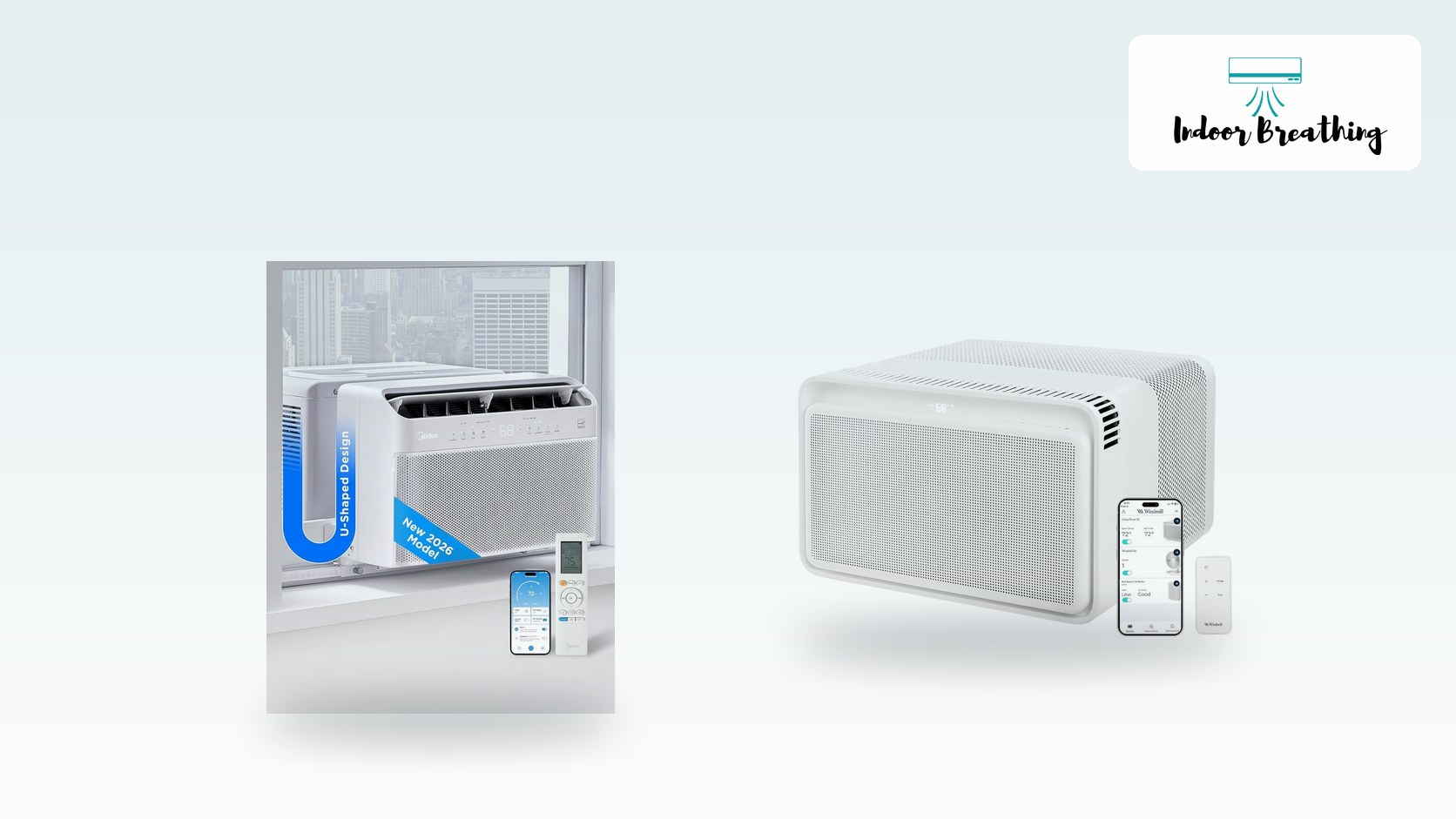
To buy a window air conditioner for energy savings, size it to the room so it is not oversized, then pick the highest CEER rating you can afford. In practice that means an inverter unit rated around 15, which uses roughly a third less power than an old single-speed unit of the same size. The top pick is the Midea U 8,000 BTU.
Figures come from manufacturer spec sheets, Department of Energy and ENERGY STAR efficiency data, and owner reviews. This is not based on in-house lab testing. Prices and ratings were last checked in September 2026 and can change, so confirm the live price on Amazon before you buy.
If your priority is fitting the right size to your room and keeping noise down rather than shaving the most off your power bill, see our companion window AC sizing and noise guide.
A window air conditioner is the cheapest way to cool one room, but the sticker price is the small number. The one that adds up is the electricity, and two units with the same BTU rating on the box can differ by a third or more on what they cost to run. The spec that tells you which is which is CEER, and most shoppers never look at it.
This guide ranks six current window units on efficiency first, from a 6,000 BTU bedroom unit to a 12,000 BTU model for a great room. Every one uses a variable-speed compressor and the newer R-32 refrigerant.
Affiliate disclosure: IndoorBreathing may earn a commission when you buy through links on this page, at no extra cost to you. Picks are chosen for verified efficiency, cooling performance, and value, not commission rate.
Table of Contents
What “Energy Savings” Means for a Window AC
Three things decide what a window unit costs to run: how efficient the machine is, how well it is sized to the room, and how well it is sealed into the window. The machine’s number is CEER, the combined energy efficiency ratio: cooling output in BTU per hour divided by the watts drawn, with the standby draw folded in. Higher is better. The current federal floor is about CEER 11 for a small unit; a good inverter unit is around 15, roughly a third less power for the same cooling. A tighter federal standard takes effect in May 2026 that raises the floor and, for units above 8,000 BTU, effectively requires a variable-speed compressor.
The efficient units are all inverter models. A single-speed compressor is either full-on or off, so it overshoots, shuts off, drifts warm, and slams back on, and every restart spikes power. An inverter compressor ramps up and down and holds the set temperature at low power. That is where the saving comes from, and it is why an inverter unit is also quieter and holds a room within a degree instead of swinging three.
The cheap single-speed window unit is on its way out. With the 2026 standard raising the floor, the sub-$200 box-store special is likely gone within a few years and the price of entry for a new window AC climbs by $100 or more. That lands hardest on renters and low-income households, for whom a window unit is often the only cooling option.
If you also run central air, our SEER2 energy savings guide covers the same math for a whole-house system.
Best Energy-Saving Window Air Conditioners: Comparison
The table lines all six up on the specs that decide the power bill: cooling capacity, the CEER rating, the room size each is good for, the lowest published noise level, and the price at the time of writing.
CEER figures are manufacturer and ENERGY STAR data; a tilde means the maker publishes only a marketing efficiency claim and the figure is estimated from the unit’s wattage and capacity. Every unit here is ENERGY STAR listed and uses R-32 refrigerant.
Midea U 8,000 BTU — Best Overall for Energy Savings
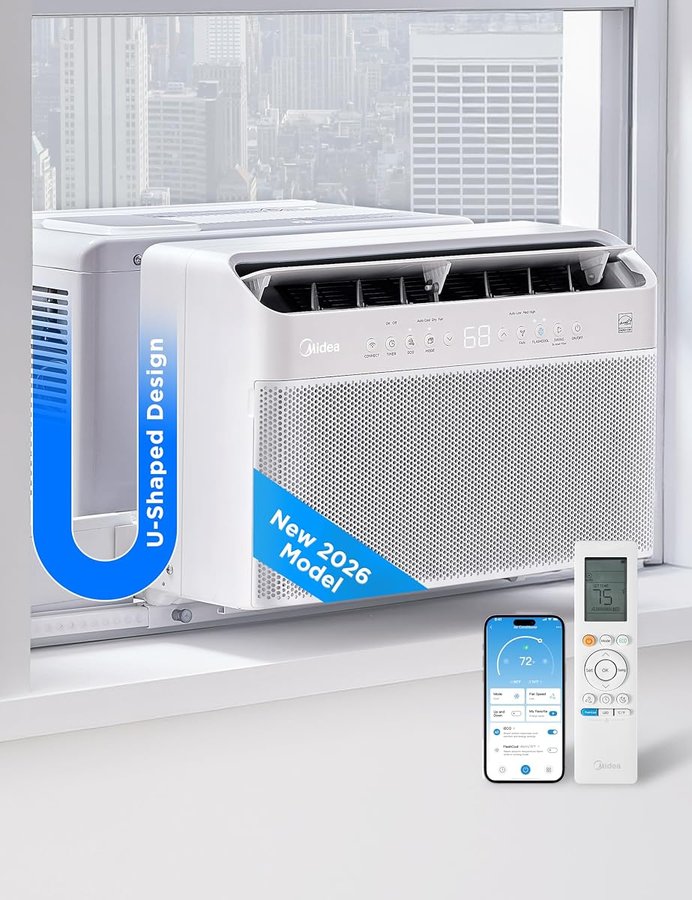
The Midea U is the window unit for most people who care about the power bill. Its saddle shape wraps around the window sash, with the compressor outside and the cold half inside, and the window closes through a slot in the middle. That gives it a far better air seal than a box unit with foam wings, and it puts the noisy compressor outside the glass, which is why it runs near 32 decibels. It is rated CEER 15, and Midea says the inverter cuts energy use more than 37 percent against a standard unit; the U line was among the first inverter window units to earn ENERGY STAR recognition. It has Wi-Fi with Alexa and Google and fits double-hung windows 22 to 36 inches wide.
Downsides: the bracket install takes about twenty minutes and real effort, it will not fit a casement or narrow window, and on a ground floor the outside half is exposed to weather and passers-by.
Pros
- CEER 15, one of the most efficient sold
- Near 32 dB, the quietest here
- Window still opens above the unit
- Tight seal from the closed sash
- Wi-Fi, Alexa and Google
Cons
- Bracket install takes real effort
- No fit for casement or narrow windows
- Outdoor half exposed on a ground floor
Verdict: the most efficient and quietest window unit here, if your window takes it.
LG LW6023IVSM 6,000 BTU — Best for a Small Bedroom
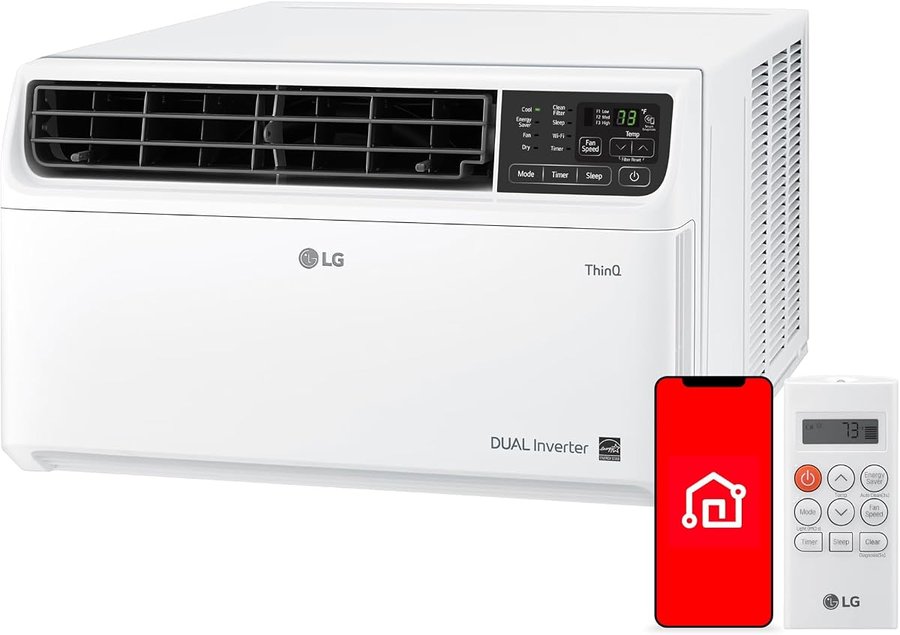
For a bedroom, home office, or nursery up to about 250 square feet, the LG LW6023IVSM is the efficient choice and, at around $380, the cheapest unit on this list. It uses LG’s dual-inverter compressor, draws only about 510 watts flat out, and LG rates it up to 35 percent past the ENERGY STAR minimum, which works out to a CEER in the mid-15s. It is a normal flush-mount box unit that installs in ten minutes in a double-hung window 22 to 36 inches wide, with ThinQ app control, Alexa and Google, a washable filter, and a quiet mode around 44 decibels.
The honest caveat: against a $180 single-speed 6,000 BTU unit, the extra $200 here can take many seasons to earn back if you run it lightly. In a small room you are buying the steady temperature and the quiet as much as the saving.
Pros
- Only about 510 watts at full cooling
- Dual-inverter, steady temperature
- Cheapest unit here
- Ten-minute flush-mount install
- ThinQ app, Alexa and Google
Cons
- Payback is slow if you run it lightly
- Around 44 dB, not the quietest
- Rooms up to about 250 sq ft only
Verdict: the low-wattage pick for a small room, if you accept the slow payback.
LG LW1022FVSM 10,000 BTU — Best for a Living Room
The LG LW1022FVSM is the one for a main living room up to about 450 square feet. It pairs LG’s dual-inverter compressor with a brushless DC fan motor to hold a room dead steady while staying near 44 decibels in Lo-Decibel mode, and LG rates it up to 35 percent past the ENERGY STAR minimum, so the CEER lands close to 15. It is a fixed-chassis flush-mount unit for a double-hung window 22 to 36 inches wide, drawing about 970 watts at full tilt, with the ThinQ app and a slide-out washable filter.
At 63 pounds it is a two-person lift, it is the priciest unit here at around $500, and its Amazon rating trails the Midea U mostly on install and weight complaints. Our LG LW1016ER review shows how far the single-speed version of this size has fallen behind.
Pros
- Dual-inverter, very steady temperature
- Near 44 dB in Lo-Decibel mode
- About 35 percent past ENERGY STAR
- Good ThinQ app
- Washable filter with reminder
Cons
- Most expensive unit here
- 63 pounds, two-person install
- Reviews dinged on install and weight
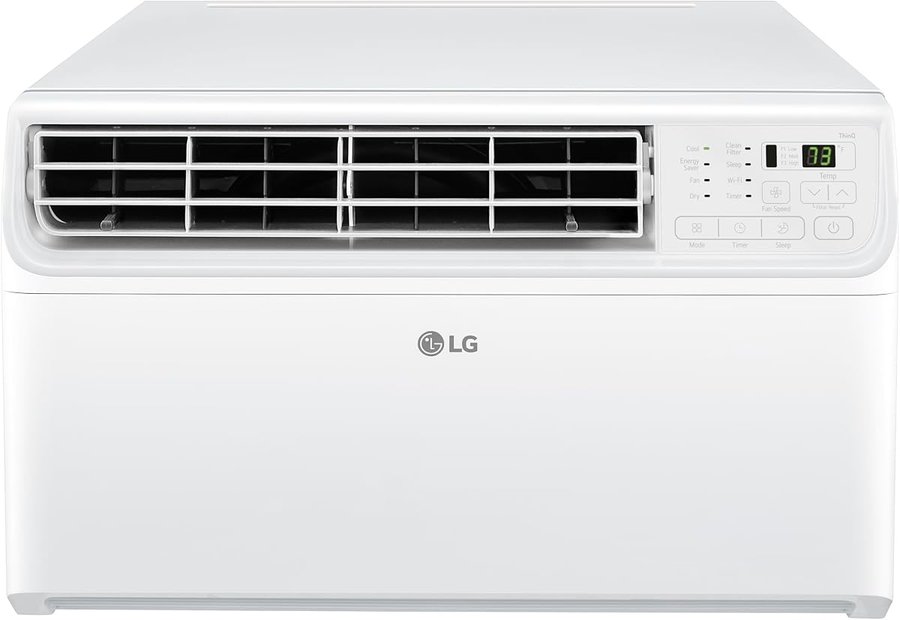
Verdict: the efficient living-room unit, worth the price if you run it all summer.
GE Profile 12,000 BTU Inverter — Best for a Large or Open Room
When the space is a great room, an open kitchen-and-living area, or a finished attic up to about 550 square feet, the GE Profile 12,000 BTU inverter cools it from one window without a bill to match. GE states a CEER of 15.0, which it says is 37 percent past a single-speed unit of the same size, and the EnergyGuide label puts annual use near 525 kilowatt-hours. It draws around 1,060 watts flat out, weighs 53 pounds, fits a double-hung window roughly 23 to 36 inches wide, and runs on a normal 115-volt outlet despite the 12,000 BTU size. It has the SmartHQ app with Alexa and Google, and a quiet night mode near 44 decibels.
The main knocks are a smaller owner-review history than the Midea and LG units and a light ring some find bright until dimmed in the app. For a 12,000 BTU comparison across formats, see our 12,000 BTU air conditioner guide.
Pros
- Stated CEER 15.0 at 12,000 BTU
- About 525 kWh a year on the label
- Runs on a standard 115-volt outlet
- Quiet night mode near 44 dB
- SmartHQ app, Alexa and Google
Cons
- Smaller review history
- Bright light ring until dimmed
- A very sunny great room may want two units
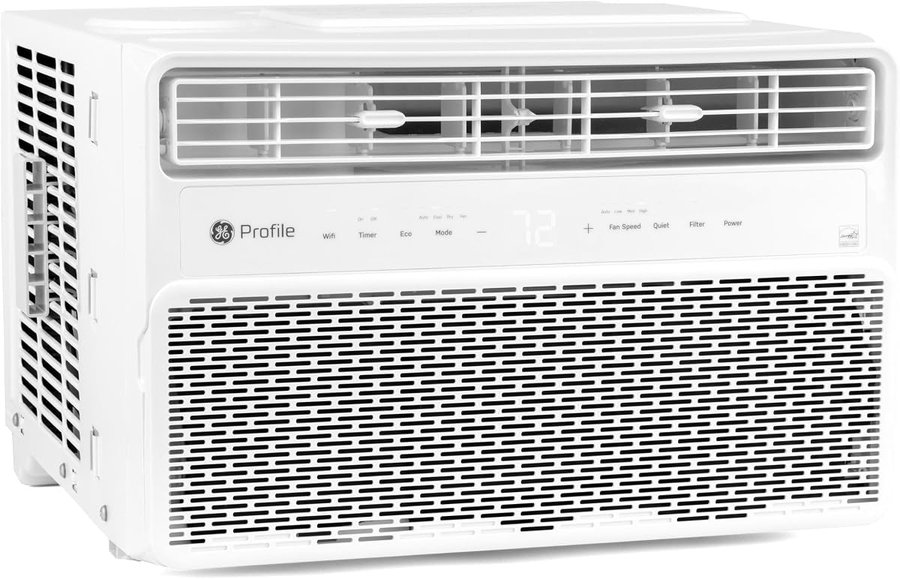
Verdict: the efficient single-unit answer for a big room on a normal outlet.
Windmill 10,000 BTU — Best Build and Seal
The Windmill 10,000 BTU takes a different route to a low bill. Instead of leaning only on the compressor, it wraps the cabinet in double-insulating side panels that block heat and outside noise better than the thin foam wings on most units, and its WhisperTech intake pulls air from the front and bottom and throws it up at a 45-degree angle so it mixes the room rather than blasting one spot. It is an inverter unit on R-32, drawing about 900 watts, with a CEER in the 15 range, auto-dimming lights, a washable mesh filter, and a tool-free pre-assembled kit. It runs near 40 decibels on low.
The trade-offs are weight, at 71 pounds it is the heaviest unit here, and price, around $450 for efficiency that is very good but not quite Midea-U territory.
Pros
- Insulated side panels cut heat and noise
- Inverter compressor, about 900 watts
- Tool-free pre-assembled install kit
- Near 40 dB on low
- Looks good in a room
Cons
- Heaviest unit here at 71 pounds
- Efficiency good but not class-leading
- Carbon filter is an add-on cost
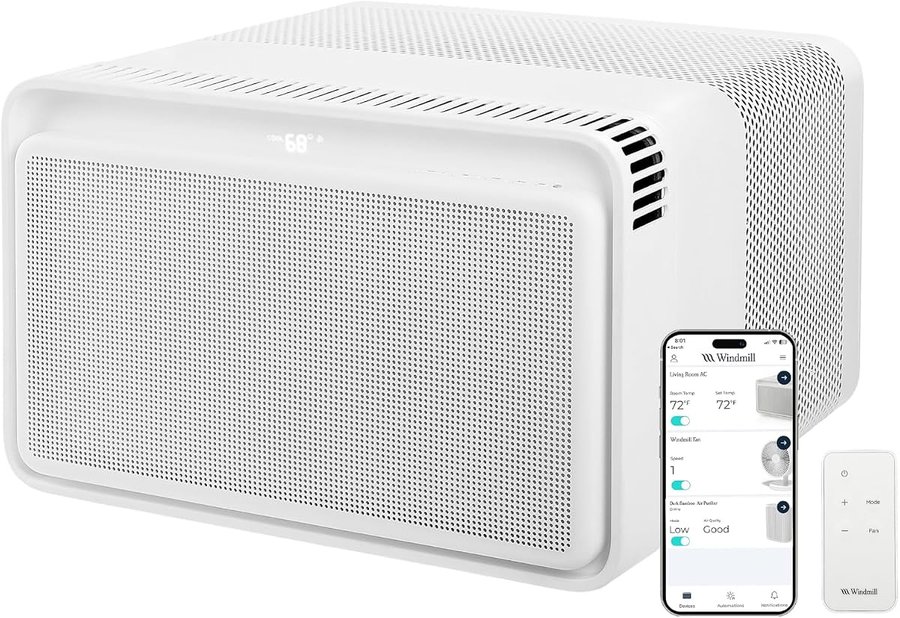
Verdict: buy it if the install seal and the look matter as much as the CEER.
Midea EasyCool 8,000 BTU Inverter with Heat — Best for Year-Round Use
The Midea EasyCool 8,000 BTU is the pick for a room you want to cool in summer and take the chill off in spring and fall without swapping the unit out. It is an inverter unit on R-32, ENERGY STAR listed, drawing about 407 kilowatt-hours a year on the label for cooling, with a supplemental electric heat mode built in. It is a normal flush-mount box that installs in a double-hung window 24 to 38 inches wide in about ten minutes, runs near 45 decibels, has the Midea app with Alexa and Google, and carries by far the largest owner-review base here.
Be clear about the heat: it is a resistance element, not a heat pump, so it is fine for taking a 60-degree room to 68 but not a cheap way to heat through a cold winter. It is also the least efficient cooler on this list, at an estimated CEER around 12, still comfortably above the federal floor.
Pros
- Cool and heat in one unit
- Inverter cooling, ENERGY STAR listed
- Normal ten-minute flush-mount install
- Huge owner-review history
- App, Alexa and Google
Cons
- Heat is resistance, not a heat pump
- Least efficient cooler here
- Near 45 dB, not the quietest
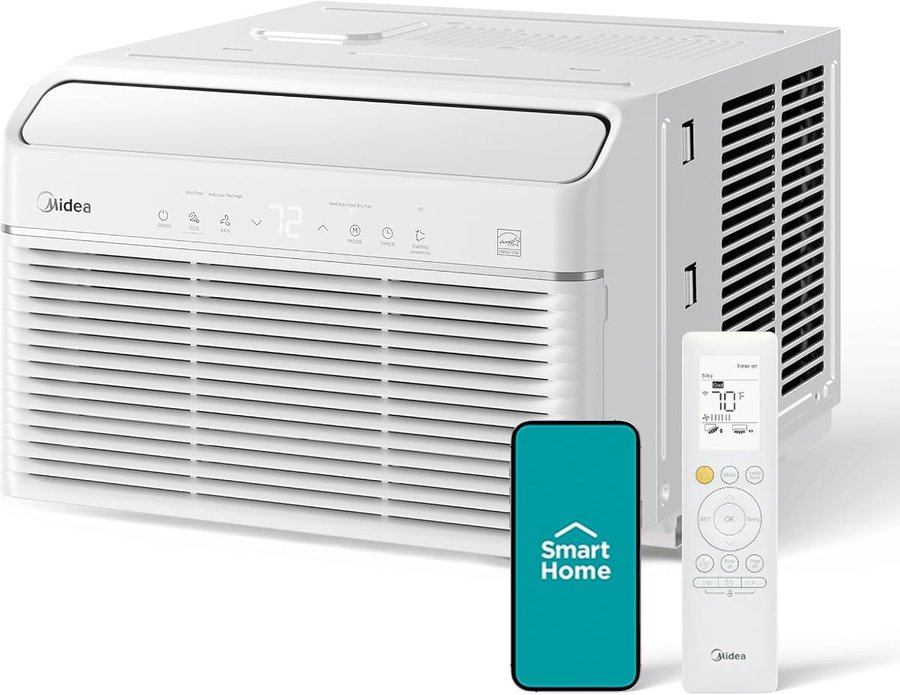
Verdict: one box for summer cooling and shoulder-season heat, with a small efficiency tax.
How Much a Window AC Costs to Run
Take an efficient 8,000 BTU inverter unit like the Midea U. It draws about 720 watts flat out, but because the inverter throttles it, the average over an evening is closer to 0.4 kilowatts. Run it eight hours a day and that is roughly 96 kilowatt-hours a month, or about $16 at the U.S. average rate near 17 cents per kilowatt-hour. Around the clock in a heat wave, closer to $45 to $50.
The same size in an old single-speed unit at CEER 11 cycles hard instead of throttling, averaging more like 0.55 kilowatts, or about $22 a month on the same schedule. Over a four-month season that gap is roughly $25, and in a hot climate it is $50 to $80. Across a ten-year life the inverter unit is a few hundred dollars ahead, which covers most of its price premium.
As summers stretch longer, more homes will run air conditioning for more of the year, pushing up the late-afternoon demand peak on the grid. Utilities will lean harder on programs that pay a small credit to let them dim your smart AC during peak hours. Handy in a heat wave, but it hands a third party a switch on your bedroom, and enrollment is quietly becoming the default on some connected models.
Two numbers to compare when you shop: the CEER on the spec sheet, and the estimated yearly cost on the yellow EnergyGuide label, which is figured on a standard number of cooling hours so it is comparable across models. If your real need is just moving air on a mild evening, a fan costs a tenth as much; our roundup of fans that cool like air conditioners covers when that is enough.
How to Size a Window AC So You Don’t Waste Energy
An oversized air conditioner is not a more powerful one, it is a less efficient one. It blasts the room cold in minutes, satisfies the thermostat, and shuts off before it has run long enough to pull the humidity out. Then it short-cycles, and each restart spikes power and leaves the room clammy. An undersized unit runs flat out and never catches up. You want the one that matches the room.
The baseline is about 20 BTU per square foot: a 250-square-foot bedroom wants roughly 6,000 BTU, a 350-square-foot room about 8,000, and a 550-square-foot open area around 12,000. Then adjust: add about 10 percent for strong afternoon sun or ceilings over 8 feet, subtract 10 percent for heavy shade, add 4,000 BTU for a kitchen, and add about 600 BTU per regular occupant beyond two. If your number lands between two sizes, take the smaller one unless the room is very sunny. Run the room through our BTU calculator for a firm figure, and our AC sizing guide walks through the adjustments. If you are still choosing formats, the best portable air conditioners guide covers when a portable makes sense despite the efficiency penalty.
Get the Install Right or Lose the Savings
A perfectly efficient unit in a leaky window is an inefficient system. Every gap around the cabinet lets cooled air slip out and hot air slip in, so the compressor runs longer. Pull the accordion side curtains all the way out and screw them to the sash rather than letting them rest, run a bead of removable weatherstrip along the top of the lower sash, and check that the unit tilts a quarter inch toward the outside so condensate drains outward. If the window faces the afternoon sun, an external awning or a light sheet on the glass above the unit cuts the heat load more than any feature on the AC. At season’s end, pull the unit or fit an insulated cover, because an installed window AC is a large uninsulated hole in your wall all winter. Our quietest window air conditioners guide covers how the install also drives noise.
The refrigerant in these units is mid-transition. R-410A is being phased down under the AIM Act, and R-32, which every unit here already uses, is replacing it. R-32 carries a “mildly flammable” A2L rating, and as it becomes standard the service, transport, and disposal rules around it will tighten. Expect DIY recharging to get harder, and a dead compressor out of warranty to mean a new unit more often than a repair, which adds to the electronic waste stream.
FAQ
What CEER should you look for in an energy-efficient window air conditioner?
Aim for CEER 14 or higher. The federal minimum is about 11 for a small unit, ENERGY STAR units generally start around 12, and the most efficient inverter models reach about 15. Each jump of one CEER point is roughly a 6 to 8 percent cut in running cost for the same cooling.
Is an inverter window air conditioner worth the extra money?
In a room you cool all summer, yes. An inverter unit uses 30 to 40 percent less electricity than a single-speed unit of the same size, holds the temperature steadier, and runs much quieter. In a small room you barely run, the payback is slow and you are mostly buying the comfort and quiet.
Does a bigger window AC cool better?
Only up to the point where it matches the room. An oversized unit cools fast, shuts off before it removes the humidity, and short-cycles, which wastes power and leaves the room clammy. A right-sized unit runs longer, gentler cycles and costs less to operate.
How much does it cost to run a window air conditioner per month?
An efficient 8,000 BTU inverter unit run eight hours a day costs roughly $16 a month at average U.S. electricity rates. Run around the clock in hot weather it is closer to $45 to $50. An older single-speed unit of the same size costs about a third more.
What is the most energy-efficient window air conditioner?
Among widely available units, the Midea U saddle-style inverter models lead, rated around CEER 15 with noise near 32 decibels. The GE Profile and LG dual-inverter units are close behind at the same CEER range in larger sizes.
Should you get a 115-volt or 230-volt window AC?
For anything up to 12,000 BTU, a 115-volt unit runs on a normal wall outlet and is simpler to install. Larger units and some 12,000 BTU models need a dedicated 230-volt circuit. All six picks in this guide are 115-volt.
The efficiency gains are real, but some will be eaten back. Households that once suffered through a hot summer now cool two or three rooms, so total air-conditioning electricity keeps climbing even as each unit sips less, and the grid, not the wall outlet, becomes the limiting factor.
Related Guides
Keep going with bedroom ceiling fans and portable air conditioners for a garage.
Bottom Line
Buy for the room you will actually cool, check the CEER before the price, and go with an inverter unit if you run the AC all summer. For most people the Midea U 8,000 BTU is the best energy-saving window air conditioner you can buy: CEER 15, a tight seal from the closed sash, and the lowest noise on this list. For a small bedroom the LG LW6023IVSM 6,000 BTU draws barely 500 watts, and for a large open room the GE Profile 12,000 BTU inverter does it from a standard outlet at CEER 15.0. Whatever you pick, size it right and seal the install, because the efficiency on the label only shows up if the cold air stays in the room.
Editorial note: Prices, CEER figures, and availability change after publication — confirm the current listing before buying.