
Choose a mini-split by matching BTU capacity to your room’s real cooling load — square footage, ceiling height, and insulation, not a flat chart — then picking single-zone or multi-zone based on how many rooms need separate control, and deciding upfront whether you want a true DIY quick-connect kit or a professional install, since that choice moves total cost more than the SEER2 number does.
Every spec below is checked against the manufacturer’s own listing, current Amazon pricing and review counts, and DOE/EPA guidance on SEER2 testing and refrigerant handling. No hands-on lab testing is involved.
A ductless mini-split cools or heats a room, or a handful of rooms, without ductwork — a wall-mounted indoor air handler connected by a thin refrigerant line to a compressor outside. That makes it the fix for rooms central air never reaches: a finished attic, a garage conversion, a sunroom, an addition built after the ductwork went in. I pulled real spec sheets and Amazon listings apart to find which systems earn their price.
Three decisions drive almost everything else: how many BTUs you actually need, whether one outdoor unit serves one room or several, and whether you’re installing it yourself or hiring a licensed technician. Get those right and the rest — SEER2, brand, noise — is a budget conversation. Get them wrong and you’ll either freeze in an undersized room, or pay someone to redo a DIY job that opened a sealed refrigerant line it shouldn’t have.
If you’re cooling a whole house rather than a room or two, central air is more cost-effective — our AC tonnage calculator and Goodman GLXS4BA4210 central air review cover that path. Renters and anyone who can’t modify a wall should look at a high-efficiency window air conditioner instead, since a mini-split is a permanent install, or a high-performance fan if you just need to take the edge off one hot room.
Affiliate disclosure: IndoorBreathing may earn a commission when you buy through links on this page, at no extra cost to you. Picks are chosen for SEER2 efficiency, real-world sizing, installation requirements, and value, not commission rate.
Table of Contents
Best Mini-Split Air Conditioners: Comparison Table
BTU and zone count set the room this system fits. Install type is the number most buyers overlook — it decides whether you can legally do the job yourself. Prices and review counts are current Amazon figures and will move.
| Model | Best for | BTU / Zones | SEER2 | Install type | Noise | Price |
|---|---|---|---|---|---|---|
| Cooper & Hunter MIA 18,000 BTU | Best overall | 18,000 BTU, 1 zone | 19.2 | Professional (not DIY) | 30 dB | ~$1,099.97 |
| MRCOOL DIY 4th Gen 12,000 BTU | Best DIY, no EPA license | 12,000 BTU, 1 zone | Up to 22.5 | DIY quick-connect | 23.5 dB | ~$1,718.00 |
| Della Serena 12,000 BTU | Best budget | 12,000 BTU, 1 zone | 22 | Professional (not DIY) | 22 dB | ~$701.96 |
| ROVSUN 9,000 BTU | Best ultra-budget | 9,000 BTU, 1 zone | 23 | Professional recommended | 30 dB | ~$499.99 |
| Senville AURA 9,000 BTU | Quietest / premium | 9,000 BTU, 1 zone | Mfr.-rated, high-20s | Professional (not DIY) | 23.5 dB | ~$1,299.99 |
| Senville Dual Zone 28,000 BTU | Best multi-zone | 28,000 BTU, 2 zones (2x12k) | 23 | Professional (not DIY) | 24 dB | ~$2,499.99 |
SEER2 vs. the Old SEER Rating: Why the Number on the Box Changed
The efficiency number on a mini-split’s box changed in 2023, and it trips people up constantly. The Department of Energy didn’t just rename SEER to SEER2 — it rewrote the test. The old procedure measured airflow resistance at 0.1 inches of water column; the new Appendix M1 test raises that to 0.5 inches, much closer to what a real installed system pushes against. The result: SEER2 numbers run roughly 4–5% lower than the old SEER number would have shown on the exact same equipment.
That matters because old stock and old reviews still use the pre-2023 SEER scale. A unit labeled “22 SEER” from 2021 isn’t directly comparable to a “22 SEER2” unit sold today — the current unit is measured under tougher conditions, so hitting the same number is a real efficiency jump. Don’t compare a SEER figure to a SEER2 figure and assume they’re equal.
ENERGY STAR certification for a ductless mini-split requires roughly 18.7 SEER2 and an HSPF2 (the heating equivalent) of at least 8.5. Every pick below clears that — the Della Serena and ROVSUN land at 22–23 SEER2 despite being the cheapest systems here, which tells you SEER2 alone isn’t a reliable way to judge build quality. Use it to compare running costs, not longevity.
Sizing a Mini-Split: BTUs, Square Footage, Ceiling Height & Insulation
Every size chart starts the same way: multiply square footage by 20 BTU. That’s a fine starting point for an 8-foot ceiling in a reasonably insulated room, but it’s only a starting point — sizing off square footage alone is one of the most common reasons people end up unhappy with a mini-split that tested fine on paper.
Ceiling height matters because you’re cooling a volume of air, not a floor plan. A vaulted room with a 12-foot ceiling holds roughly 50% more air than the same footprint under a standard 8-foot ceiling — add about 10% more BTU capacity per 2 feet of ceiling height above 8 feet.
Insulation changes the math just as much. A well-insulated room with double-pane windows can run at the low end of 20 BTU per square foot. An older room with single-pane glass or heavy west-facing sun can need 25–30% more capacity to hold the same temperature on a 95-degree afternoon. A finished garage or converted sunroom — two of the most common mini-split projects — almost always land in that “needs more capacity” bucket, since the slab, the garage door, and thinner walls leak heat faster than the rest of the house.
A couple of flat additions apply on top: 4,000–6,000 BTU for a kitchen, roughly 600 BTU per person for a crowded room. When between two sizes, size up — an oversized unit short-cycles and loses a little efficiency, but an undersized one never keeps up on the hottest day of the year, which is the day you need it to work. Sizing central air for a whole house is a different calculation; our AC tonnage calculator and commercial HVAC tonnage calculator handle those versions.
Single-Zone vs. Multi-Zone: Which Setup Fits Your Home
A single-zone system pairs one outdoor compressor with one indoor air handler — the cheapest way to condition one room. A multi-zone system connects two to five indoor units to one larger outdoor compressor, so you can cool a bedroom and an office independently, on separate thermostats, without mounting two outdoor units.
The tradeoff is line-set length and elevation limits. Every mini-split has a maximum total refrigerant line length between indoor and outdoor units — often 25 to 100-plus feet depending on the system — and a maximum height difference between them. True DIY quick-connect kits, like the MRCOOL DIY below, ship with a fixed, non-cuttable line set, so you’re locked into how far the outdoor unit can sit from the wall. Standard pre-charged systems needing a professional vacuum and charge can usually run longer, field-cut line sets instead.
Multi-zone systems add a wrinkle: the combined line-set length across every zone, and the per-zone length, both have limits, and running one zone near its maximum can quietly reduce capacity on every zone sharing that compressor. Before buying a kit like the Senville Dual Zone below, sketch out where the outdoor unit will sit relative to both indoor heads. For two or three rooms, run the numbers both ways — two single-zone systems sometimes cost close to one multi-zone system, and each keeps working if the other’s compressor ever fails.
DIY Quick-Connect vs. Professional Install: What EPA 608 Actually Requires
This is the distinction that trips up more mini-split buyers than any spec sheet: “pre-charged” does not mean “DIY-legal.” Nearly every mini-split ships with its outdoor unit pre-charged with refrigerant from the factory — that’s normal. What decides whether you can legally install it yourself is whether the line set uses quick-connect fittings, or has to be brazed, evacuated with a vacuum pump, and charged on site.
Federal law (EPA Section 608) requires certification to handle refrigerant — brazing a line, pulling a vacuum, or adding or releasing refrigerant. If installing a system means opening the sealed refrigerant circuit at any point, a licensed, EPA 608-certified technician has to do that part, even if the outdoor unit arrived pre-charged. That’s the case for the Della Serena, the ROVSUN, the Senville systems, and the Cooper & Hunter here — each says “professional installation required” directly on its listing, despite shipping pre-charged.
A small number of systems, led by MRCOOL’s DIY line, use a genuinely different connection: a two-stage, quick-connect coupler that never opens the refrigerant circuit. You bolt the line set together and the system self-charges — no brazing, no nitrogen purge, no vacuum gauge, no EPA license required. That’s the only category of mini-split a handy homeowner can legally install start to finish without hiring a certified tech.
Budget accordingly. A professional install typically runs $500 to $2,000 in labor on top of equipment, depending on line-set length, electrical work (most systems need a dedicated 208/230V circuit), and permitting — which is why DIY quick-connect kits often cost more upfront than an equivalent pro-install-only system. You’re paying for hardware to save on labor. If you’re not confident evaluating a 230V circuit yourself, a clamp meter or a full HVAC multimeter is worth having on hand, even for a quick-connect install.
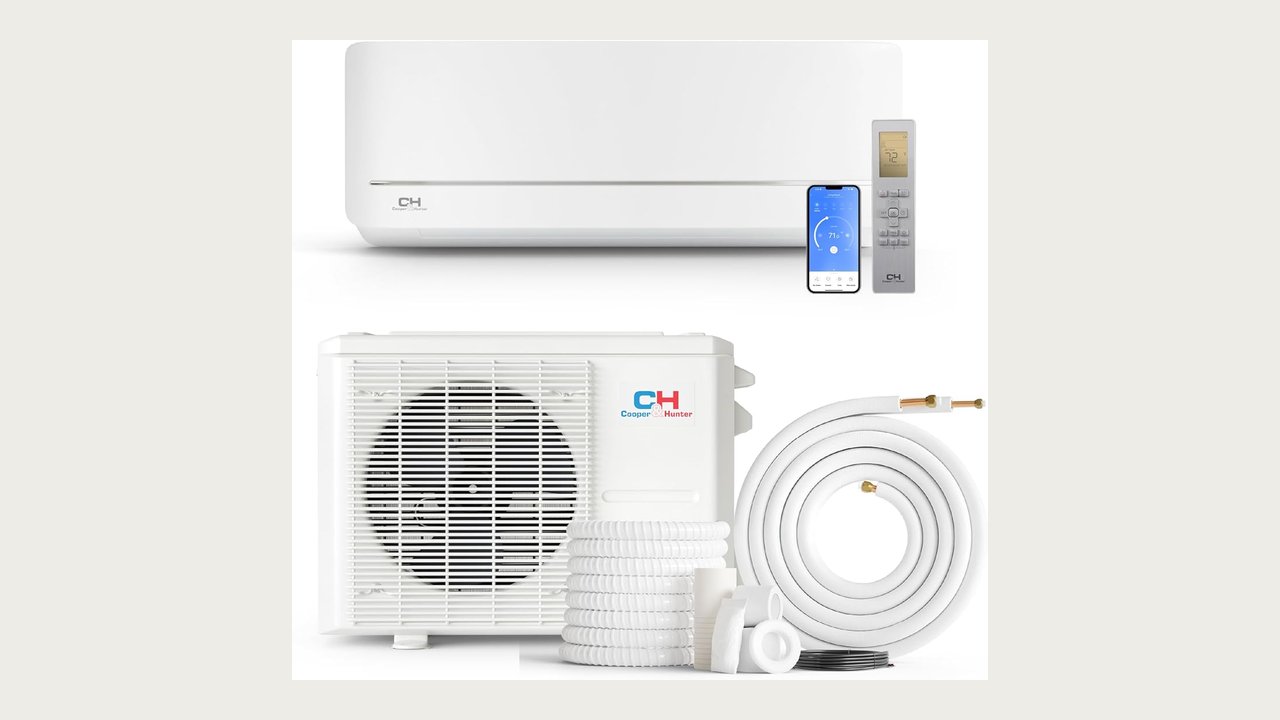
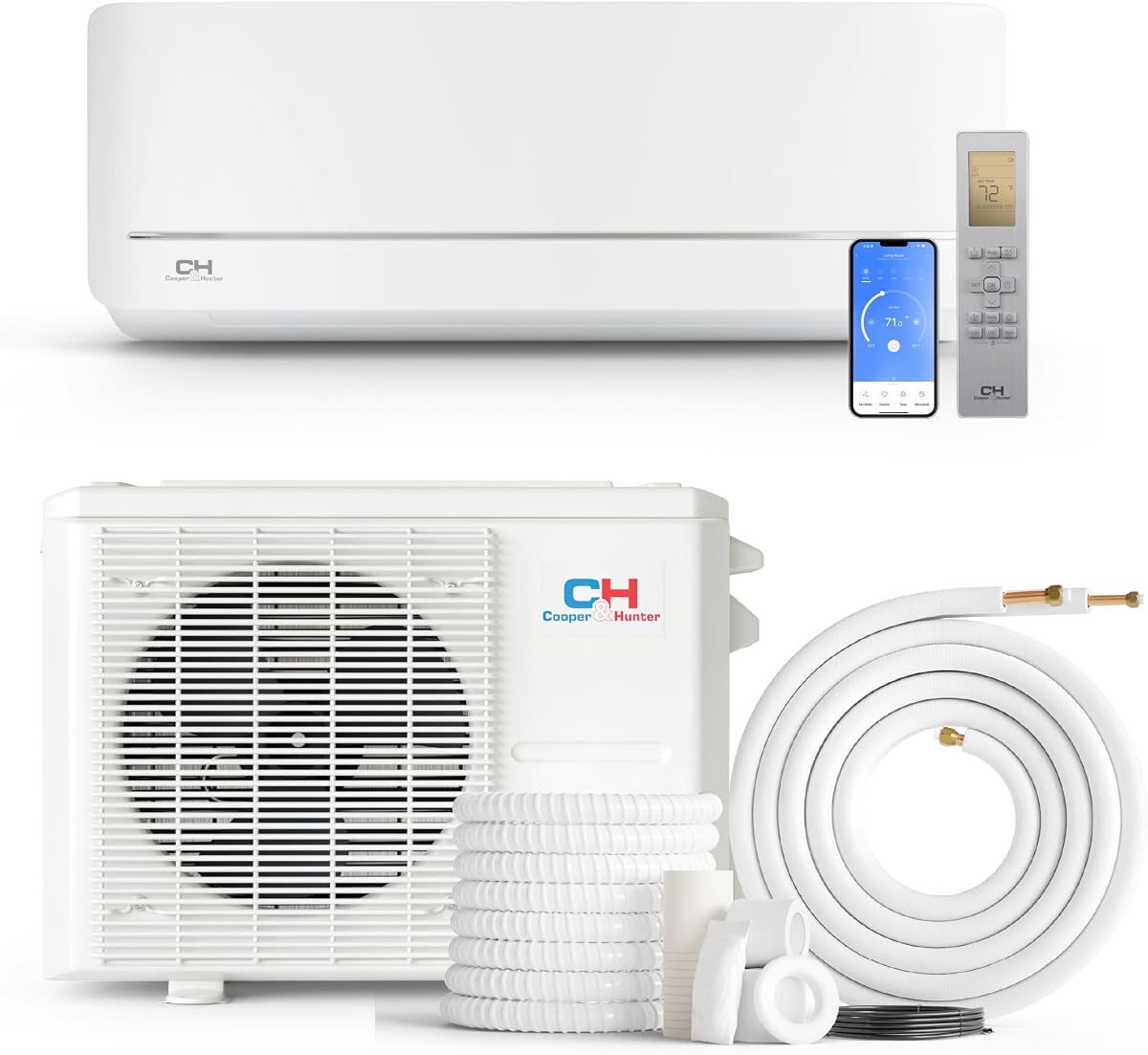
Cooper & Hunter MIA Series 18,000 BTU — Best Overall
For a single large room — a finished basement, an open living/dining combo, a detached office — the Cooper & Hunter MIA Series 18,000 BTU is the one I’d point most people toward. It’s rated 19.2 SEER2, ships with a 16-foot line set, and is Amazon’s Choice with 428 ratings at 4.3 stars — a real sample size for this category.
This is not a DIY system; Cooper & Hunter says so directly on the listing, since the line set needs vacuuming and a proper charge. Budget for a licensed installer. Once running, the inverter compressor holds at 30 dB indoors and the app handles scheduling well. The same MIA Series also comes in 9,000, 12,000, and 24,000 BTU sizes.
Pros
- 428 ratings at 4.3 stars, Amazon’s Choice
- 19.2 SEER2, real inverter efficiency
- Covers large rooms (~800-1,000 sq ft)
- Smart app scheduling included
Cons
- Professional installation required
- Ships via freight, heavier system
- No DIY quick-connect option
MRCOOL DIY 4th Gen 12,000 BTU — Best for DIY Installation
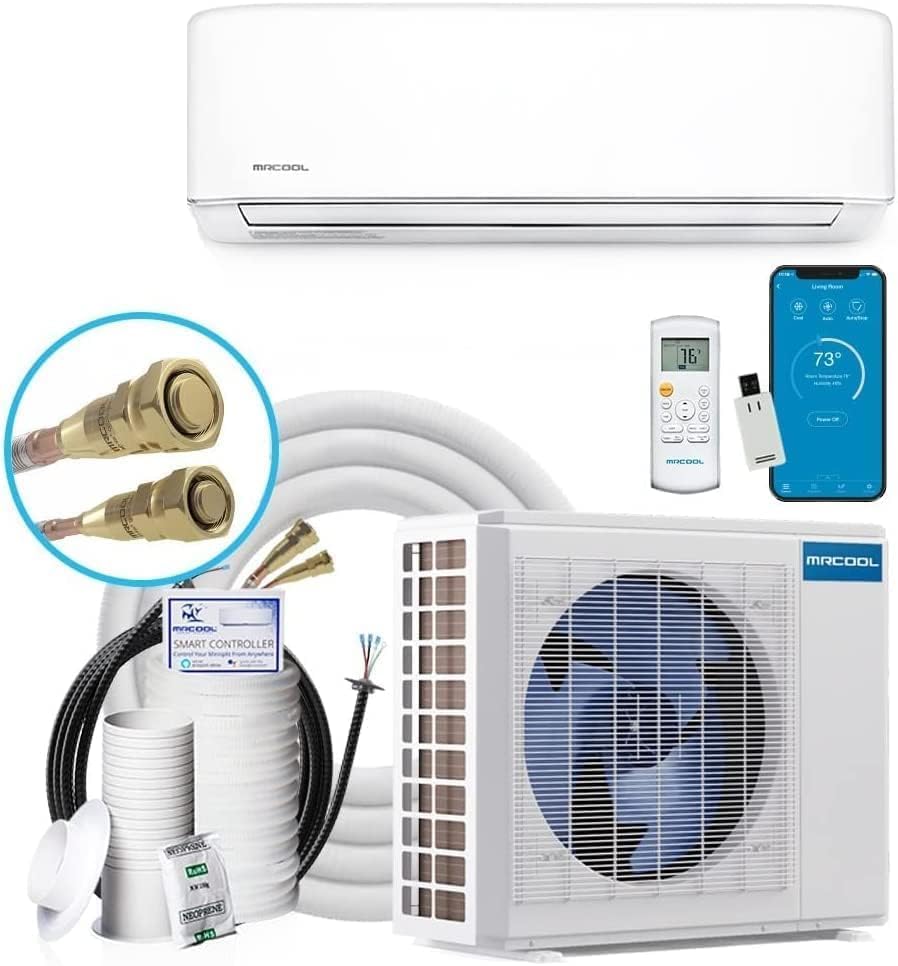
If you want to install a mini-split yourself, this is the category MRCOOL built its reputation on. The DIY 4th Generation ships with a pre-charged quick-connect line set — no brazing, no vacuum pump, no EPA 608 certification — and MRCOOL rates it up to 22.5 SEER2. It’s sized for one room up to about 500 square feet, includes a low-refrigerant alarm and filter alerts, and heats down to -22°F outdoor air.
It’s not cheap for a single-room system — at $1,718 it costs more than several pro-install alternatives here — because you’re paying for the quick-connect hardware that skips the labor bill. It carries 193 ratings at 4.3 stars. If you’re set on installing it yourself, this is the real thing.
Pros
- True DIY quick-connect, no EPA license needed
- Up to 22.5 SEER2
- Low-refrigerant alarm & filter alerts
- Heats down to -22°F outdoor air
Cons
- Pricier than several pro-install alternatives
- Fixed-length line set
- Best for one room, not whole floors
Della Serena 12,000 BTU — Best Budget Pick
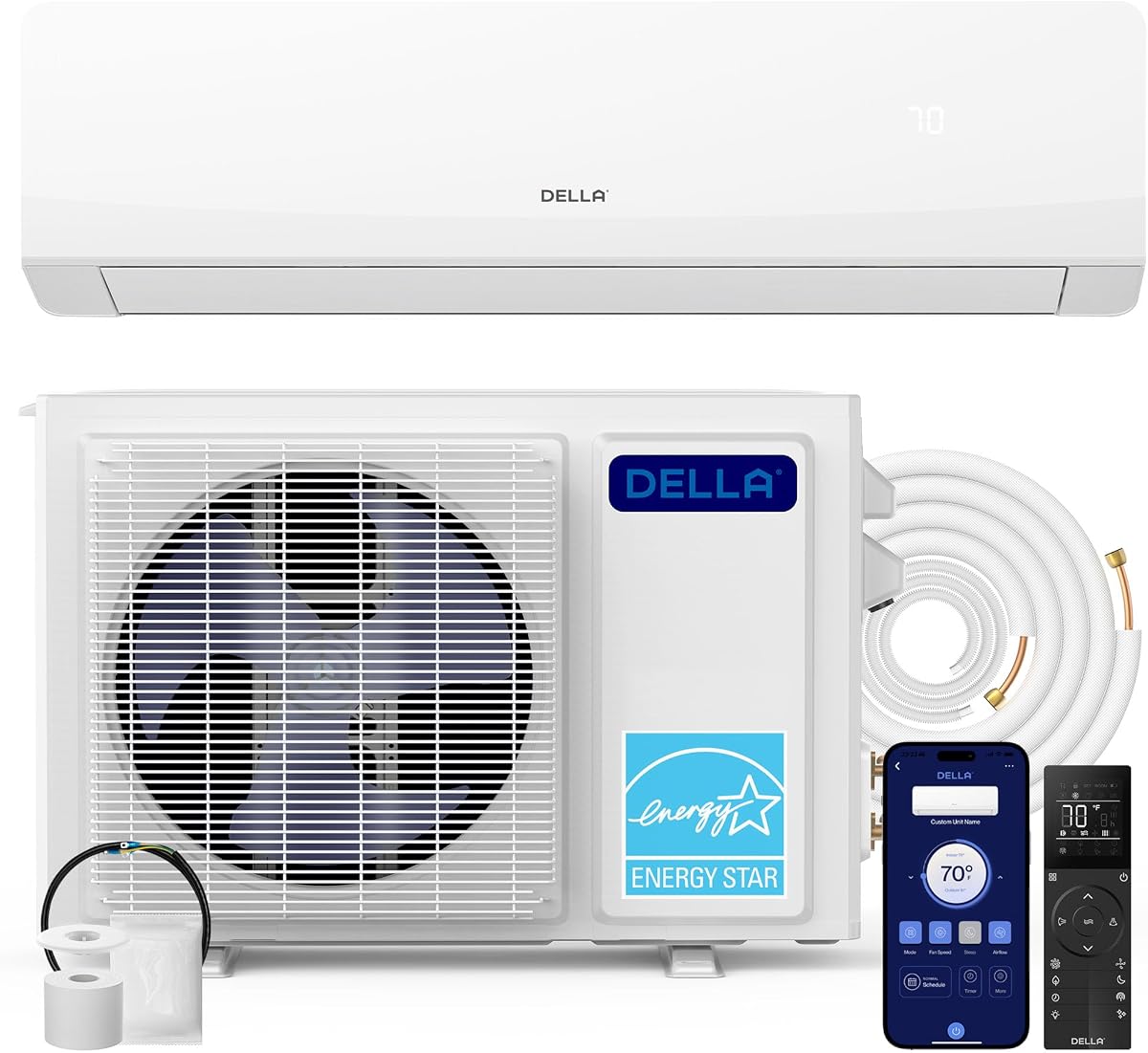
The Della Serena undercuts almost everything else here on price while still hitting 22 SEER2 and running as quiet as 22 dB. It’s rated for rooms up to 550 square feet, includes geo-location app scheduling, and comes with a 16.4-foot install kit. At $701.96 for Prime members (regularly $779.96), it’s one of the cheapest full systems that’s genuinely well-reviewed — 4.4 stars across 74 ratings, Amazon’s Choice.
Like most systems at this price, it’s pre-charged but still requires professional installation, since the line set needs vacuuming during setup. Treat the sticker price as roughly half the real project cost once an installer is added.
Pros
- Lowest price among full-featured systems here
- 22 SEER2 and 22 dB on low
- Geo-location app scheduling
- Amazon’s Choice, 4.4 stars
Cons
- Requires professional installation
- Shorter 16.4-ft install kit
- Smaller review base than the Cooper & Hunter
ROVSUN 9,000 BTU — Best Ultra-Budget Pick
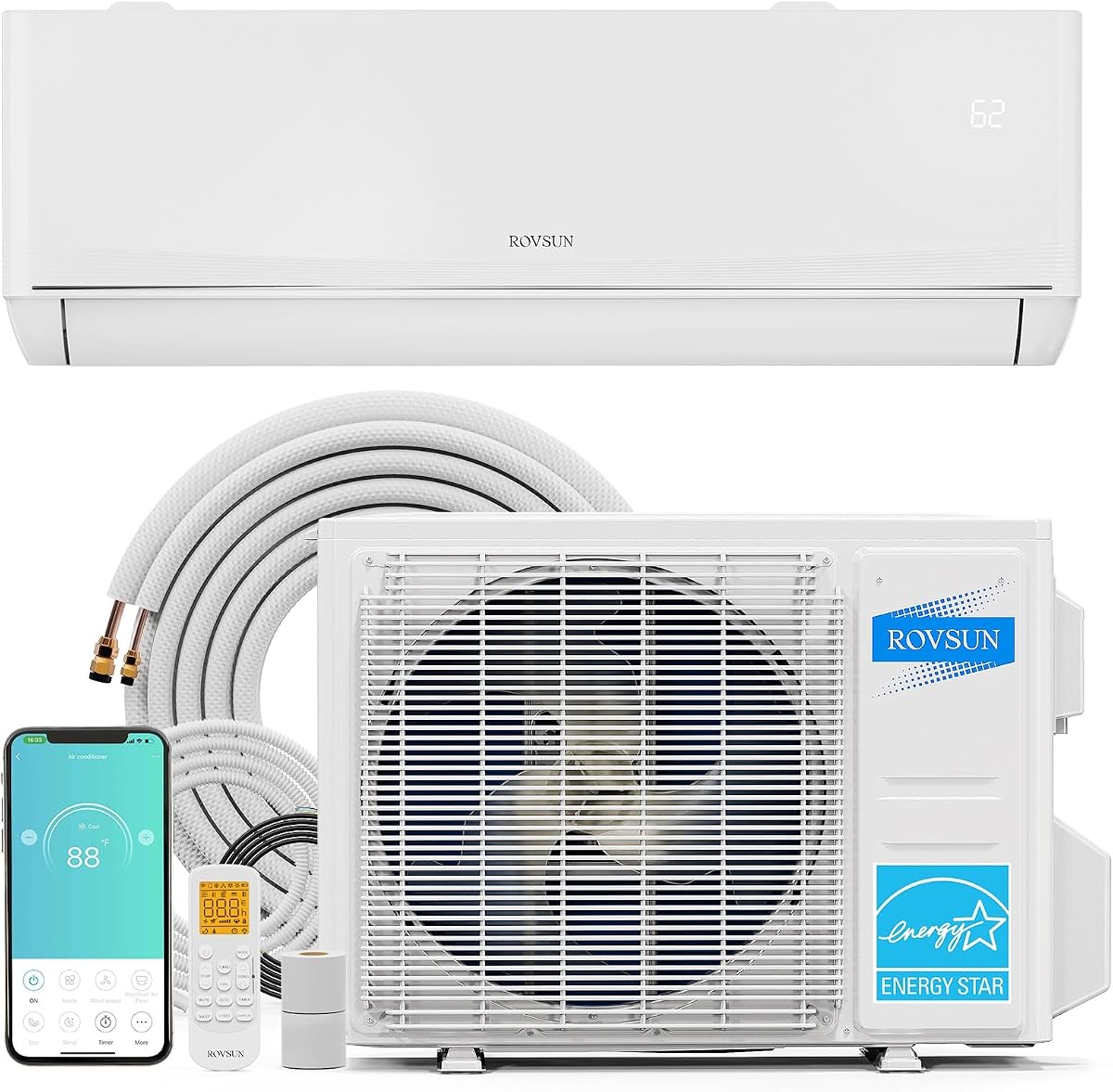
For a small bedroom, home office, or single-room addition, the ROVSUN 9,000 BTU is the cheapest complete mini-split worth buying at $499.99. It’s rated 23 SEER2, fits roughly 350–450 square feet, and includes WiFi and voice control through Alexa. Reviews sit at 4.4 stars across 61 ratings.
ROVSUN recommends licensed installation “for optimal performance and safety,” even though the condenser ships pre-charged — the same install category as the Della and Cooper & Hunter above. At 30 dB it’s not the quietest pick, but it’s hard to beat for one small room.
Pros
- Lowest price in this guide ($499.99)
- 23 SEER2 rated
- WiFi and voice control included
- Good fit for small rooms
Cons
- Smaller review sample (61 ratings)
- 30 dB, louder than premium picks
- Professional installation recommended
Senville AURA 9,000 BTU — Quietest / Premium Pick
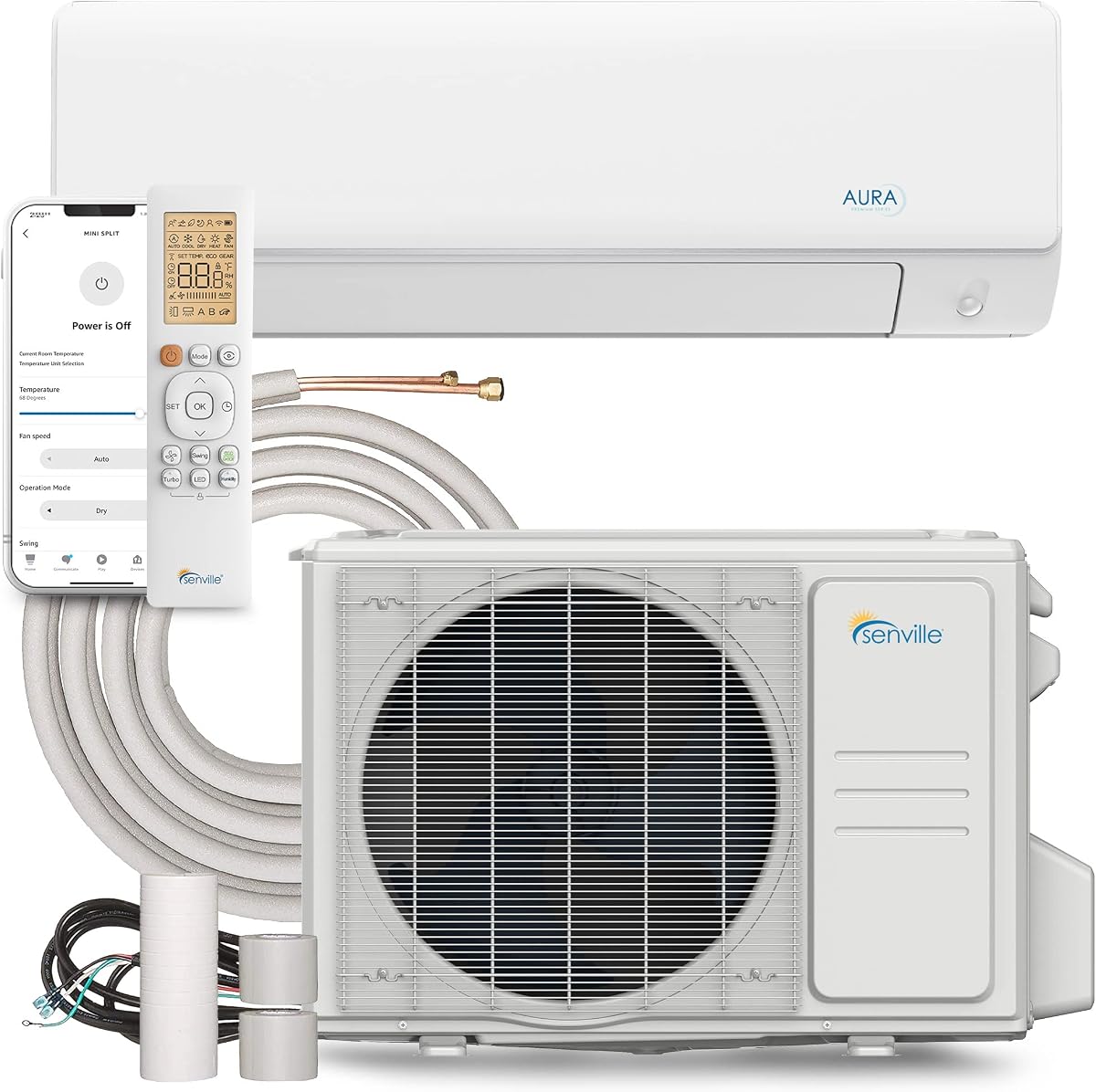
Mitsubishi, Daikin, and LG — the brands most people ask about for a whisper-quiet mini-split — mostly sell through contractor and dealer networks rather than direct on Amazon, so they aren’t verifiable and buyable the way everything else here is. The Senville AURA is the closest Amazon-available match on quietness: rated at 23.5 dB, and Energy Star and AHRI certified.
It’s rated for rooms up to roughly 350–400 square feet, works with Alexa, and carries 4.6 stars across 85 ratings. Like the other pre-charged systems here, it requires professional installation. At $1,299.99 it’s a premium price for a 9,000 BTU unit, but the quiet operation is the point.
Pros
- Rated as low as 23.5 dB
- Energy Star and AHRI certified
- 4.6 stars across 85 ratings
- Alexa compatible
Cons
- Premium price for the BTU size
- Professional installation required
- Smaller footprint than 12k-plus systems
Senville Dual Zone 28,000 BTU — Best Multi-Zone System
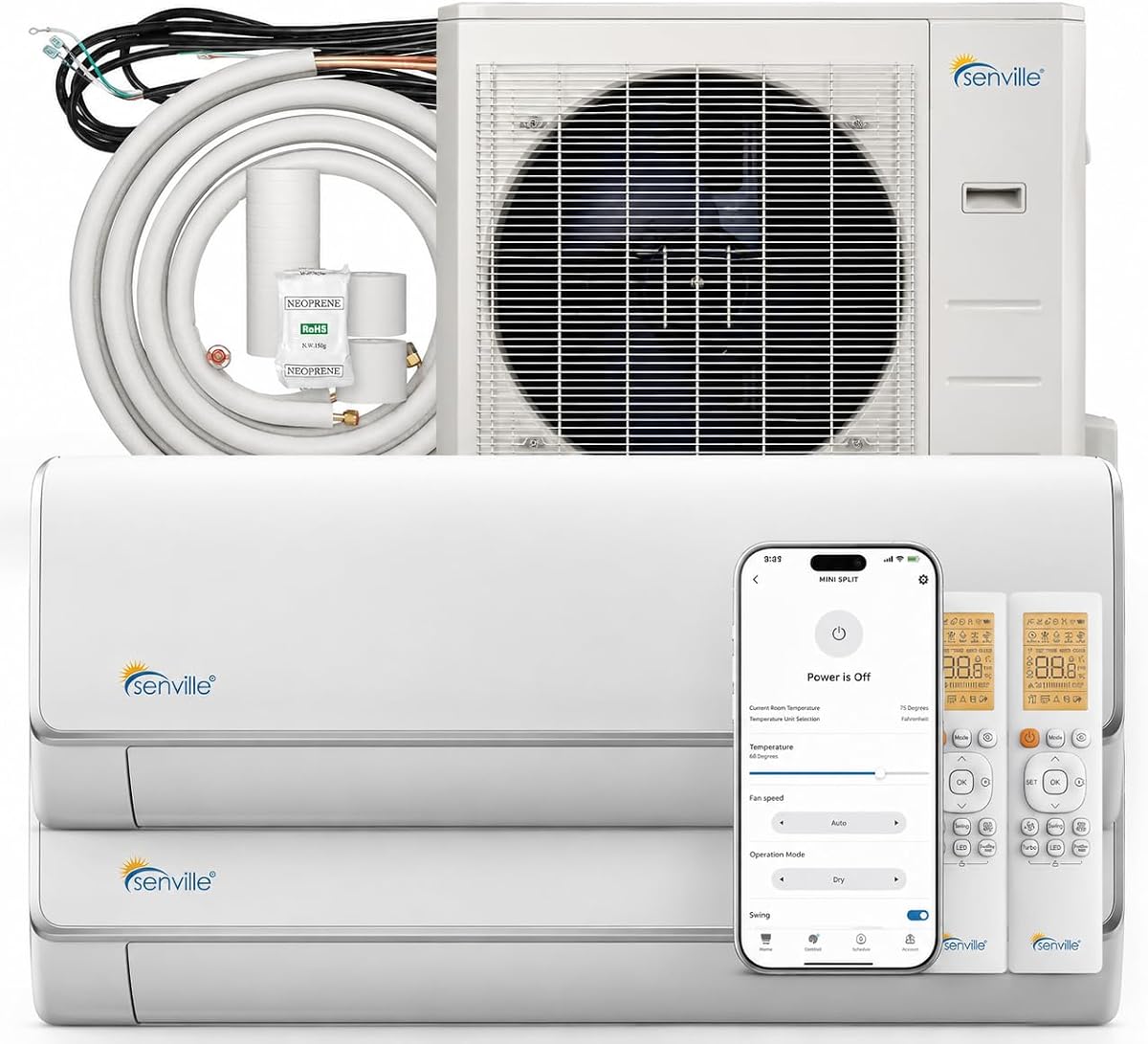
When you need two rooms on independent thermostats off one outdoor compressor — a primary bedroom and a nursery, or two offices in a converted space — the Senville Dual Zone pairs two 12,000 BTU indoor heads with a single 28,000 BTU outdoor unit. It’s rated 23 SEER2, runs as quiet as 24 dB, and carries the largest review base of any multi-zone system here: 4.5 stars across 211 ratings.
At $2,499.99 it costs less than buying two separate single-zone systems from this guide, but remember the line-set math — check both indoor units’ distance from the outdoor unit before buying, since running one zone near its limit can affect the other. A tri-zone version (three 9,000 BTU heads) is also available for $2,699.99.
Pros
- Two independent zones, one outdoor unit
- 211 ratings at 4.5 stars
- Quiet at 24 dB
- Costs less than two single-zone systems
Cons
- Professional installation required
- Line-set limits apply per zone
- Higher upfront cost
Heating Performance in Cold Climates: Why HSPF2 Matters Too
Every mini-split here is also a heat pump, and heating performance is where the spread between cheap and premium units shows up. HSPF2 measures heating-season efficiency the way SEER2 measures cooling — look for at least 8.5 HSPF2 for the ENERGY STAR heating rating, and check the low-temperature spec separately. Most standard mini-splits lose meaningful heating capacity below about 5°F outdoor air, while cold-climate-rated units like the MRCOOL DIY keep producing usable heat down to -13°F or -22°F.
If you mostly want supplemental cooling in a mild climate, this matters less. If you’re hoping to use a mini-split as a real winter heat source — a common reason to buy one for a converted garage — check the low-temperature spec directly, since similar HSPF2 ratings can hide very different cold-weather cutoffs.
Noise Levels, Maintenance, and What to Budget Beyond the Unit
Indoor noise here ranges from 22 dB (Della, lowest setting) to 30 dB (Cooper & Hunter and ROVSUN) — 30 dB is close to a quiet library, 22 dB close to rustling leaves. Outdoor compressor noise runs louder, typically mid-50s dB, so consider where that unit will sit relative to a bedroom wall or a neighbor’s window.
Maintenance is light next to central air: wash or vacuum the pre-filters monthly during heavy use, and have a technician check the charge and clean the outdoor coil every year or two. Budget for what a spec sheet skips — a dedicated 208/230V circuit if your panel lacks one, a condensate pump if gravity drainage isn’t an option, and a permit in many municipalities, since this is a permanent installation, not a plug-in appliance. A basic HVAC diagnostic kit is worth owning if you’ll maintain the system yourself.
FAQ
Do I need a permit to install a mini-split?
Often, yes. A mini-split involves permanent electrical wiring and, for non-DIY systems, refrigerant handling, so many municipalities require an electrical and sometimes a mechanical permit, even for a single-zone system. Check with your local building department first — the refrigerant line may be DIY-legal, but the electrical work usually still needs to meet code.
Can I install a mini-split myself without any HVAC experience?
Only with a true quick-connect DIY kit, like the MRCOOL DIY line here. Those systems use a sealed coupler that never opens the refrigerant circuit, so no EPA 608 certification is required. Standard pre-charged systems that need the line set vacuumed and charged — most mini-splits, including several in this guide — legally require a licensed technician for that step.
What’s the difference between SEER and SEER2?
SEER2 is the current efficiency rating, in effect since 2023, tested under a tougher airflow-resistance standard than the old SEER test. SEER2 numbers run roughly 4–5% lower than SEER numbers would have shown on the same equipment, so don’t compare a pre-2023 SEER rating directly to a current SEER2 rating.
How many BTUs do I need for a 300-square-foot room?
Start at 20 BTU per square foot for an 8-foot ceiling with decent insulation — 6,000 BTU for 300 square feet. Add roughly 10% for every 2 feet of ceiling height above 8 feet, another 25–30% for poor insulation or heavy sun, and 4,000–6,000 flat for a kitchen. Most 300-square-foot rooms end up needing 9,000 to 12,000 BTU once those adjustments are in.
How much does it cost to install a mini-split?
Equipment here runs $500 to $2,500 depending on size, zones, and brand. Add $500 to $2,000 for professional labor if you’re not using a true DIY quick-connect kit, plus more for new electrical wiring, a condensate pump, or a permit. A DIY kit is often the lowest total cost once labor is factored out, even though the equipment costs more upfront.
Bottom Line
A mini-split earns its keep in the room central air can’t reach — a converted garage, a finished attic, an addition, a sunroom. Size it by real cooling load, not a flat chart; decide whether you’re installing it yourself or hiring a licensed tech before you fall for a price tag; and match zones to how many rooms need separate control. The Cooper & Hunter 18,000 BTU MIA Series is the best overall pick. For a genuinely DIY-legal install, go with the MRCOOL DIY 4th Gen. On a budget, the Della Serena or ROVSUN deliver real SEER2 efficiency under $800; the Senville AURA is the quietest, and the Senville Dual Zone covers two rooms off one compressor.
Editorial note: Prices, review counts, SEER2 figures, and availability change after publication — confirm the current listing before buying, and confirm local permit and electrical requirements with your municipality before installing.