
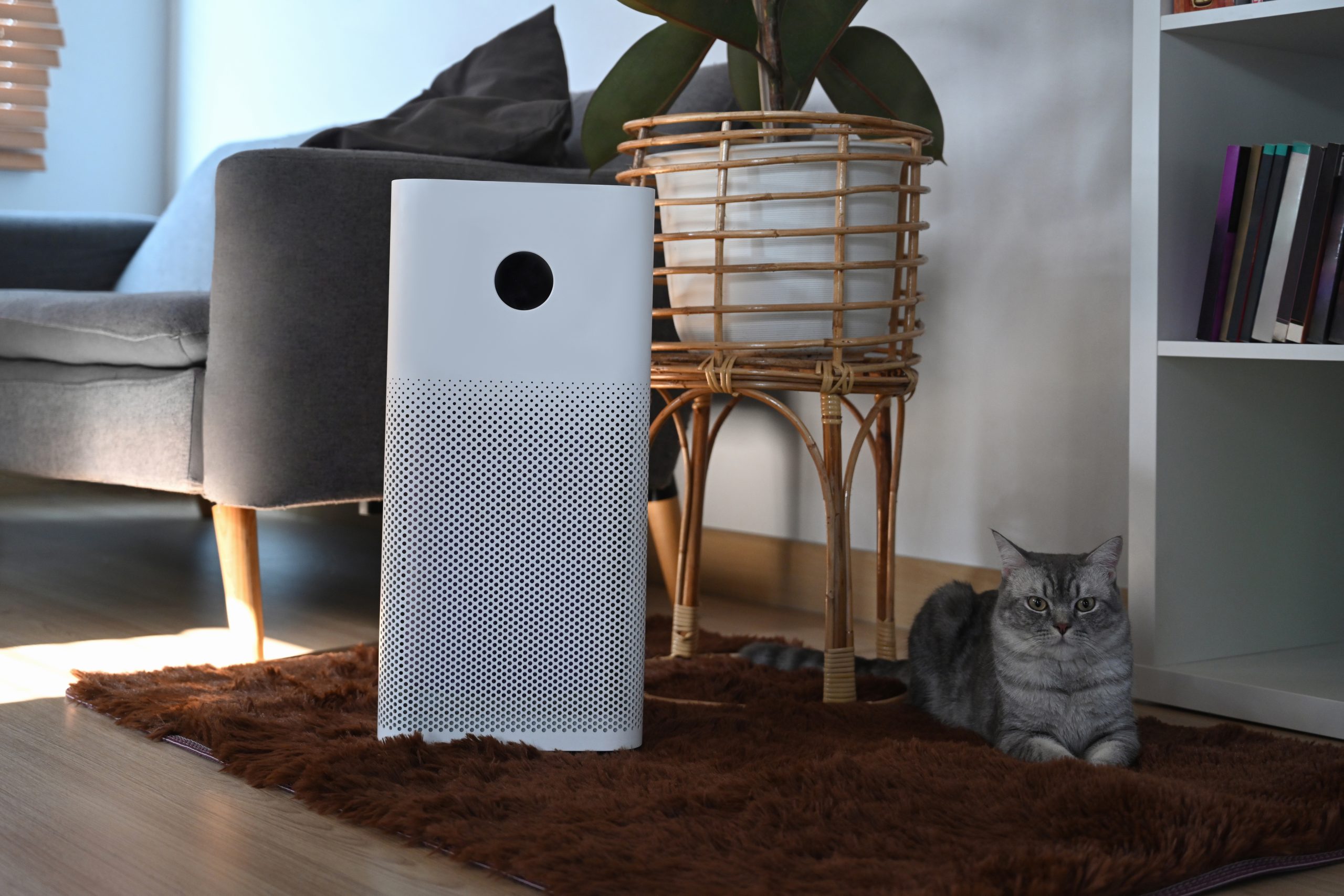
If you live with a shedding dog or a cat and a litter box, the air purifier I would buy first is the Levoit Core 600S-P: genuine HEPA-and-carbon filtration, a pre-filter that grabs floating fur, an AHAM-verified clean-air rate for big rooms, and a low yearly filter bill. A purifier handles what floats — airborne dander and odor. The hair on your couch still needs a vacuum.
Figures here come from manufacturer and AHAM Verifide data, current Amazon pricing, and owner reviews. This is not based on in-house lab testing. Prices and availability shift, so check the current listing before you buy.
Pets add three things to your air: fine dander that triggers allergies, coarse hair that clogs filters, and odor that HEPA alone does nothing about. A good pet air purifier deals with all three, and the seven picks below cover every room size and budget without overpaying for marketing.
Quick picks
- Best overall: Levoit Core 600S-P — big-room CADR, carbon-pellet odor filter, quiet, cheap filters
- Best for dander and allergies: Coway Airmega AP-1512HH — long track record, washable pre-filter, sensor
- Best value: Winix 5510 — washable pre-filter and washable carbon, lowest yearly cost here
- Best for pet hair: Levoit Vital 200S-P — wide U-shaped intake that pulls in floating fur
- Best for a small room or the litter-box room: Levoit Core P350-P — pet-tuned carbon at around $130
- Best for heavy pet odor: Austin Air HealthMate — 15 pounds of carbon and zeolite, five-year filter
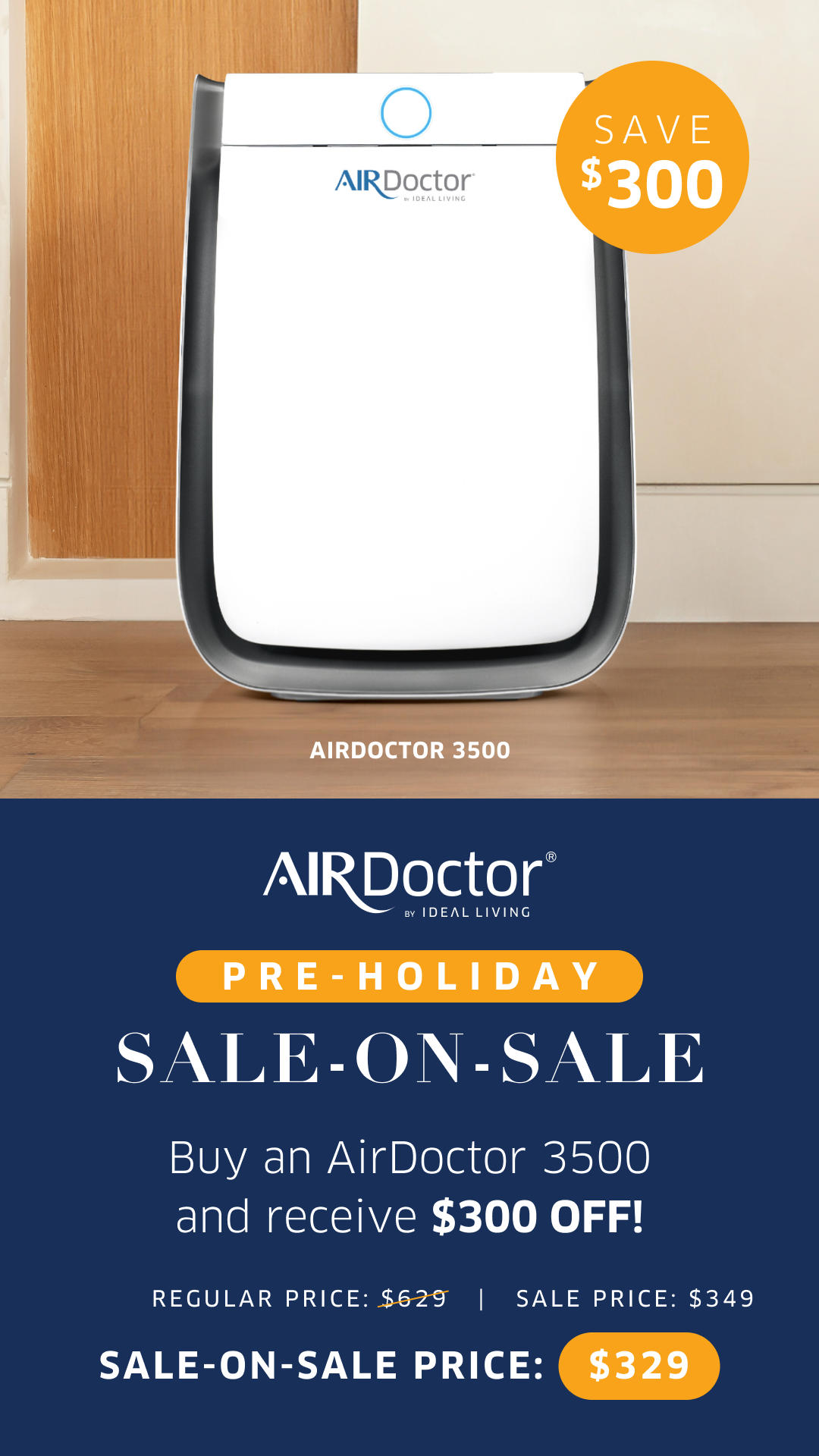
- Best premium: AirDoctor 3500 — sealed UltraHEPA plus a heavy gas and VOC filter
Table of Contents
Best Air Purifiers for Pets: Comparison
The table lines all seven up on what decides a pet purchase: CADR, the room size that covers at four to five air changes an hour, whether the pre-filter can be cleaned instead of binned, how the carbon layer is built, a realistic yearly filter cost for a fur-heavy home, noise, price, and rating.
| Model | CADR smoke / dust / pollen (cfm) | Rated room size | Cleanable pre-filter | Carbon layer | Est. annual filter cost (pet home) | Noise (low–high) | Price | Rating |
|---|---|---|---|---|---|---|---|---|
| Levoit Core 600S-P | 391 cfm overall (Levoit; not split by type) | ~606 sq ft at 4.8x | Yes, vacuum-clean | Activated carbon pellets | ~$50–70 | 26–55 dB | ~$289 | 4.7 |
| Coway Airmega AP-1512HH | 233 / 246 / 240 | ~360 sq ft | Yes, washable mesh | Coated deodorization filter | ~$55–75 | ~24–53 dB | ~$230 | 4.6 (29,046) |
| Winix 5510 | ~232 / ~243 / ~246 (Winix) | ~360–390 sq ft | Yes, washable mesh | Washable carbon filter | ~$35–55 | ~23.5–62 dB | ~$180 | 4.6 (32,161) |
| Levoit Vital 200S-P | 250 / 254 / 289 | ~380 sq ft | Yes, washable | Coated HEPA-plus-carbon (3-in-1) | ~$55–75 | ~25–52 dB | ~$170 | 4.7 (14,916) |
| Levoit Core P350-P | 140 / 145 / 165 | ~215 sq ft | Yes, vacuum-clean | Pet-tuned ARC-formula carbon | ~$35–50 | 24–50 dB | ~$130 | 4.7 (13,652) |
| Austin Air HealthMate (HM400) | Not AHAM-rated; maker cites ~400 cfm | ~750 sq ft (4–5x) | Yes, large perforated pre-filter | 15 lb activated carbon / zeolite | ~$80–95 (one 5-year filter) | ~50–66 dB | ~$845 | 4.4 (239) |
| AirDoctor 3500 | 340 (AirDoctor); dust/pollen not published | ~630 sq ft | Yes, pre-filter | Dual carbon / VOC with potassium permanganate | ~$200+ | 39–59 dB | ~$629 | — |
How I Picked the Best Air Purifiers for Pets
There is no in-house chamber testing behind this list. It draws on maker spec sheets, the AHAM Verifide database of independently confirmed CADR figures, live Amazon prices and ratings, and long-term owner reports from homes with shedding animals. When a brand skips AHAM or only publishes one combined CADR, I say so. Every model here pairs a real HEPA filter with a genuine carbon layer, has a pre-filter you clean instead of replace, and leaves any ionizer as an option you can switch off.
Best Overall: Levoit Core 600S-P
For a house with a shedding dog, two cats, or an open living-and-kitchen space, this is the one I would buy. The Levoit Core 600S-P pairs a genuine H13 HEPA layer with an activated-carbon-pellet panel, and Levoit’s AHAM-verified figure of 391 cfm turns over about 606 square feet at 4.8 air changes an hour. The pellets hold more carbon than the thin coated mats in compact units, so it stays on top of litter-box and dog smell for longer. A laser sensor drives a PM2.5 readout and auto mode, sleep mode sits near 26 decibels with the display off, and the outer pre-filter panel vacuums clean in seconds. Budget about $50 to $70 a year for replacements in a pet home. Downsides are minor: the app wants an account, the unit is tall, and it is audible at top speed.
Pros
- Big-room CADR verified by AHAM
- Carbon pellets hold up to pet odor
- Quiet on sleep mode
- Accurate sensor and auto mode
- Pre-filter vacuums clean
Cons
- App requires an account
- Tall footprint
- Loud at top speed
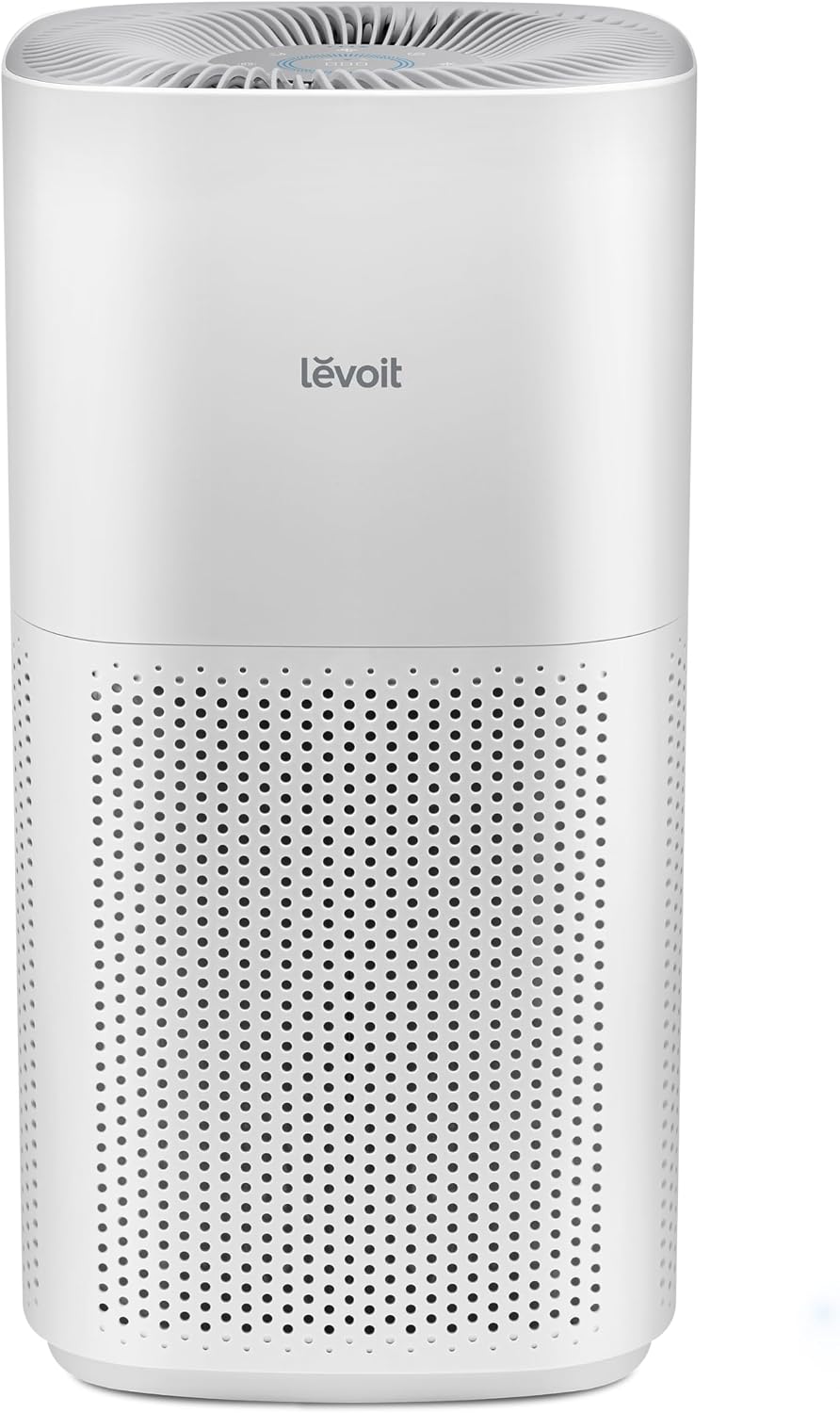
For a room closer to 300 square feet the Coway or Winix below cost less to buy and run; for a bedroom, the Core P350-P is plenty. To size it against your own room, run the numbers through our CADR calculator.
Best for Dander and Allergies: Coway Airmega AP-1512HH
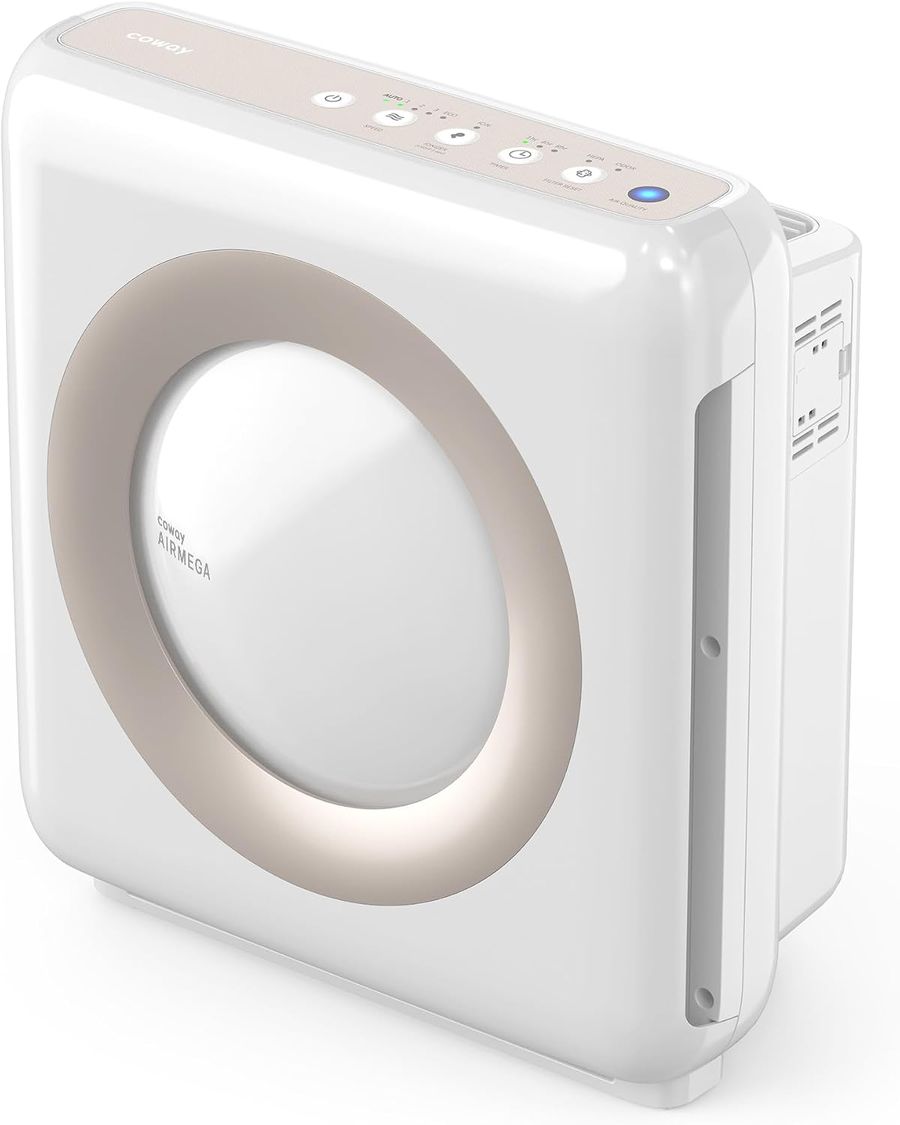
The Coway Airmega AP-1512HH, sold as the “Mighty,” has been the default allergy pick for close to a decade, and fine pet dander is exactly what it was built to catch. Its AHAM CADR is 246 for dust, 240 for pollen, and 233 for smoke, covering about 360 square feet at nearly five air changes an hour. What suits it to pet homes is the washable mesh screen that traps hair and grit before it packs into the pleated HEPA — you rinse it every couple of weeks instead of paying for it. A coated carbon filter handles everyday pet smell, genuine replacement sets run $55 to $75 a year, a sensor drives auto mode, and the ionizer has a labeled off switch. Our guide to the best air purifiers for allergies covers placement and filter choices in more depth.
Best Value: Winix 5510
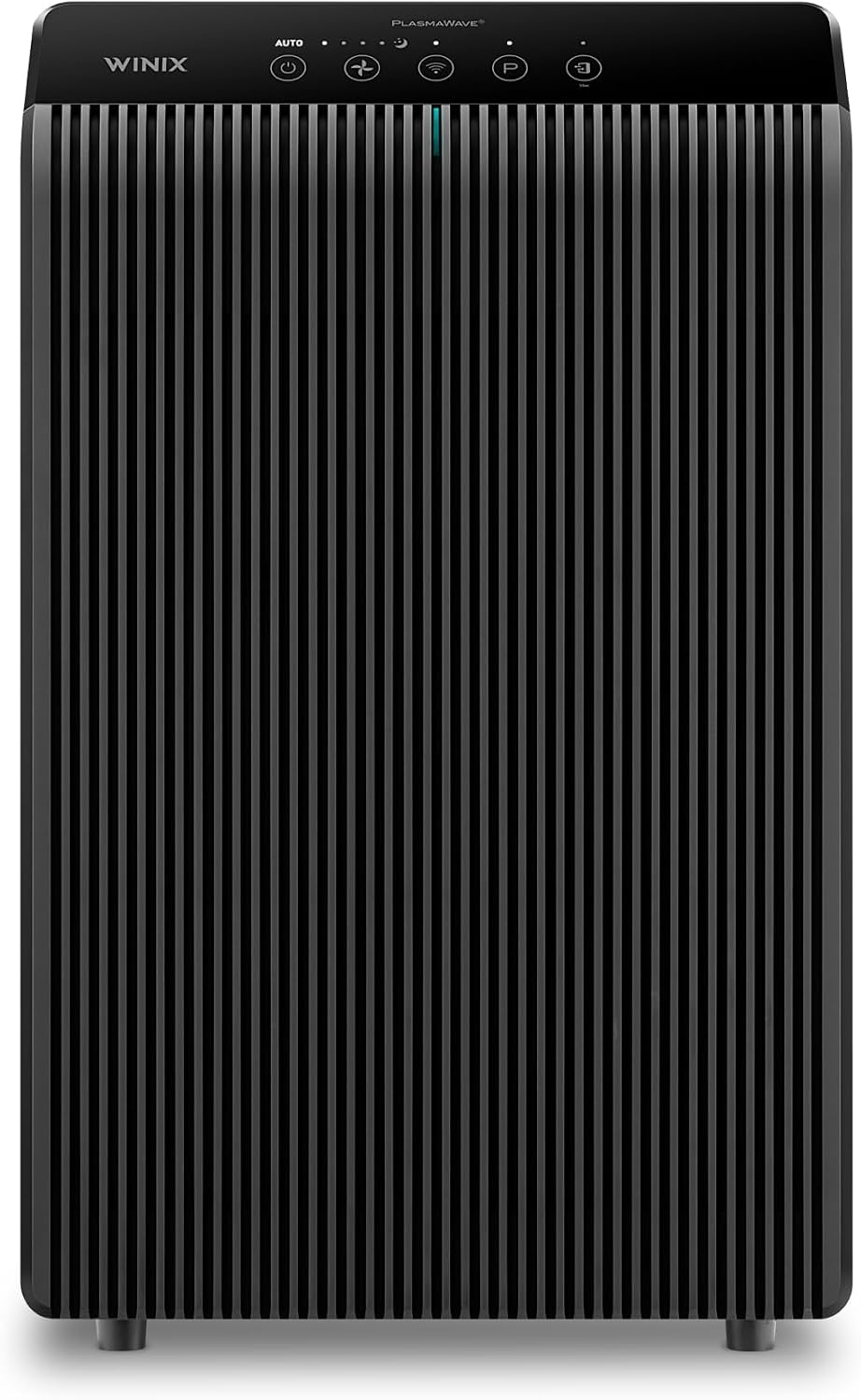
The Winix 5510 updates the popular 5500-2, and it earns the value slot in a fur-heavy home because two of its three filter stages wash and go back in: the mesh pre-filter and the carbon deodorizing filter both rinse clean, leaving only the True HEPA to buy. That holds running cost to roughly $35 to $55 a year, the lowest here. Winix lists a CADR near 232 for smoke, 243 for dust, and 246 for pollen, enough for 360 to 390 square feet, with a low speed rated at 23.5 decibels. Turn off the PlasmaWave ionizer, and keep it on auto or low — reviewers clock it past 60 decibels at full tilt.
Best for Pet Hair: Levoit Vital 200S-P
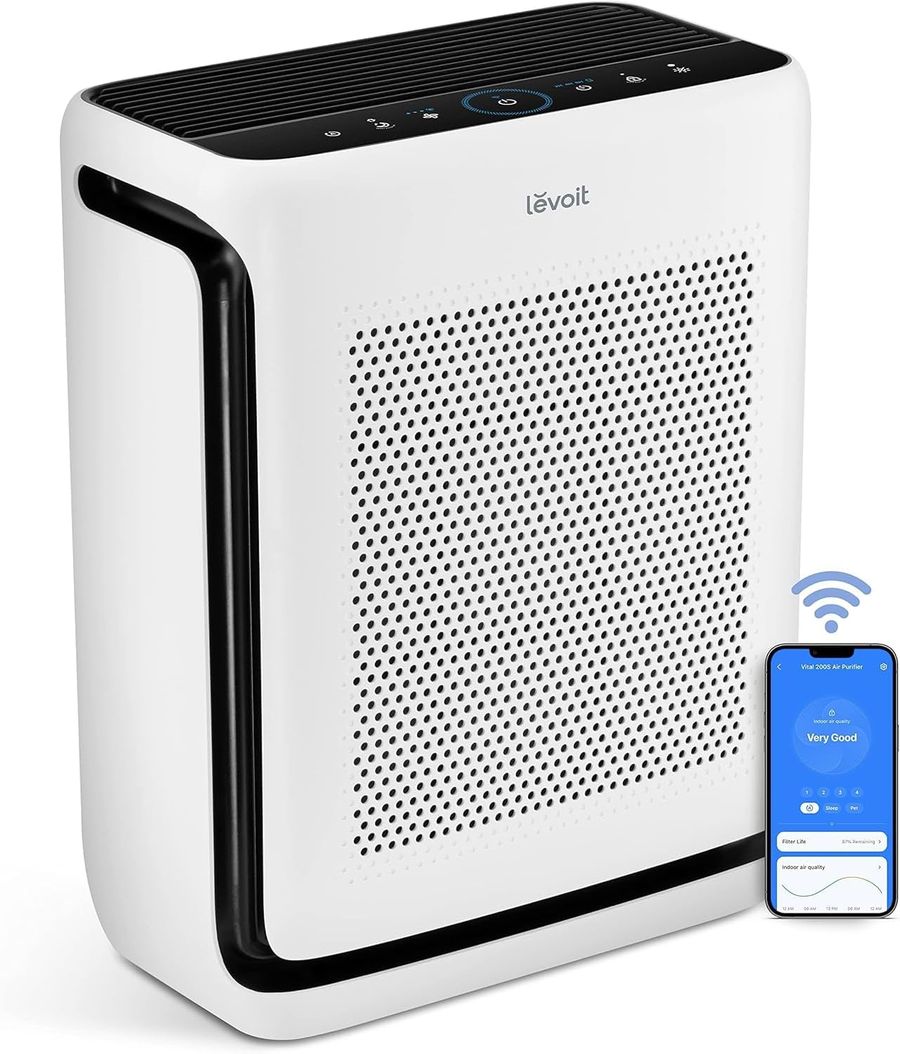
Floating fur defeats most purifiers before the filter gets a chance, and the Levoit Vital 200S-P is built around that problem. Instead of a small grille, it draws air through a wide U-shaped inlet down three sides of the cabinet, so lightweight hair gets pulled in from a low angle rather than drifting past. Behind that sits a washable pre-filter, then a genuine HEPA-and-carbon 3-in-1 filter. Its AHAM-verified CADR is 250 for smoke, 254 for dust, and 289 for pollen, enough for a room close to 380 square feet, and the lowest setting is rated near 25 decibels. It has a sensor, a display-off button, and a top handle; filters run $55 to $75 a year and the cabinet is bulkier than the Core line. For a bedroom placement, our roundup of the best air purifiers for the bedroom compares sleep-mode noise across more models.
Best for a Small Room or the Litter-Box Room: Levoit Core P350-P
The Levoit Core P350-P is Levoit’s pet-specific compact unit, and it is what I would put in a bedroom, a home office, or the small room where the litter box lives. It is AHAM-verified with a CADR of 140 for smoke, 145 for dust, and 165 for pollen, which turns over roughly 215 square feet at nearly five air changes an hour. Levoit swaps its standard carbon for an ARC-formula blend aimed at animal odor, and the pre-filter is a non-woven panel you vacuum. It is plain: three speeds, a timer, a filter light, a pet lock so a curious paw cannot change settings, no Wi-Fi or sensor. Filters run about $35 to $50 a year. Do not stretch it to a living room; for a small space it is the cheapest honest option here at around $130.

Best for Heavy Pet Odor: Austin Air HealthMate
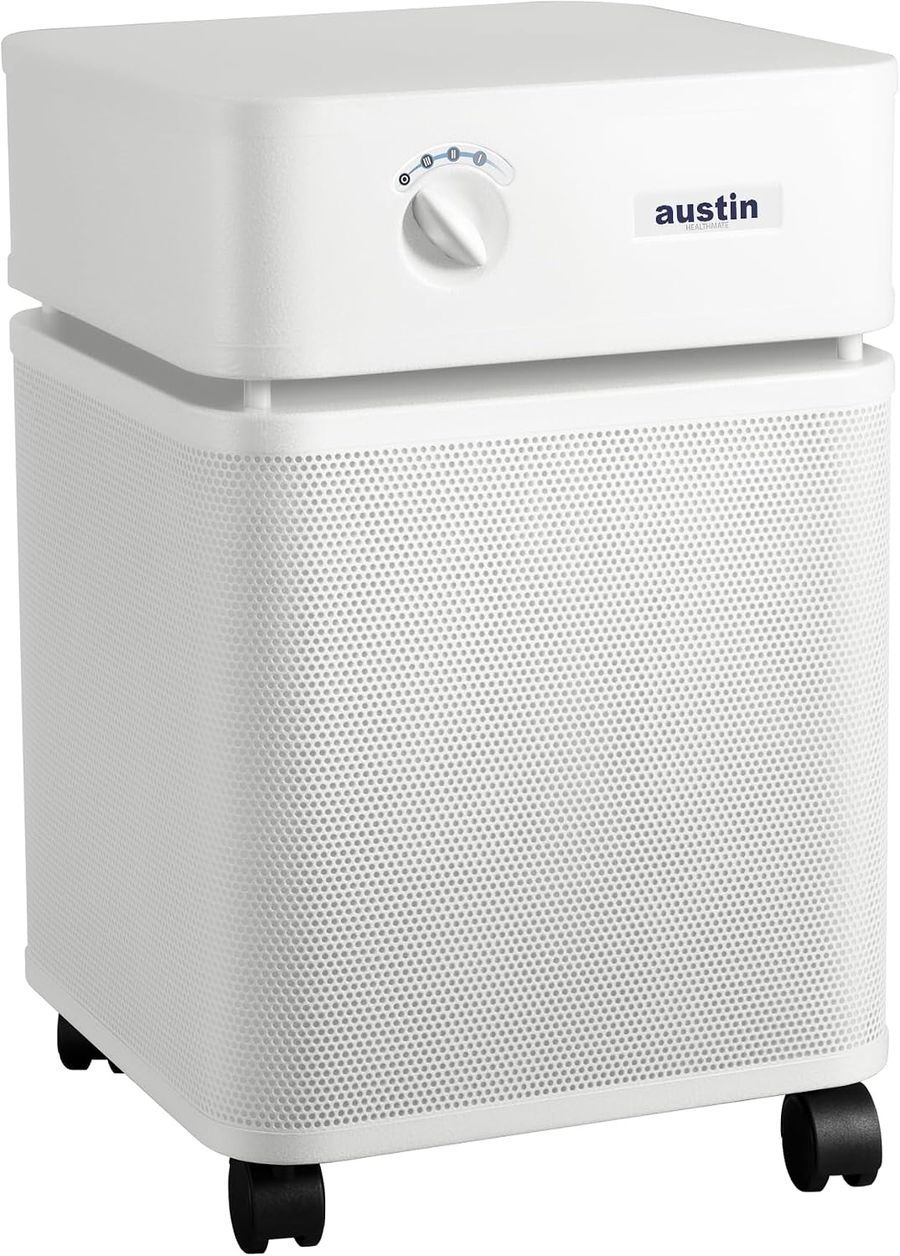
Most pet purifiers carry a few ounces of carbon, which freshens everyday dog smell but saturates fast against a strong, constant source like a multi-cat litter room. The Austin Air HealthMate is the exception: behind its true HEPA layer sits a 15-pound bed of activated carbon and zeolite, housed in a sealed steel cabinet. That is the machine for odor a house has held onto for years — the kind you stop noticing but guests do not. Austin skips AHAM testing, so there is no verified smoke or pollen number; plan on about 750 square feet for four to five air changes an hour, not the “up to 1,500 square feet” claim. The one filter lasts five years and costs $400 to $470 to replace, roughly $80 to $95 a year. It is heavy, sensorless, and loud at speed — you buy it purely for the carbon.
Best Premium: AirDoctor 3500
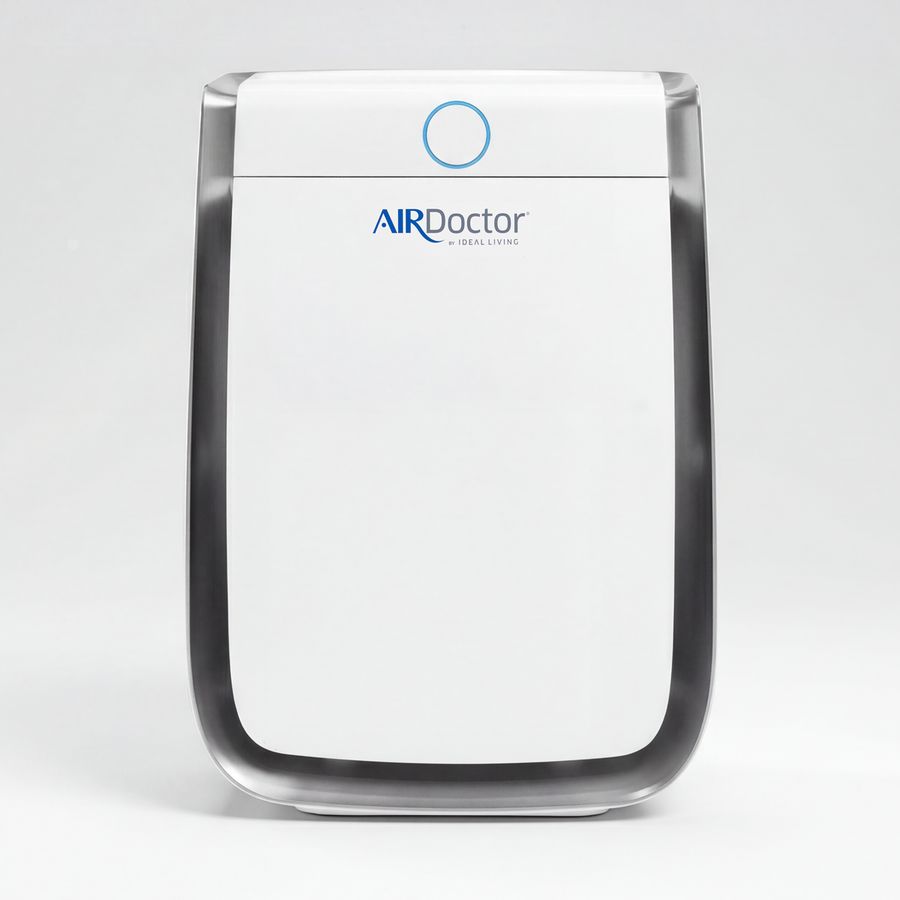
For a large main room where you want top-tier dander capture and real gas handling in one box, the AirDoctor 3500 is the upgrade. Its sealed UltraHEPA filter is rated at 99.99% capture down to 0.003 microns, and a dual-layer carbon and VOC filter with potassium permanganate backs it up — handy where pet odor mixes with cooking and cleaning-product fumes. AirDoctor cites a 340 CADR and about 630 square feet at four air changes an hour, without breaking out dust and pollen. Auto mode keeps noise in the 39-to-59-decibel band. Filters are the sting: an UltraHEPA yearly plus a carbon/VOC filter roughly twice a year, well past $200 annually and the most expensive here to run. Our full AirDoctor 3500 review digs into the sealed-housing claims and filter schedule.
What an Air Purifier Fixes for Pets, and What It Cannot
A purifier only cleans what is floating in the room it sits in, so it helps with two of your three pet problems: airborne dander — the flake-sized skin particles that carry the protein most people react to — and odor, once there is real carbon in the filter. A right-sized HEPA unit measurably lowers the dander load in that room within an hour, which is why a bedroom purifier often helps an allergic sleeper. It does little for the hair itself: most pet hair is too heavy to stay airborne and lands on the couch and floor, where a vacuum, a lint roller, and regular grooming are the only fix. It also does nothing for dander worked into carpet, or for odor at the source — a litter box still needs scooping. Treat the purifier as the airborne layer of a routine that also includes cleaning and grooming. For the biology behind the trigger, see our explainer on what pet dander is.
The Pre-Filter Is the Part That Matters Most
In a home without pets, the pre-filter barely registers. In a home with a shedding animal, it is the difference between a HEPA filter that lasts a year and one matted with fur in three months. The pre-filter is the coarse outer screen that stops hair and lint before they reach the pleated media; when it clogs, airflow drops, the CADR you paid for disappears, and the hair that slips through packs into folds you cannot clean. So favor a model with a pre-filter you can physically clean — a washable mesh screen you rinse under the tap, like the Coway and Winix units here, or a rigid panel you vacuum, like the Levoit Core models. Avoid units where the “pre-filter” is a thin fabric wrap glued to the main filter. Clean it every two to four weeks, more often during a seasonal blowout.
Carbon Depth Is What Beats Litter-Box Smell
HEPA does nothing for odor. Litter-box ammonia, “dog smell,” wet fur, and the general funk of a house with animals are gas-phase, and only activated carbon adsorbs them — but carbon comes in wildly different amounts. A thin carbon-coated mat, standard in compact units, freshens a room for a few months and then quietly quits. A pelletized carbon panel, like the Core 600S-P’s, holds far more and lasts longer; a dedicated carbon machine like the Austin Air HealthMate carries pounds of it and works for years. If odor is your main reason for buying, weight the choice toward carbon mass and expect to replace that layer before the HEPA. If dander and hair are the priority and the smell is mild, a standard carbon layer in a Coway or Vital 200S is fine. Our breakdown of air purifier filter types explains how coated, granular, and pelletized carbon differ.
Sizing a Purifier to a Room With Pets
CADR — clean air delivery rate, measured by AHAM in cubic feet per minute — tells you how fast a unit actually clears a room, and it is the spec marketing hides behind a big “cleans up to 1,700 sq ft” headline. Pet dander mostly sits in the 2-to-10-micron range and is easy for any true HEPA to catch, so your limiting factor is airflow, not filter quality. Multiply the room’s square footage by 0.66 for the minimum smoke CADR you want; that delivers close to five air changes an hour under an eight-foot ceiling. Two air changes an hour makes the air “better,” but four to five is what counts when someone has a pet allergy or asthma, because dander keeps being produced as long as the animal is in the room. So size up, and halve or third the maker’s “up to X sq ft” claim before you trust it. To match your room to verified numbers, see our list of air purifiers ranked by CADR.
What Filters Really Cost in a Pet Home
The sticker price is a third of the story, and pet homes are harder on filters than the spec sheet assumes: fur loads the pre-filter and the HEPA faster, so real filter life often runs 30 to 50 percent shorter than the rated interval. The Winix 5510 washes and reuses both its pre-filter and its carbon filter, leaving only the True HEPA as a consumable at roughly $30 to $40 a year — about $35 to $55 all in, the cheapest here. The Levoit Core 600S-P uses one 3-in-1 filter at $30 to $35, replaced every six to nine months in a pet home, so about $50 to $70 a year. The AirDoctor 3500 needs an UltraHEPA filter yearly plus a carbon/VOC filter about every six months — well over $200 a year, the highest here. Our air purifier filter replacement cost guide lists per-year figures for most current models.
Noise, and Where to Put It in a Pet Home
A purifier that is too loud gets turned down, and then it is not cleaning anything. Check the sleep-mode rating: near or below 25 decibels it disappears at night, and the Core 600S-P, Core P350-P, and Vital 200S-P are all close, while the Winix 5510 and Austin Air both pass 60 decibels wide open. Buy enough CADR that your target air-change rate happens on speed one or two. Placement matters for pets: put the unit where the animal spends time and dander gets stirred up — beside the cat tree, near the dog bed, a few feet from the litter box — not out in a hallway. Leave clearance at the intake, raise it slightly off the floor so it is not just inhaling settled hair, and run it continuously, because the dander load rebuilds within an hour of shutting it off.
Skip Ozone, and Be Careful With Ionizers Around Pets
Do not buy a purifier that deliberately makes ozone. Ozone is a lung irritant, health agencies are clear that ozone generators sold as air cleaners are unsafe in occupied rooms, and “activated oxygen” does not change that. It matters more in a pet home, not less: birds are extremely sensitive to airborne irritants, and cats and dogs breathe faster and closer to the floor than you do. Several purifiers include a switchable ionizer — PlasmaWave on the Winix, the toggle on the Coway — that still makes trace ozone and mostly pushes particles onto your walls rather than removing them, so leave it off and let the HEPA do the work. Be equally wary of purifiers built around a proprietary reactive coating sold as destroying pet allergens at the molecular level; independent testing usually comes back underwhelming next to a plain HEPA-and-carbon unit at the same price.
FAQ
Do air purifiers really help with pet dander and allergies?
Yes, for the airborne part. A right-sized HEPA purifier measurably lowers floating pet dander in the room it occupies, and people with mild to moderate pet allergies often notice fewer symptoms there, especially in the bedroom. It does not touch dander already settled into carpet and bedding, so pair it with washing pet bedding and vacuuming. Our article on whether an air purifier helps with pet allergies walks through the evidence.
Will an air purifier get rid of pet hair?
Only the light, airborne fraction. Most pet hair is too heavy to float for long and lands on surfaces, where a vacuum and a lint roller are the real fix. A purifier catches drifting undercoat and stops it recirculating — a wide-intake model like the Vital 200S-P does that better than a small-grille unit — but no purifier clears a room of visible hair.
Does an air purifier remove litter-box and dog smell?
It reduces it, if the filter holds enough activated carbon. A thin coated layer takes the edge off for a few months; a pelletized carbon panel lasts longer; a dedicated carbon unit like the Austin Air HealthMate handles strong, persistent odor. In a strong-odor home the carbon saturates within months and needs replacing before the HEPA does.
What CADR do I need for a room with pets?
Multiply the room’s square footage by 0.66 and shop for a smoke CADR at or above that number. Because pet allergens are produced continuously, aim 20 to 30 percent above that minimum so you can hit four to five air changes an hour on a quieter speed.
How often will I replace filters if I have pets?
More often than the box says. Fur loads the pre-filter and HEPA media faster, so plan on real filter life 30 to 50 percent shorter than the rated interval. Cleaning the pre-filter every two to four weeks helps, and a model with a washable carbon filter, like the Winix 5510, removes one recurring cost entirely.
Are ionizing air purifiers safe around pets and birds?
Ozone generators are unsafe in any occupied room and especially risky around birds, which have very sensitive airways. Switchable ionizers are milder but still make trace ozone and mainly deposit particles onto surfaces; leave them off and let the HEPA filter work.
Bottom Line
Size the purifier to your largest lived-in room, insist on a true HEPA filter with a real carbon layer, and pick one whose pre-filter you can wash or vacuum so fur does not wreck the expensive filter. For most pet homes the Levoit Core 600S-P is the right balance of verified CADR, carbon-pellet odor control, and a low yearly filter cost. Drop to the Coway AP-1512HH or Winix 5510 for mid-size rooms, the Core P350-P for a bedroom or litter-box room, and step up to the Austin Air HealthMate or AirDoctor 3500 only if odor and VOCs are the main problem. If pets are not your primary concern, our general guide to the best air purifiers for home covers the wider field. Whatever you pick, run it continuously and leave any ionizer off.