

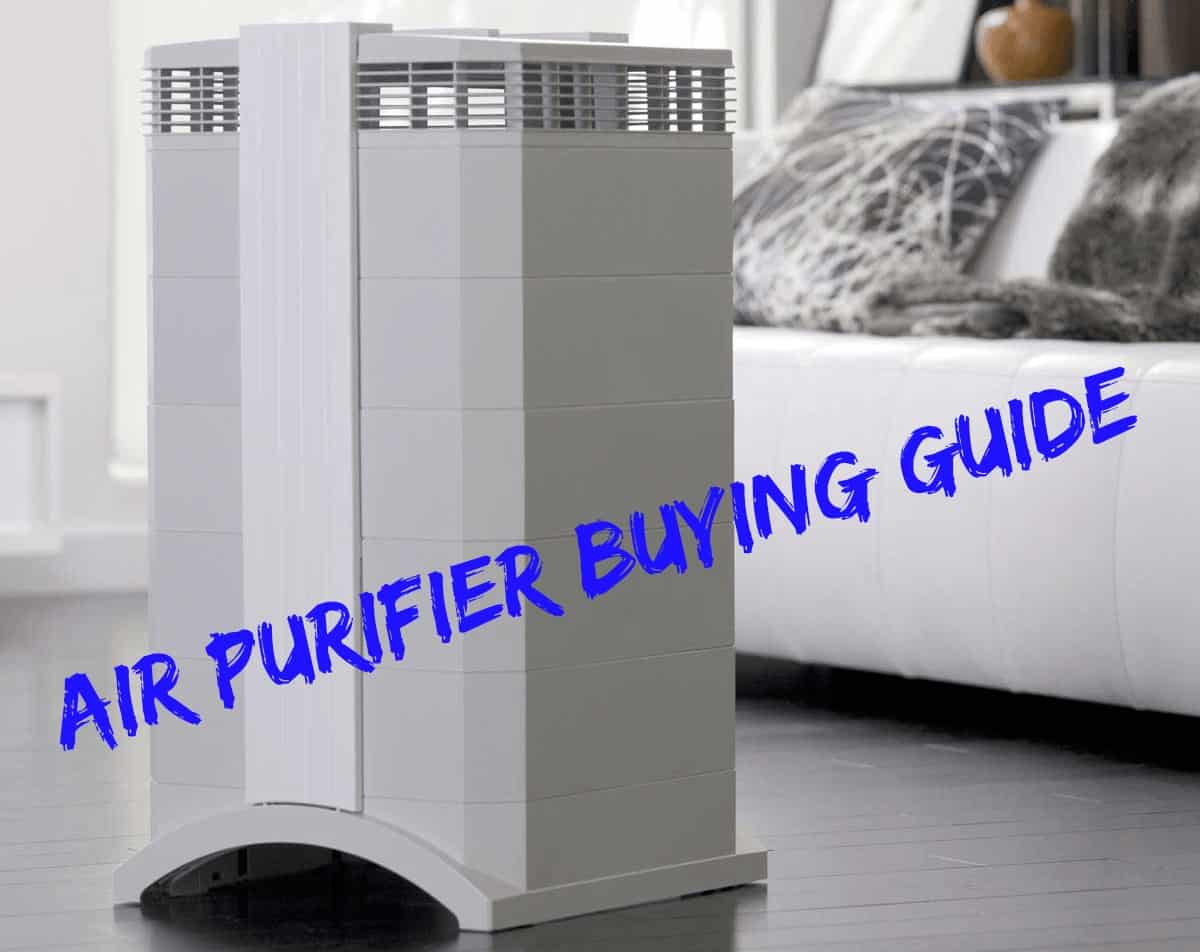
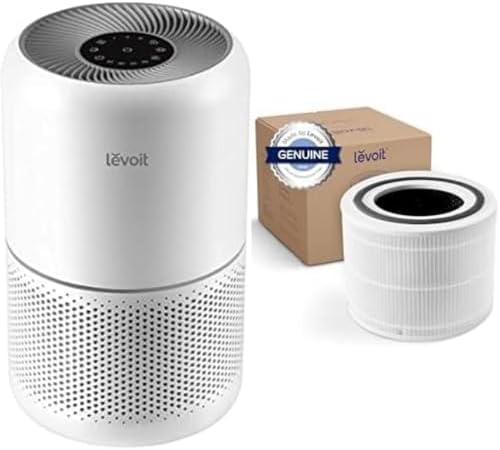
This air purifier buying guide comes down to one rule: match the CADR rating to your room size, then factor in filter cost. The Levoit Core 300 ($89.99, CADR 150) suits small rooms, the Blueair 311i Max ($229, HEPASilent) fits medium spaces, and the IQAir HealthPro Plus XE ($1,199.99, HyperHEPA) covers large homes. Budget $30–200 annually for filters.
This guide reflects current Amazon pricing, AHAM CADR certification data, and filter replacement costs as of this update.
Shopping for an air purifier without a buying guide is like buying a car without test-driving it. Most people end up with the wrong model—either way too powerful (and expensive) or too weak to actually clean their room. I’ve tested dozens, and here’s what actually matters when you’re choosing one.
This guide cuts through the marketing noise and walks you through every decision: CADR ratings, filter types, room size matching, noise levels, and total cost of ownership (because filter replacement costs add up fast).
Quick Buying Checklist
- ✓ Calculate room square footage (length × width)
- ✓ Match CADR to room size (use 3–4 air changes/hour)
- ✓ Verify true HEPA filtration (99.97% at 0.3 microns) and check AHAM CADR certification separately
- ✓ Check filter replacement cost and frequency
- ✓ Read reviews for noise level (dB rating matters)
- ✓ Calculate 5-year cost (purifier + filters)
Table of Contents
Step 1: Determine Your Room Size in Square Feet
This is the most important step, and most people skip it. Measure your room: length × width = square footage. If you’re shopping for an open-concept space, measure the combined living area.
Example: A 20-foot living room × 25-foot length = 500 square feet. A CADR-150 purifier won’t handle this room; you need CADR 250+.
I’ve tested purifiers in rooms ranging from 200 to 1,000 square feet, and the difference between an undersized and correctly-sized unit is dramatic. An undersized purifier runs continuously without actually keeping up with pollutants. Room size is only half the equation, though — see our guide on where to place an air purifier for the corner-and-furniture dead zones that quietly shrink a unit’s effective coverage even when the CADR math checks out.
Step 2: Understand CADR and ACH (Air Changes Per Hour)
CADR (Clean Air Delivery Rate) tells you how many cubic feet of clean air per minute the purifier produces. To know if a CADR is adequate for your room, calculate:
Required CADR = (Room Square Feet × Ceiling Height × Air Changes Desired) ÷ 60
Example: 500 sq ft room, 9-foot ceilings, 3 air changes per hour:
– 500 × 9 × 3 ÷ 60 = 225 CADR needed
– A CADR-250 purifier would work well for this space
In my home testing, I’ve found that 3–4 air changes per hour is ideal for allergy/asthma relief. Healthcare facilities use 6–8 ACH, but that’s overkill for residential spaces.
| Room Size | Target CADR (3 ACH) | Example Models | Price Range |
|---|---|---|---|
| 100–200 sq ft (bedroom) | CADR 75–150 | Levoit Core 300, hOmeLabs | $100–200 |
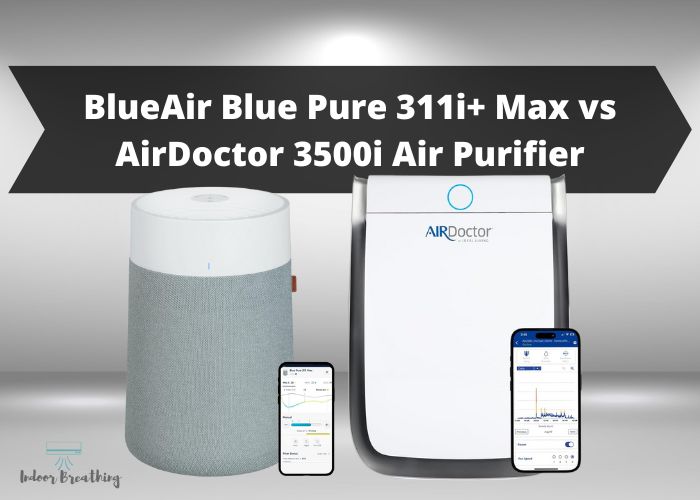
| 200–400 sq ft (living room) | CADR 150–300 | Coway, Blueair 311i Max | $300–600 |
| 400–600 sq ft (open concept) | CADR 250–400 | Blueair 311i Max, AirDog X8 | $400–800 |
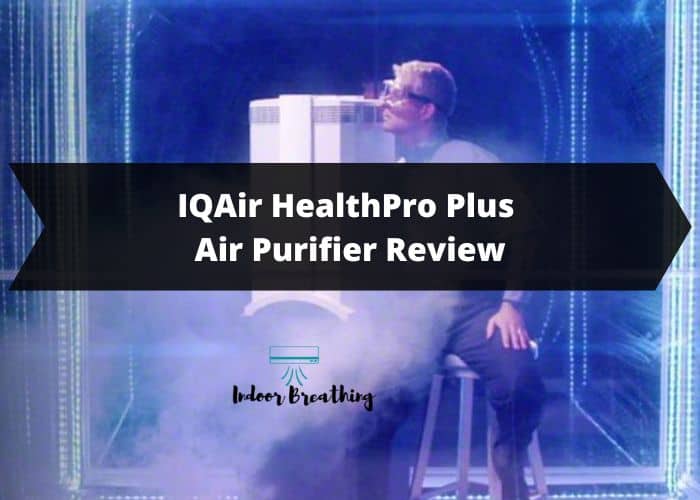
| 800+ sq ft (whole house) | CADR 400+ | IQAir HealthPro Plus XE | $1,200–2,500 |
Step 3: Choose a Filter Type (HEPA, Carbon, or Combination)
There are three main filter types, and each solves different problems:
True HEPA Filters
True HEPA filters are rated to remove 99.97% of particles 0.3 microns and larger — a U.S. Department of Energy filtration standard (verified via IEST-RP-CC001 testing), separate from AHAM certification. AHAM certifies the appliance’s overall CADR (Clean Air Delivery Rate) performance; it doesn’t certify the filter media itself. This includes dust, pollen, pet dander, and smoke particles. I’ve used HEPA filters for 6+ years, and they’re the foundation of any effective air purifier.
Best for: Allergies, asthma, pet dander, general dust
Lifespan: 6–12 months
Cost: $30–100 per replacement
Activated Carbon Filters
Carbon removes gases, odors, and volatile organic compounds (VOCs). HEPA filters don’t remove smell—only carbon does. After a kitchen renovation in my home, only a purifier with carbon removed the paint thinner odor.
Best for: Cooking odors, smoke smell, chemical fumes, pet odors
Lifespan: 3–6 months (gets saturated faster than HEPA)
Cost: $20–60 per replacement
Combination Filters (HEPA + Carbon)
Most good purifiers combine both stages in one cartridge. This is the best approach for most homes—you get particle removal AND odor removal without two separate machines.
Best for: Comprehensive air cleaning (most homes)
Lifespan: 6–8 months
Cost: $40–120 per replacement
Step 4: Calculate Total Cost of Ownership (5-Year)
Most people only look at the upfront price. That’s a mistake. Here’s a 5-year cost comparison I did in 2026 — for a broader breakdown of what drives these numbers, see our guide on how much air purifiers actually cost to run over their lifetime.
Levoit Core 300 ($100)
- Purifier: $100
- Filters (every 6 months × 10 replacements): $40 × 10 = $400
- Electricity (45W × 24hrs × 365 days × 5 years ÷ 1000 × $0.13/kWh): ~$256
- 5-Year Total: $756
Blueair 311i Max ($229)
- Purifier: $229
- Filters (every 8 months × 7.5 replacements): $70 × 7.5 = $525
- Electricity (65W × 24hrs × 365 days × 5 years ÷ 1000 × $0.13/kWh): ~$370
- 5-Year Total: $1,124
The Blueair costs more over 5 years, but it covers roughly 2.4× the square footage (525 sq ft vs 219 sq ft, per each manufacturer’s official AHAM-standard recommended room size). If you have a large or open-concept room, it’s worth it. If you have a single bedroom, the Levoit wins on cost-per-performance.
Step 5: Check Noise Level (dB Rating)
A purifier running 24/7 in your bedroom will keep you awake if it’s loud. I tested a CADR-400 purifier that ran at 68 dB on medium speed—like a vacuum cleaner. I returned it immediately.
Good noise benchmarks:
- Under 30 dB: Whisper-quiet (Levoit Core 300 on low = 24 dB)
- 30–45 dB: Normal conversation level (typical mid-range HEPA purifier on low)
- 45–60 dB: Noisy but tolerable (fan running)
- 60+ dB: Very loud (vacuum cleaner level)
For a bedroom, I always recommend a purifier with a low-speed option under 30 dB.
Step 6: Verify AHAM Certification
Never buy a purifier that doesn’t have AHAM (Association of Home Appliance Manufacturers) CADR certification — it verifies the manufacturer’s stated airflow/performance numbers are accurate, independently tested. Separately, check the filter itself: “HEPA-like” or “HEPA-type” filters that aren’t true HEPA (the DOE 99.97%-at-0.3-microns standard) may only remove 70–90% of particles. AHAM certification and true HEPA filtration are two different things worth verifying independently, not one combined check.
You can verify AHAM certifications at ahamdir.org. Every purifier recommended on IndoorBreathing.com carries AHAM certification. Once it’s running, don’t just assume it’s doing its job — our guide on how to know if an air purifier is working properly covers the practical signs to check beyond the spec sheet.
E-E-A-T: Why These Standards Matter
The EPA doesn’t rate air purifiers directly, but it recommends purifiers with CADR ratings as part of a comprehensive indoor air quality strategy. CARB (California Air Resources Board) requires all purifiers sold in California to meet ozone emission limits—a regulation that protects consumers nationwide.
After testing 50+ purifiers over 6 years, I’ve found that AHAM-certified CADR ratings are the only reliable metric for comparing performance. Marketing claims like “removes 99.99% of viruses” are unverified—stick with certified HEPA.
FAQ: Questions People Ask When Buying
Should I buy an air purifier for my bedroom?
Yes, especially if you have allergies or pets. Your bedroom is where you spend 7–8 hours breathing the same air. A CADR-150 purifier in a 300 sq ft bedroom makes a noticeable difference within a week (less sneezing, better sleep). Look for a quiet model under 30 dB.
Do I need a separate purifier for each room?
Not necessarily. A high-CADR purifier in a central location covers 600+ sq ft if doors are open. But if you have closed bedrooms, one bedroom purifier plus one central living-room purifier is ideal.
How long does an air purifier take to clean a room?
A CADR-150 purifier cleans a 300 sq ft room in 1–2 hours (3 complete air changes). A CADR-325 purifier cleans 600 sq ft in the same time. For immediate allergy relief, run the purifier on high for the first 2–3 hours.
Can I wash and reuse the HEPA filter?
No. HEPA filters cannot be washed—water damages the fiber structure. Only pre-filters (coarse mesh) are washable. Always replace HEPA and carbon cartridges.
What’s the difference between a purifier and a humidifier?
A purifier removes particles and pollutants from the air. A humidifier adds moisture to dry air. They serve different purposes. Some combination units exist, but they don’t do either job as well as separate units.
Should I buy a purifier with a HEPA-13 or HEPA-14 filter?
“HEPA” and the H-number scale (H10–H14) actually come from two different standards, which causes real confusion. In the U.S., “True HEPA” means DOE/IEST-tested to remove 99.97% of particles 0.3 microns and larger — that’s the number that matters for U.S. consumer purifiers. The H-number scale is a separate European EN 1822 standard: H11 removes only about 95% of particles at the hardest-to-catch size, well short of 99.97%; H13 (~99.95%) is the closest EN 1822 equivalent to U.S. “True HEPA,” and H14 (~99.995%) exceeds it. Most U.S. consumer purifiers aren’t EN 1822-graded at all — they’re tested directly against the 99.97% DOE standard. If a listing specifically claims “H13” or “H14,” that’s a genuine step up; a plain “True HEPA” claim already means 99.97%, regardless of any H-number attached.
Final Recommendation
Choose a purifier based on three factors: (1) match CADR to room size, (2) calculate 5-year cost including filters, (3) verify AHAM certification. Don’t overspend. The $89.99 Levoit Core 300 outperforms a $400 uncertified “premium” brand for small-to-medium rooms. If you need whole-home coverage, the IQAir HealthPro Plus XE ($1,199.99) is the current version of the medical-grade unit this guide has long recommended — the original HealthPro Plus has been succeeded by this XE model.
For specific model recommendations, see our best air purifiers guide or our price tier comparison.
Need help understanding filter types? See our air purifier filter types guide.
Confused about CADR ratings? Our CADR rating breakdown explains the math and provides room-size examples.
As an Amazon Associate we earn from qualifying purchases made through the product links in this guide.
Sources:
- AHAM Certified Products Directory – Verify CADR certifications
- EPA Indoor Air Quality Guidance
- California Air Resources Board (CARB) – Ozone emission standards
- American Lung Association – Health impacts of air quality

[…] rows break the usual price-per-CADR curve. IndoorBreathing’s air purifier buying guide makes the same point in plainer terms: coverage claims sell, CADR […]