
Sizing a whole-house humidifier means matching gallons-per-day (GPD) output to your home’s square footage and how tight or drafty its construction is — construction tightness changes the number more than home size does. A 2,000 sq ft home with average construction needs roughly 17 GPD of humidifier output, but the same footprint in a loose, older, drafty home can need well over 30 GPD, while a newer, tightly sealed home might get by on 10-12 GPD. Undersize it and the house never reaches a comfortable humidity level through a cold winter; oversize it and you’re paying for output capacity — and water — you’ll never use.
This guide reflects AprilAire’s published whole-house humidifier sizing chart, the manufacturer standard most HVAC contractors use for bypass, fan-powered and steam units.
Most people size a whole-house humidifier the same way they’d size a portable one — by matching square footage to a single number on the box. That approach misses the biggest variable in whole-house humidification: how much of the humidified air your house is actually losing to air leaks before it ever raises the indoor humidity reading. Two identically sized homes can need genuinely different GPD output, and getting it wrong either leaves you running a wide-open humidistat all winter without ever hitting your target humidity, or paying for a fan-powered or steam unit sized for a much bigger house.
Table of Contents
How Much GPD Output Do You Actually Need?
GPD — gallons per day — is the amount of moisture a whole-house humidifier evaporates into your ductwork over 24 hours of operation. It’s the number printed on every AprilAire, Honeywell, and Aprilaire-style humidifier spec sheet, and it’s the number that actually determines whether the unit can keep up with your home. AprilAire’s own published sizing chart (Form No. 222) rates every model against three construction categories, not a single square-footage number:
- Tight construction — a newer home, recently re-insulated, or one that’s been professionally air-sealed, with modern double- or triple-pane windows
- Average construction — typical construction for most homes built in the last few decades, standard windows and insulation levels, no unusual drafts
- Loose construction — an older home with visible gaps around windows and doors, noticeable drafts, or minimal insulation
Construction tightness is the bigger variable by far: AprilAire’s own chart shows the exact same 12-GPD unit covering 3,000 sq ft in a tight home but only 750 sq ft in a loose one — a 4x difference for identical output. If you’re not sure which category your home falls into, a rough rule of thumb: if you can feel a draft standing near an exterior wall or window on a cold day, or your energy bills run noticeably higher than similarly sized neighbors, treat your home as Average or Loose rather than Tight.
Why Ceiling Height and Climate Severity Change the Math
Square footage alone undercounts the real air volume a tall or vaulted ceiling adds — the same logic that applies to sizing an air conditioner or dehumidifier applies here. A 2,000 sq ft home with a standard 8-foot ceiling has 16,000 cubic feet of air to humidify; the same footprint with 10-foot ceilings has 20,000 cubic feet, 25% more air that needs to reach the same target humidity.
Climate severity matters just as much, and it’s the factor most sizing charts skip entirely. AprilAire’s published GPD ratings assume a 20°F outdoor design temperature. Colder climates lose humidity faster — cold air holds less moisture to begin with, and the colder it gets outside, the harder your furnace has to work to replace the moisture that’s constantly leaking out along with your heated air. If your winter design temperature regularly drops below 10°F, plan on roughly 15% more GPD capacity than the base chart suggests, or you’ll find yourself unable to hit 40% indoor relative humidity on the coldest nights of the year even with a correctly-sized-on-paper unit.
Calculate Your Exact GPD Needs
The generic “one humidifier size per square footage” approach ignores construction tightness, ceiling height, and climate severity entirely. For an exact GPD number based on your real home, use the calculator below:
Loose: older home, visible gaps, noticeable drafts. Average: typical construction, standard windows and insulation. Tight: newer or recently sealed/insulated home with modern windows — needs less GPD for the same square footage since less humidified air escapes.
Humidifier output you need
Square footage
2,000 sq ft
Construction
Average
Adjustments
None
Real humidifiers that clear this GPD rating
GPD = 0.005 × (sq ft × construction multiplier) − 3, where the multiplier is 4 for loose, 2 for average, or 1 for tight construction — then scale by Ceiling Height ÷ 8, and add 15% for very cold/dry winter climates (design temp below 10°F), since AprilAire's own chart assumes a 20°F outdoor design temperature.
Looking ahead, homes are getting tighter, and tighter homes hold more moisture. That means the humidifier you need may be smaller than the one a chart suggests, and smart humidistats are making it easier to run one without guessing.
Humidifier Size Chart: GPD by Square Footage and Construction Tightness
| Home Size | Tight | Average | Loose |
|---|---|---|---|
| 1,000 sq ft | 6 GPD | 7 GPD | 17 GPD |
| 2,000 sq ft | 7 GPD | 17 GPD | 37 GPD |
| 3,000 sq ft | 12 GPD | 27 GPD | 57 GPD |
| 4,000 sq ft | 17 GPD | 37 GPD | 77 GPD |
| 5,000 sq ft | 22 GPD | 47 GPD | 97 GPD |
Assumes a standard 8-foot ceiling and a moderate winter climate (design temp above 10°F). Add roughly 15% for very cold/dry climates and scale proportionally for taller ceilings — or run the calculator above with your exact numbers. Loose-construction homes above about 3,000 sq ft typically need multiple humidification zones rather than one oversized unit; see the “large spaces” note in the calculator’s product picks.
GPD Rating vs. Manufacturer Coverage Claims: Why the Numbers Don’t Match
A common point of confusion, and one that trips up even careful shoppers: AprilAire’s own technical specification sheet (Form No. 222) rates its 700-series fan-powered humidifier — an 18 GPD unit — for up to 4,200 sq ft in tight construction. But the current retail listing for the same AprilAire 700M advertises coverage “up to 5,300 sq ft.” Same physical unit, same 18 GPD output, two different square-footage claims from the same manufacturer.
This isn’t unique to AprilAire — it’s the same pattern we see across air conditioners, dehumidifiers, and air purifiers on this site. Technical spec sheets tend to be conservative and tied to a specific, documented test condition; retail and marketing copy tends to round up, get revised over time, or reflect a less conservative internal calculation than the original engineering documentation. Neither number is necessarily “wrong,” but they’re not measuring the same thing, and a 25% gap in advertised coverage for an identical GPD rating is enough to genuinely undersize a humidifier if you shop off the marketing headline alone.
The fix is the same as it is everywhere else on this site: ignore the manufacturer’s headline square-footage claim and work from the GPD rating plus your own honest construction-tightness assessment instead. That’s the only way to compare two units, or two conflicting claims about the same unit, on equal footing.
The risk to watch is oversizing. A unit that is too big can push the humidity too high, which leads to window condensation, damp walls and mold. Hard water also leaves mineral dust, so plan for a water panel or filter if your supply is hard.
Choosing Between Bypass, Fan-Powered, and Steam Humidifiers
GPD output and construction tightness get you to the right number, but which type of humidifier delivers that number matters too:
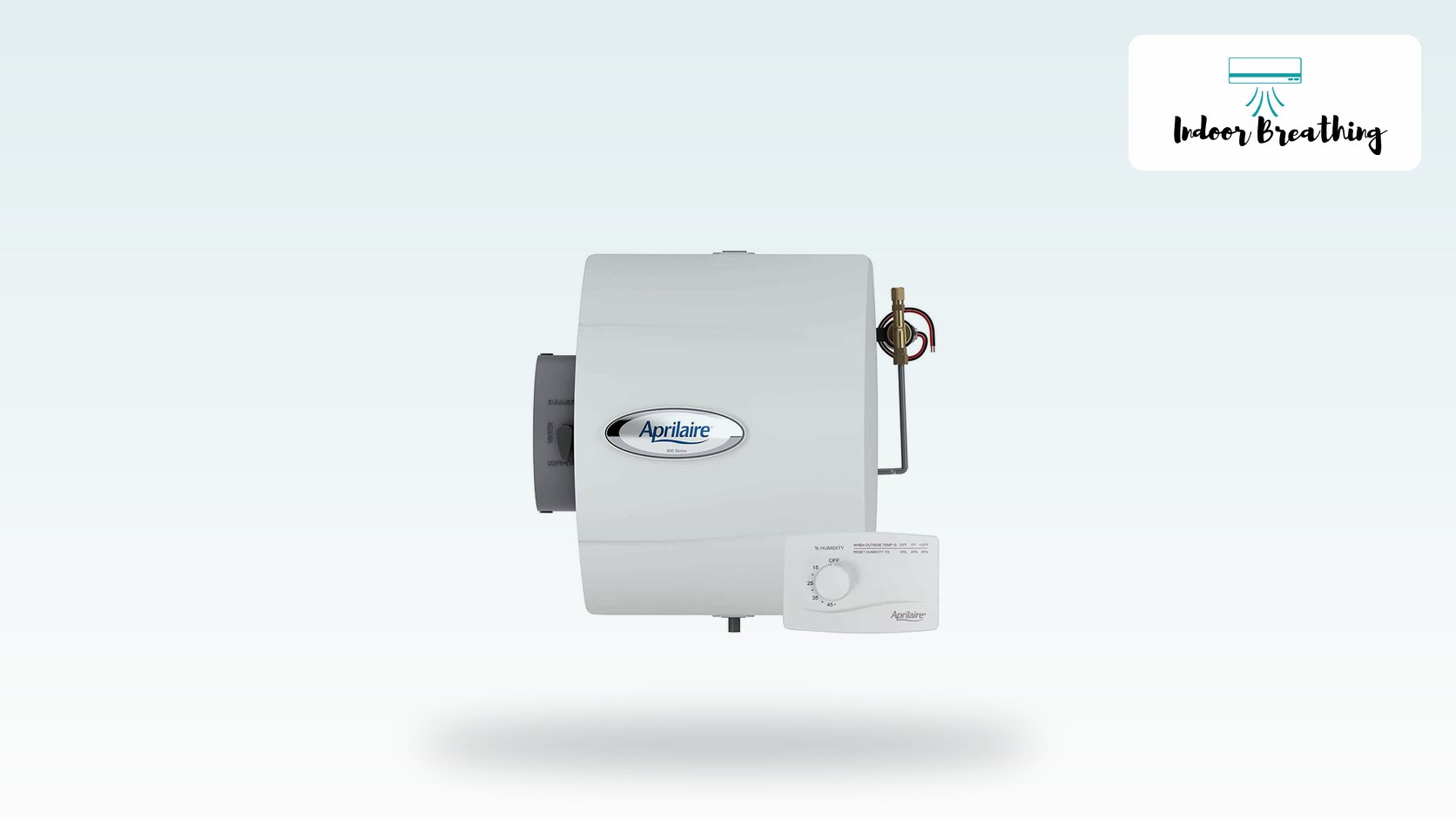
- Bypass humidifiers (AprilAire 500/600 series): the most affordable and simplest option — no dedicated fan, they use your furnace blower’s own airflow to pull air through a water panel. Good fit for average-to-tight homes up to about 5,000 sq ft. See our AprilAire 600M review for a closer look at this category.
- Fan-powered humidifiers (AprilAire 700/720 series): a dedicated fan pushes air through the water panel independent of blower speed, delivering more consistent output and faster recovery after a cold snap — a better fit for larger homes, leakier construction, or homes where the furnace blower doesn’t run long enough on its own. Our AprilAire 700 review covers this in more detail.
- Steam humidifiers (AprilAire 800 series): the highest-output category, and the only one that works completely independent of the furnace blower — useful for heat pump systems, homes with a shorter heating-cycle runtime, or anyone needing precise year-round humidity control regardless of whether the HVAC system happens to be running.
Whichever type you land on, our broader whole-house humidifier buying guide and general humidifier buying guide cover installation and humidistat considerations that GPD sizing alone doesn’t answer. And if you’re still deciding between a whole-house system and a portable unit in the first place, our whole-house vs. portable comparison walks through that trade-off directly.
FAQ
What’s the difference between a bypass and a fan-powered whole-house humidifier?
A bypass humidifier relies entirely on your furnace blower to push air through its water panel, so it only humidifies while the blower runs. A fan-powered unit has its own built-in fan, so it can deliver its full rated GPD output on a shorter blower cycle and generally recovers faster after a cold snap or an open door lets a lot of dry air in.
Can you use an oversized whole-house humidifier?
You can, but it’s not free of downsides — an oversized unit reaches your target humidity and shuts off quickly, then cycles on and off more often than necessary. That’s more wear on the water panel and valve, more wasted water, and in some cases enough humidity swing to cause window condensation, which oversizing is meant to avoid, not cause.
Does ceiling height really matter for a whole-house humidifier?
Yes, the same way it matters for air conditioner and dehumidifier sizing — a taller ceiling means more actual cubic feet of air to humidify even though the floor space hasn’t changed. See the calculator above for the exact adjustment.
Why do two humidifiers with the same GPD rating list different square-footage coverage?
Different documents from the same manufacturer — technical spec sheets versus retail marketing copy — often use different assumptions or get updated at different times. Ignore the advertised coverage claim and size from the GPD rating plus your own honest construction-tightness assessment instead.
How do you know if your home is “tight,” “average,” or “loose” construction?
If your home is newer, recently insulated or air-sealed, or has modern double/triple-pane windows, treat it as Tight. If it’s an older home with visible gaps around windows and doors or noticeable drafts near exterior walls, treat it as Loose. Most homes built in the last few decades without recent air-sealing work fall into Average.
Do you need a humidistat, and does it matter which type?
Yes — a correctly sized humidifier still needs a humidistat to avoid over-humidifying and causing window condensation or mold risk. Automatic/digital humidistats that factor in outdoor temperature (like AprilAire’s Model 60/62 controls) adjust your target humidity down automatically as it gets colder outside, which a basic manual dial can’t do on its own.
Can a whole-house humidifier run without the furnace blower on?
Bypass and most fan-powered models need the blower running to move humidified air through the ducts, though fan-powered units can run their own fan on a shorter blower cycle. Steam humidifiers are the exception — they generate humidity independent of the blower, which matters most for heat pump systems or homes with unusually short furnace runtimes.
Related Guides
Keep going with the humidifier GPD calculator and humidifiers for large rooms.
What happens next: more models will tie into smart thermostats, adjusting to the weather outside. Size by the tightness of your home and your coldest weeks, set the humidistat to the level your windows can handle, and check the windows when it gets cold.
Bottom Line
Choosing the right whole-house humidifier size comes down to two numbers: your home’s square footage and its construction tightness, which matters more than most people expect, adjusted for ceiling height and winter climate severity. Use the calculator above to get an exact GPD target, then match it against real, currently-available units rather than a manufacturer’s marketing coverage claim.