

Choose a space heater for a large room by checking three things first: a genuine tip-over and overheat shutoff with ETL or UL listing, the real wattage-to-square-footage math rather than the box’s coverage claim, and the running cost at your electricity rate — a 1500W unit costs roughly two dollars for every eight hours of use.
Every price, rating, and safety spec below is checked against the current Amazon listing and each manufacturer’s own product documentation. No hands-on lab testing is involved.
A space heater rated for a “large room” and a space heater that actually warms one are two different products, and the gap is where most buyers get burned — sometimes literally. Shopping for a space heater for large rooms almost always comes down to two questions that have nothing to do with which model looks nicest: will this start a fire if it is left running, and how much is it going to add to the electric bill. Every plug-in heater sold for a standard household outlet tops out at the same 1500 watts no matter what the box says about square footage, so the real differences come down to how safely they handle that heat and how efficiently they deliver it. This guide covers both, with five heaters worth recommending for a living room, open-concept space, or finished basement.
Affiliate disclosure: IndoorBreathing may earn a commission when you buy through links on this page, at no extra cost to you. Picks are chosen for safety, real-world running cost, and honest coverage, not commission rate.
Table of Contents
Space Heaters for Large Rooms: Comparison Table
Wattage is nearly identical across every heater here — the real differences are in the safety switches and what each one actually costs to run.
How to Size a Space Heater for Large Rooms (Real BTU Math, Not Box Claims)
Walk down the space heater aisle and you’ll see coverage claims from 150 square feet to 1,000 square feet on units that all draw the same 1500 watts on high. That’s not physically possible — a heater’s wattage sets a hard ceiling on how much heat it can put into a room, and 1500W is close to the maximum any plug-in heater can produce, full stop.
Here’s why: virtually every portable space heater made for the U.S. market tops out at 1500 watts because that’s the safe continuous load for a standard 120-volt, 15-amp household circuit. Push more than that through a normal outlet and you risk tripping the breaker or overheating the wiring behind the wall. Hardwired 240V units bolted to a garage wall can run hotter, but a plug-in heater for a living room or bedroom is capped at 1500W regardless of brand or price.
Converted to heat output, 1500W works out to about 5,118 BTU per hour (watts × 3.412). Whether that’s enough for your room depends on climate, insulation, and ceiling height, not the number on the box. Our own space heater wattage calculator factors in all three and gives you a real target wattage in under a minute; the short version, per our guide to sizing a space heater correctly, is that a moderate climate with average insulation needs roughly 10 watts per square foot. That puts a single 1500W heater’s honest coverage closer to 130-150 square feet — not the 270 or 1,000 square feet some boxes advertise. Expect better in a well-insulated, mild-climate room, and worse in an older, drafty house with high ceilings.
The manufacturer numbers aren’t fabricated exactly — they’re usually measured under ideal lab conditions, or describe the space a heater can nudge a few degrees warmer rather than hold comfortable all evening. Treat the box number as a ceiling, not a promise, and size up, run two heaters, or lean on central heat as backup if your room is genuinely large, poorly insulated, or has ceilings above eight feet.
Space Heater Safety for Large Rooms: What Actually Prevents Fires
Space heaters have an outsized safety record for how common they are. Per the National Fire Protection Association, heating equipment causes an estimated 37,000-plus home fires a year, and while space heaters and heating stoves account for roughly 29-30% of those fires, they’re responsible for around 70-77% of the resulting deaths and injuries. More than half of all home heating fire deaths start the same way: a heater placed too close to something that burns — a couch, curtains, bedding, a stack of laundry.
That statistic changes how a large-room heater should be chosen. A big open living room or finished basement means more furniture, more foot traffic, and more chances for a heater to end up closer to something flammable than it should, or to get bumped by a kid, a pet, or a vacuum cord. Two features matter most.
Tip-over protection cuts power automatically if the heater is knocked over or tilts past a set angle, typically 45 degrees. Every heater here except the two Lasko ceramic towers includes it; that gap is flagged in their reviews below because it’s a real difference worth knowing, not a dealbreaker if you’re placing the heater somewhere stable and out of high-traffic paths.
Overheat protection shuts the unit down if internal temperatures climb too high, regardless of whether it’s tipped over — this guards against the other common failure mode, where dust buildup or a blocked vent traps heat inside the housing. All five heaters here include it.
Beyond those two switches, look for a genuine UL or ETL listing — an independent safety-testing mark, not just a manufacturer’s claim — and a cool-touch exterior around kids or pets. Whichever heater you buy, never run one on an extension cord or power strip: the current a 1500W heater draws generates real heat inside a cord not rated for it, one of the most common, most preventable causes of space heater fires. Plug directly into a wall outlet, keep three feet of clearance on all sides, and don’t leave one running unattended overnight in an empty room. Our guide to keeping a space heater clean covers the dust buildup that can trigger that overheat protection in the first place.
What a Space Heater for Large Rooms Really Costs to Run
Every heater here draws close to the same 1500 watts on its highest setting, so the running cost math is nearly identical between them, with one real exception. At the current U.S. average residential rate of roughly 17 cents per kilowatt-hour (it ranges from about 11 cents in the cheapest states to over 50 cents in Hawaii, per the EIA), a 1500W heater running eight hours costs about $2.04 a day, or roughly $61 a month run daily for a 30-day cycle. Run it only in the evenings — three hours a night — and that drops to about 77 cents a day, or $23 a month.
The heater here that genuinely changes that math is the EdenPURE CopperPLUS, with a real 1000W low setting alongside its 1500W high mode. Run the same eight hours on low and you’re looking at about $1.36 a day, roughly $41 a month — a real savings of about a third over a heater stuck at 1500W, assuming the lower output still keeps the room comfortable. Infrared heaters like this one also warm people and objects directly rather than heating the air first, the idea behind “zone heating”: heat the room you’re using and turn your central thermostat down elsewhere, rather than heating the whole house for one cold room.
That math only pays off if you’re using the space heater instead of central heat, not in addition to it. Heating a large room most of the day, all winter, is worth comparing against a more permanent fix — a ductless mini-split heat pump moves heat rather than generating it and can cost a fraction as much per BTU, though the upfront cost is far higher. Our mini-split buying guide breaks down that tradeoff if a space heater feels like a band-aid for a room that’s cold every winter.
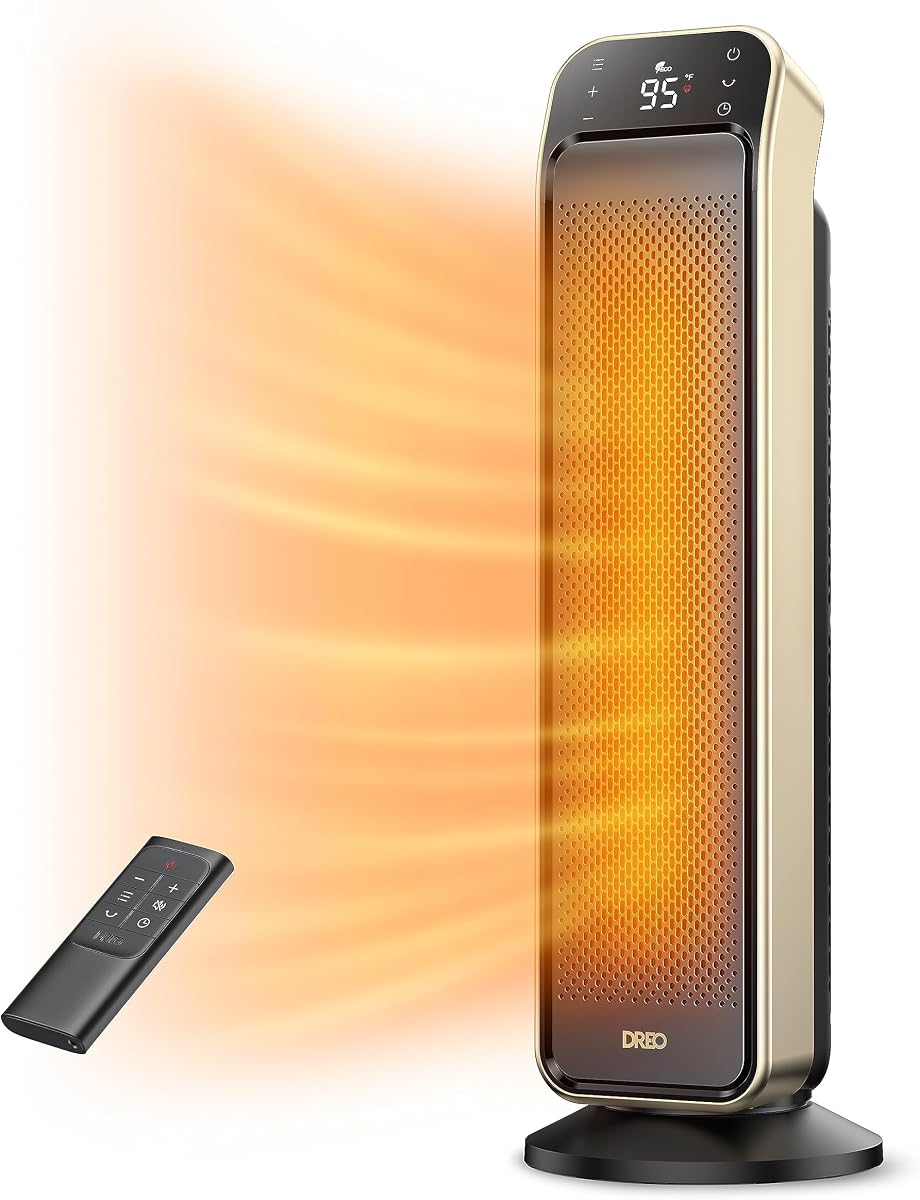
DREO 25 Inch Electric Space Heater — Best Overall for Large Rooms
The DREO 25 Inch is the pick to point most people toward first. It’s ETL listed and built with V0 flame-retardant material, backed by the two safety features that matter most: automatic shutoff if it tips past 45 degrees, and overheat protection that cuts power if internal temperatures climb too high. A child lock adds a third layer if you’ve got curious hands in the house.
For a large room, the 70° oscillation actually matters — it’s wide enough to spread heat across a living room rather than blasting one narrow column of air. DREO rates it for 100-270 square feet, which lines up reasonably well with the real wattage math above for a moderate climate with decent insulation (expect the lower end in a larger or drafty room). At 25dB on its quietest setting, it’s genuinely quiet enough for a room where people are watching TV, working, or sleeping, and the digital thermostat holds a set temperature within about a degree instead of cycling in big swings.
At $79.96 with 4.4 stars across more than 12,000 ratings, it’s priced like a mid-tier heater but built with safety features usually reserved for pricier ones.
Pros
- ETL-listed tip-over and overheat protection
- Wide 70° oscillation for large rooms
- Genuinely quiet at 25dB
- 4.4 stars across 12,000+ ratings
Cons
- Real coverage skews toward lower end of claim
- Digital controls take a moment to learn
- Gold color won’t suit every room
Looking ahead, expect space heaters to add smart plugs, Wi-Fi thermostats and better tip-over sensors as standard. The catch is that more electronics means more things that can fail, so a simple dial and a solid shutoff still count for a lot.
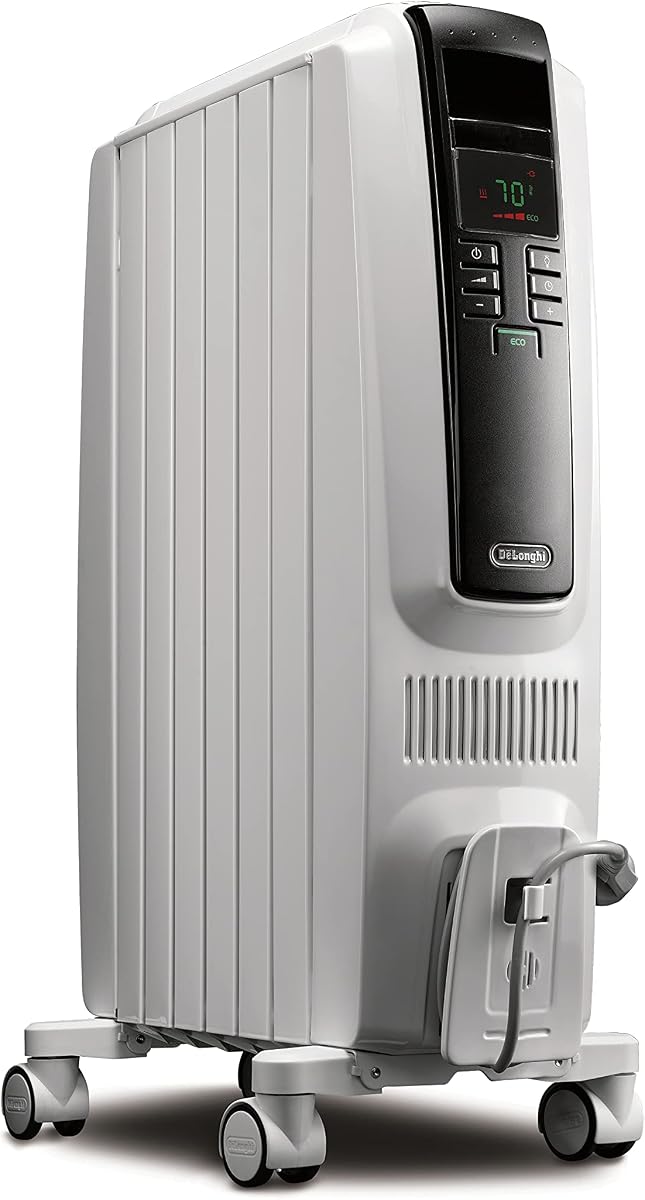
De’Longhi Dragon Digital Oil-Filled Radiator (TRD40615E) — Safest Pick
If safety is your top priority — running a heater overnight near a baby monitor, or you just don’t love an exposed heating coil around pets — an oil-filled radiator solves a different part of the safety problem than the tower heaters here. There’s no fan blowing hot air across a coil and no glowing element behind a grille; the whole unit heats a sealed reservoir of oil inside its finned panels, so the exterior stays warm rather than hot enough to burn skin on contact, even after hours of use.
The TRD40615E backs that design with real switches, confirmed against De’Longhi’s own product documentation since its Amazon listing doesn’t spell each one out: a tip-over safety switch, a thermal cutoff, a child lock, and an anti-freeze setting that turns the heater on automatically below 41°F. Its digital ECO Plus mode also cycles the 1500W element on and off to hold a set temperature rather than running flat-out, part of why De’Longhi markets it as energy-saving despite drawing the same wattage as everything else here.
The tradeoff is warm-up time — oil radiators heat a room slower than a fan-forced heater — and at $189.95, it’s the second-priciest pick in this guide. For overnight use or rooms with kids and pets, that’s a fair trade.
Pros
- No exposed heating element or coil
- Tip-over switch, thermal cutoff, child lock
- Cool-to-touch panel surface
- Anti-freeze auto-on setting
Cons
- Slower to warm a room than fan heaters
- Heavier and bulkier than tower heaters
- Pricier than most picks here
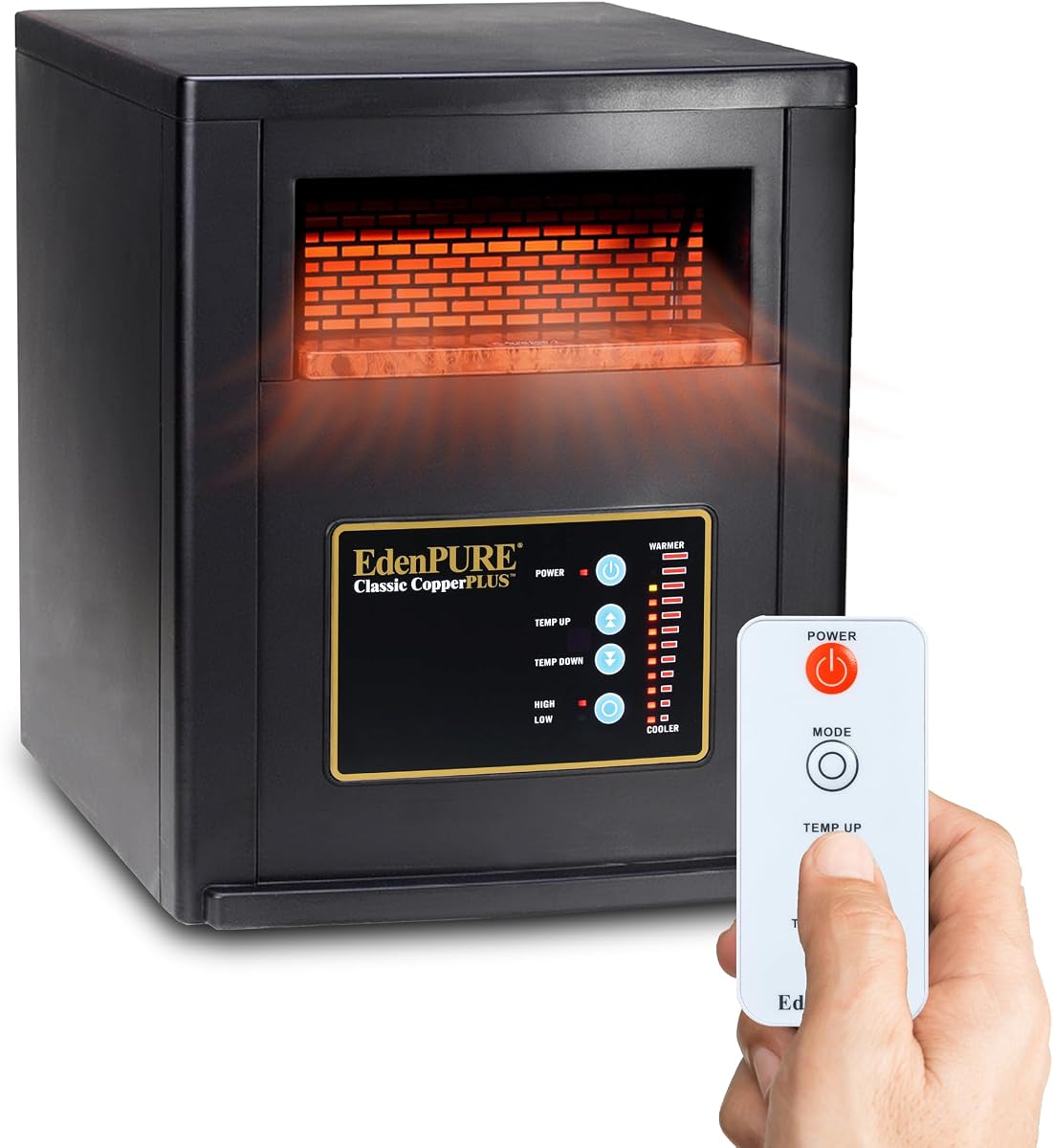
EdenPURE CopperPLUS Infrared Heater — Most Efficient / Cheapest to Run
The EdenPURE CopperPLUS earns its spot on running cost, not upfront price — at $272.00 it’s the most expensive heater here, but the only one with a genuine second wattage tier: 1500W on high, a real 1000W on low, across 24 preset temperature levels from 40-90°F. That low mode is where the savings happen (see the math above), built for the zone-heating idea EdenPURE leans on in its own marketing: heat the room you’re in, not the whole house.
Safety-wise, it’s cETL approved with dual overheat sensors, an automatic tip-over shutoff, and a cool-touch housing with a touch-safe front grille — reassuring if you’ve got kids or pets nearby. It also runs quieter than most fan-forced heaters since there’s no strong blower, and a washable lifetime filter means no replacement filters every season.
Treat EdenPURE’s “1000 square feet” claim skeptically — that’s a lab-condition number, and the real wattage math from earlier in this guide (roughly 130-150 sq ft per 1500W in an average room) applies here just as much as to any heater on this list, regardless of the copper-element marketing. It’s efficient and well-built; it’s not heating a great room from clear across it.
Pros
- Real 1000W low mode cuts running cost
- cETL approved, dual overheat sensors, auto tip-over
- Cool-touch housing, touch-safe grille
- Washable lifetime filter
Cons
- Most expensive pick in this guide
- “1000 sq ft” claim is optimistic
- No oscillation, stays pointed one way
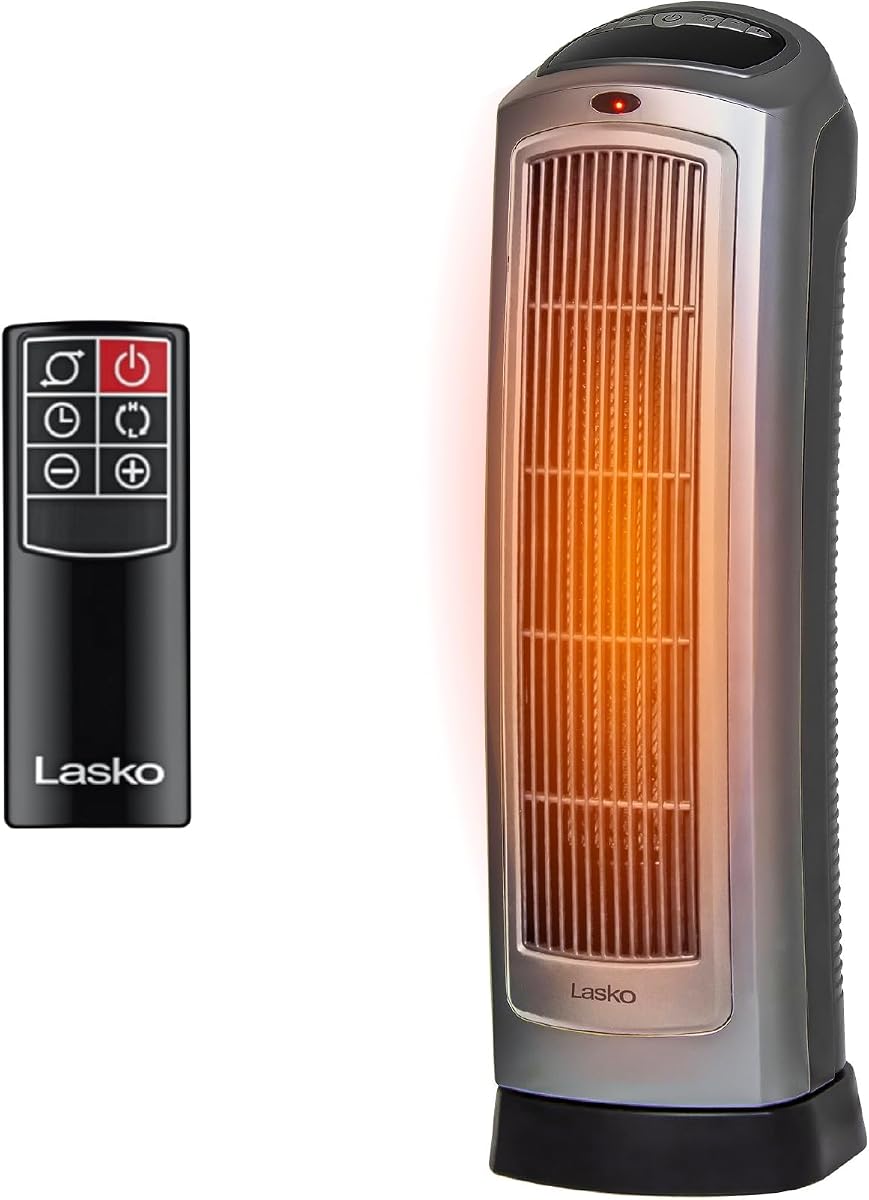
Lasko 755320 Ceramic Tower Heater — Quietest Full-Featured Pick
The Lasko 755320 is the heater to point to for a full-featured oscillating tower — remote control, digital thermostat, an 8-hour timer — without paying EdenPURE money. It’s ETL listed with a cool-touch housing and overheat protection, and with over 33,000 ratings at 4.4 stars, it’s one of the most-reviewed space heaters on Amazon, which counts for something when gauging long-term reliability.
Here’s the honest gap, and why it is not the overall pick despite the strong reviews: unlike the DREO and the De’Longhi, Lasko doesn’t list tip-over protection on this model — only overheat protection and a cool-touch exterior. For a stable spot away from foot traffic, cords, or curious pets, that’s a manageable tradeoff. For a busier room, or anywhere it might realistically get bumped, size up to the DREO instead.
At $79.99 for 1500W of oscillating ceramic heat with remote control, it’s a genuinely good heater — just go in aware of what it doesn’t have.
Pros
- ETL listed, cool-touch housing
- Full remote control and digital thermostat
- 33,000+ ratings at 4.4 stars
- Widespread oscillation
Cons
- No tip-over protection listed
- Needs a stable, low-traffic spot
- No dedicated large-room coverage claim
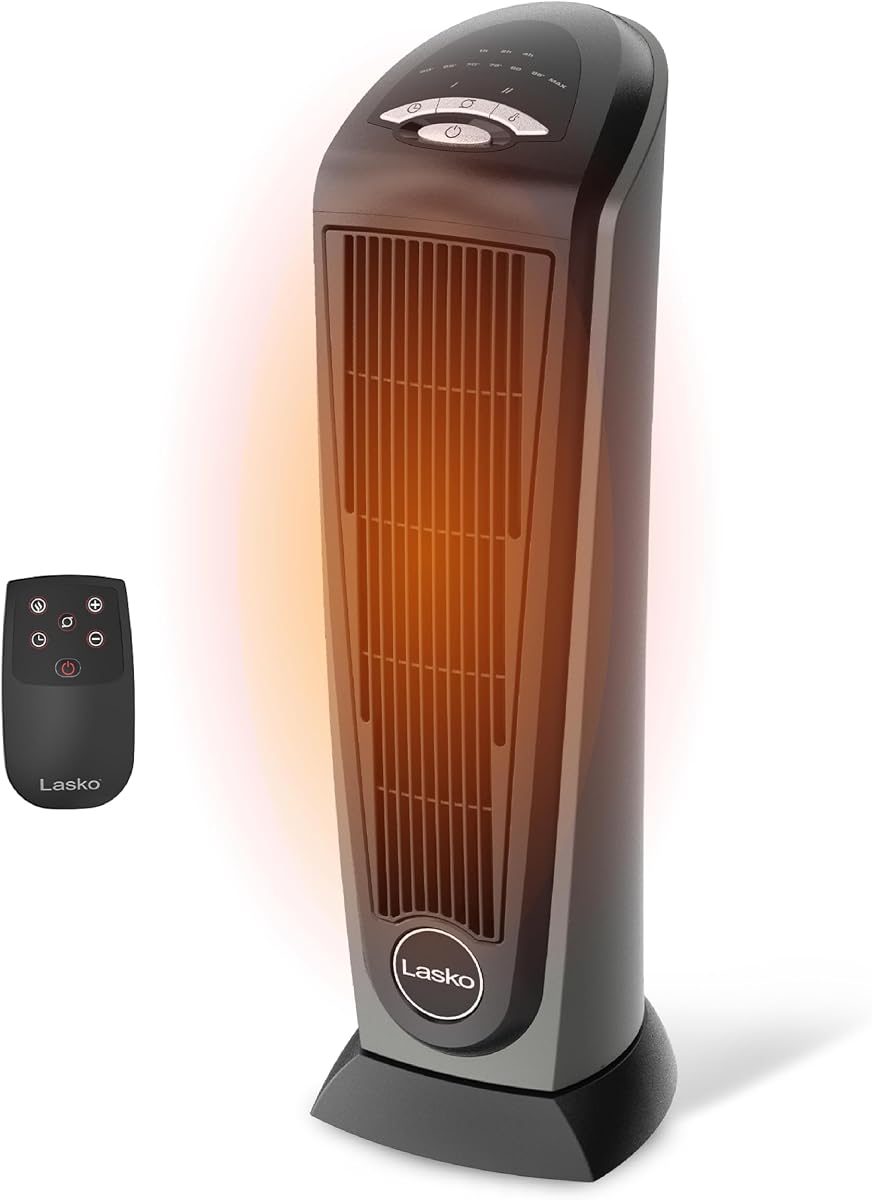
Lasko 751320 Ceramic Tower Heater — Budget Pick
If you just need reliable 1500W heat without extra features, the Lasko 751320 is the least expensive heater here at $71.99, and the highest-rated one too — 4.5 stars across more than 40,000 ratings. It’s ETL certified with overheat protection and a cool-touch housing, and Lasko describes it as built for medium-sized rooms: in a genuinely large, open room, expect it to hold its own near where it’s placed rather than warm the whole space evenly.
Like the 755320, it doesn’t list tip-over protection, so the same placement advice applies — a stable spot away from foot traffic, cords, and anything flammable. What you do get is a remote control, widespread oscillation, and a 7-hour auto-off timer, a genuinely useful safety feature on its own: even without tip-over detection, a heater that can’t run all night unattended by default is safer than one that can.
For a guest room, home office, or supplementing central heat in one chronically cold corner, it’s hard to beat the price.
Pros
- Lowest price in this guide ($71.99)
- 4.5 stars across 40,000+ ratings
- ETL certified, overheat protection
- 7-hour auto-off timer
Cons
- No tip-over protection listed
- Rated for medium rooms, not large ones
- Basic feature set vs. pricier picks
A Few Placement Rules, Whichever You Buy
Keep at least three feet of clearance on all sides, including above — the “three-foot rule” fire departments recommend, for curtains and shelving as much as furniture. Set the heater on a hard, level surface rather than a rug, where a slight tip is harder to notice. None of the five picks here are rated for damp locations, so a bathroom needs a dedicated GFCI-safe unit — see our bathroom heater guide. And if your “large room” is really a garage, our garage heater guide is a better fit than sizing up one of these.
Running any of these for hours also dries the air, especially the ceramic fan models — our humidifiers for large rooms guide covers picks sized to match. For more infrared options beyond the EdenPURE, see our infrared heater reviews. Everything here is indoor-only — outdoor patio heaters use different fuel and safety standards, covered in our outdoor patio heater guide.
The risk with cheaper heaters is that safety claims are not always backed by real testing. Expect more recalls and listing takedowns as marketplaces tighten, and do not be surprised if a favorite model quietly changes between production runs.
FAQ
Is it safe to run a space heater all night in a large room?
Only with both tip-over and overheat protection, plugged directly into a wall outlet (never an extension cord), with at least three feet of clearance from anything flammable. Even then, avoid running one unattended overnight in an empty room — the De’Longhi’s slow, steady radiator heat is the safer overnight choice here.
How many watts does it take to heat a large room?
It depends on climate and insulation, but a moderate climate with average insulation needs roughly 10 watts per square foot. Since every plug-in heater tops out at 1500W, that puts the honest single-heater coverage limit around 130-150 sq ft for most large rooms — use our space heater wattage calculator for an exact number.
Why do all space heaters seem to be 1500 watts?
Because 1500W is close to the safe continuous load limit for a standard 120-volt, 15-amp household outlet. Going higher risks tripping breakers or overheating household wiring, so nearly every plug-in heater sold in the U.S. is built to that same ceiling regardless of brand or price.
Is an oil-filled radiator or a ceramic tower heater better for a large room?
A radiator heats more evenly and holds heat longer after shutoff, and is safer around kids and pets since there’s no hot exposed element. A ceramic tower heater warms a room faster and moves between rooms more easily.
How much does it cost to run a space heater for 8 hours?
At the roughly 17-cent U.S. average electricity rate, a 1500W heater running 8 hours costs about $2.04, or roughly $61 a month run daily. A lower-wattage setting, like the EdenPURE CopperPLUS’s 1000W low mode, drops that to about $1.36 for the same 8 hours.
Do space heaters actually cause a lot of house fires?
Yes, disproportionately. Space heaters and heating stoves account for roughly 29-30% of home heating equipment fires but around 70-77% of the resulting deaths and injuries, per NFPA data — mostly because they’re placed too close to furniture, bedding, or curtains.
What happens next on the bill: electric rates keep creeping up in many areas, so the running-cost gap between a 1,500-watt heater and a lower-wattage zone heater will likely widen. Heating one room instead of the whole house only pays off if the central thermostat actually goes down.
Bottom Line
For most large rooms, the DREO 25 Inch is the place to start — it gets the safety fundamentals right, oscillates wide enough to matter, and is realistically priced. If safety is non-negotiable for overnight or around-kids use, the De’Longhi oil-filled radiator’s lack of an exposed element is worth the extra cost. If your electric bill is the deciding factor, the EdenPURE’s real low-wattage mode is the only heater here that meaningfully changes the running-cost math. And if you just need reliable 1500W heat without paying extra, either Lasko does the job — just give it a stable spot away from foot traffic.
Editorial note: Prices, review counts, and availability change after publication — confirm the current listing before buying.