
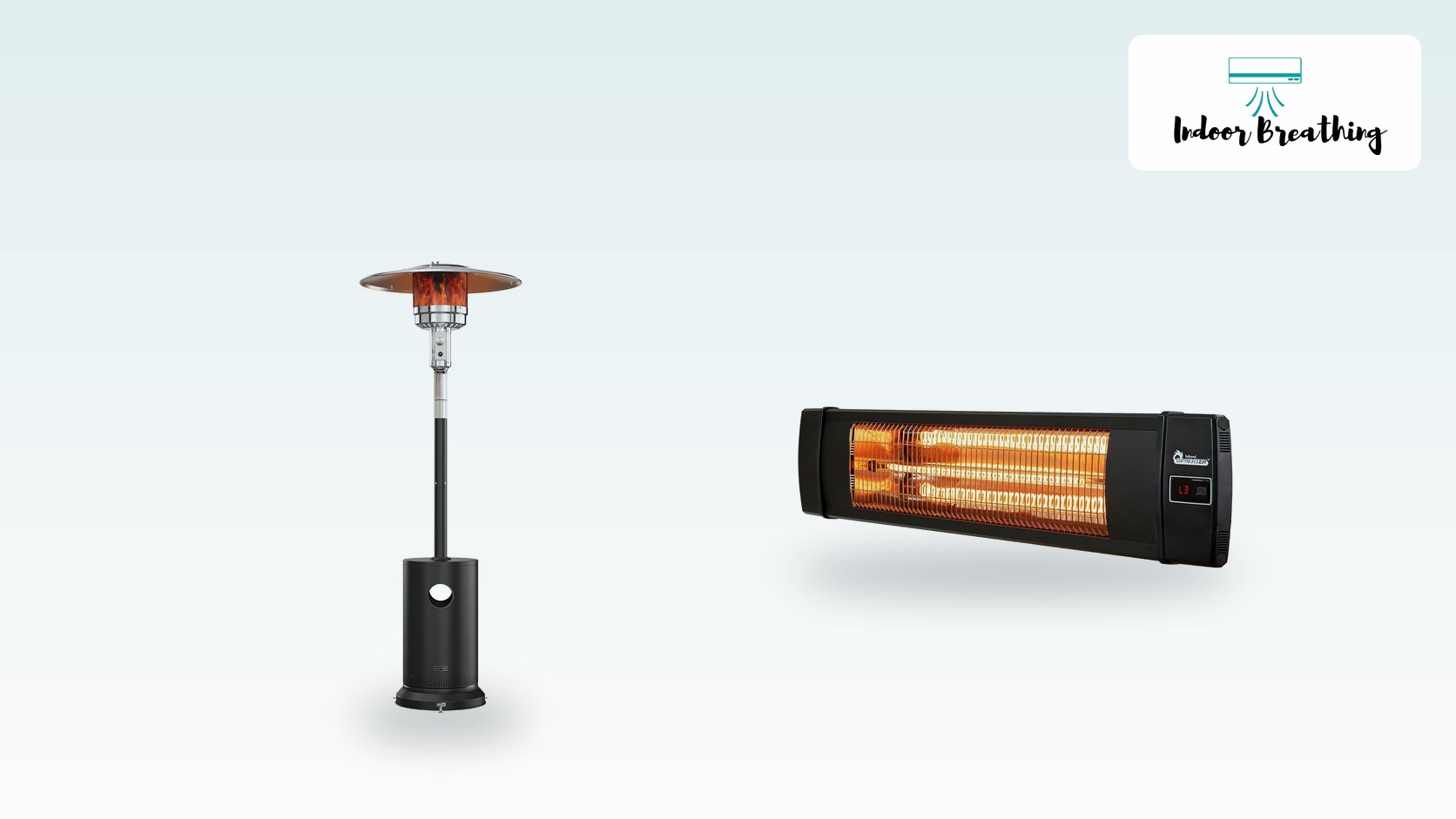
The best outdoor patio heaters start with the right fuel. Propane standing heaters like the EAST OAK 55,000 BTU put out the most heat and go anywhere, while electric infrared models such as the Dr. Infrared DR-238 suit covered patios and porches where fumes and overhead clearance are a problem. Then size by BTU or wattage, and plan for wind.
Prices and ratings were checked on Amazon on October 10, 2026. This guide draws on manufacturer BTU and wattage specs, listing details and owner reviews, not hands-on lab or field testing.
Outdoor patio heaters buy you two or three more months of usable outdoor space every year, but the wrong one either roasts your ankles while your face stays cold or blows out in the first stiff breeze. The nine outdoor patio heaters below cover every format worth considering, and the sections ahead of them walk through the decisions that actually determine which one you should buy.
Table of Contents
Propane, Electric, or Natural Gas
Three fuels power almost every patio heater, and that choice narrows your options more than any other single decision.
Propane is what most people picture: a tall mushroom or pyramid heater with a 20-pound tank hidden in the base. It delivers the most heat per dollar, needs no wiring, and rolls wherever you want it.
The tradeoffs are refills — a tank lasts roughly 8 to 10 hours on high — an open flame, and combustion byproducts that make propane outdoor patio heaters a poor fit for tightly enclosed spaces. If you want to understand what is happening inside the burner, our explainer on how propane heaters work covers the combustion and safety basics.
Electric infrared heaters warm objects and people directly instead of heating the air, so they lose less to a breeze than you would expect and produce zero fumes. That makes them the only safe choice for a covered porch, a three-season room, or a low pergola. A standard 120-volt unit draws 1,500 watts and warms a spot; larger 240-volt models need a dedicated circuit or hardwiring.
Natural gas heaters plumb straight into your home’s gas supply, so they never run out and cost the least per hour to run, but you are committing to a fixed location and usually a professional install. They make sense for a permanent setup, not for flexibility.
BTU and Wattage: Sizing a Heater to Your Space
For gas heaters, BTU per hour is the number that matters. As a rough guide, a covered area needs about 20 BTU per cubic foot; an open patio needs far more because the heat dissipates into the air. A 40,000 to 50,000 BTU standing heater warms a circle roughly 10 to 20 feet across, which covers a typical bistro set or a cluster of four chairs. Tank-top and tabletop heaters in the 10,000 to 15,000 BTU range only warm the people right next to them.
Electric heaters are rated in watts. A 1,500-watt unit produces about 5,100 BTU — enough for one or two people at close range. Jumping to a 4,000 to 6,000-watt 240-volt fixture gets you into the coverage range of a mid-size propane heater, but you pay for it in wiring. If you are already comfortable sizing indoor heaters by wattage, the same logic applies outdoors with more heat lost to the open air; our guide to choosing the right size space heater lays out the wattage-to-square-footage math.
Do not oversize blindly. A 50,000 BTU heater on a tiny balcony is uncomfortable and wasteful, and two smaller heaters placed on either side of a seating area beat one giant heater in the middle every time.
Covered Patio, Open Patio, or Screened Porch
Where the heater will sit decides which fuels are even on the table.
Open patio or deck: propane standing heaters shine here. They throw heat in every direction, and the open air handles combustion byproducts. Wind is the enemy — more on that below.
Covered patio or pergola: check the clearance spec before anything else. Most propane standing heaters need 18 to 36 inches of top clearance and several feet on the sides, away from any ceiling, beam, or wall. If your roof is lower than about 8 feet, an electric infrared heater mounted to the wall or ceiling is safer and uses no floor space.
Screened porch or three-season room: treat this as indoors. Do not run propane or natural gas in an enclosed space — the carbon monoxide risk is real. Electric infrared is the only category that belongs here.
Looking ahead, electric infrared heaters and smart controls are likely to take a bigger share of the patio market, because they need no fuel run and no tank swaps. The catch is the power draw, since a 1,500-watt heater needs its own circuit and a long cord is a poor fix.
Wind, Rain, and Where Heaters Struggle
Wind is the single biggest reason people are disappointed with a patio heater. A propane flame heater loses a large share of its output to even a light breeze, and many will blow out above roughly 10 mph unless they have a wind guard. Pyramid heaters with an enclosed glass tube, like the FOOWIN below, hold a flame in wind better than an open mushroom design. Electric infrared handles wind best of all, because it heats surfaces directly rather than a column of warm air that simply drifts away.
Rain and snow matter too. Look for a stated IP rating on electric models — IPX4 or better means it tolerates splashing. The Paraheeter and the Haimmy tower are both rated IPX5, so they can stay outside. Cover any gas heater when it is not in use; the burner and igniter corrode quickly, and a $25 cover pays for itself in one season.
Safety: Tip-Over, Clearances, and Carbon Monoxide
Every gas patio heater sold in the US should carry a CSA or ETL certification and two automatic shutoffs: a tip-over switch that cuts the gas if the heater tilts past about 45 degrees, and a flame-failure device that stops the flow if the burner goes out. Confirm both are listed before you buy.
Beyond that, keep 3 feet of clearance from furniture and anything combustible, never move a heater while it is lit, and shut the tank valve when you are done. Tank-top heaters like the Mr. Heater MH30T sit directly on the cylinder and are tippier than a weighted base, so they belong on level ground away from foot traffic.
The risk to watch is carbon monoxide and fire. Propane heaters belong in open air, and some people move them under covers or into tents when the weather turns. Some cities have looked at limits on gas patio heaters over fire and carbon concerns, so rules may tighten.
What It Costs to Run a Patio Heater
Propane runs about $3.50 to $4.50 per gallon, and a 20-pound tank holds roughly 4.5 gallons. A 40,000 BTU heater on high burns close to half a gallon an hour, so figure $1.50 to $2.00 per hour of full-blast heat, less when you turn it down.
Electric is usually cheaper per hour. A 1,500-watt infrared heater uses 1.5 kWh per hour, about 20 to 25 cents at the US average rate, and even a 6,000-watt Bromic stays under a dollar an hour. Natural gas is cheapest of all, often 30 to 50 cents an hour for a 40,000 BTU fixture, which is why restaurants use it.
Best Outdoor Patio Heaters: Comparison
The table below lines up all nine outdoor patio heaters on the numbers that decide the purchase: heat output, coverage, weight, price, and how buyers rate them.
Best Overall: EAST OAK 55,000 BTU Propane Patio Heater
If you have an open patio and want one heater that just works, this is the one to buy. The EAST OAK 55,000 BTU is a mushroom-style standing heater with a one-touch ignition the seller says lights in under five seconds, an upgraded reflector shield, and a round tabletop lid on the tank housing so you have somewhere to set a drink. The seller changed this listing from 50,000 BTU to 55,000 BTU, and this page follows the current one.
It rolls on two wheels, and the listing puts assembly at about 30 minutes. Tip-over protection shuts off the flame past a 45-degree tilt, and flame-out protection cuts the gas if the flame goes out. At $149.99 it undercuts most name-brand equivalents while holding a 4.6-star average across more than 1,500 ratings, one of the highest scores in the category. The usual trade-offs for a propane flame heater apply: it struggles in wind, and reflector finishes can discolor over a few seasons. The tank is sold separately.
Pros
- Strong 55,000 BTU output
- Wide heat circle
- Built-in drink table
- Rolls on two wheels
- 4.6 stars, 1,500+ reviews
Cons
- Loses heat in wind
- Reflector finish can discolor
- Propane tank not included
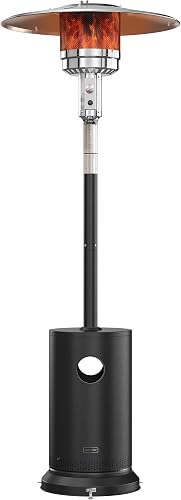
Price on Amazon: $149.99 | 4.6 stars from 1,522 ratings (checked October 10, 2026)
The Proven Budget Pick: Amazon Basics 46,000 BTU
The Amazon Basics commercial patio heater has been the default budget choice for years, and its 11,000-plus ratings at 4.4 stars make it the most-reviewed patio heater on Amazon. It is a straightforward 46,000 BTU steel mushroom heater, 91 inches tall, with a water-fillable base for stability, wheels, and the same pair of safety shutoffs you want. Amazon quotes a conservative 9-foot heat radius, which is realistic once there is any air movement.
At around $165 it costs a little more than the EAST OAK, so the decision comes down to details: the EAST OAK has a higher review score and adds a drink table, while the Amazon Basics has the longer track record and a heavier water-ballast base that resists tipping. Both are fine heaters. Buy whichever is cheaper the day you shop.
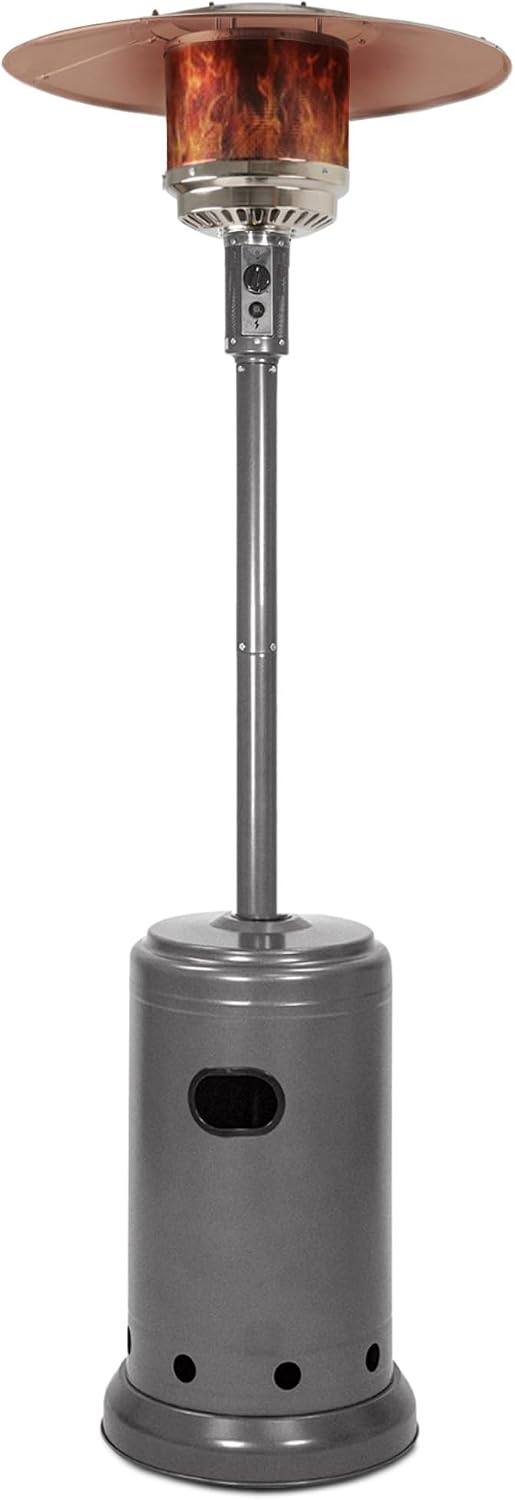
Price on Amazon: $164.99 | 4.4 stars from 11,079 ratings (checked October 10, 2026)
Pyramid Style: FOOWIN 48,000 BTU Glass-Tube Heater
Pyramid heaters trade a little efficiency for a lot of ambiance — the dancing flame inside a quartz-glass tube is the whole point. The FOOWIN 48,000 BTU is a well-reviewed example at 4.4 stars, standing about 81 inches tall on a bronze steel frame with wheels, a cover, and gloves included. Because the flame is enclosed in the glass column, it resists wind better than an open mushroom burner, though the heat radiates in a narrower band around the tube rather than a broad circle.
At around $225 it costs noticeably more than a standard mushroom heater, and at 51 pounds it is heavier to move. You are paying for the look. If a fire feature is what you are really after, a dedicated gas fire pit or bowl gives you flame plus a gathering point, and often more warmth at seated height.
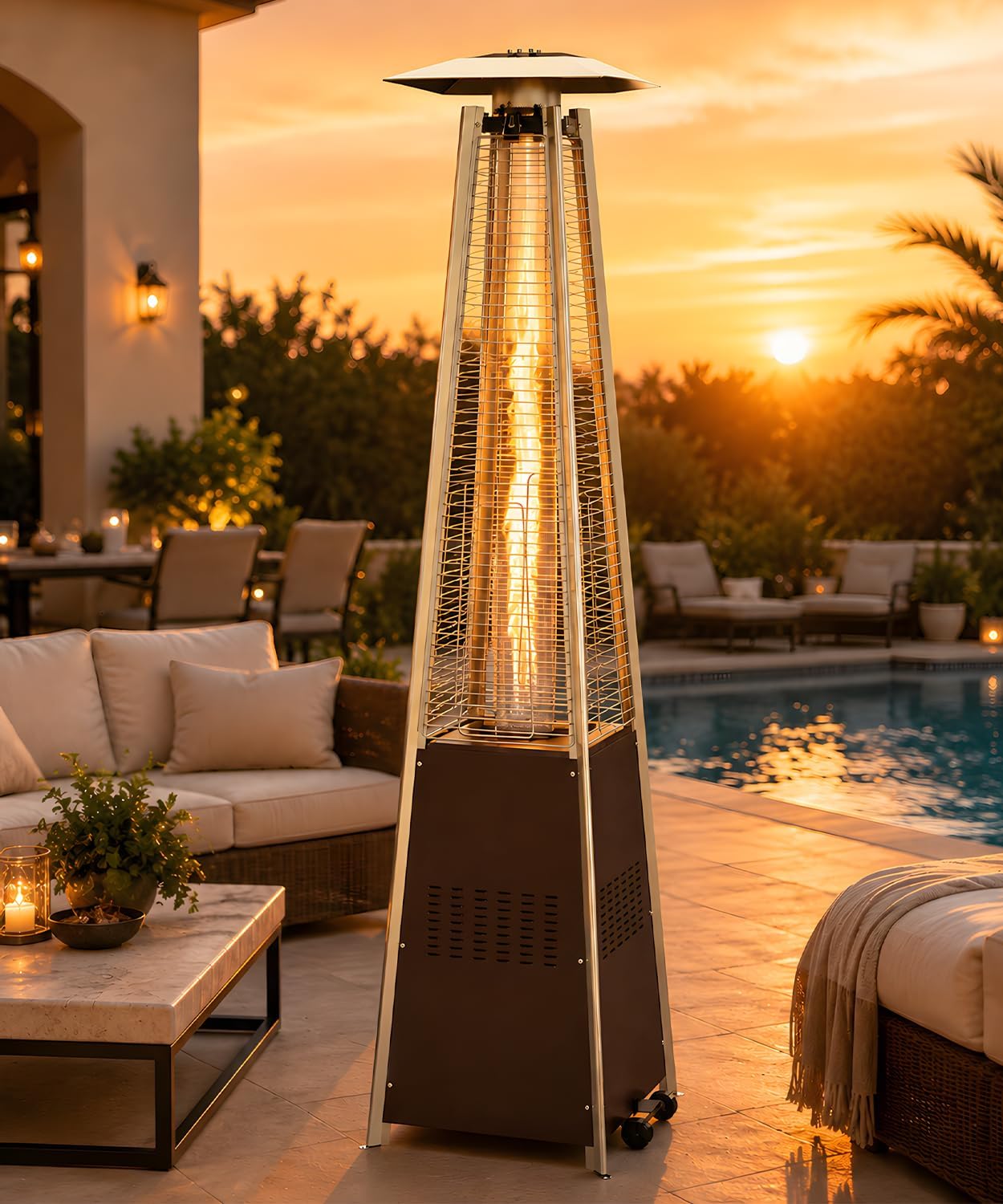
Price on Amazon: $224.99 | 4.4 stars from 224 ratings (checked October 10, 2026)
Spot Heat With No Footprint: Mr. Heater MH30T
Not every situation calls for a 7-foot tower. The Mr. Heater MH30T is a double-burner radiant head that threads directly onto the top of a 20-pound propane tank, with output adjustable from 10,000 to 30,000 BTU and a 4.6-star average across more than 1,800 ratings. It weighs five pounds, packs away in a corner, and costs under $100.
It is the heater to pick for a workshop doorway, a tailgate, a hunting camp, or one end of a picnic table — anywhere you need to aim heat at a specific spot rather than fill a circle. The downsides are real: sitting on top of the tank makes it top-heavy, so it needs flat ground and a wide berth, and the basic model has no tip-over cutoff. For an enclosed garage, a proper garage heater with a thermostat and tip protection is the better tool.
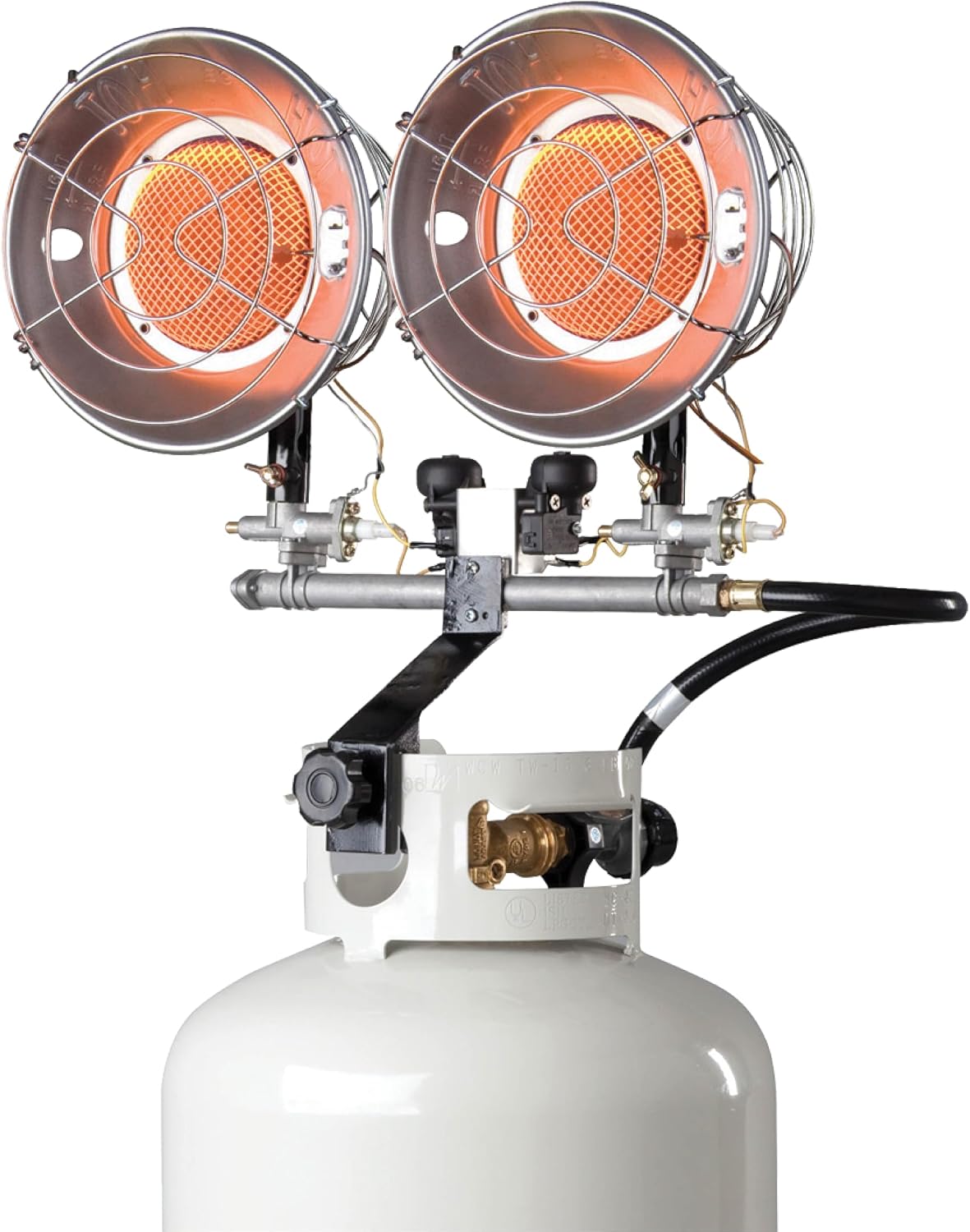
Price on Amazon: $97.27 | 4.6 stars from 1,849 ratings (checked October 10, 2026)
Electric Infrared for Covered Patios and Porches
Once you have a roof overhead, electric infrared becomes the sensible choice — no fumes, no refills, no open flame, and heat that shrugs off a draft.
The Dr. Infrared Heater DR-238 is the one to try first. It is a 1,500-watt carbon-infrared bar heater with three power levels (900, 1,200, and 1,500 watts), a remote, a 12-hour timer, and brackets to mount it on a wall or ceiling or stand it on the included base. It runs on a normal 120-volt outlet, holds a 4.3-star average across roughly 6,000 ratings, and costs about $126.
One unit comfortably warms one or two people at a bistro table or covers a doorway; for a wider seating area you would mount two. Infrared heat is line-of-sight, so aim it where people actually sit — our primer on how infrared heaters work explains why that matters.
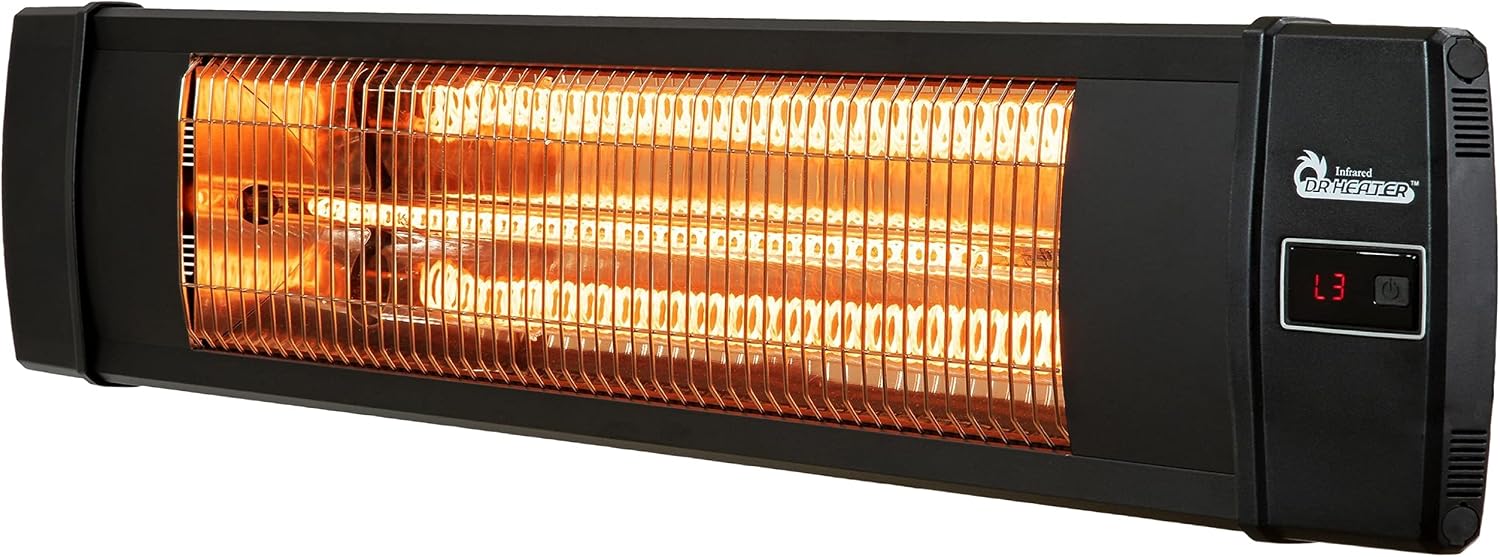
Price on Amazon: $125.99 | 4.3 stars from 6,100 ratings (checked October 10, 2026)
If you would rather not drill into anything, the Paraheeter 1500W is the same idea on a telescoping tripod. It is IPX5 water-resistant, comes with a remote, adjusts from about 4 to 7 feet tall, and runs around $170 at 4.3 stars. The tripod makes it easy to wheel between the patio and the garage, though at 19 pounds with a tall, narrow stance it can tip on uneven ground, so weight the legs or keep it on a hard surface.
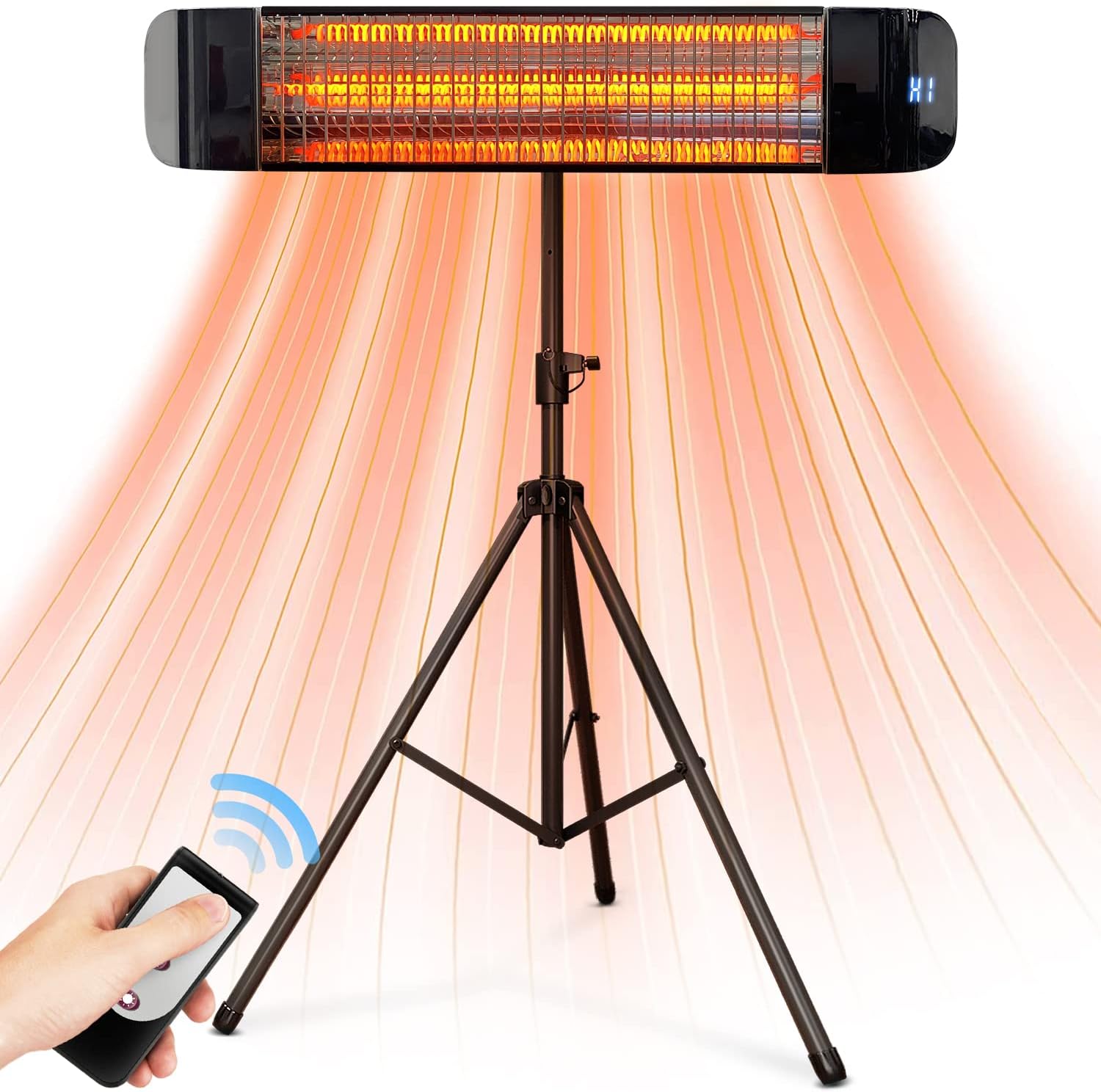
Price on Amazon: $169.98 | 4.3 stars from 268 ratings (checked October 10, 2026)
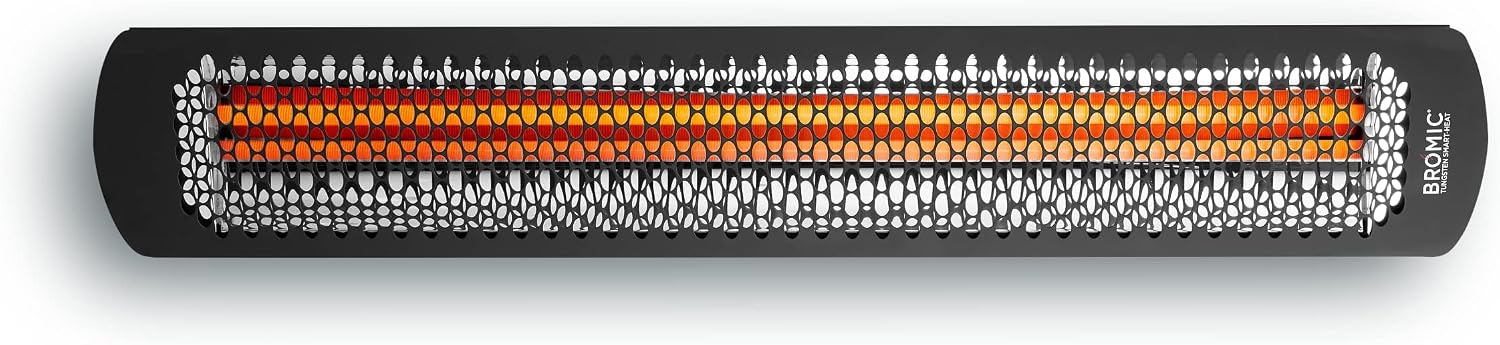
A Permanent Mounted Heater: Bromic Tungsten Smart-Heat
For a finished outdoor room — an outdoor kitchen, a covered bar, a high-end pergola — a hardwired electric heater disappears into the architecture. The Bromic Tungsten Smart-Heat 6000W is the benchmark here: a sleek black bar with dual infrared elements behind a mesh screen, designed to mount on a wall or ceiling and wire into a 220–240-volt circuit. It is built to warm a substantial area from overhead, works with Bromic’s dimmer controls, and holds a 4.5-star average.
At about $1,160 for the heater alone — before an electrician — it is a different budget conversation than a $150 propane tower. But it never runs out of fuel, makes no noise, throws no flame, and looks like it belongs. If you are building the space rather than furnishing it, price the Bromic into the plan.
Price on Amazon: $1,161.00 | 4.5 stars from 64 ratings (checked October 10, 2026)
Tabletop and Standing Electric Options for Small Spaces
On a balcony or a small deck where a full tower is overkill, two smaller formats work well.
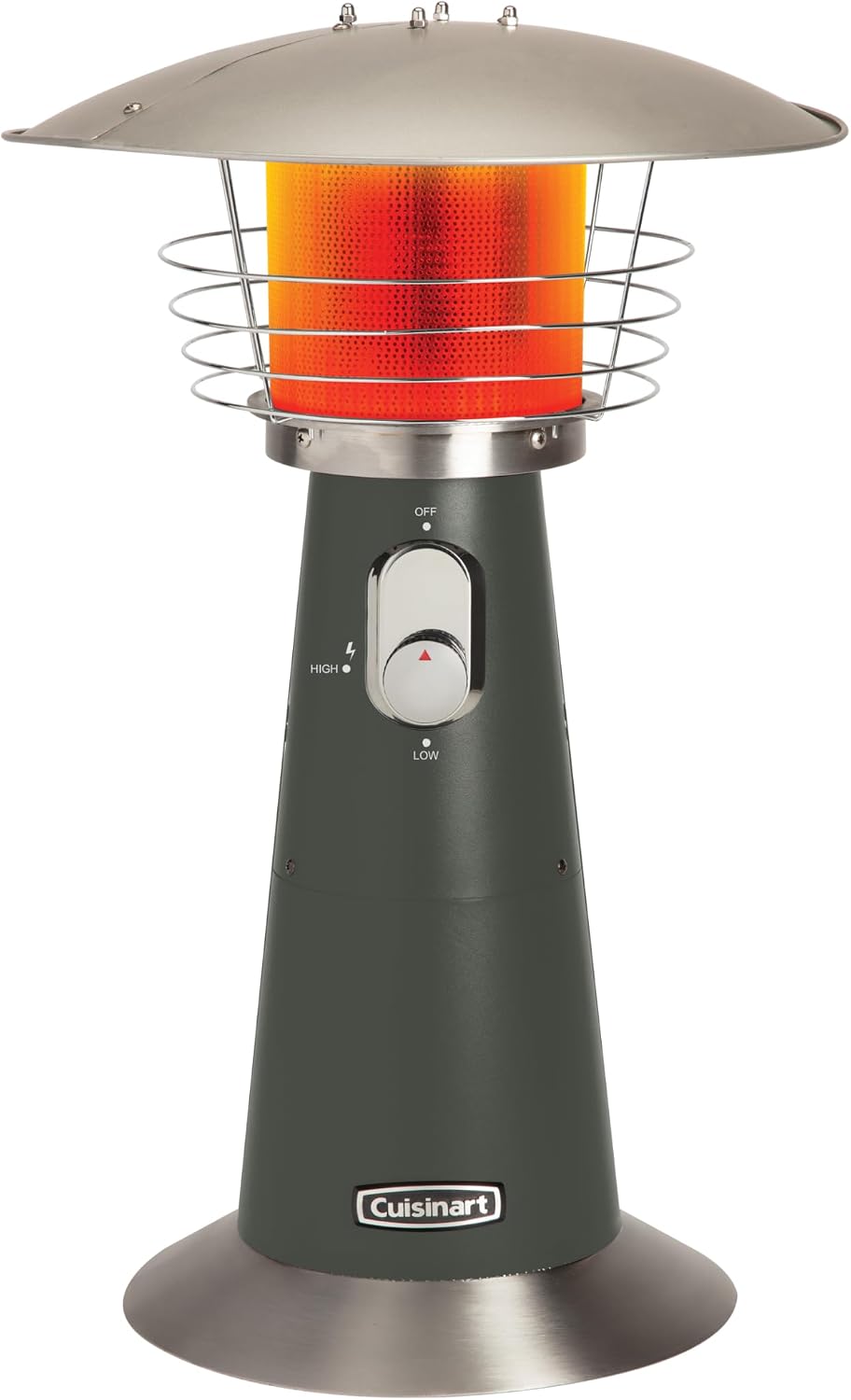
The Cuisinart tabletop propane heater puts about 11,000 BTU into a compact stainless unit that sits on a table and warms the people around it — roughly a 30-square-foot bubble. It runs on a 1-pound camping cylinder, or a 20-pound tank with an adapter hose, weighs 8.5 pounds, has a tilt shutoff, and costs about $150 at 4.4 stars. It is the right size for a two-person dinner outside, not for heating a whole patio.
Price on Amazon: $149.99 | 4.4 stars from 208 ratings (checked October 10, 2026)
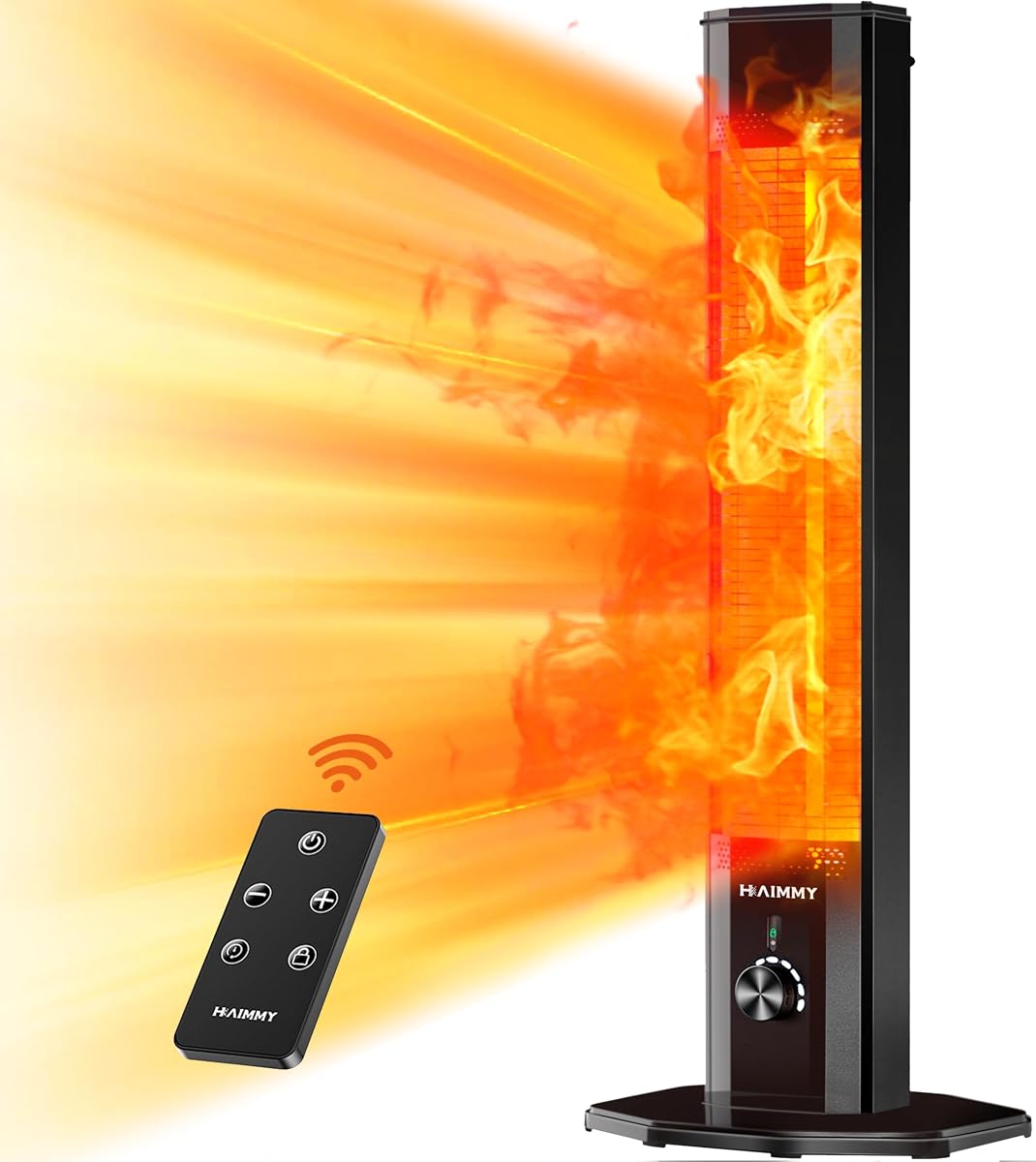
For a standing electric option, the Haimmy 42-inch infrared tower is a 1,500-watt floor heater with nine heat levels, a remote, a timer, and an IPX5 rating, at around $160. It heats a spot the way any 120-volt infrared heater does, but the tower form factor is tidier than a tripod and needs no mounting. Its 4.2-star average reflects the usual 1,500-watt limit: excellent up close, modest past about 6 feet.
Price on Amazon: $159.99 | 4.2 stars from 654 ratings (checked October 10, 2026)
How Much Should You Spend on Outdoor Patio Heaters?
Outdoor patio heaters run from about $90 to well over $1,100, and the right budget depends on format more than brand.
Under $130: A tank-top radiant heater like the Mr. Heater MH30T for spot heat, or wait for a sale on a standing mushroom heater.
$130 to $170: The sweet spot for standing propane. The EAST OAK 55,000 BTU or the Amazon Basics 46,000 BTU cover most open patios, and a 1,500-watt electric infrared heater like the Paraheeter or Haimmy covers a porch.
$170 to $300: A FOOWIN-style pyramid glass-tube heater for the flame effect, or a cleaner electric infrared setup with two mounted units.
$1,100 and up: A hardwired Bromic or a plumbed natural-gas fixture, for a permanent installation you are designing around — architecture, not an appliance.
FAQ
How many BTUs do you need for your patio?
For an open patio with a small seating area, a 40,000 to 50,000 BTU standing heater is the standard answer and warms a circle roughly 10 to 20 feet across. A covered space needs less — about 20 BTU per cubic foot — and a single table or two chairs can be handled by a 10,000 to 15,000 BTU tabletop or a 1,500-watt electric unit. When in doubt, two medium heaters flanking a seating area beat one oversized heater in the center.
Are propane patio heaters safe on a covered patio?
Only with enough clearance. Most propane standing heaters require 18 to 36 inches above the reflector and several feet to the sides, clear of any ceiling, beam, or wall, and they should never be used in a fully enclosed space because of carbon monoxide. If your roof is under about 8 feet or the area is screened in, use an electric infrared heater instead.
Do electric patio heaters actually keep you warm outside?
Yes, within their range. Infrared heat warms your body and nearby surfaces directly rather than the air, so it works outdoors and resists wind better than a gas flame. The limit is coverage: a 120-volt, 1,500-watt heater warms one or two people at close range. To heat a group you need multiple units or a 240-volt model in the 4,000 to 6,000-watt range.
How long does a propane tank last in a patio heater?
A standard 20-pound tank holds about 4.5 gallons. A 40,000 BTU heater on high burns roughly half a gallon per hour, so expect 8 to 10 hours of full-output heat, and longer if you run it on a lower setting. Buying a spare tank so you always have a full one ready is worth it.
What is the best patio heater for a windy area?
Electric infrared handles wind best because it heats surfaces rather than air. Among gas heaters, a pyramid model with an enclosed quartz-glass tube, like the FOOWIN, holds its flame in a breeze far better than an open mushroom burner. Open flame heaters without a wind guard often blow out above about 10 mph.
Can you leave a patio heater outside in the rain?
Electric models with a stated IP rating of IPX4 or higher tolerate rain — the Paraheeter and Haimmy are both IPX5. Gas heaters are weather-resistant but not weatherproof; water sitting on the burner and igniter causes corrosion and hard starts, so keep a fitted cover on any gas heater whenever it is not in use.
Propane or electric — which is cheaper to run?
Electric is usually cheaper per hour of use. A 1,500-watt infrared heater costs about 20 to 25 cents an hour at average US electricity rates, while a 40,000 BTU propane heater on high runs $1.50 to $2.00 an hour in fuel. Propane wins on upfront cost and portability; electric wins on running cost and clean, flame-free heat.
Related Guides
Keep going with the outdoor patio heater buying guide, propane heaters, infrared heaters, infrared heater reviews and the space heater wattage calculator.
What happens next: expect more models with tip-over, flame-out and overheat cutoffs as standard, and higher prices for the ones that skip them. Buy before the first cold snap, when stock is good, and keep the heater at least a few feet from walls, awnings and furniture.
Bottom Line
Outdoor patio heaters come down to one question: covered space or open space. For an open patio, buy the EAST OAK 55,000 BTU — it is the best mix of heat, coverage, reviews, and price. Save money with the Amazon Basics 46,000 BTU, step up to a FOOWIN pyramid for the flame effect, or grab a Mr. Heater tank-top for pure spot heat.
The moment you add a roof, switch to electric infrared: a Dr. Infrared DR-238 or Paraheeter for a plug-in spot, a Bromic Tungsten if you are wiring the space permanently. Whatever you choose, plan for wind and keep a cover on it — that is what separates a heater that lasts five seasons from one that rusts out in two. And when summer swings back around, the same patio does fine with a good outdoor-rated fan.