
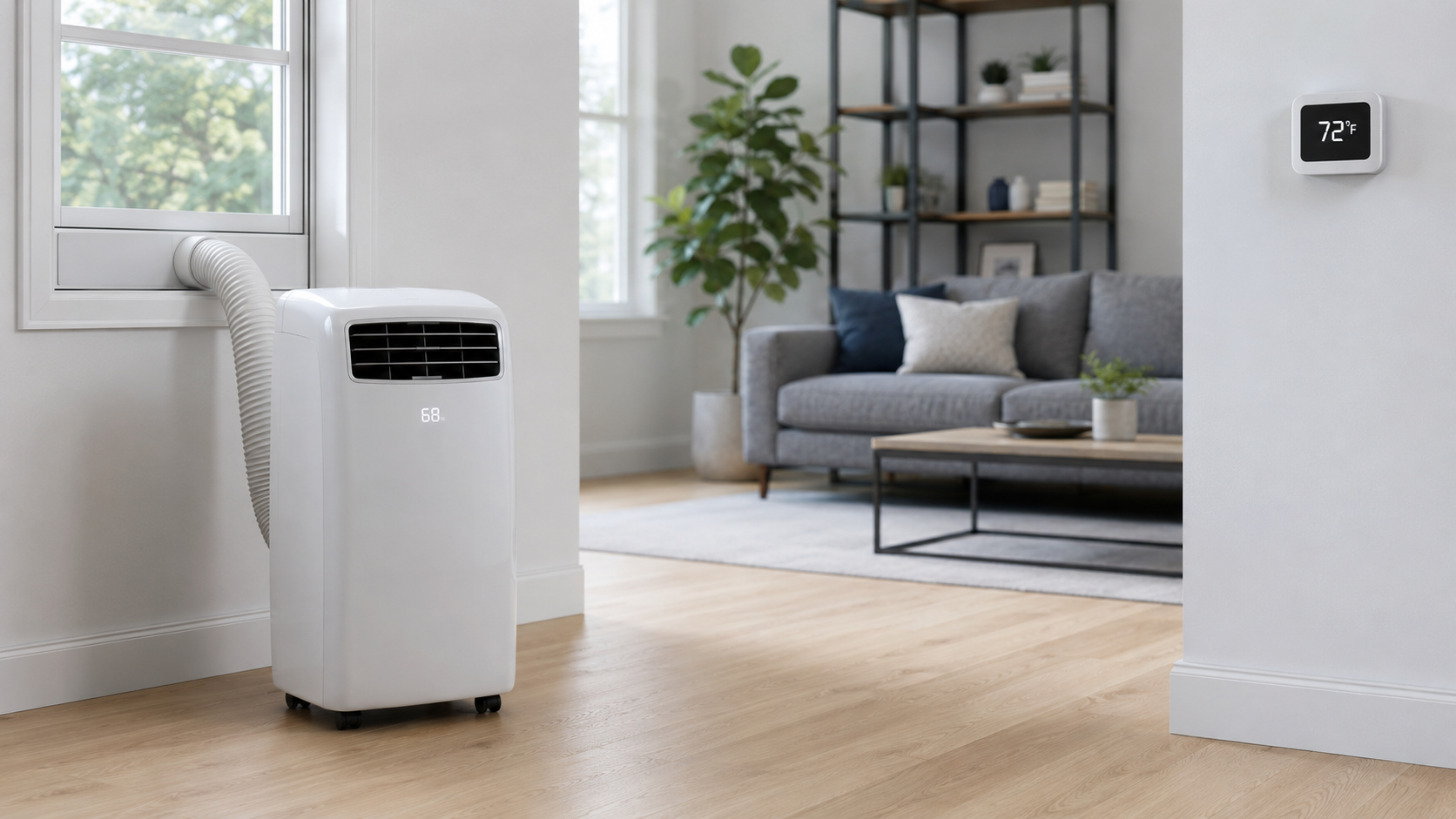
To choose a portable air conditioner, size it by the SACC (DOE) BTU rating rather than the bigger ASHRAE number on the box, then match that figure to your room’s square footage. Pick a dual-hose model if the room runs warm or sunny, check the noise rating and the window-kit fit, and budget for what it adds to your power bill.
Figures here come from manufacturer spec sheets, current Amazon pricing, DOE and ASHRAE capacity data, and owner reviews. This is not based on in-house lab testing. Prices and stock move around, so check the live listing before you buy.
A portable air conditioner earns its place when you cannot put a unit in the window: casement and slider windows that crank sideways, a landlord who bans window units, a room with no exterior window, or a space you only cool part of the year. It is not the efficient or the quiet choice. It is the possible one.
Capacity is the number the marketing hides. Every box shouts an ASHRAE BTU figure; the rating that predicts whether it cools your room is the smaller SACC (or DOE) number, usually 30 to 40 percent lower. Get that straight and the rest follows: hose count, noise, weight, drainage, running cost. The seven picks below cover small bedrooms to warm 500-square-foot living rooms, plus a heat-pump model.
Quick picks
- Best overall: Midea Duo MAP12S1TBL — dual-hose inverter, quiet, efficient
- Best quiet pick: LG LP1022FVSM — dual-inverter compressor, low-decibel mode
- Best true dual-hose for warm rooms: Whynter ARC-14S — two separate hoses, heavy cooling
- Best smart / app control: Frigidaire FHPW122AC1 — Wi-Fi with Alexa and Google
- Cheapest that still cools a bedroom: SereneLife SLPAC10 — real bedroom capacity, low price
- Best budget / renters: Black+Decker BPACT08WT — light, compact, in stock everywhere
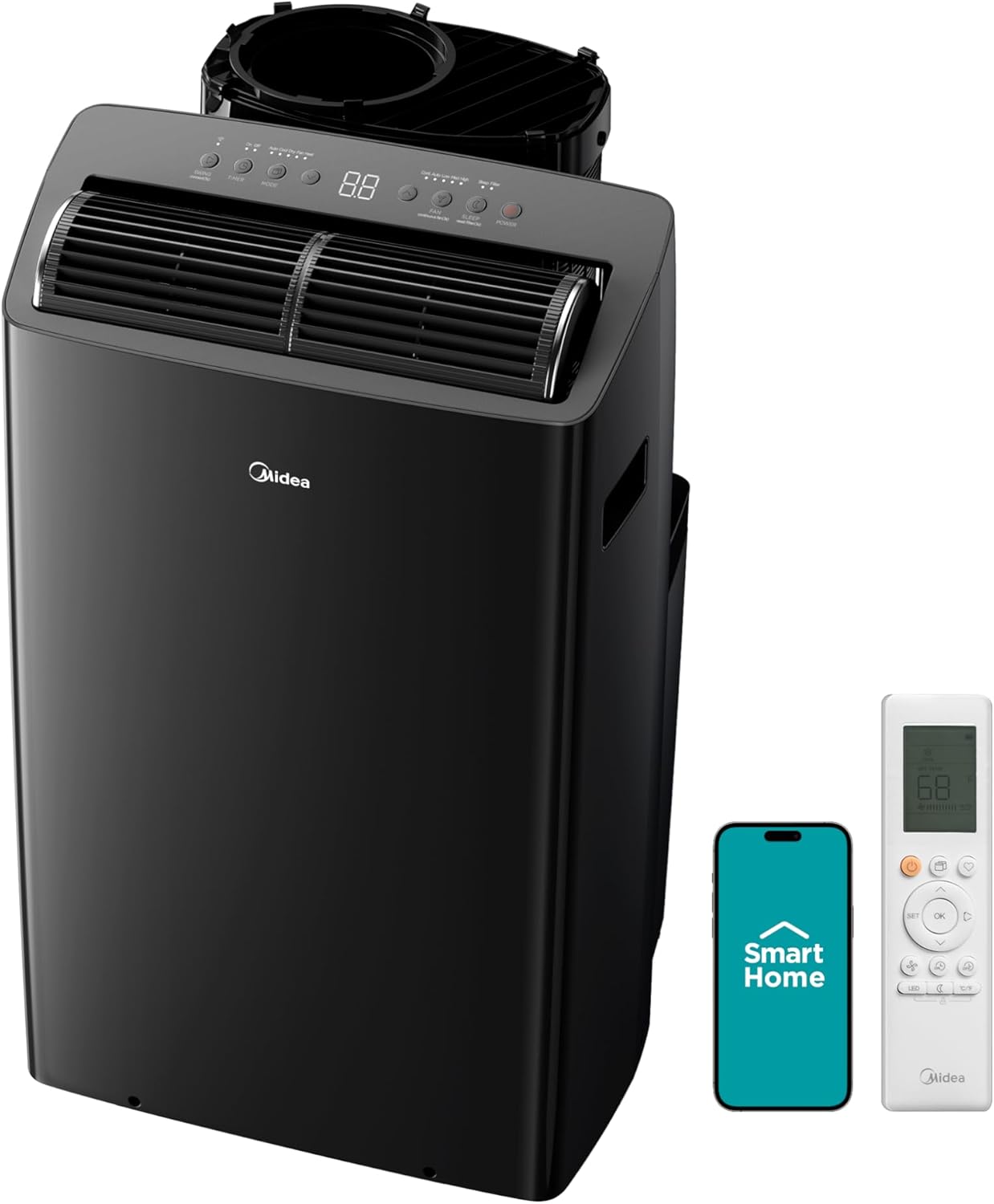
- Best 4-in-1 with real heat: Midea Duo MAP14HS1TBL-A — dual-hose inverter with heat-pump mode
Table of Contents
Best Portable Air Conditioners: Comparison
The table lines all seven up on the specs that decide the purchase: real cooling capacity (SACC) next to the inflated ASHRAE figure, the room size I would trust it in, hose count, the lowest published noise level, weight, heat mode, and price band.
| Model | SACC / ASHRAE BTU | Room size I’d trust | Hose | Noise (low) | Weight | Heat mode | Price band |
|---|---|---|---|---|---|---|---|
| Midea Duo MAP12S1TBL | ~10,000 / 12,000 | up to ~450 sq ft | Dual (hose-in-hose) | ~42 dB | 73 lb | No | $$$ |
| LG LP1022FVSM | ~10,000 / 14,000 | up to ~450 sq ft | Single | ~44 dB | 69 lb | No | $$$ |
| Whynter ARC-14S | ~9,500 / 14,000 | up to ~450 sq ft, warm rooms | Dual (two separate) | ~51 dB | 73 lb | No | $$ |
| Frigidaire FHPW122AC1 | ~8,000 / 12,000 | up to ~350 sq ft | Single (self-evaporating) | ~49 dB | 69 lb | No | $$ |
| SereneLife SLPAC10 | ~6,000 / 10,000 | up to ~200 sq ft | Single | ~52 dB | 55 lb | No | $ |
| Black+Decker BPACT08WT | ~5,300 / 9,000 | up to ~150 sq ft | Single | ~54 dB | 53 lb | No | $ |
| Midea Duo MAP14HS1TBL-A (heat) | ~12,000 / 14,000 | up to ~550 sq ft | Dual (hose-in-hose) | ~42 dB | 77 lb | Yes (heat pump) | $$$ |
Price bands: $ is under $380, $$ is $380 to $600, $$$ is above $600. Two picks from the original shortlist were discontinued and are swapped here for their current equivalents, noted in each review.
How to Read Portable AC Specs: SACC vs ASHRAE BTU
ASHRAE is the old, generous lab rating. SACC, also written DOE, is the number the Department of Energy requires on the EnergyGuide label, and it accounts for the heat a single-hose unit pulls back into the room plus duct losses. It runs about 30 to 40 percent below the ASHRAE figure, so a “14,000 BTU” unit is usually 9,500 to 10,000 BTU SACC. Size your room with SACC; if a listing only shows ASHRAE, multiply by roughly 0.65. “Self-evaporating” means the unit blows most condensate out the exhaust, so you rarely drain it except in a damp room or in dehumidify mode. Hose count gets its own section below, because it is the spec people get wrong most often.
Best Overall: Midea Duo MAP12S1TBL
If you can absorb the price and the weight, the Midea Duo MAP12S1TBL is the portable I would put in most rooms. Rated around 10,000 BTU SACC (12,000 ASHRAE) for about 450 square feet, it works because of two things: an inverter compressor that ramps up and down instead of cycling on and off, and Midea’s hose-in-hose duct, which delivers dual-hose behavior through a single flexible hose. Midea says the inverter cuts energy use more than 40 percent against the federal minimum. It is genuinely quiet, near 42 decibels on low, with Wi-Fi, Alexa, and Google built in. The downsides: it often sells in the high-$700s, it weighs 73 pounds, and its Amazon rating is dragged down by shipping damage to a heavy box.
Pros
- Dual-hose cooling, one easy duct
- Inverter compressor, low power draw
- Near 42 dB on low
- Smart app, Alexa and Google
Cons
- Expensive
- Heavy at 73 pounds
- Reviews dinged by shipping damage
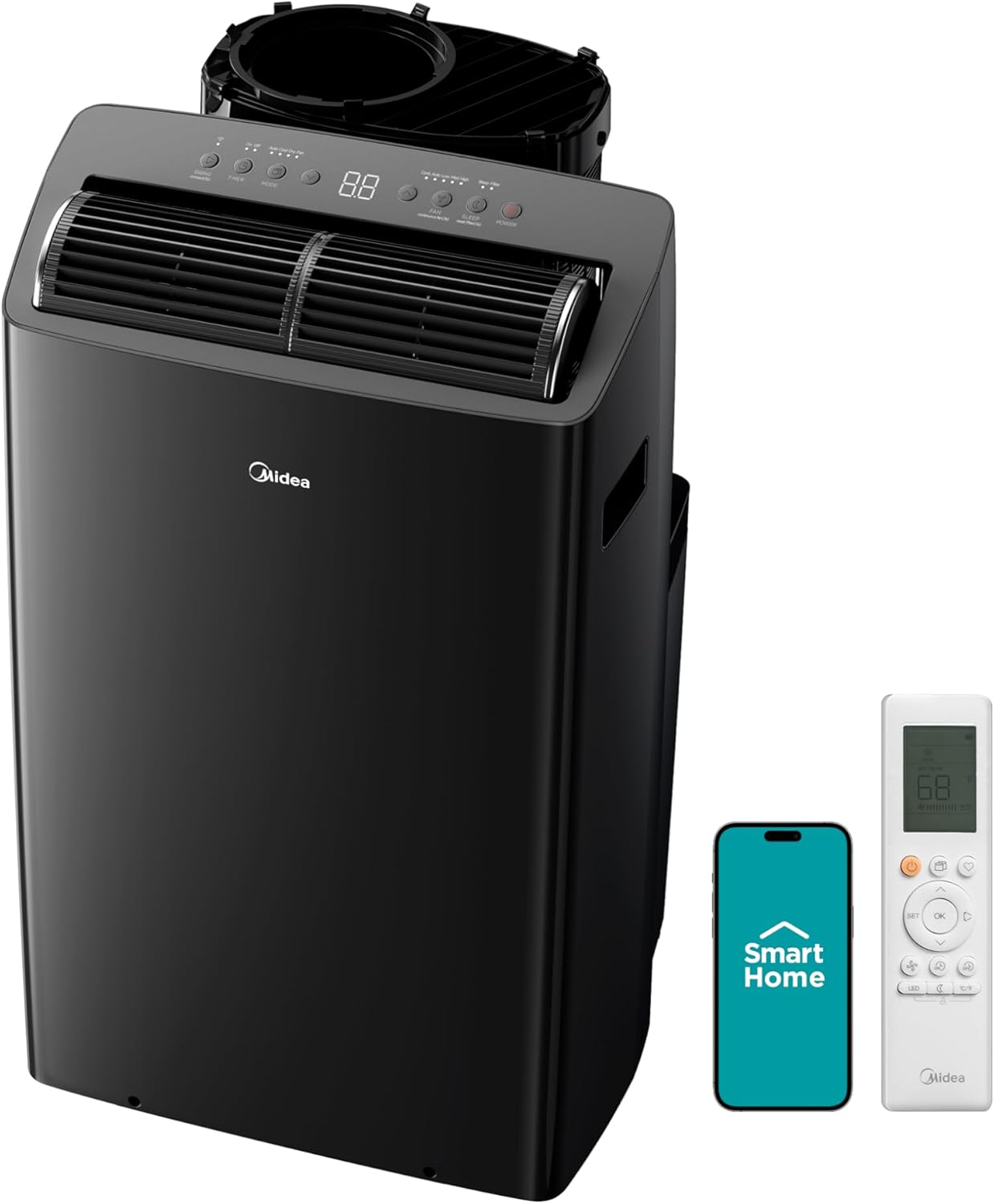
Verdict: best cooling and lowest noise here; worth the price.
Best Quiet Pick: LG LP1022FVSM
The original shortlist named the LG LP1419IVSM, which LG has discontinued. Its direct replacement is the LG LP1022FVSM, which keeps what made the older unit a quiet-room favorite: a dual-inverter compressor and LG’s Lo-Decibel mode, rated around 44 decibels. It is single hose, near 10,000 BTU SACC (14,000 ASHRAE) for rooms up to about 450 square feet. The inverter holds the setpoint without the loud restart thump that wakes people, and the ThinQ app is one of the few that is genuinely pleasant. Being single hose, it will not pull down a hot, sun-facing room as fast as the Midea Duo or the Whynter, and it weighs about 69 pounds. For a normal bedroom or office where quiet is the priority, this is the one.
Pros
- Dual-inverter, quiet Lo-Decibel mode
- No loud compressor restarts
- Genuinely good ThinQ app
- Self-evaporating in normal humidity
Cons
- Single hose limits warm rooms
- About 69 pounds
- Premium price
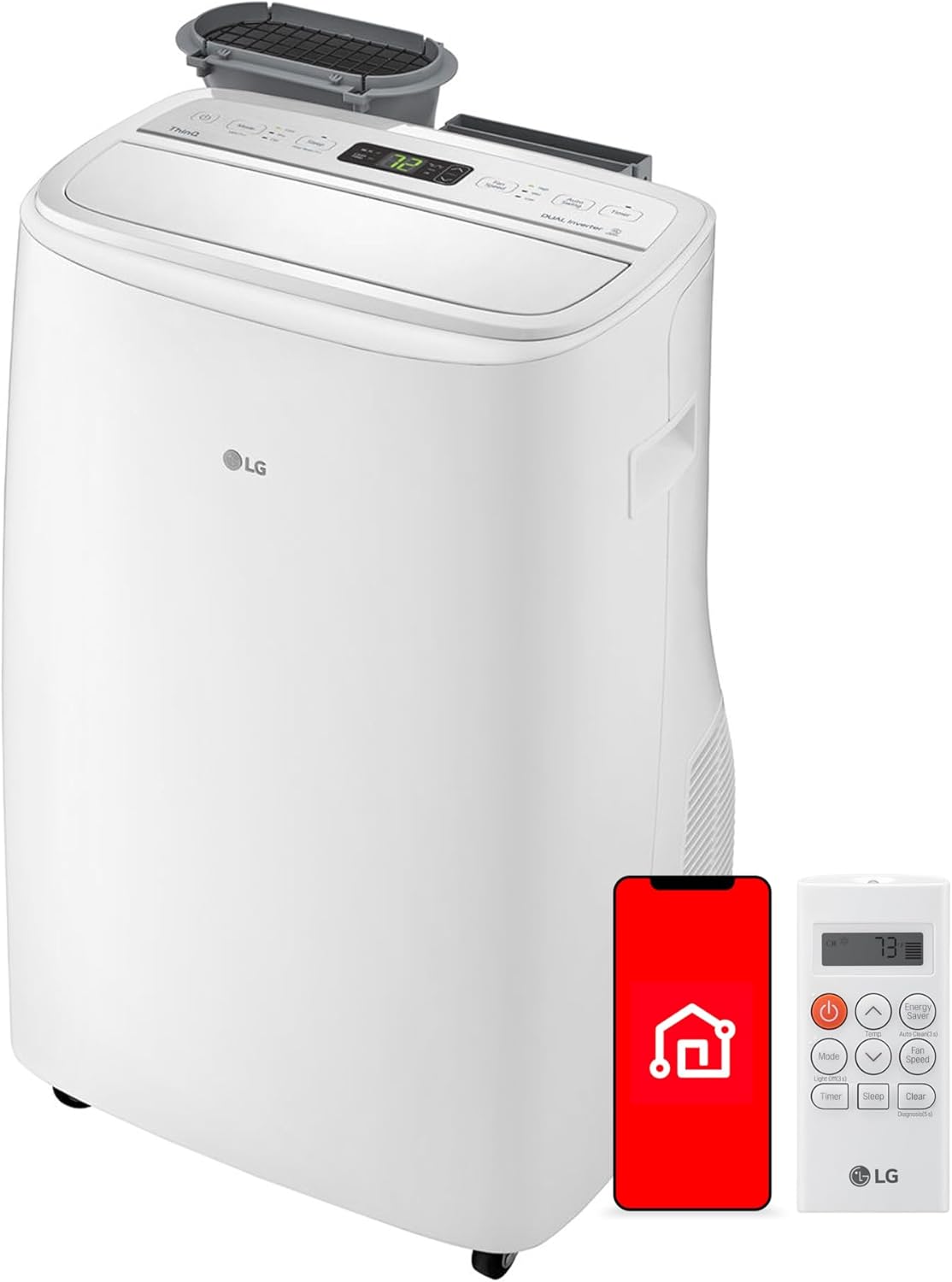
Verdict: the quietest pick for a normal bedroom.
Best True Dual-Hose for Warm Rooms: Whynter ARC-14S
The Whynter ARC-14S is the unit I point people to when the room runs hot: a west-facing living room, a converted attic, a space with a lot of glass. It uses two separate hoses, so the room never goes negative and warm air is not pulled in around the doors. Rated near 9,500 BTU SACC (14,000 ASHRAE), it holds about 400 to 450 square feet in conditions that defeat a single-hose unit of the same rating, and it carries one of the largest owner-review histories of any portable. Trade-offs: it is loud, around 51 decibels on low, and at 73 pounds with two hoses it is the most awkward install here, with dated controls and no Wi-Fi. Our full Whynter ARC-14S review covers the setup.
Pros
- True two-hose design, no negative pressure
- Strong cooling in hot, sunny rooms
- Huge owner-review track record
- Easy-clean filters and auto-drain
Cons
- Loud, around 51 dB on low
- Two hoses make install fiddly
- Basic controls, no Wi-Fi
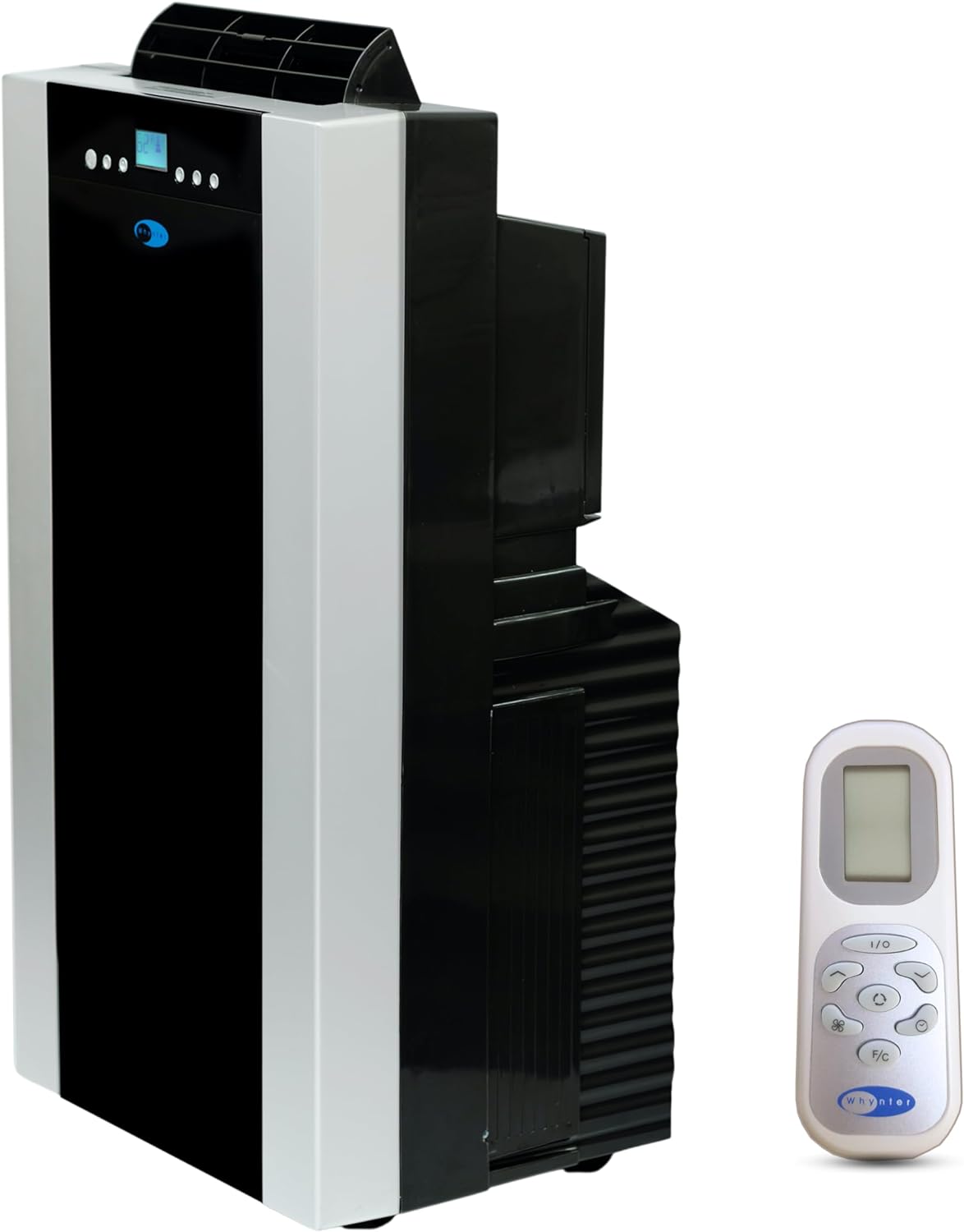
Verdict: buy it when single hose keeps losing to the sun.
Best Smart / App Control: Frigidaire FHPW122AC1
The original shortlist called for the Frigidaire Gallery GHPC132AB1, now out of stock almost everywhere. Its current stand-in is the Frigidaire FHPW122AC1, a 12,000 BTU unit with an 8,000 BTU SACC rating for rooms up to about 350 square feet in real use. It is single hose and self-evaporating, and the draw is the software: full Wi-Fi through the Frigidaire app plus Amazon Alexa and Google Assistant, so you can start it from the driveway or schedule the bedroom cool by bedtime. For the class it is reasonably quiet, near 49 decibels on low. It is a mid-tier cooler, though: push it into a 400-square-foot sunroom and it runs flat out without catching up, the app drops its connection occasionally, and at roughly 69 pounds it is not light for its output.
Pros
- Full Wi-Fi with Alexa and Google
- Scheduling from the app
- Quiet for the class, near 49 dB
- Compact cabinet, self-evaporating
Cons
- Only mid-tier cooling power
- Occasional app disconnects
- Heavy for its output
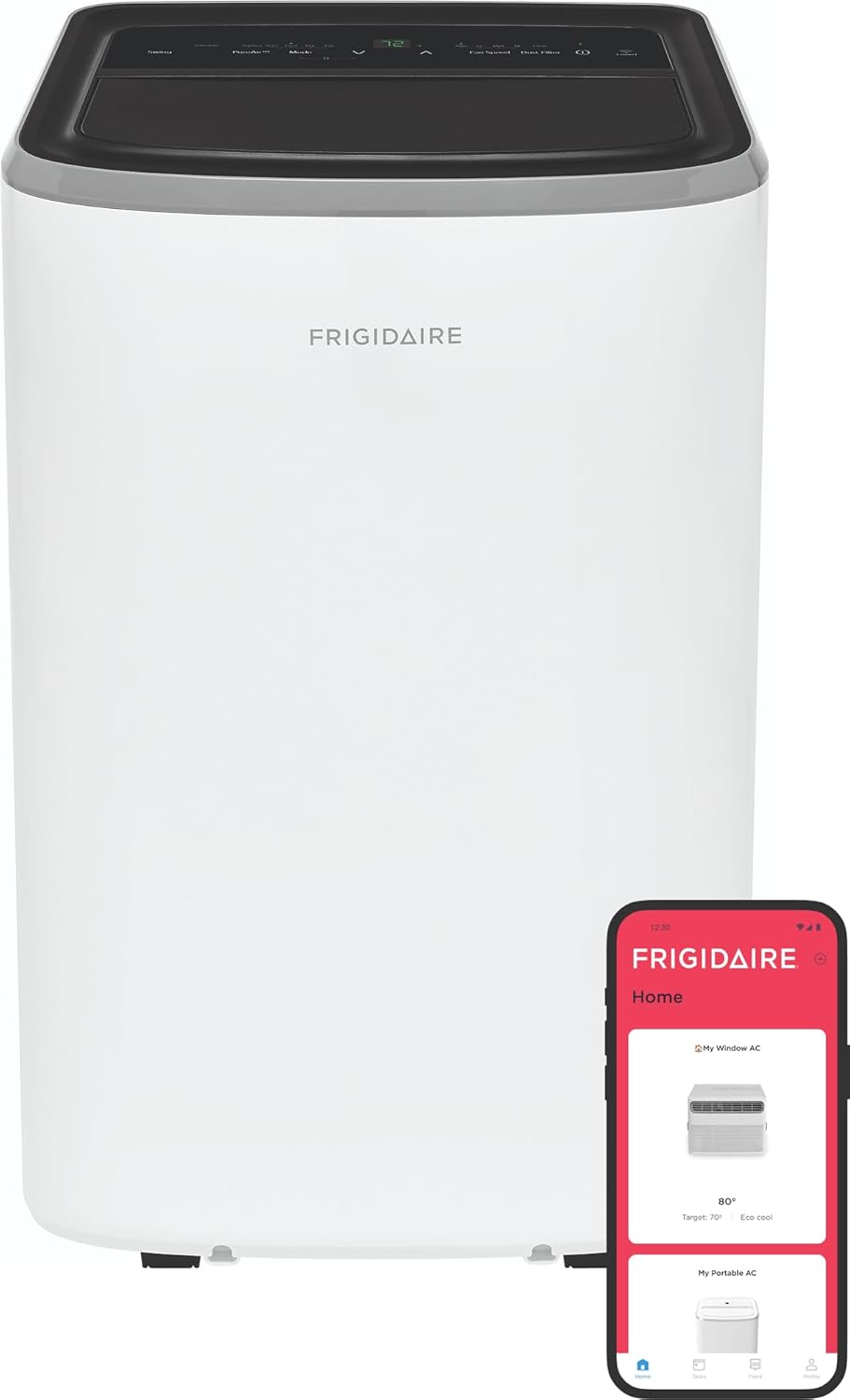
Verdict: cheapest real path to app and voice control.
Cheapest That Still Cools a Bedroom: SereneLife SLPAC10
Many budget portables are 8,000 ASHRAE units that struggle in anything bigger than a closet. The SereneLife SLPAC10 is a step up: around 6,000 BTU SACC (10,000 ASHRAE), enough to hold a real 180 to 200-square-foot bedroom, and it regularly sells at the low end of the price range. It is single hose with cool, fan, and dehumidify modes, a 24-hour timer, and a remote, and at 55 pounds it is one of the lighter units here. Do not expect finesse: it is rated around 52 decibels and is a steady drone, and with no inverter the room temperature swings a degree or two. But it cools, it is cheap, and it has a long, mostly positive owner history. Our SereneLife 10,000 BTU review covers the window kit and the dehumidify drain.
Pros
- Enough capacity for a real bedroom
- Low price, frequent discounts
- Light at 55 pounds
- Long, mostly positive review history
Cons
- Steady drone, around 52 dB
- No inverter, temperature swings
- Flimsy window bracket
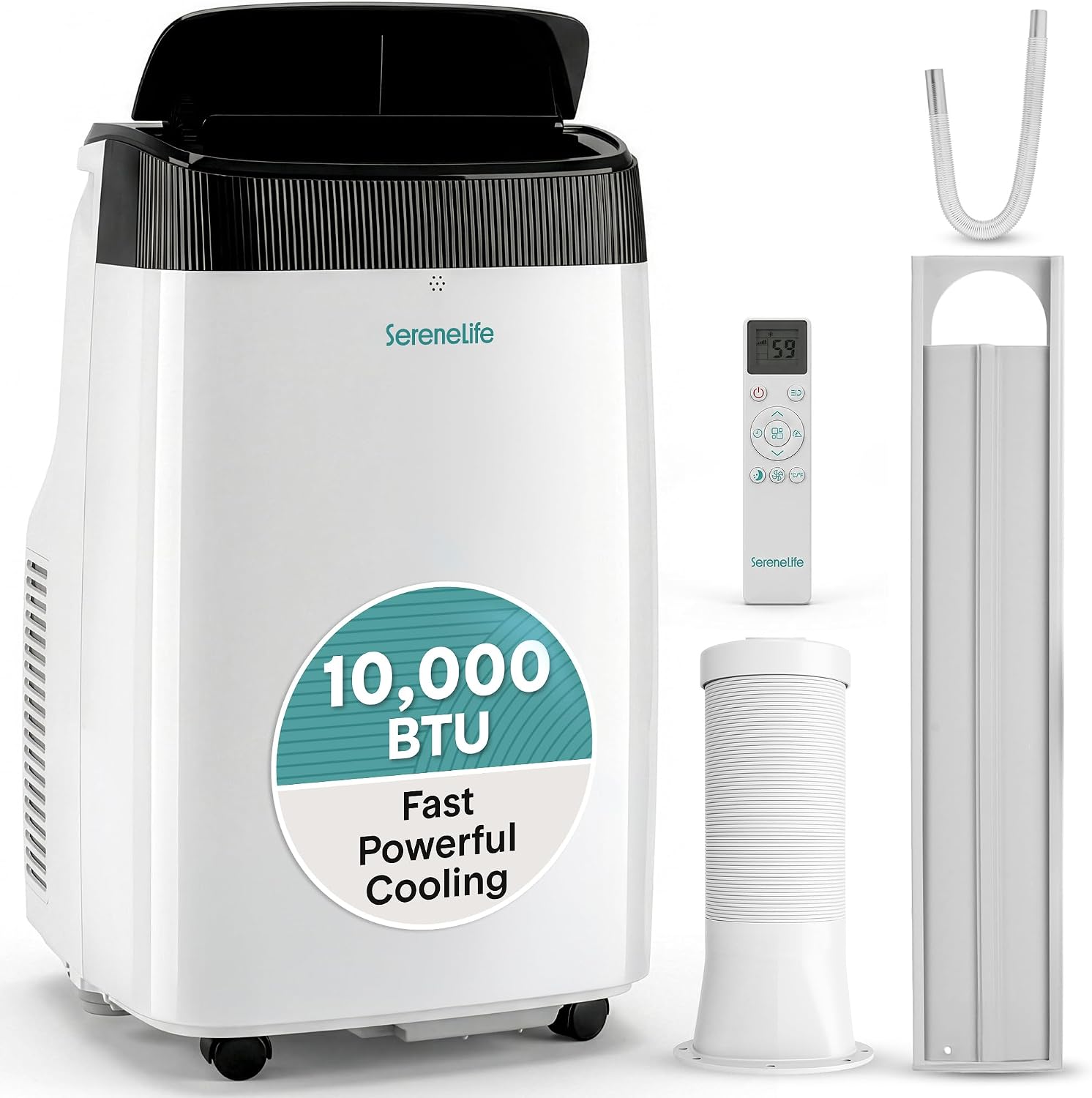
Verdict: lowest price with true bedroom capacity.
Best Budget for Small Rooms and Renters: Black+Decker BPACT08WT
The Black+Decker BPACT08WT is the portable I recommend most often to renters and to anyone cooling one small room. Black+Decker relabeled it recently, so the box now reads 9,000 BTU with a 5,300 BTU SACC rating; treat it as a 100 to 150-square-foot cooler for an office or a small bedroom. It is single hose with fan and dehumidify modes and a “Follow Me” remote that reads the temperature where you sit. What makes it the default budget pick is availability and support: it is in stock nearly everywhere, parts and window kits are easy to find, and at 53 pounds it stores in a closet over winter. It is not quiet, around 54 decibels, and the thermostat reads a couple of degrees optimistic. Maya runs a full teardown in our Black+Decker BPACT08WT review, and our guide to small portable air conditioners has more at this size.
Pros
- Low price, always in stock
- Light and compact, easy to store
- Follow Me remote thermostat
- Huge owner-review base
Cons
- Small capacity, about 150 sq ft
- Around 54 dB, not quiet
- Thermostat reads a bit low
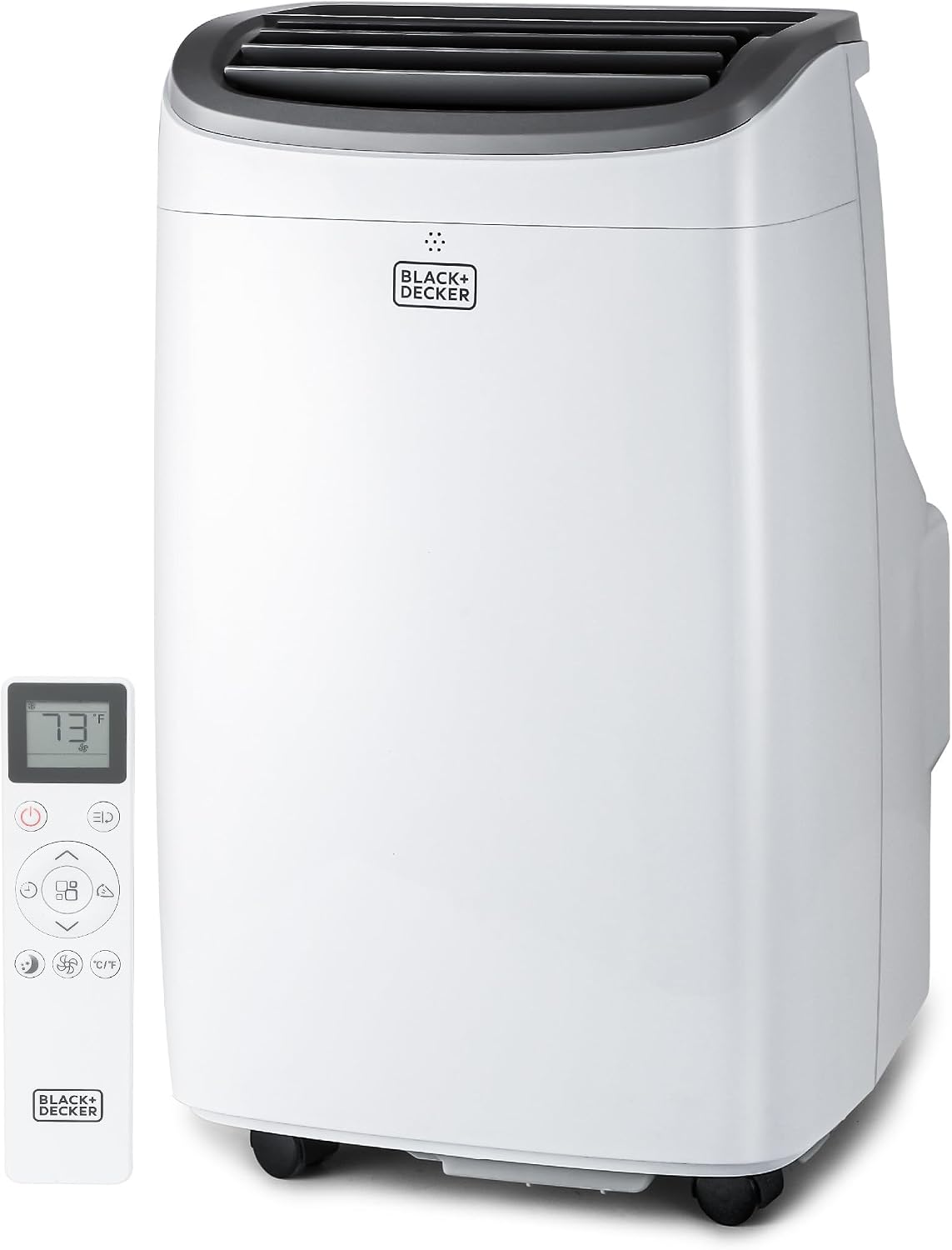
Verdict: the safe cheap choice for one small room.
Best 4-in-1 With Real Heat: Midea Duo MAP14HS1TBL-A
The original shortlist listed the De’Longhi Pinguino PAC EL290HLWKC, no longer sold new in the U.S. The unit that now fills the year-round role is the Midea Duo MAP14HS1TBL-A, the heat-pump version of the Duo. It brings the same hose-in-hose dual-hose duct and inverter compressor as my top pick, scaled up to about 12,000 BTU SACC (14,000 ASHRAE) for rooms up to 550 square feet, plus a true heat-pump mode. A heat pump moves heat rather than burning watts in a resistance coil, so it warms a room for a fraction of a space heater’s electricity, down to outdoor temperatures near freezing. In summer it behaves like the standard Duo. It is the heaviest unit here at 77 pounds, it is expensive, and the heat is supplemental, not a furnace replacement for a cold climate.
Pros
- Efficient heat-pump winter mode
- Dual-hose inverter cooling
- Quiet near 42 dB
- Covers up to about 550 sq ft
Cons
- Heaviest here at 77 pounds
- Expensive
- Heat is supplemental, not for cold climates
Verdict: one machine for summer cooling and shoulder-season heat.
How Many BTU Do You Need?
Start with square footage and use the SACC rating. The rough baseline is 20 BTU of SACC capacity per square foot, then adjust for the room.
| Room size | Baseline SACC BTU | Typical pick from this guide |
|---|---|---|
| Up to 150 sq ft | ~5,000 | Black+Decker BPACT08WT |
| 150–250 sq ft | ~6,000 | SereneLife SLPAC10 |
| 250–350 sq ft | ~8,000 | Frigidaire FHPW122AC1 |
| 350–450 sq ft | ~9,000–10,000 | Midea Duo, LG LP1022FVSM, Whynter ARC-14S |
| 450–550 sq ft | ~11,000–12,000 | Midea Duo MAP14HS1TBL-A |
Then adjust. Add about 10 percent for ceilings above 8 feet, and 10 to 20 percent for strong afternoon sun or a lot of west or south-facing glass. Add roughly 4,000 BTU for a kitchen, and about 600 BTU per person beyond the first two. If your number lands between two units, size up: an oversized portable on a low fan speed is quieter than a maxed-out one that never reaches setpoint. Run your room through our BTU calculator for a firm figure, and if a window unit is still on the table, compare both formats in our 12,000 BTU air conditioner guide.
Single Hose vs Dual Hose, in Plain English
A portable air conditioner has to dump heat outside, so it blows hot air out the exhaust hose. That air has to come from somewhere.
A single-hose unit pulls it from the room, and that air is replaced by outside air leaking in around doors, windows, and outlets, because the room is now at slightly lower pressure than the rest of the house. So the unit fights itself: it cools the room and simultaneously invites warm, humid air back in. In a small, sealed room this is a minor tax. In a big or leaky room it can cut effective capacity by a third.
A dual-hose unit runs a second duct from outdoors straight to the condenser, so the air it exhausts never came from your room. No negative pressure, no infiltration penalty: it cools faster and uses less energy per degree. Midea’s hose-in-hose approach is the middle path, giving dual-hose airflow with one duct to manage. Under about 200 square feet and tight, single hose is fine. Above that, or anywhere sunny, buy dual hose.
What a Portable AC Actually Costs to Run
A 10,000 BTU SACC portable draws roughly 1,100 to 1,200 watts while the compressor runs, but it cycles, so figure an average near 0.75 kW. Run it 8 hours a day and that is about 6 kWh daily, or 180 kWh a month. At the U.S. average residential rate near 17 cents per kWh, that is roughly $30 a month. Run it around the clock and you are closer to 400 kWh and $65 to $70 a month, more in a hot climate.
Two things move that number. An inverter unit like the Midea Duo throttles the compressor instead of slamming it on and off, realistically shaving 20 to 35 percent off the bill. And a single-hose unit in a leaky room runs longer to hit the same temperature, so it costs more than its wattage suggests. If your real need is just air movement on a mild evening, a fan costs a tenth as much; our roundup of fans that cool like air conditioners covers when that is enough.
Installation and Venting
Most portables ship with a window kit for a double-hung window: cut the plastic panel to width, seat it on the sill, close the sash onto it, clip the hose adapter in. Ten minutes, no tools. A sliding window or door uses the same kit’s long vertical panel, or a cheap universal slider kit. Casement and crank-out windows are the hard case, because the stock panel will not seal; you cut a piece of acrylic to fit the opening and mount the adapter in that, or buy a casement kit.
For a room with no window at all, vent through a dropped ceiling tile into a plenum, through a door into a room that has a window, or through a capped 5 to 6-inch hole in an exterior wall. Never vent into an enclosed closet, a lived-in attic, or another interior room; you are just moving the heat a few feet and adding the compressor’s waste heat on top. Garages are their own problem because they are hot, unsealed, and often uninsulated; our guide to portable air conditioners for a garage covers what works there. Keep the exhaust hose short and straight, because every extra foot and sag radiates heat back into the room.
Maintenance
Draining. In normal humidity a self-evaporating unit may go a season without draining. In a damp room or in dehumidify mode, run the drain hose to a floor drain or empty the tank when the “full” light comes on. Before winter storage, pull every drain plug and let it dry for a day, or it smells musty next spring.
Filter and coils. Rinse the mesh pre-filter every two to four weeks in cooling season; a clogged filter chokes airflow and makes the compressor work harder. Once a year, vacuum the condenser fins through the back grille. At season’s end, run fan-only for 30 minutes to dry the interior and store the unit upright; laying a portable on its side can shift the compressor oil.
FAQ
Does a portable air conditioner actually cool a room?
Yes, if you size it right and vent it properly. A unit matched to the room’s square footage on its SACC rating will hold a comfortable temperature. Disappointment almost always traces to buying by the ASHRAE number, using single hose in a sunny room, or a long, sagging exhaust hose.
Is a dual-hose portable worth it?
In a room over about 200 square feet, or any room with strong sun, yes. Dual hose avoids the negative-pressure problem that makes a single-hose unit pull warm air in as fast as it cools. In a small, sealed bedroom the benefit is small.
Can I vent a portable AC without a window?
You can, but the exhaust still has to reach outdoors: a dropped-ceiling plenum, a door into a room that has a window, or a capped 5 to 6-inch hole through an exterior wall. Venting into a closet or a sealed interior room does not work.
Portable or window AC, which should I get?
If your window takes a standard unit and you can leave it in place, a window AC is cheaper, more efficient, and quieter for the same capacity. Choose a portable for a casement or slider window, a lease that bans window units, a weak sill, or when you need to move the cooling between rooms.
How often do I have to drain it?
In cooling mode in average humidity, rarely, because the unit evaporates most of the water out the exhaust. In a humid room or in dehumidify mode, connect the drain hose or empty the tank every day or two. Always drain it fully before storage.
Can a portable air conditioner run 24/7?
Yes, these are built for continuous duty. Use a moderate setpoint and let it cycle rather than setting the coldest number, keep the filter clean, and expect roughly $65 to $70 a month for a 10,000 BTU SACC unit run around the clock at average rates.
Do portable air conditioners dehumidify?
They remove moisture as a side effect of cooling, and most have a separate dehumidify mode. It is fine for a muggy room, but it is not a substitute for a real dehumidifier in a wet basement; see our guide to the best dehumidifiers for basements for that.
Why is my portable AC blowing warm air?
Usual causes, in order: a dirty filter, a full condensate tank that has tripped a safety mode, a kinked or disconnected exhaust hose, or the room overwhelming an undersized unit. If the filter is clean, the tank is empty, and the hose is short and clear, the unit is probably too small for the space.
Bottom Line
Size by the SACC number, match it to the one room you will run it in, and go dual hose if that room is large or sunny. For most people the Midea Duo MAP12S1TBL is the best portable air conditioner you can buy: dual-hose cooling from a single duct, an inverter compressor that keeps the bill and the noise down. If your priority is a quiet bedroom, the LG LP1022FVSM is the calmest single-hose unit here. On a budget, or in a rental with one small room, the Black+Decker BPACT08WT is cheap, light, and available everywhere. Whatever you pick, keep the exhaust hose short, rinse the filter every few weeks, and do not buy by the number on the front of the box.