
The best whole-house dehumidifier for most homes is the AprilAire E070 Pro: it holds every room near 50% humidity, drains to a line so you never touch it, and runs far more efficiently than a stack of portables. Size it by your home’s square footage and climate, decide whether to duct it into your HVAC or free-stand it, and plan on a drain within reach.
Every pick here is checked against verified capacity ratings, current DOE and Energy Star data, live Amazon listings, and buyer feedback. Sizing follows AprilAire and ACCA guidance. This guide does not involve hands-on lab testing.
The comfort difference is bigger than people expect. Instead of a clammy basement and a sticky upstairs while a portable roars in one room, a whole-house dehumidifier holds the same comfortable humidity in every room, quietly, from a spot you never see. No buckets, no hoses across the floor, no white noise in the living room.
It also protects the house. Steady 45 to 55% humidity keeps wood floors from cupping, stops mold before it starts on framing and in closets, and takes load off your air conditioner, which no longer has to overcool the house just to wring out moisture.
The trade-off is cost and a bit of planning: these units run $420 to $2,650, most need a drain nearby, and the ducted ones usually want a pro. This guide covers when a whole-house unit is worth it, how to size and install one, and six models across the price range. For the room-by-room decision, see our dehumidifiers for damp homes guide, and if you are cross-shopping the older AprilAire 1800-series units, our original whole house dehumidifier guide covers those in depth.
Affiliate disclosure: IndoorBreathing may earn a commission when you buy through links on this page, at no extra cost to you. Picks are chosen for capacity, efficiency, filtration, and value, not commission rate.
Table of Contents
What a Whole-House Dehumidifier Actually Does
It is a single large dehumidifier, 70 to 160 pints a day, that treats the air for your whole home instead of one room. It sits in the basement, crawl space, attic, or a utility closet, connects to a permanent drain, and runs off a humidistat that you set once. When the humidity anywhere it serves climbs past your target, it turns on; when the air is dry, it stops.
Most units also filter the air they move, usually through a MERV-8 to MERV-13 filter, so the whole airstream gets cleaned as it is dried. Some add a fresh-air intake that pulls filtered outdoor air in, which matters in tightly sealed newer homes that do not breathe on their own. Because the machine lives away from your living space, you never hear it the way you hear a portable.
Under the hood it is the same refrigeration process as a portable, warm humid air passes over a cold coil, moisture condenses and drains away, and the now-dry air is reheated slightly and returned. The difference is scale and placement: a much larger coil and blower, a permanent drain instead of a tank, and a home in the mechanical room instead of the corner of the den. That is what lets it treat 2,000 or 5,000 square feet instead of one room, and why it can hold a steady humidity that a portable chasing one space never quite manages. Our dehumidifier buying guide walks through the mechanics in more depth.
Signs You Need a Whole-House Unit, Not a Portable
Put a hygrometer on each level for a few humid days. You need a whole-house dehumidifier if:
The humidity reads above 55% on the main floor, not just the basement. Two or more separate areas feel damp or smell musty. Your air conditioner runs constantly in summer and the house still feels sticky. You have wood floors cupping, condensation on windows in multiple rooms, or recurring mold in closets and around the base of exterior walls. Or you are simply tired of emptying buckets and living with a portable running in the family room. If only the basement is damp and the rest of the house is fine, a basement dehumidifier is the cheaper answer.
Ducted vs. Free-Standing
Every unit here can run free-standing: you set it in a central low spot, plug it in, run the drain, and it pulls damp air from the surrounding space and pushes dry air back out. This is the simplest install and works well for a basement, a crawl space, or a smaller home where air moves between rooms freely.
A ducted install ties the unit into your HVAC system. The common setup pulls air from the return duct and dumps dry air into the supply duct, so your existing vents distribute it to every room. This gives the most even results in a larger or more compartmentalized house, and it can run independently of your heating and cooling. The downside is that ducting is a job for an HVAC pro, adding $600 to $1,800 to the project.
There is a middle option too: a dedicated duct that runs from the dehumidifier to a few key rooms or back to a central hallway, without fully tying into the HVAC. It costs less than a full HVAC integration and still moves dry air where you need it, which suits a house where only the bedrooms or a finished lower level stay damp.
The rule: free-stand it for a basement, a crawl space, or an open smaller home; duct it for a larger house with lots of closed doors, or when you want the dehumidifier and the AC to work as one system. Whichever way you go, keeping the space sealed helps, our notes on basement air quality cover sealing and ventilation alongside dehumidification.
How to Size a Whole-House Dehumidifier
Start with square footage and climate. As a rough guide, a 70-pint unit covers up to about 2,500 to 2,800 square feet in a moderately humid climate, a 100-pint unit up to about 5,000 to 5,500, and a 130-pint unit up to about 7,000. In a very humid climate, a new build with a tight envelope, or a home with a wet crawl space, size up one step.
Remember the pint number changed. The Department of Energy moved its test from 80 to 65 degrees in 2019, so today’s “70 pint” whole-house unit is the same machine that would have been labeled higher a few years ago. Compare current ratings to current ratings.
Do not undersize. A unit that is too small runs constantly, never quite catches up, and wears out early. A slightly oversized unit cycles less and lasts longer. Our pint calculator and size guide help you land on a number.
6 Best Whole-House Dehumidifiers: Comparison Table
Capacity is pints per day on the current DOE test. Coverage is the manufacturer’s figure for a moderate climate. Prices and ratings are current Amazon figures and will move.
AprilAire E070 Pro — Best Overall Whole-House Dehumidifier
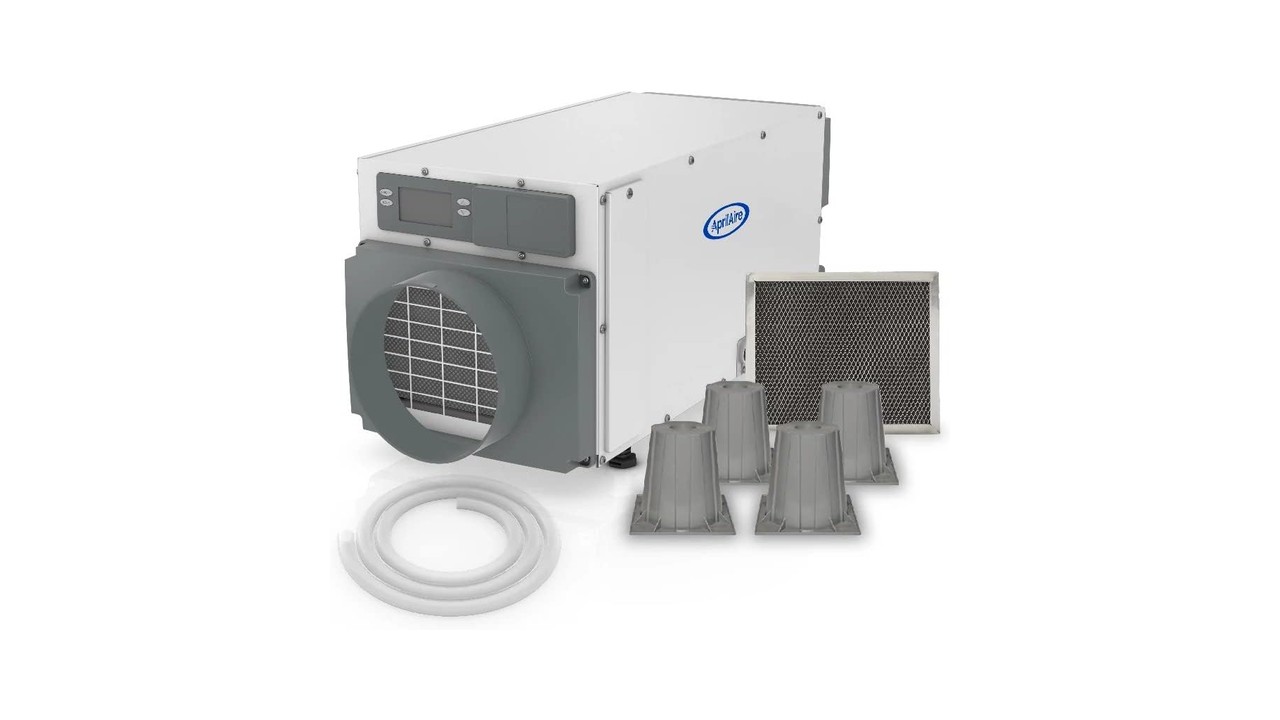
The E070 is the unit that fits the most homes. It removes 70 pints a day on the current test, covers up to about 2,800 square feet, and is Energy Star certified, so it pulls far more water per watt than portables. It arrives as a complete kit with the drain hose, two MERV-8 filters, and mounting risers, ships without a water tray to empty, and runs off simple smart-sensing: set the humidity you want and it takes over. AprilAire backs it with a 5-year warranty.
You can free-stand it in a basement or crawl space, or an HVAC pro can duct it to your return so it dries the whole house through your existing vents. It fits through most crawl-space doors. The drawbacks are the price, around $1,770 before any install labor, and the need for a drain within reach. For a typical home that is damp everywhere, this is the safe, well-supported choice.
Pros
- Right size for most homes (~2,800 sq ft)
- Energy Star efficient
- Free-stands or ducts into HVAC
- Complete kit, 5-year warranty
- Fits through crawl-space doors
Cons
- Around $1,770 before install
- Needs a drain nearby
- No fresh-air intake
- Ducting needs a pro
Looking ahead, expect whole-house dehumidifiers to pair with fresh-air ventilation and smart thermostats as homes get tighter. The catch is that these systems cost more to install than the box itself, so ask for a full quote.
AprilAire E100 Pro — Best for a Whole Medium-to-Large Home
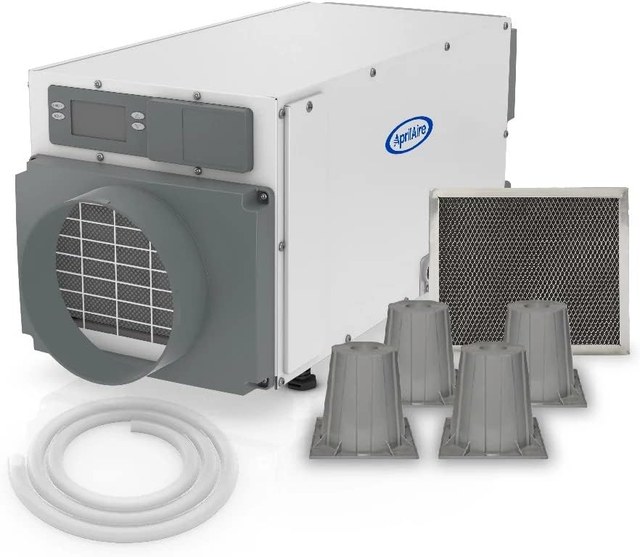
When one E070 is not enough, the E100 is the step up: 100 pints a day, coverage to about 5,500 square feet, and an Energy Star Most Efficient rating, which is the top efficiency tier. It ships as the same kind of complete bundle, drain hose and spare filter included, with corrosion-resistant aluminum coils built for years of continuous duty, and the same set-and-forget smart sensing.
This is the one for a two-story home in a humid region, a house with a finished basement plus main and upper floors, or anywhere the E070 would be running flat out all summer. Ducted into the HVAC return, it holds the whole house steady with the AC doing only its cooling job. The cost, around $2,280 plus install, is the barrier, and like the rest of the AprilAire line it has no fresh-air function.
Pros
- 100 pints/day, covers ~5,500 sq ft
- Energy Star Most Efficient tier
- Corrosion-resistant aluminum coils
- Complete kit, 5-year warranty
Cons
- Around $2,280 before install
- No fresh-air intake
- Overkill for a small home
- Ducting needs a pro
AprilAire E130 Pro — Best for Large Homes and Humid Climates
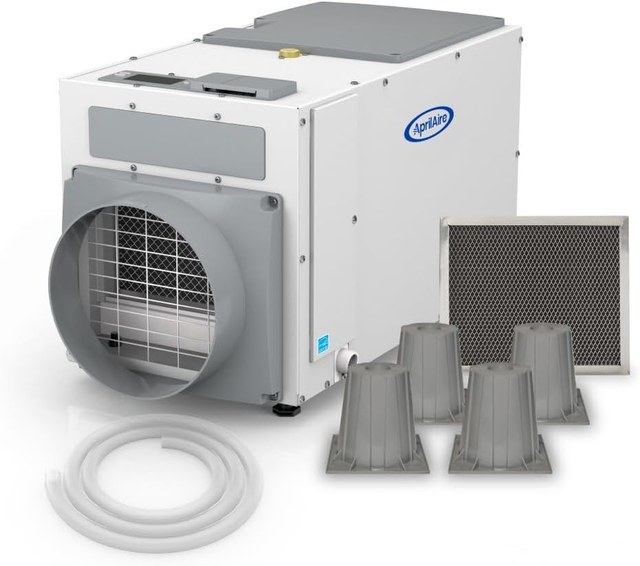
The E130 is the biggest in the residential line: 130 pints a day, coverage to about 7,200 square feet, and again an Energy Star Most Efficient rating. It includes the Model 76 digital wall control, which lets you set and monitor the dehumidifier from a living space instead of a crawl space, and it can serve a basement, an attic, or a whole ducted home.
You buy this when the house is genuinely large, the climate is genuinely wet, or both, a big home in the Southeast, a lake house, a place with a large open crawl space feeding the structure. For an average home it is more capacity than you can use, and at roughly $2,650 before install it is the most expensive pick here. Within its intended job, keeping a large humid house comfortable everywhere, nothing on this list matches it.
Pros
- 130 pints/day, covers ~7,200 sq ft
- Energy Star Most Efficient tier
- Includes Model 76 wall control
- Serves basement, attic, or ducted home
Cons
- Around $2,650 before install
- Too much capacity for an average home
- No fresh-air intake
- Large and heavy
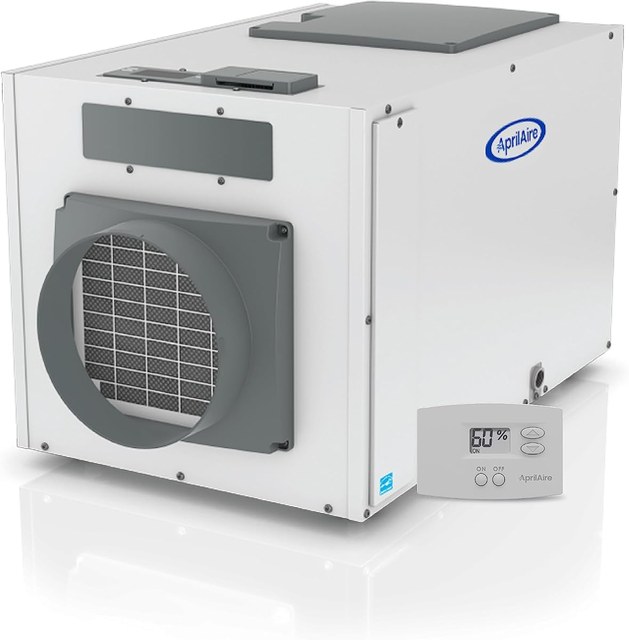
AlorAir Sentinel HD55 — Best Value
The Sentinel HD55 brings whole-house-style operation to a much lower price. It is a metal-cased, tankless unit that removes 53 pints a day on the AHAM test, covers about 1,200 square feet, drains continuously through a built-in condensate pump, and has a ducting collar so an installer can tie it into supply ducting. An automatic low-temperature defrost keeps it working in a cold crawl space where a portable would frost over.
It is the right pick for a crawl space, a small home, or an unfinished basement that feeds the rest of the house, at roughly a quarter of the price of the AprilAire units. The compromises: it is louder at around 50 decibels, the controls are basic with no app on this model, and its coverage is genuinely smaller, so do not stretch it to a large home. Pair it with a sealed vapor barrier and it holds a crawl space dry for years.
Pros
- Far cheaper than the AprilAire units
- Built-in condensate pump, tankless
- Low-temperature defrost for crawl spaces
- Ducting collar for supply-side install
- Rugged metal case
Cons
- Smaller coverage (~1,200 sq ft)
- Louder, around 50 dB
- Basic controls, no app
- Best paired with a vapor barrier
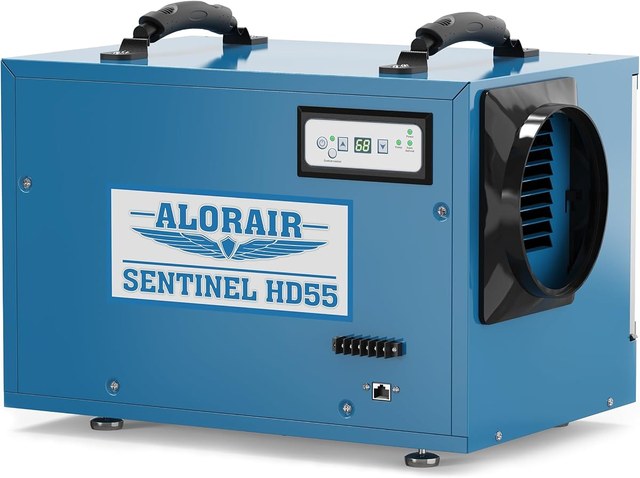
Moiswell WD160 — Best with Fresh-Air Ventilation
The WD160 is built around a feature the AprilAire units do not have: a fresh-air intake. A damper opens a duct to the outside so the unit brings in filtered outdoor air while it dehumidifies, which helps a tight, well-sealed home meet ventilation guidelines without a separate system. It moves a lot of air, 330 CFM, removes 65 pints a day on the DOE test and up to 160 in soaking conditions, and the outlet direction converts between horizontal and vertical for flexible ducting into a basement, attic, or HVAC system.
At around $990 it undercuts the comparable AprilAire units by a wide margin. The catch is the track record: it is a newer brand with only a handful of reviews so far, so long-term reliability is unproven, and support is an unknown. If the fresh-air function is what you need and you are comfortable being an early adopter, it is a lot of capability for the money.
Pros
- Filtered fresh-air intake, rare at this price
- High airflow (330 CFM)
- Convertible outlet for flexible ducting
- Well under the AprilAire price
Cons
- Newer brand, few reviews
- Long-term reliability unproven
- Support is an unknown
- Big soaking-condition capacity number
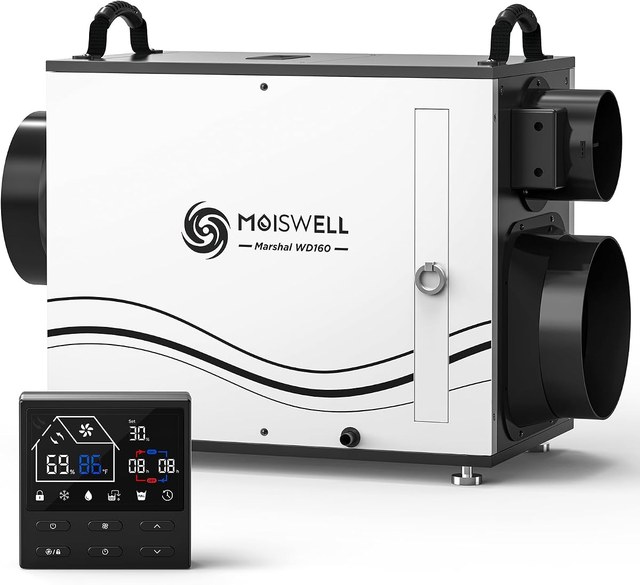
AlorAir Smart Wi-Fi 70 Pint — Best App Control for a Crawl Space
This compact AlorAir adds what the Sentinel HD55 lacks: a real app. You check the live humidity, adjust the target, and get alerts from your phone, which matters for a crawl space or a vacation home you do not visit often. It removes 35 pints a day on the AHAM test, covers about 1,000 square feet, and includes a built-in condensate pump that lifts water almost 20 feet up and out, plus an automatic defrost for cold operation.
It is small enough to slide through a crawl-space hatch and priced at around $420, between a portable and a full whole-house unit. It will not dry a large home, and its “70 pint” saturation figure is a hot-condition maximum, not a standard rating, so treat its real capacity as suiting a single crawl space or a small sealed area. For remote peace of mind about a space you rarely enter, the app earns its place.
Pros
- Wi-Fi app with live humidity and alerts
- Built-in pump lifts water ~20 ft
- Auto defrost for cold crawl spaces
- Compact, fits a crawl-space hatch
Cons
- 35 pints/day AHAM, small coverage
- Saturation “70 pint” is a hot-condition max
- Not for a whole large home
- Around $420
Installation: DIY or Pro, and What It Costs
A free-standing install is within reach for a handy owner: set the unit on its risers in a central low spot, connect the drain hose to a floor drain, sump, or condensate pump, plug it in, and set the humidistat. Budget a few hundred dollars for a pump and fittings if you need them. A ducted install is a job for an HVAC pro: they cut into your return and supply ducts, seal the connections, wire the control, and balance the airflow, typically $600 to $1,800 on top of the unit. All in, most whole-house dehumidifier projects land between $2,000 and $4,000 installed, with the AlorAir units at the low end and a ducted AprilAire at the high end. It is a real cost, but spread over the 10-plus-year life of the unit and set against replacing portables every few years, it pencils out for a genuinely damp house.
Running Costs and Filters
A whole-house dehumidifier draws roughly 500 to 800 watts while running, but the Energy Star and Energy Star Most Efficient units on this list remove far more water per watt than portables, so a house-wide unit often costs less to run than the two or three portables it replaces. Expect somewhere between $20 and $60 a month in a humid summer, dropping to near nothing in dry weather. Filters are the only routine cost: a MERV-8 to MERV-13 filter every 6 to 12 months at $15 to $40. Set the target at 45 to 55%, not 40%, and the unit runs far less. Our troubleshooting guide covers what to check if it stops pulling water.
Whole-House Dehumidifier vs. Running the AC Colder
Many people fight summer humidity by dropping the thermostat, letting the air conditioner run longer and pull out more moisture. It works, but badly: the house gets cold and clammy, some rooms overcool while others stay muggy, and the energy bill climbs. A dedicated dehumidifier removes moisture without overcooling, so the AC can run normally for temperature alone. The result is a house that is both the temperature you want and comfortably dry, usually for less total energy than the overcooling approach. It also keeps working on mild, humid days when the AC barely runs at all.
The risk with ducted units is poor setup: wrong duct size, a missing drain or a dirty filter can cut results in half. Expect installer skill to matter more than the brand name.
FAQ
Is a whole-house dehumidifier worth it?
If two or more separate areas of your home are damp, if your main floor sits above 55% humidity in summer, or if you are running multiple portables, yes. It costs more upfront but runs more efficiently, needs no emptying, protects the house, and holds every room comfortable. For one damp room or basement, a portable is the better value.
Where does a whole-house dehumidifier get installed?
Usually the basement, a crawl space, a mechanical room, or occasionally the attic, somewhere central and low, near a drain, and out of living space. Free-standing units just sit there; ducted units tie into your HVAC return and supply so your vents distribute the dry air.
Does it need to be ducted into the HVAC system?
Not always. In a smaller or open home, or for a basement or crawl space, a free-standing unit works fine. Ducting is worth it in a larger house with many closed doors, or when you want the dehumidifier and air conditioner to act as one system. Ducting adds cost and needs a pro.
What size whole-house dehumidifier is needed?
Roughly: 70 pints a day for up to about 2,800 square feet, 100 pints for up to about 5,500, and 130 pints for up to about 7,200, in a moderate climate. Size up one step for a very humid region, a tight new build, or a wet crawl space.
How long does a whole-house dehumidifier last?
Ten to fifteen years is typical with basic maintenance, which is mostly changing the filter on schedule and keeping the drain clear. That is two to three times the life of a hard-run portable, which is part of why the math works out.
Can a whole-house dehumidifier replace an air conditioner?
No. It removes humidity, not heat. But it lets your air conditioner focus on cooling instead of moisture, which usually means the AC runs less and the house feels better at a higher, cheaper thermostat setting.
Does a whole-house dehumidifier need its own electrical circuit?
The residential units here run on a standard 120-volt outlet and draw well under what a dedicated circuit would require, though it is good practice to put a large unit on a circuit that is not already loaded with other appliances. Commercial-capacity models can need more; check the nameplate before you plan the install.
How loud is a whole-house dehumidifier in the living space?
Most owners cannot hear it from upstairs. The unit itself runs 50 to 60 decibels up close, similar to a portable, but it sits in a basement or mechanical room behind a door, so in the living areas it is usually inaudible. That is a large part of the comfort appeal.
What happens next: expect more homes to add a dedicated dehumidifier as tighter houses and right-sized AC leave moisture behind. Do not be surprised if utility rebates start to cover them.
Bottom Line
For a home that is damp everywhere, a whole-house dehumidifier is the comfort upgrade that a stack of portables never delivers: every room held near 50%, silently, with no buckets. The AprilAire E070 Pro is the right size and the safe choice for most homes; step up to the E100 Pro or E130 Pro for a larger or more humid house. The AlorAir Sentinel HD55 is the value pick for a crawl space or small home, the Moiswell WD160 adds fresh-air ventilation, and the AlorAir Smart Wi-Fi 70 Pint gives you phone control of a crawl space. Size it to your square footage and climate, decide ducted or free-standing before you buy, and make sure there is a drain where it will sit.
Editorial note: Prices, ratings, capacity ratings, and availability change after publication — confirm the current listing before buying.