

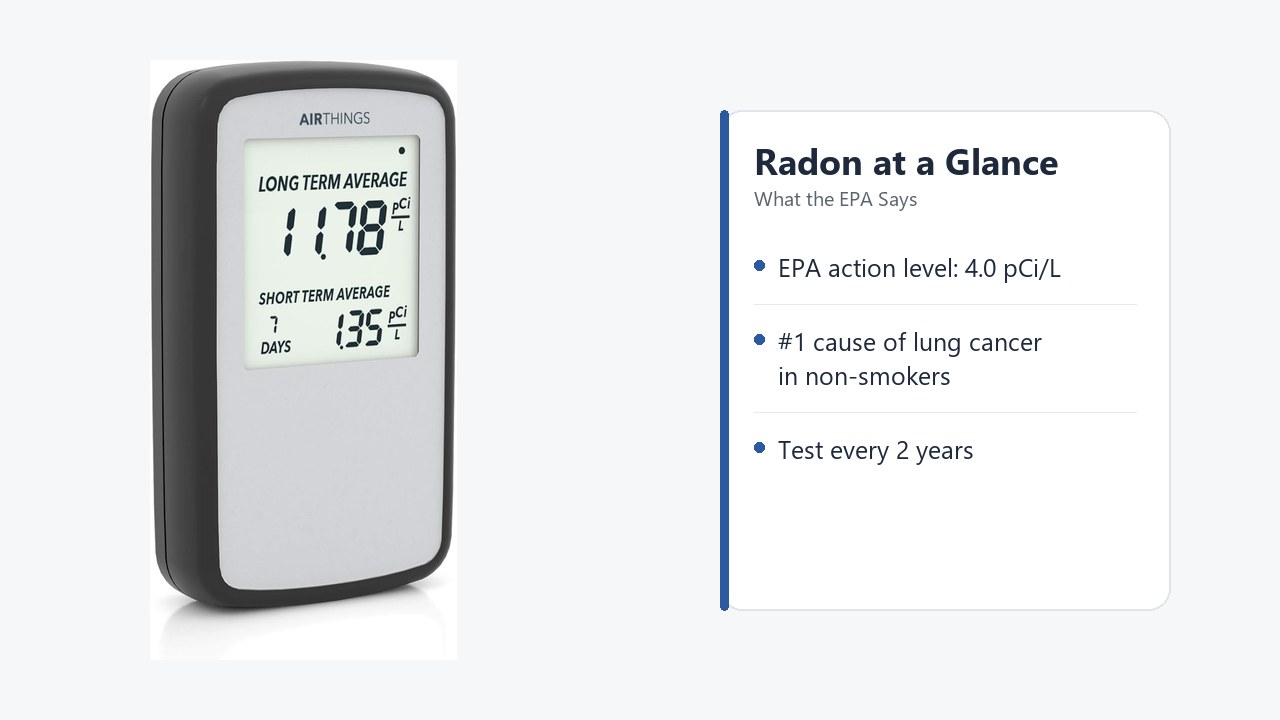
Radon is an invisible, odorless radioactive gas released as uranium decays in soil and rock. It seeps into homes through foundation cracks and is the leading cause of lung cancer in non-smokers, and the second-leading cause overall, per the EPA. The EPA’s action level is 4.0 pCi/L; test your home and always fix anything at or above that.
Every health statistic, action level, and testing recommendation below is checked directly against current EPA and CDC guidance, plus the EPA’s own published radon risk tables, rather than repeated from older radon-marketing copy.
I didn’t think much about radon until a home inspector pulled a small charcoal canister out of a paper bag and left it sitting on a shelf in my client’s basement for two days, then mailed it off like it was nothing unusual. It felt almost too low-key for something the EPA ranks as a leading cause of lung cancer. But that’s the whole point: radon testing is quiet and cheap precisely because the gas itself gives you zero warning otherwise.
This guide covers what radon gas actually is, why the EPA and CDC treat it as such a serious health risk, exactly what the EPA’s 4.0 pCi/L action level means in practice, and how to test your home for radon — whether that’s a cheap mail-in kit, a digital monitor, or a professional inspection.
Table of Contents
What Is Radon Gas?
Radon doesn’t smell like anything. It doesn’t look like anything. You can live in a house with a dangerously high level of it for twenty years and never notice, because there’s no headache, no cough, no obvious warning sign — just a slowly accumulating statistical risk sitting in your basement air. That’s exactly why public health agencies have spent decades trying to get homeowners to actually test for it instead of assuming it’s somebody else’s problem.
Radon is a radioactive gas produced when uranium, a naturally occurring element found in soil, rock, and groundwater almost everywhere on Earth, slowly decays. Uranium breaks down into a chain of other radioactive elements, and radon is one link in that chain — a gas, unlike most of the others, which means it can move through soil and into the air you breathe. It’s colorless, odorless, and tasteless, which is the entire reason it’s dangerous: there’s no sensory cue telling you it’s there. Outdoors, radon disperses harmlessly into the atmosphere. Indoors, in an enclosed home, it can build up to levels that pose a real, measurable health risk.
Every home has some radon in it, because uranium is present in soil almost everywhere. The amount varies enormously based on local geology, a home’s foundation type, and how the house is built and ventilated. Two homes right next door to each other, built the same year on the same street, can have wildly different radon levels — which is part of why “my neighbor tested fine” isn’t a reason to skip testing your own place.
Radon itself has a half-life of about 3.8 days, meaning it decays fairly quickly once released — but the soil beneath a house keeps producing a fresh supply continuously, so indoor levels don’t just fade away on their own over time. Concentrations also shift with the weather: radon tends to read higher in winter, when homes are sealed tightly for heating and shifting barometric pressure can pull more soil gas indoors, and lower in mild weather when windows open more often. That’s one more reason a single reading on a single day isn’t the full picture, and why testing method and duration genuinely matter for getting an honest number.
How Radon Gets Into Your Home
Radon gas moves upward through the soil and enters a home through any opening in contact with the ground: cracks in a foundation slab, gaps around utility pipes and sump pump openings, dirt crawl spaces, and construction joints where a foundation wall meets the floor. Warm indoor air rises and leaks out through upper floors and the roofline, and that creates a slight negative pressure at the bottom of the house — sometimes called the “stack effect” — which actively pulls soil gas, radon included, up into the lowest levels of the home rather than just letting it seep in passively.
Radon can also enter a home through well water, since groundwater passing through uranium-bearing rock picks up dissolved radon that gets released into the air during showers, dishwashing, and laundry. For most households, though, soil gas is by far the bigger contributor to indoor radon than water is. Homes with basements or slab-on-grade foundations tend to have more direct entry points than homes on a well-ventilated crawl space, but no foundation type is immune, and older homes are not automatically worse off than newer ones — radon-resistant construction techniques only became common in some regions in recent decades, so a home’s age tells you very little on its own.
Because the problem is well understood at this point, many local building codes in higher-risk areas now require radon-resistant new construction (RRNC) techniques: a layer of gas-permeable gravel under the slab, a sealed plastic vapor barrier over that gravel, and a vent pipe roughed in during construction so a fan can be added later without tearing up the foundation if a post-construction test comes back high. If you’re buying new construction, it’s worth asking the builder directly whether these features were included, since not every state or county mandates them.
Why Radon Is Dangerous: The Health Risks
Radon itself decays into a series of radioactive particles — often called radon progeny or radon daughters — that attach to dust and other particles in the air. When you inhale them, they lodge in lung tissue and release small bursts of alpha radiation directly into the surrounding cells. Over years of exposure, that repeated cellular damage raises the risk of developing lung cancer. This isn’t a fringe theory: it’s built on decades of research, including large occupational studies of underground miners exposed to high radon levels and, more recently, pooled residential studies directly linking home radon exposure to lung cancer risk in the general population.
The numbers from the EPA are stark. Radon is the leading cause of lung cancer among people who have never smoked, and the second-leading cause of lung cancer overall in the United States, after smoking itself. The EPA estimates radon is responsible for about 21,000 lung cancer deaths every year in the U.S., including roughly 2,900 among people who never smoked — a death toll the agency notes is comparable to annual U.S. deaths from leukemia or lymphoma. In January 2005, then-U.S. Surgeon General Dr. Richard Carmona issued a national health advisory specifically on radon, stating that more than 20,000 Americans die of radon-related lung cancer each year and urging every homeowner to test.
Radon and Smoking: A Dangerous Combination
Smoking and radon exposure don’t just add together — they compound. The EPA’s own published risk tables, from its Citizen’s Guide to Radon, illustrate this clearly. At the 4.0 pCi/L action level, out of 1,000 smokers exposed over a lifetime, about 62 could be expected to develop lung cancer from that exposure, versus about 7 out of 1,000 people who never smoked at that same level — roughly a ninefold difference in risk from identical radon exposure, based entirely on smoking status.
| Radon Level | Lifetime Risk, Smokers (per 1,000) | Lifetime Risk, Never-Smokers (per 1,000) | EPA Guidance |
|---|---|---|---|
| 20 pCi/L | ~260 | ~36 | Fix your home |
| 10 pCi/L | ~150 | ~18 | Fix your home |
| 8 pCi/L | ~120 | ~15 | Fix your home |
| 4 pCi/L (EPA action level) | ~62 | ~7 | Fix your home |
| 2 pCi/L | ~32 | ~4 | Consider fixing |
| 1.3 pCi/L (avg. indoor level) | ~20 | ~2 | Reducing below 2 pCi/L is difficult |
Source: EPA, A Citizen’s Guide to Radon (EPA 402-K-09-001), lifetime risk estimates from EPA’s Assessment of Risks from Radon in Homes.
It’s worth being precise about what radon does and doesn’t do. Unlike mold or dust, radon isn’t linked to asthma flare-ups, allergic reactions, or acute respiratory symptoms — its entire documented health risk is the increased chance of lung cancer from cumulative radiation exposure over years. There’s no solid evidence tying short-term or low-level radon exposure to headaches, fatigue, or other vague symptoms sometimes blamed on it online. If you’re feeling unwell and wondering whether radon is the cause, a doctor is a better next step than assuming it from a general symptom list.
The EPA’s Radon Action Level: What 4.0 pCi/L Means
Radon is measured in picocuries per liter of air, written as pCi/L. The EPA’s official action level is 4.0 pCi/L: if a test shows your home at or above that level, the EPA recommends you fix it, typically with a mitigation system installed by a qualified contractor.
Importantly, the EPA is explicit that there’s no fully safe level of radon exposure. Between 2 and 4 pCi/L, the agency recommends homeowners consider fixing the problem even though it’s technically below the formal action level, since reducing radon lowers risk at any starting point. Below roughly 2 pCi/L, further reduction becomes technically difficult with current mitigation methods, so the EPA doesn’t generally push homeowners to chase lower numbers past that point. For international context, the World Health Organization recommends a stricter reference level of about 2.7 pCi/L (100 Bq/m³) where achievable, which is one reason you’ll sometimes see slightly different “safe” thresholds cited depending on the source — but for U.S. homes, the EPA’s 4.0 pCi/L figure is the one that matters for deciding whether to act.
For scale, the EPA estimates that about 1 in 15 U.S. homes has an elevated radon level at or above the 4.0 pCi/L action level. That’s not a rare, isolated problem confined to a few unlucky houses — it’s common enough that testing every home, regardless of location, age, or foundation type, is the standard public health recommendation from both the EPA and the CDC.
Where Radon Risk Is Highest: The EPA Radon Zone Map
The EPA’s Map of Radon Zones sorts every U.S. county into one of three tiers based on predicted average indoor screening levels: Zone 1 counties have a predicted average above 4 pCi/L, Zone 2 counties fall between 2 and 4 pCi/L, and Zone 3 counties average below 2 pCi/L. Zone 1 counties cluster heavily in the northern and central U.S., where glacial soil deposits and uranium-bearing bedrock are common — states like Iowa, Minnesota, Pennsylvania, Ohio, and Colorado all have a large share of Zone 1 counties.
That map is genuinely useful for understanding regional patterns, but it’s a planning tool, not a substitute for testing your specific address. The EPA is direct about this: homes with elevated radon have been found in all three zones, including plenty of individual houses in “low-risk” Zone 3 counties. Local geology can vary within a few hundred feet, let alone across an entire county, so a Zone 3 label doesn’t mean your particular home is in the clear.
How to Test Your Home for Radon
Testing is the only way to know your home’s actual radon level. You can’t estimate it from the age of your house, your zone on the EPA map, or whether a neighbor’s home tested clean. The good news is that testing is cheap and simple, and there are a few different ways to do it depending on how much detail and speed you want.
Short-term test kits are the most common starting point. These are inexpensive, passive devices — usually charcoal canisters or similar — that you place in the lowest lived-in level of your home (a finished basement counts if you spend time down there; an unused crawl space doesn’t) for a minimum of 48 hours, up to about 90 days, then mail to a lab for results. For an accurate short-term reading, the EPA and CDC both recommend “closed-house conditions”: keep windows and exterior doors closed as much as possible starting at least 12 hours before the test and for its full duration, and turn off any fans or systems that exchange indoor air with the outdoors, like window fans or a whole-house fan. A central air conditioner that just recirculates indoor air is fine to leave running.
Many state radon programs also offer free or heavily discounted short-term test kits through their health department websites, which is worth a quick check before buying one retail — especially if you just want a baseline reading rather than the faster paid turnaround a purchased kit’s included lab fee gets you.
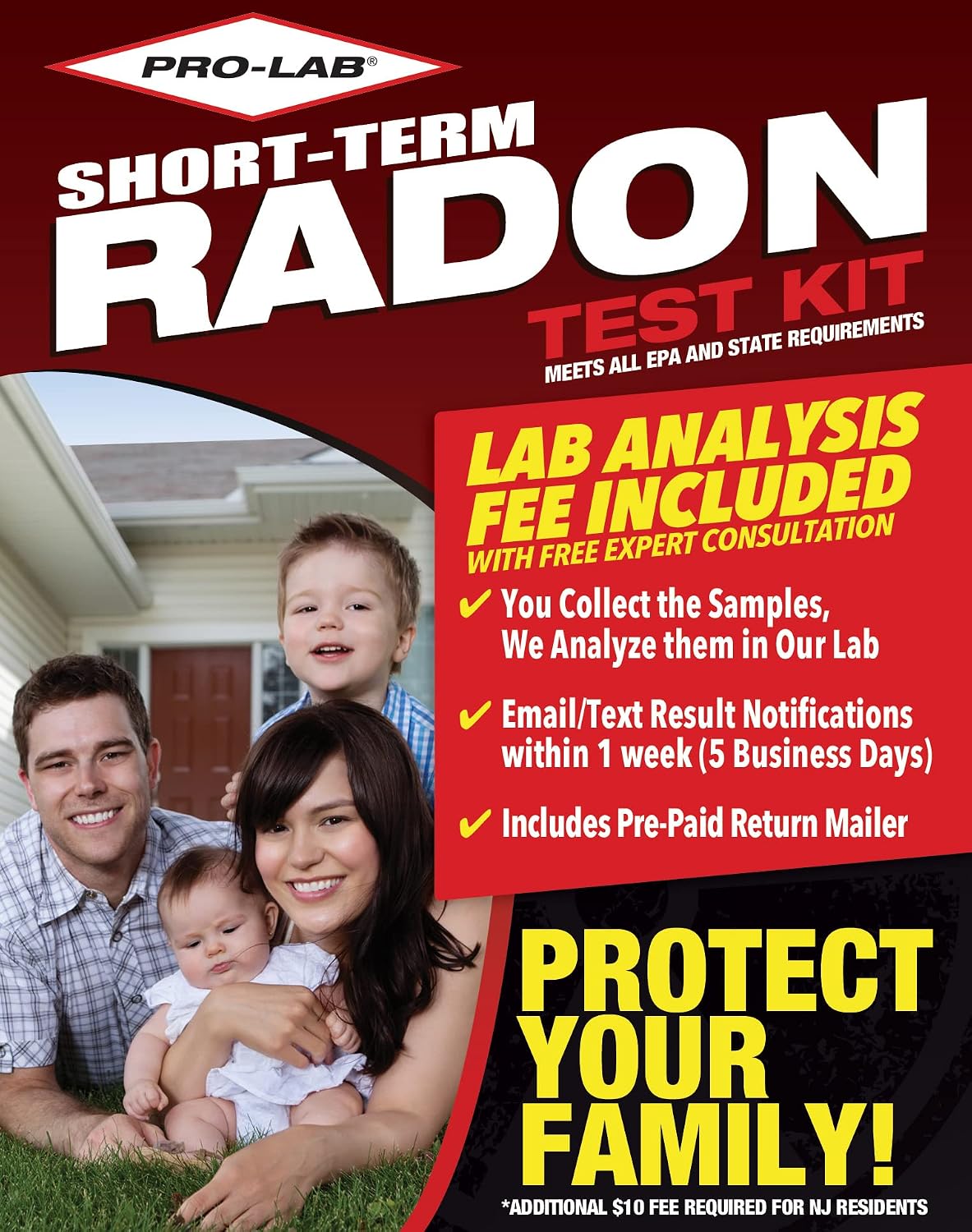
A kit like the PRO-LAB Radon Test Kit for Home is a straightforward way to get your first reading. It includes two short-term detectors and a prepaid mail-in lab fee, which matters for real estate transactions that specifically require two simultaneous test results. You set it out, leave it for the recommended window, mail it back in the included envelope, and get lab results within about a week. Our full PRO-LAB radon test kit review walks through the unboxing and results process in more detail.
Long-term test kits stay in place for more than 90 days, using the same basic alpha-track or electret-ion-chamber technology as many short-term kits. Since radon levels naturally fluctuate by season, weather, and even time of day, a long-term test gives you a more reliable read on your home’s actual year-round average than a single short-term snapshot does — useful if your short-term result came back borderline and you want more certainty before spending money on mitigation.
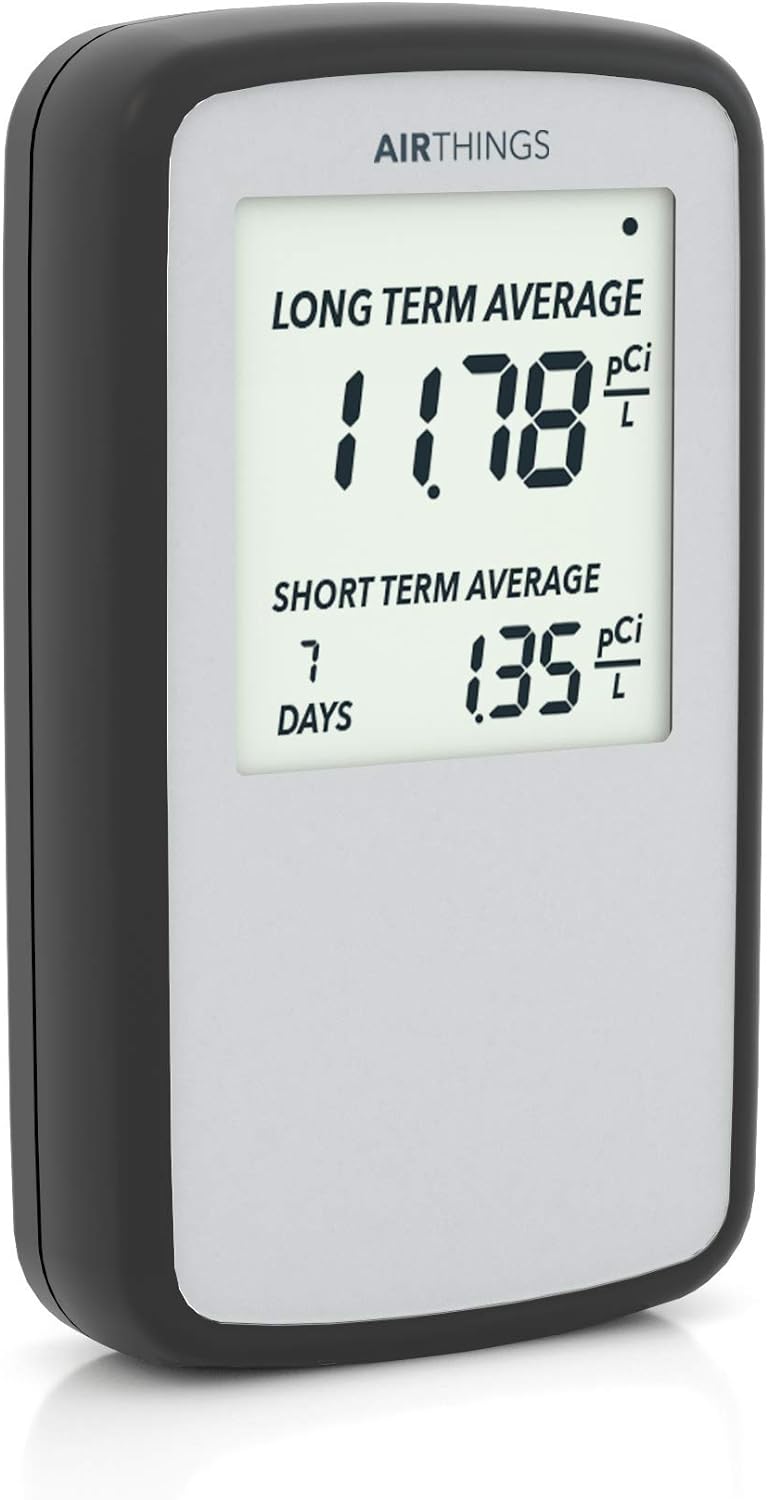
Continuous digital radon monitors are a pricier but genuinely more convenient option for anyone who wants an ongoing answer instead of a one-time lab result. A battery-powered unit like the Airthings Corentium Home 223 gives you an on-screen reading you can check anytime, tracking both a short-term and long-term average, which is particularly useful for confirming a mitigation system is actually working after it’s installed, or for keeping an eye on levels through different seasons without buying a new mail-in kit every time. If you’re weighing a monitor that also tracks other pollutants like CO2 or PM2.5 alongside radon, our guide to the best indoor air quality monitors compares several multi-pollutant options.
Professional testing is the fourth option, typically using a continuous radon monitor operated by a certified measurement technician. It costs more than a DIY kit but is often required (or simply expected) during real estate transactions, and it removes any question about whether the test was set up correctly.
Whichever method you use, the EPA recommends retesting roughly every two years even if your first result came back low, since radon levels can shift with foundation settling, renovations, or changes to your home’s ventilation. You should also retest specifically after finishing a basement into living space, after any major foundation or HVAC work, and after installing a mitigation system, to confirm it’s actually keeping levels below 4.0 pCi/L.
| Method | Cost | Timeframe | Best For |
|---|---|---|---|
| Short-term DIY kit | $10–$50 | 2–90 days (48-hr minimum) | First-time baseline read |
| Long-term DIY kit | $25–$50 | 90+ days | Confirming a borderline result |
| Digital continuous monitor | $130–$300 | Ongoing / reusable | Monitoring after mitigation, repeat use |
| Professional testing | $150–$800 | 1–7 days | Real estate transactions |
What to Do If Your Radon Level Is High
If your test comes back at or above 4.0 pCi/L, the standard fix is a mitigation system. The most common design is active soil depressurization: a sealed vent pipe run from beneath the foundation slab up through the house and out above the roofline, with an inline fan that continuously pulls radon-laden soil gas out from under the house and vents it safely outdoors before it can seep into the living space. Done correctly, these systems typically cut indoor radon levels by 50 to 99 percent.
Not every mitigation system looks identical. Homes with a crawl space instead of a basement often use sub-membrane depressurization instead: a heavy plastic sheet sealed over the exposed soil, with a vent pipe and fan pulling air from beneath that membrane rather than through a slab. Some new homes are built with a passive system already roughed in — a vent pipe with no fan, relying on natural stack-effect airflow — and if a post-construction test still comes back high, a fan can usually be added to that same pipe to convert it into an active system without any new construction work.
These systems are almost always installed by a certified radon mitigation contractor rather than as a DIY weekend project, since improper venting, sealing, or fan placement can fail to fix the problem or, in some cases, make it worse by changing the pressure dynamics of the house. You can find a contractor certified through the National Radon Proficiency Program (NRPP) or the National Radon Safety Board (NRSB), the two EPA-recognized certification bodies, through their online directories. A typical professionally installed system costs somewhere between $800 and $2,500, depending on your home’s foundation type, size, and how many suction points the house needs. Our guide to reducing radon gas in a basement goes deeper on the airproofing and sealing steps that work alongside a mitigation system, and if you’re also dealing with general basement dampness, our basement dehumidifier guide covers the separate, but often related, humidity side of basement air quality.
After installation, retest to confirm the system brought your level below 4.0 pCi/L, and keep an eye on it periodically after that — a continuous monitor like the one mentioned above makes this easy without buying a new kit every time. If you want a broader read on your home’s air quality beyond just radon while you’re at it, our guide to testing air quality at home covers the other pollutants worth checking alongside it.
FAQ
Can radon gas make you sick right away?
No. Radon doesn’t cause acute symptoms like headaches, nausea, or breathing trouble on exposure. Its health risk comes entirely from long-term exposure raising your lung cancer risk over years or decades, not from any immediate physical reaction, which is exactly why testing rather than “noticing a problem” is the only way to catch it.
Is radon a problem everywhere, or just certain regions?
Elevated radon has been found in every U.S. state. Some regions have higher average levels because of local geology, and the EPA’s radon zone map reflects that, but individual homes in “low-risk” counties still test high often enough that the EPA and CDC both recommend testing regardless of where you live.
How much does it cost to fix a radon problem?
A professionally installed mitigation system typically runs $800 to $2,500, depending on your foundation type and home size, plus the cost of testing before and after. That’s a real expense, but it’s small compared to the health stakes, and many contractors offer financing.
Do I need to retest after installing a mitigation system?
Yes. A follow-up test confirms the system actually brought your level below 4.0 pCi/L, since installation quality varies. The EPA also recommends periodic retesting afterward, roughly every two years, to confirm the system keeps working as the fan ages or the house settles.
Can I test for radon myself, or do I need a professional?
DIY test kits are EPA-approved and reliable when you follow the closed-house conditions correctly. A professional is worth it if you want a faster turnaround, need documentation for a real estate transaction, or just want someone else to handle the setup and placement.
Does opening windows lower radon levels?
Temporarily, yes — ventilation dilutes indoor radon while the windows are open, which is part of why closed-house conditions are required before and during a test. But it’s not a real fix, since levels climb back up once you close the house again, especially overnight or in winter when most homes stay sealed for heating and cooling efficiency.
Bottom Line
Radon is a serious, thoroughly documented health risk that’s completely invisible without a test, and the EPA’s 4.0 pCi/L action level gives you a clear, unambiguous line to work from: test your home, and if you’re at or above it, get a mitigation system installed by a certified contractor. A basic test kit costs less than a dinner out, mitigation is a well-understood, fixable problem with a contractor who does it right, and skipping the test is one of the more avoidable health risks sitting in your own house.
Editorial note: This article covers general health information, not medical advice. If you have concerns about radon exposure or a lung cancer diagnosis, talk to a doctor. Prices and availability on linked products change after publication — confirm the current listing before buying.