

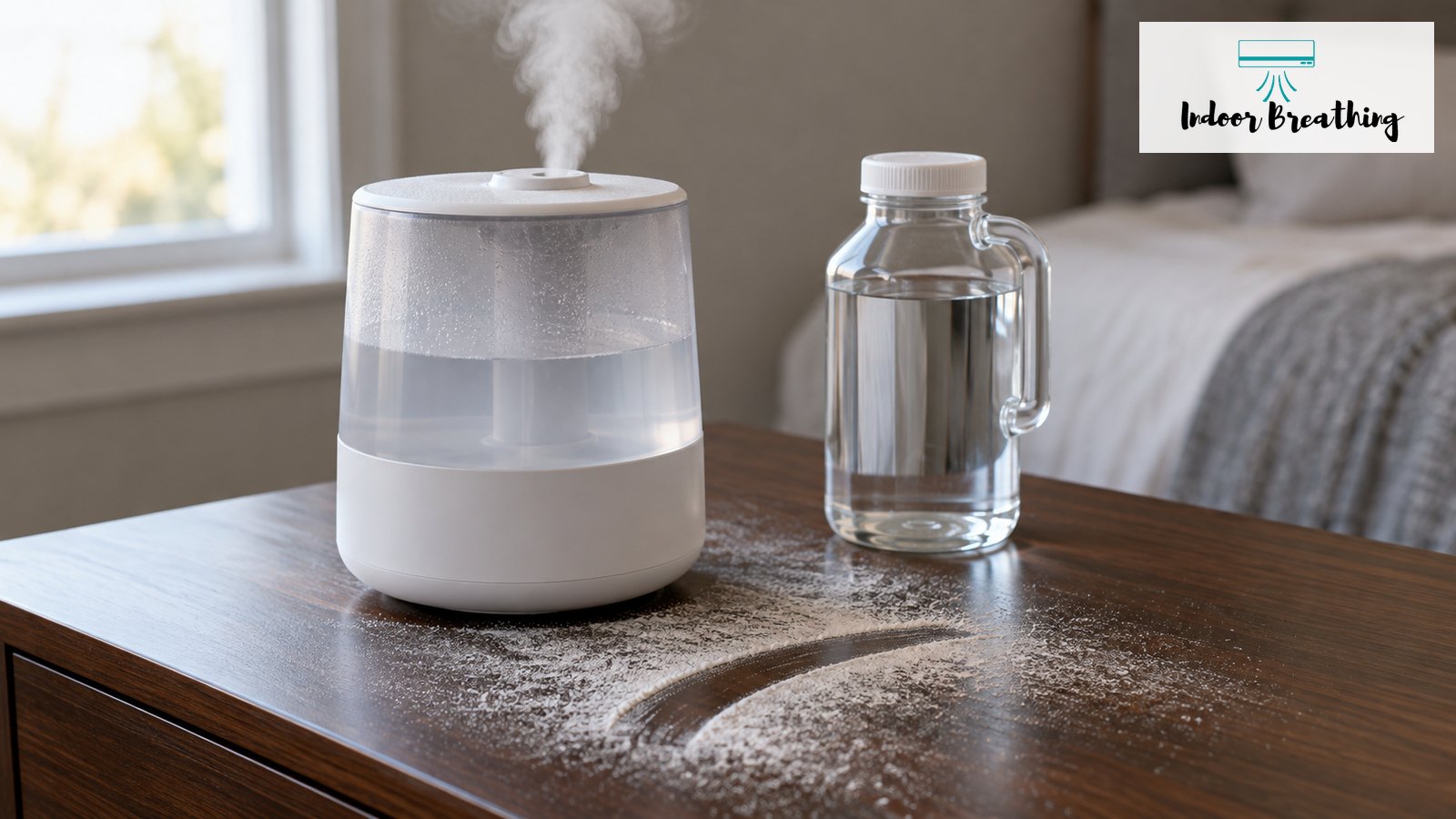
Wipe the dresser on Monday. By Wednesday, a fine white film is back, as if the room grew a frost coat. Annoying, yes. But that powder is a clue, and it points straight at the humidifier.
Short answer: the white dust is minerals from the tap water. The fix is cheap. Switch the water, clean the tank the right way, and keep humidity in check. Here is how it works, and what to buy if the machine itself is the problem.
Table of Contents
Why a humidifier leaves white dust
Tap water is not just water. It carries calcium, magnesium and other dissolved minerals. An ultrasonic humidifier shakes that water into a fine mist. The water dries up in the air. The minerals do not. They float around, then settle on shelves, TVs, floors and anything else nearby.
So the dust is not coming from the room. It is coming from the tank. More minerals in the water means more powder on the furniture. Homes with hard water see it first, and you can look up your area in our water hardness by state guide. Even water that tastes fine can leave a film.
The type of humidifier matters too. The EPA says ultrasonic and impeller models spread the most minerals. Evaporative models trap most of them in the wick. Steam units boil the water off and leave the minerals behind in the tank.
Is humidifier white dust harmful?
Mostly it is a mess, not an emergency. Still, it is not something to ignore. Studies on ultrasonic humidifiers show that mineral-heavy water makes far more tiny airborne particles than low-mineral water. The EPA says the health effects of breathing those minerals are not fully understood, and it still advises cutting exposure. The Consumer Product Safety Commission adds that some particles are small enough to reach the lungs.
Babies, older adults and people with asthma or allergies should be extra careful. If breathing gets worse when the humidifier runs, turn it off and talk to a doctor.
There is a second issue. Mineral scale gives germs a rough surface to cling to. A dirty tank can send bacteria or mold into the air along with the mist. Different problem, same neglected machine.
The fastest fix: change the water
Use water labeled distilled. Distillation removes minerals better than any home filter, so there is far less to float out of the mist. You can find it for a few dollars a gallon in the grocery aisle. No fancy gear needed.
Read the label with care. Spring, artesian and mineral water sound pure, but they are full of minerals on purpose. Water labeled “purified” can mean many things, so check how it was treated. And a fridge or pitcher filter fixes taste, not minerals. Clear water is not low-mineral water.
Want to test it? Clean the humidifier, fill it with distilled water, and run it for a few days. Wipe one surface once. If no new film shows up, the old water was the culprit. If you live in a very hard water area, see our guides to water distillers and water softeners for a whole-home answer.
Yes, hauling jugs gets old. But compare it to the cost of wiping, replacing cartridges that only half work, and dusting electronics. Price it by the month, not by the bottle.
Cleaning alone will not stop the dust
A spotless humidifier still makes white dust if the next refill is hard water. Cleaning removes scale and slime. It does not remove the minerals in tomorrow’s water. Think of two jobs: water choice controls what goes into the air, and cleaning controls what grows in the tank.
Start with the owner’s manual. The EPA says to empty the tank, dry it and refill with fresh water every day, and to clean portable units every third day. Unplug first. Rinse well, because leftover cleaner can end up in the air. Never mix bleach, vinegar and other cleaners.
Demineralization cartridges help in some models, but results vary and they wear out. If the dust comes back, the cartridge is probably done.
Pick a humidifier that handles hard water
If hauling distilled water is not your style, change the machine. An evaporative humidifier pulls air through a wet wick, so most minerals stay in the wick instead of on your bookshelf. The trade-off: the wick needs replacing, and the fan makes some noise. Our humidifier buying guide covers every type, and the filterless humidifier roundup is worth a look if you hate buying wicks.
| Model | Type | Best for | Price |
|---|---|---|---|
| Vornado EV100 | Evaporative, 1 gal tank | Hard water, small to mid rooms | ~$59.69 |
| TempPro TP50 Hygrometer | Digital humidity gauge | Checking the real room humidity | ~$10.99 |
Prices checked October 2026 and change often.
Vornado EV100: the no-mist-cloud option
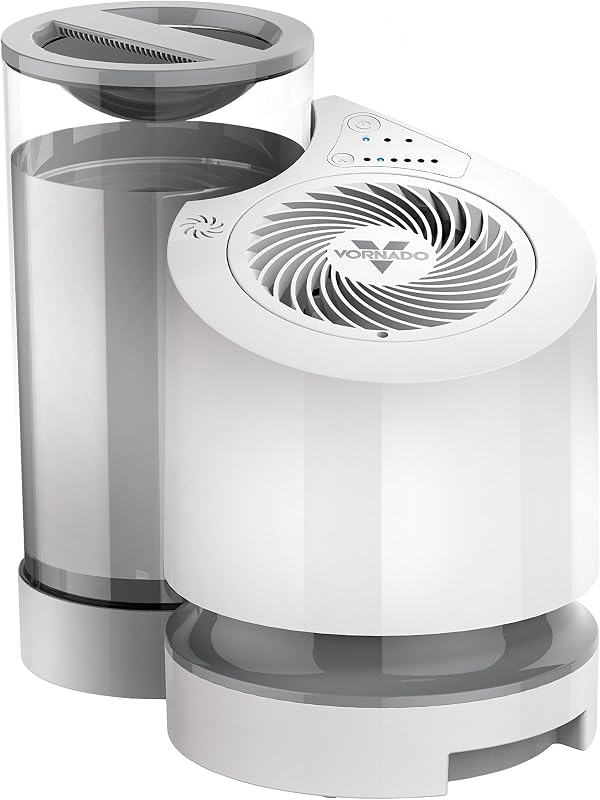
The Vornado EV100 is an evaporative model. Water soaks a wick, a fan blows air through it, and moisture goes into the room as invisible vapor. The minerals stay in the wick. That means no white film on the TV, which is the whole point. It holds one gallon, has two speeds and an electronic humidistat, and costs about $60. Amazon shows a 3.9-star rating.
The catch: the wick needs a swap every so often, and the fan hums. Fine for a living room, a bit much for light sleepers.
Set the humidity without making a new problem
More mist is not better. Too much moisture feeds mold and dust mites. The EPA says to keep indoor humidity at or below 50 percent, and 30 to 50 percent is the sweet spot.
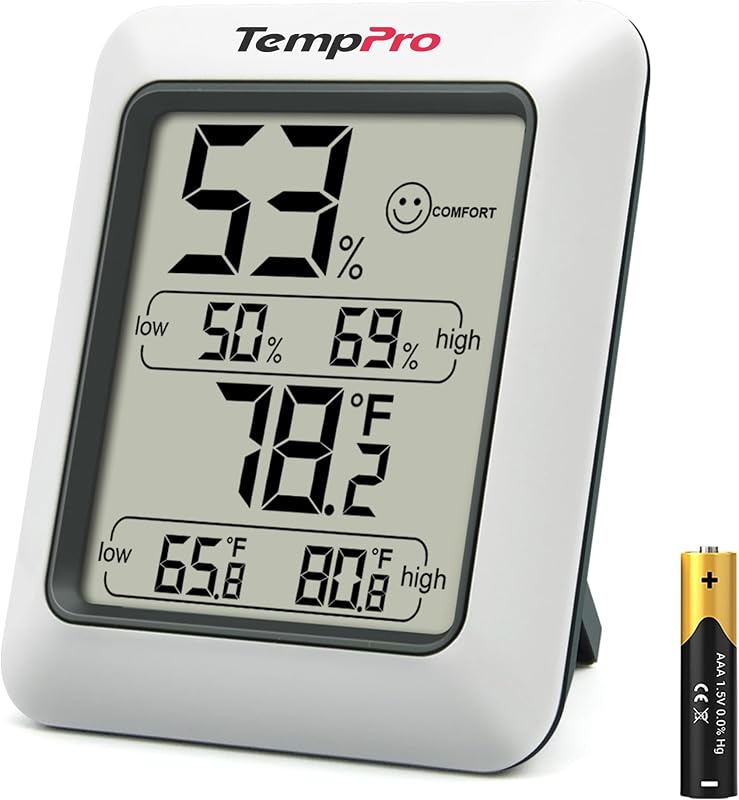
The built-in display on many humidifiers is optimistic. A small separate gauge tells the truth. The TempPro TP50 is a cheap, popular pick at about $11, with a 4.6-star Amazon rating. Put it across the room, away from the mist, vents and sunny windows. A gauge sitting in the cloud only measures the cloud. Our guide on calibrating a digital hygrometer shows how to check it.
Foggy windows, damp walls or wet furniture mean the output is too high or the spot is wrong. Turn it down or move it. Keep it off electronics, books and wood finishes. Not sure where it belongs? Read where to place a humidifier.
How to remove white dust and keep it away
- Turn off and unplug the humidifier. Empty the tank.
- Clean and descale it using the manual. Rinse every part that touches water, then let it dry.
- Wipe nearby surfaces with a damp microfiber cloth. Damp wipes catch the powder, dry dusting kicks it back into the air. Skip spraying cleaner on electronics.
- Refill with distilled water from a clean container. Do not top off yesterday’s water.
- Run it on a moderate setting and watch the room humidity with a gauge.
- Still seeing dust? Check that the jug really said distilled, that the cartridge is fresh, and that the powder is not coming from a furnace vent, candles or renovation dust.
The routine is boring on purpose: fresh low-mineral water, a dry tank between uses, regular cleaning, and humidity under 50 percent. No hacks. No mystery additives.
The bottom line
White dust is just the minerals in your water, made visible. Ultrasonic models spread them the most. Distilled water is the strongest first fix, regular cleaning handles the scale and germs, and an evaporative model is the backup plan if jugs are not practical. Watch the room, not just the mist.
Frequently asked questions
Why does a humidifier leave white dust? Minerals in the tank water. The water evaporates, the minerals settle on nearby surfaces.
Does distilled water stop white dust? It cuts it down sharply, because almost all the minerals are gone. Spring and mineral water do not work for this.
Is white dust from a humidifier dangerous? The health effects are not fully known. The EPA still advises cutting exposure, especially for babies, older adults and people with asthma.
Which humidifier does not make white dust? Evaporative and steam models release far fewer minerals than ultrasonic or impeller models.