


The best whole house water filter for hard water is an ion-exchange softener like the Aquasure Harmony 48,000-grain system, because it actually removes the calcium and magnesium causing the problem. Salt-free “conditioners” only prevent new scale — they don’t soften. Test your water’s hardness in grains per gallon first, then size the resin to your household before you buy.
This guide draws on manufacturer specs, NSF/ANSI certification listings where they exist, current Amazon pricing, and owner reviews — not hands-on lab testing. Prices, ratings, and availability were checked against live Amazon listings as of this update and change over time.
Hard water shows up as white crust on faucets, film on shower glass, and skin that feels dry no matter how much lotion you use — and behind the scenes it’s scaling up your water heater’s element and shortening the life of anything with a pump or heating coil. The right fix depends on what’s actually in your water and how much of the house you need to treat, which is what the sections below walk through before the nine specific systems worth buying.
Table of Contents
Testing Your Water and Sizing a Softener to Your Household
Before you buy anything, find out how hard your water actually is. Hardness is measured in grains per gallon (GPG) or parts per million (ppm) — divide ppm by 17.1 to get GPG. Your water utility publishes an annual water quality report with this number, or you can run a $10-15 drop-count test kit at home. Anything above 7 GPG is considered hard, and a lot of the country sits well above that; our breakdown of water hardness by state shows which regions typically deal with the worst mineral content.
Once you know your GPG, sizing comes down to multiplying your hardness by your household’s daily water use (roughly 75-100 gallons per person) and the number of people in the house, then matching that to a grain capacity that only has to regenerate every few days, not daily. I walk through that math in how to choose the right size water softener, or skip the arithmetic with our water softener grain calculator. As a rule of thumb, a 2-3 bathroom home on moderately hard water (10-15 GPG) fits a 32,000-40,000 grain system, while a 3-4 bathroom home or anything above 20 GPG should step up to 48,000 grains or larger. Undersizing is the most common mistake — a softener that regenerates constantly wastes salt and wears out faster.
Salt-Based vs. Salt-Free: What Each One Actually Does
This distinction gets muddied in marketing copy, so I want to be direct about it. A salt-based softener uses ion exchange: resin beads swap calcium and magnesium ions for sodium as water passes through, physically removing the minerals that cause hardness. That’s the only category here that actually softens water in the technical sense, and the only one that can carry NSF/ANSI Standard 44 certification, which specifically covers hardness reduction.
A salt-free “softener,” “conditioner,” or descaler does not remove calcium and magnesium at all. Most use template-assisted crystallization or an electronic signal to alter how minerals behave so they’re less likely to stick to pipes and fixtures — reducing new scale without changing your water’s actual hardness reading. The AO Smith unit later in this guide says so plainly on its own listing: it reduces scale, not hardness. That’s a legitimate, lower-maintenance option if scale prevention is your only goal, but if you want the slick feel of genuinely soft water, only ion exchange delivers it. I go deeper on this split in water conditioning vs. water softening. And reverse osmosis, which the old version of this guide lumped in as a third whole-house option, doesn’t belong in this conversation at all — RO is a point-of-use technology sized in gallons per day, not a whole-house fix. More on that near the end.
Well Water vs. City Water: Iron, Manganese, and Pre-Filtration
City water and well water need different upstream treatment before a softener gets involved. Municipal water is already filtered and disinfected, so a softener alone usually does the job, sometimes with a sediment/carbon pre-filter for chlorine and grit. Well water is different: iron, manganese, tannins, and hydrogen sulfide (the rotten-egg smell) are common, and each will foul softener resin or stain fixtures orange if you don’t deal with them first.
A standard softener can handle only a small amount of dissolved iron — the AO Smith descaler, for example, is rated for under 0.3 ppm. Past that, you need a dedicated iron/manganese filter ahead of or instead of a softener, which is where the iSpring WCFM500K and WGB32BM further down come in. If your water report shows iron above a couple ppm or you smell sulfur at the tap, our guides to whole house water filters for well water and iron filters for well water cover it before you spend money on a softener that will just clog up.
Regeneration Type: Metered vs. Timer, and Where Electronic Descalers Fit
Every salt-based softener needs to regenerate — flush the resin with brine to recharge it — and how it decides when matters. A metered (demand-initiated) control head, like the digital heads on the Aquasure Harmony, Aquasana SimplySoft, and DuraWater Fleck 5600 SXT below, tracks actual usage and only regenerates when the resin is close to exhausted, saving salt and water versus an old-style timer valve that regenerates on a fixed schedule regardless. It’s the standard nearly every current whole-house softener uses. Electronic descalers like the iSpring ED2000 sidestep regeneration entirely because they never remove anything from the water — no resin, no salt, no drain line — but that simplicity comes at the cost of not actually softening anything.
Installation, Space, and What Maintenance Actually Costs
A whole-house softener installs at your main line and needs floor space for the resin tank plus a brine tank next to it (unless it’s a compact cabinet model like the SimplySoft). Plan on a bypass valve for outdoor spigots or maintenance, and a nearby drain for the backwash cycle. Most systems ship pre-assembled, and DIY installation is realistic if you’re comfortable cutting into copper, PEX, or CPVC and running a drain line — generally a half-day job; otherwise budget $300-$600 for a plumber. Electronic descalers like the ED2000 skip all of this — a wrap-around coil, no cutting required.
Ongoing cost matters too. A 40-pound bag of softener salt runs $6-$10, and a household typically uses 1-3 bags a month — $10-$30 monthly, exactly what salt-free buyers avoid. Resin lasts 10-15 years. Salt-free systems trade that for their own upkeep: the AO Smith cartridge is rated for 6 years or 600,000 gallons, and pre-filters like the WGB32BM need cartridge swaps roughly every 12 months. Neither category is maintenance-free, just maintenance-different.
Whole House Water Filter for Hard Water: Comparison
Here’s how all nine systems stack up: what they do to hardness, capacity, price, and rating.
| Model | Type | Capacity | Handles | Price | Rating |
|---|---|---|---|---|---|
| Aquasure Harmony 48,000 Grain | Salt-based, ion exchange | 48,000 grains | 3-4 bathrooms, city or well | $629.99 | 4.4 (3,183) |
| Aquasana SimplySoft 40K | Salt-based, ion exchange | 40,000 grains, 15.5 GPM | Up to 5 people, city or well | $749.00 | 4.4 (124) |
| DuraWater Fleck 5600 SXT 48K | Salt-based, ion exchange | 48,000 grains, 1.5 cu ft resin | Standard household hardness | $805.00 | 4.5 (367) |
| AO Smith Salt-Free Scale Control | Salt-free, TAC descaler | 600,000 gal / 6 yrs | Under 15 GPG, iron under 0.3 ppm | $339.99 | 4.3 (1,956) |
| iSpring ED2000 Electronic Descaler | Salt-free, electronic | Any pipe, no capacity limit | 10-19 GPG | $139.99 | 4.1 (2,179) |
| iSpring WCFM500K | Iron/manganese well filter | 26 GPM peak, 3-micron | Iron to 12 ppm, Mn/H2S to 20 ppm | $2,078.09 | 4.4 (67) |
| iSpring WGB32BM 3-Stage | Sediment/carbon/iron pre-filter | 15 GPM, 100K gal/cartridge | Iron to 3 ppm, Mn to 1 ppm | $473.68 | 4.6 (1,400) |
| Aquasure 32,000 Grain + RO Bundle | Salt-based softener + RO | 32,000 grains + 75 GPD RO | 1-2 bathrooms, up to 3 people | $676.79 | 4.4 (314) |
| Kind Water Systems E-3000 | Salt-free combo (sediment/carbon/conditioner) | Reduces ~95% sediment | City water only | $1,884.69 | 4.6 (61) |
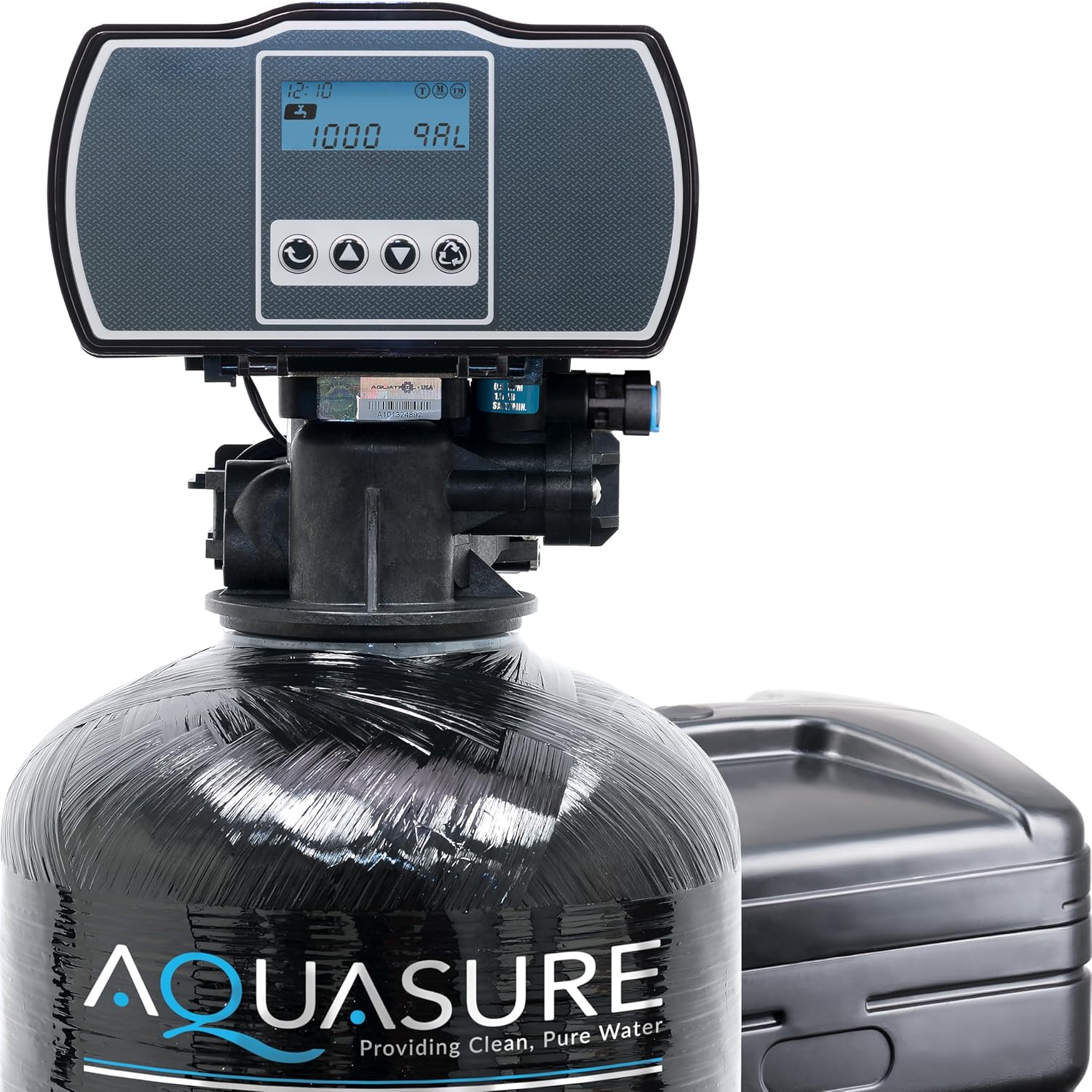
Best Overall: Aquasure Harmony 48,000 Grain Water Softener
If you want one system that actually solves hard water for most homes, this is the one I’d buy. The Aquasure Harmony is a genuine ion-exchange softener rated for 48,000 grains, enough for a 3-4 bathroom household on moderately hard water, with a digital metered control head that regenerates based on real usage instead of a fixed timer. It ships with a fiberglass-lined tank, a built-in sediment/carbon/zinc pre-filter stage Aquasure says removes 99% of chlorine, VOCs, and sediment ahead of the resin, and works on city or well water.
At $629.99 it holds a 4.4-star average across more than 3,100 ratings — one of the largest review bases of any whole-house softener on Amazon — backed by a 5-year extended warranty. The tradeoffs are the ones every salt-based softener shares: floor space for two tanks, a drain line, and a steady supply of salt.
Pros
- Actually removes hardness minerals
- Digital metered regeneration
- Built-in pre-filter stage
- 4.4 stars, 3,100+ ratings
- Works on city or well water
Cons
- Needs floor space for two tanks
- Requires a drain line
- Ongoing salt cost
NSF/ANSI 44-Certified Pick: Aquasana SimplySoft 40K Grain
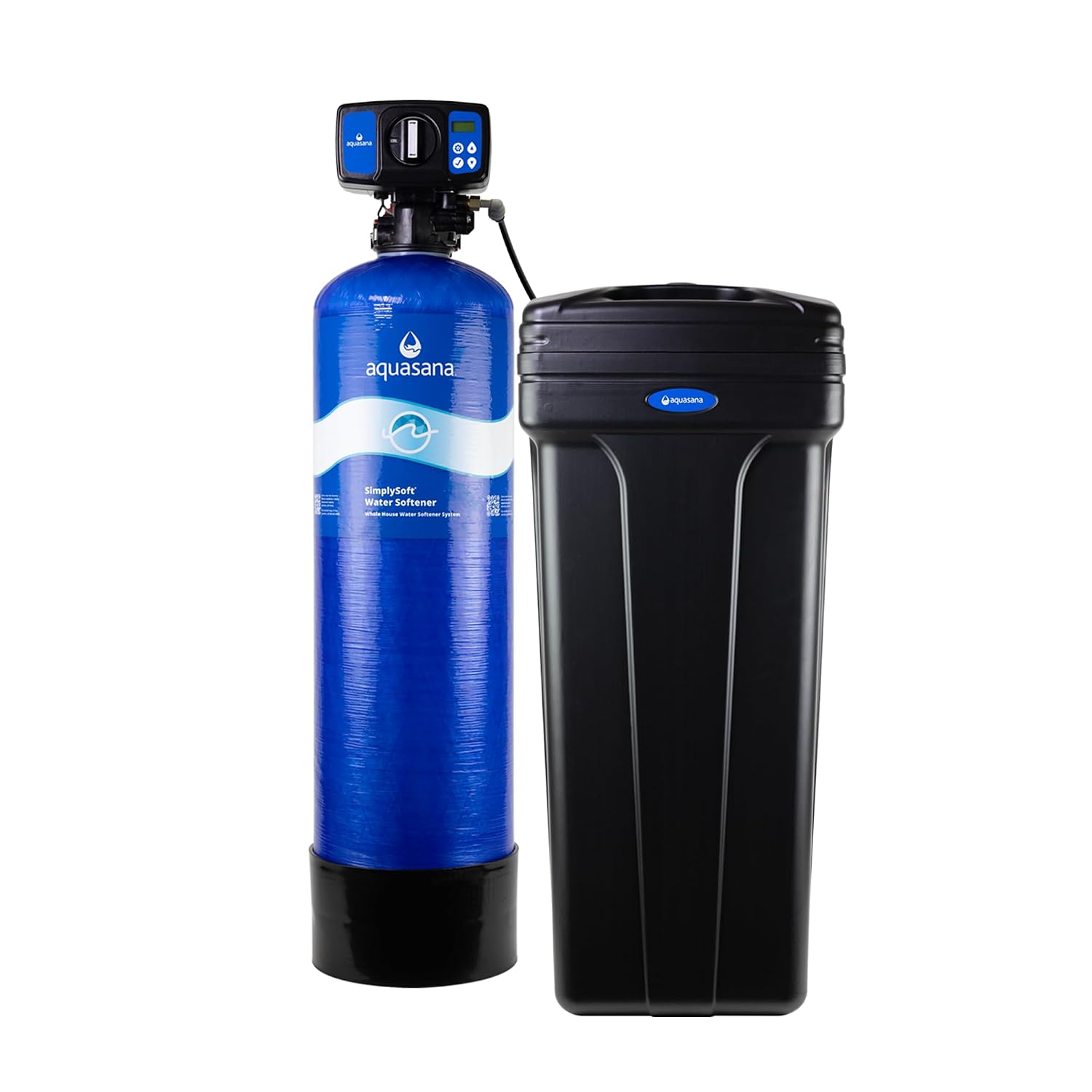
If third-party certification matters to you, the Aquasana SimplySoft is the one to look at. It’s IAPMO-certified to NSF/ANSI Standard 44 specifically for hardness reduction and to CSA B483.1, which most whole-house softeners on Amazon simply don’t carry. It’s a genuine salt-based ion-exchange system rated for 40,000 grains and 15.5 GPM, built for up to 5 people and 4 bathrooms, with a metered mode Aquasana says uses 50% less salt and 28% less water than a time-based softener.
At $749.00 it costs more than the Harmony, and its 124 ratings are a smaller sample, but its 4.4-star average and certification paperwork make it the safer pick for a home sale or HOA requirement.
The Pro-Grade Build: DuraWater Fleck 5600 SXT 48K
The Fleck 5600 SXT valve is the control head plumbers and water treatment dealers install most often nationwide, and DuraWater’s version brings that same industry-standard hardware to a DIY-priced package: 1.5 cubic feet of high-capacity resin rated for 48,000 grains, a 1-inch yoke, and a matching 14×36 brine tank with a safety float. Because the valve is so widely used commercially, replacement parts and local service technicians are easier to find years down the road than with a less common brand.
At $805.00 it’s the most expensive of the three salt-based softeners here, but it also holds the highest rating of the group — 4.5 stars across 367 reviews. Buy this one if long-term serviceability matters more than upfront price.
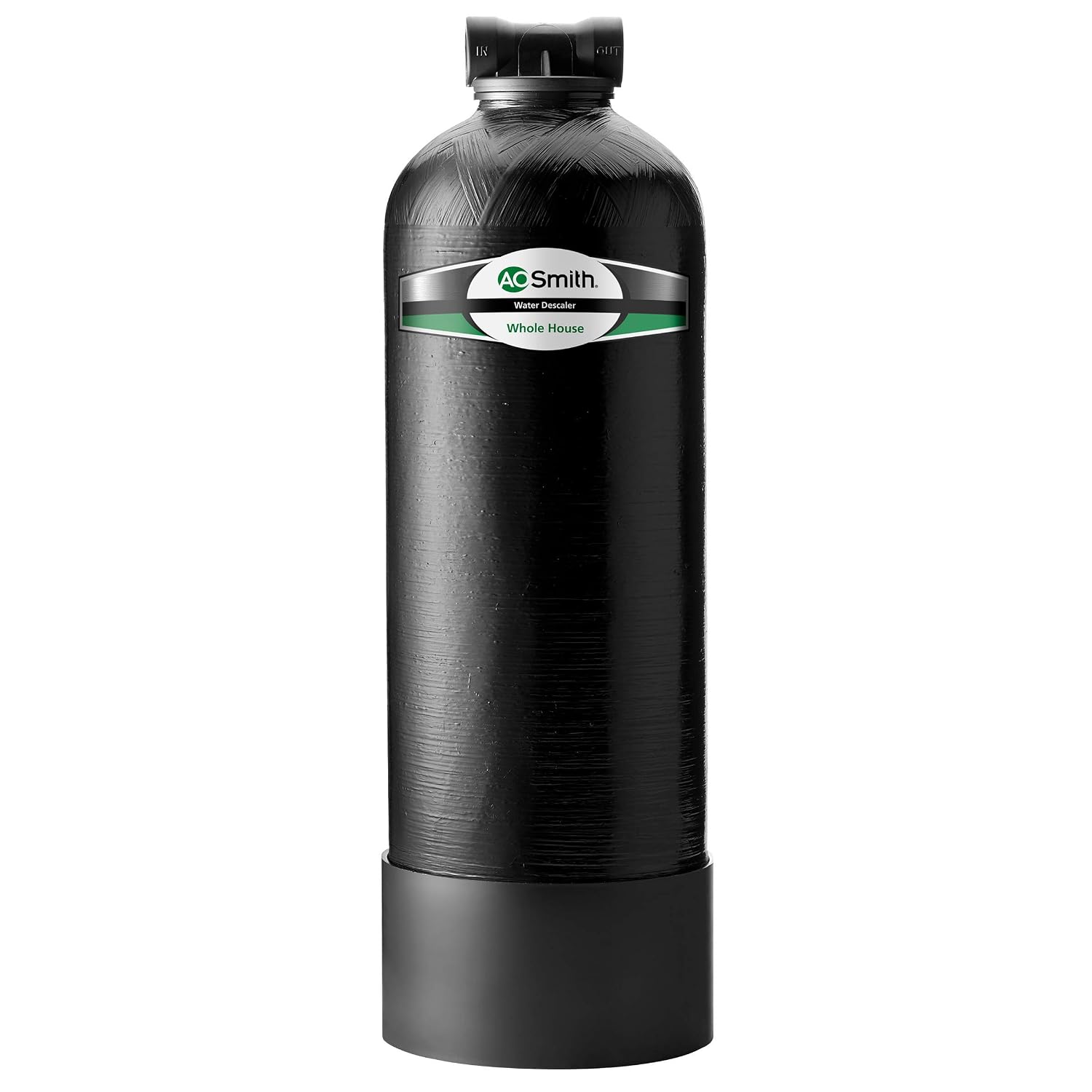
The Honest No-Salt Option: AO Smith Whole House Salt-Free Scale Control
If you genuinely don’t want salt, a drain line, or electricity draw, AO Smith’s descaler is the most straightforward option and it doesn’t oversell what it does. The listing states plainly that it “does not soften water or remove minerals that cause hardness” — it’s scale prevention only, rated for incoming hardness under 15 GPG, alkalinity under 250 mg/L, pH under 8.3, and iron under 0.3 ppm. Inside that window it needs zero backwashing and no bypass plumbing beyond a shut-off valve, rated for 600,000 gallons or 6 years before the cartridge needs replacing.
At $339.99 with a 4.3-star average across nearly 2,000 ratings, it’s the cheapest genuinely no-maintenance option here — as long as your water falls within its stated limits. Past those numbers, you need an actual softener instead.
Cheapest Fix: iSpring ED2000 Electronic Descaler
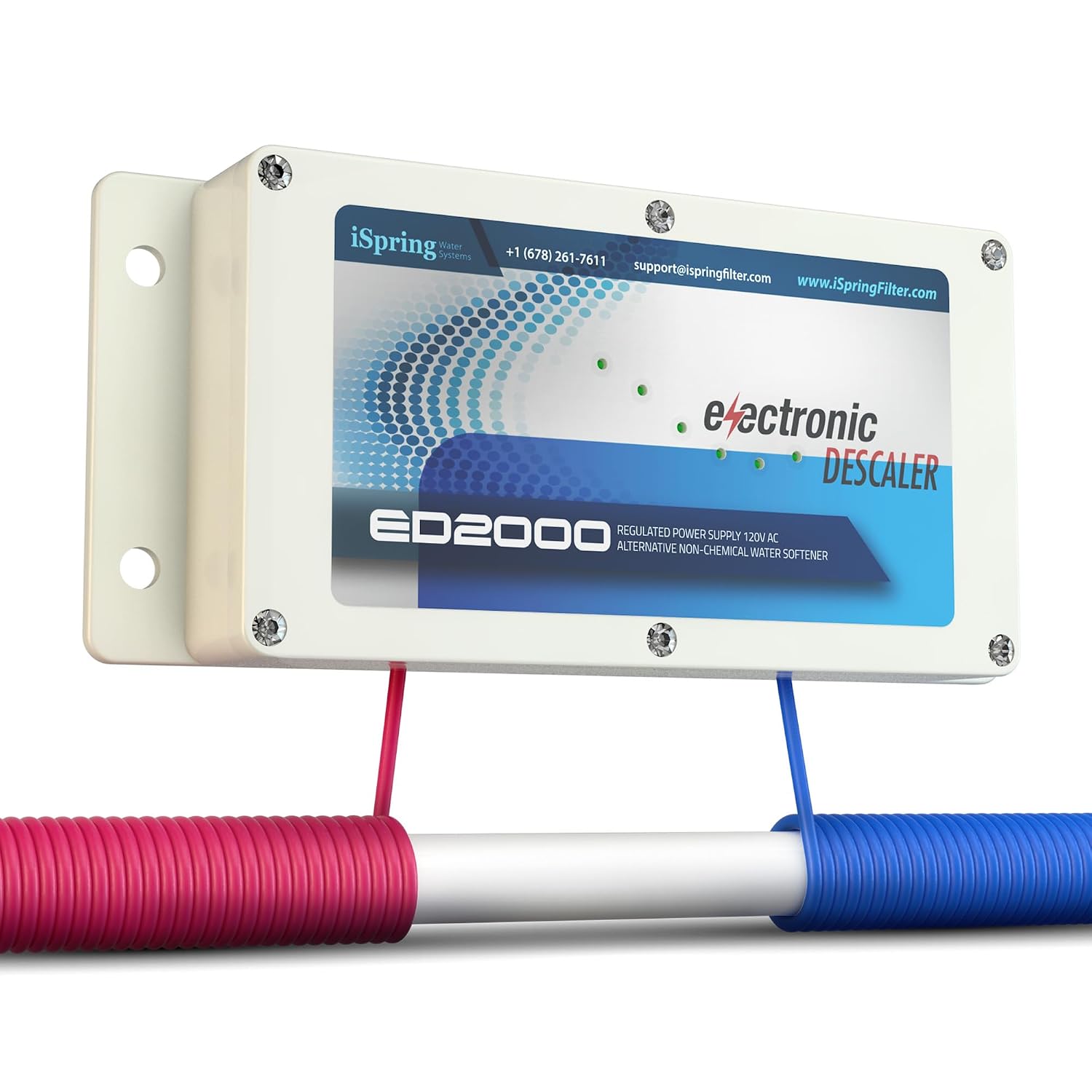
The iSpring ED2000 is about as low-commitment as whole-house scale control gets: two coils wrap around your incoming pipe, plug into a standard outlet, and send an electronic signal through the water with no cutting and nothing to maintain. iSpring designed it for water in the 10-19 GPG range and is upfront that it changes how minerals behave rather than removing them — “different from a water softener,” as the listing puts it.
At $139.99 it’s the cheapest entry in this guide, and its 4.1-star average across 2,100+ ratings reflects the mixed outcomes typical of electronic descalers — some households see real scale reduction, others notice little, depending on pipe material and water chemistry. A reasonable low-risk first step, not a guaranteed fix.
Best for Well Water: iSpring WCFM500K and WGB32BM
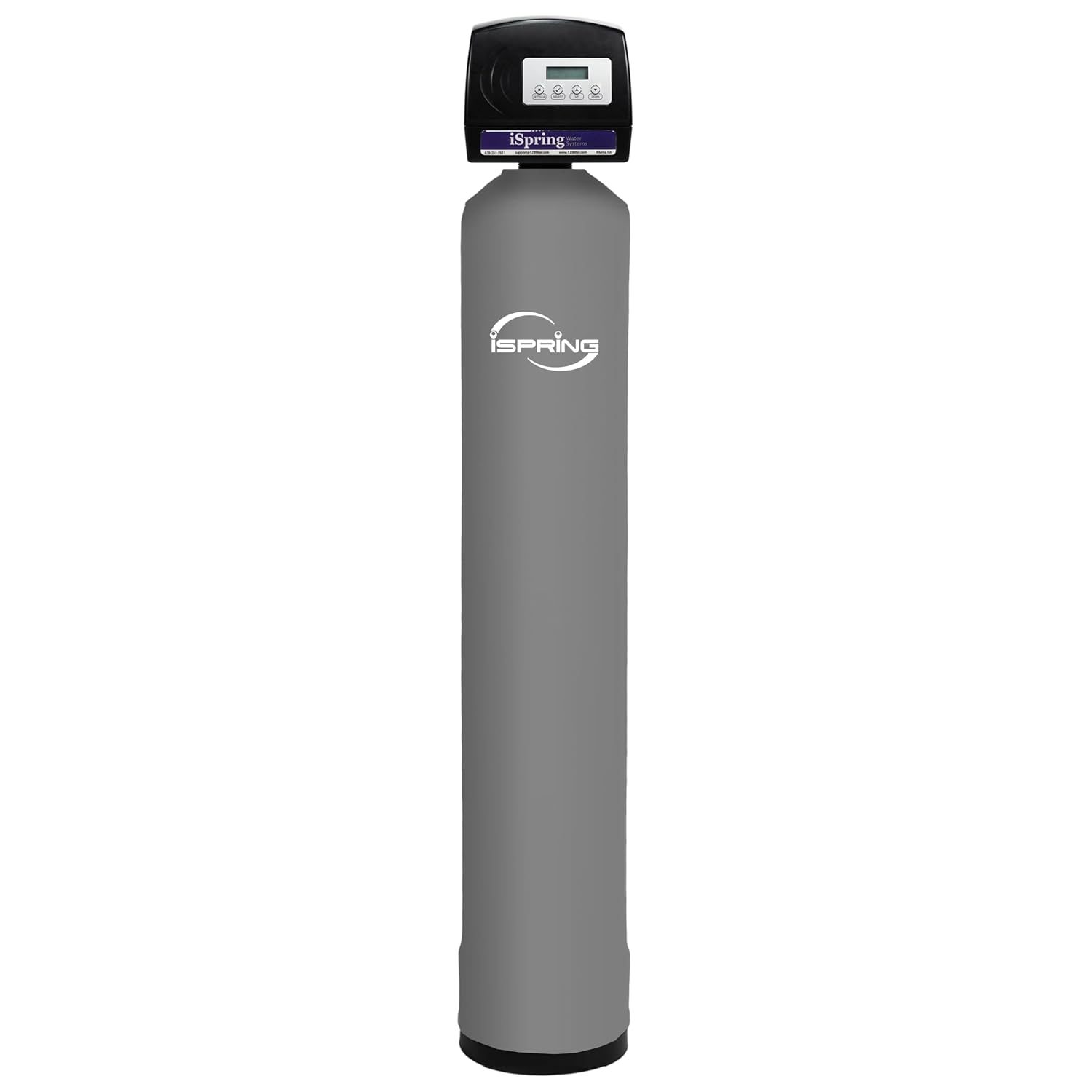
Softening well water without dealing with iron and manganese first is asking for a resin bed full of rust stains. The iSpring WCFM500K is built for that: it reduces iron up to 12 ppm and manganese or hydrogen sulfide up to 20 ppm, plus 3-micron sediment filtration, via air-injection oxidation that needs no chemicals. It’s rated for up to 10 years without a filter change, flows up to 26 GPM peak, and does not reduce total dissolved solids. At $2,078.09 with a 4.4-star average across 67 ratings, it’s aimed at heavy well-water iron problems, not a casual purchase.
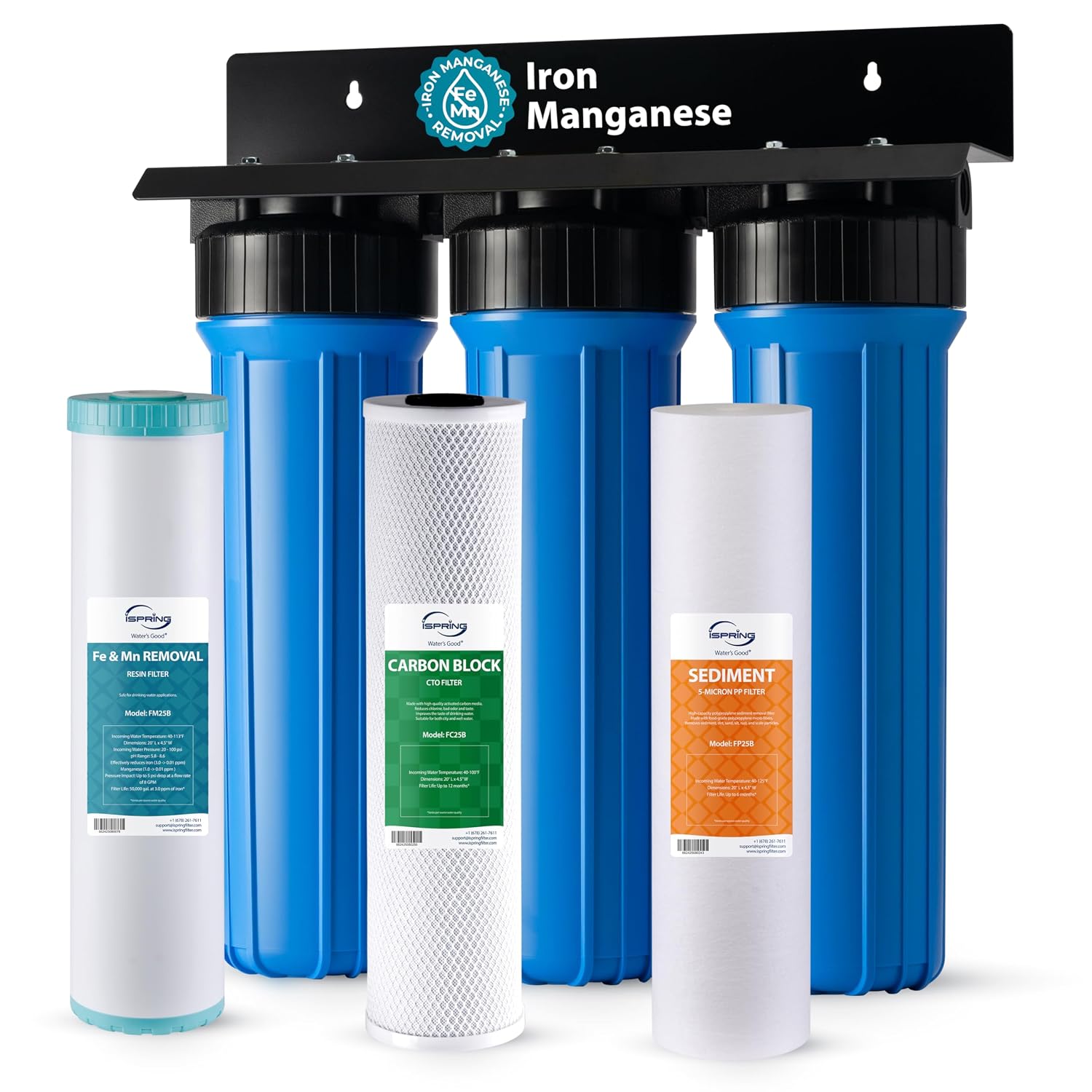
For lighter iron and manganese along with basic sediment and chlorine, the iSpring WGB32BM 3-stage filter is the more affordable path at $473.68, with the highest rating of any product here — 4.6 stars across 1,400 reviews. Its three cartridges (5-micron sediment, coconut-shell carbon, and an iron/manganese media good to 3 ppm iron and 1 ppm manganese) flow at up to 15 GPM and last roughly 100,000 gallons or about a year; iSpring says both are third-party tested to meet NSF/ANSI standards. Pair either ahead of a softener rather than expecting the softener to handle iron alone — our guides to whole house water filters for well water and sediment filters for well water cover the layering.
All-in-One Softening Plus Drinking Water: Aquasure 32,000 Grain + RO Bundle
If you want soft water throughout the house and a fix for the kitchen tap too, the Aquasure bundle pairs a 32,000-grain digital metered softener with a separate 75 GPD reverse osmosis system under the sink — sized for smaller households (1-2 bathrooms, up to 3 people), covering both jobs from one brand.
At $676.79 with a 4.4-star average across 314 ratings, larger households on harder water should size up to the plain Harmony 48,000 instead and treat drinking water separately. See our reverse osmosis system guide for what that RO stage removes beyond hardness.
Compact Salt-Free Combo for City Water: Kind Water Systems E-3000
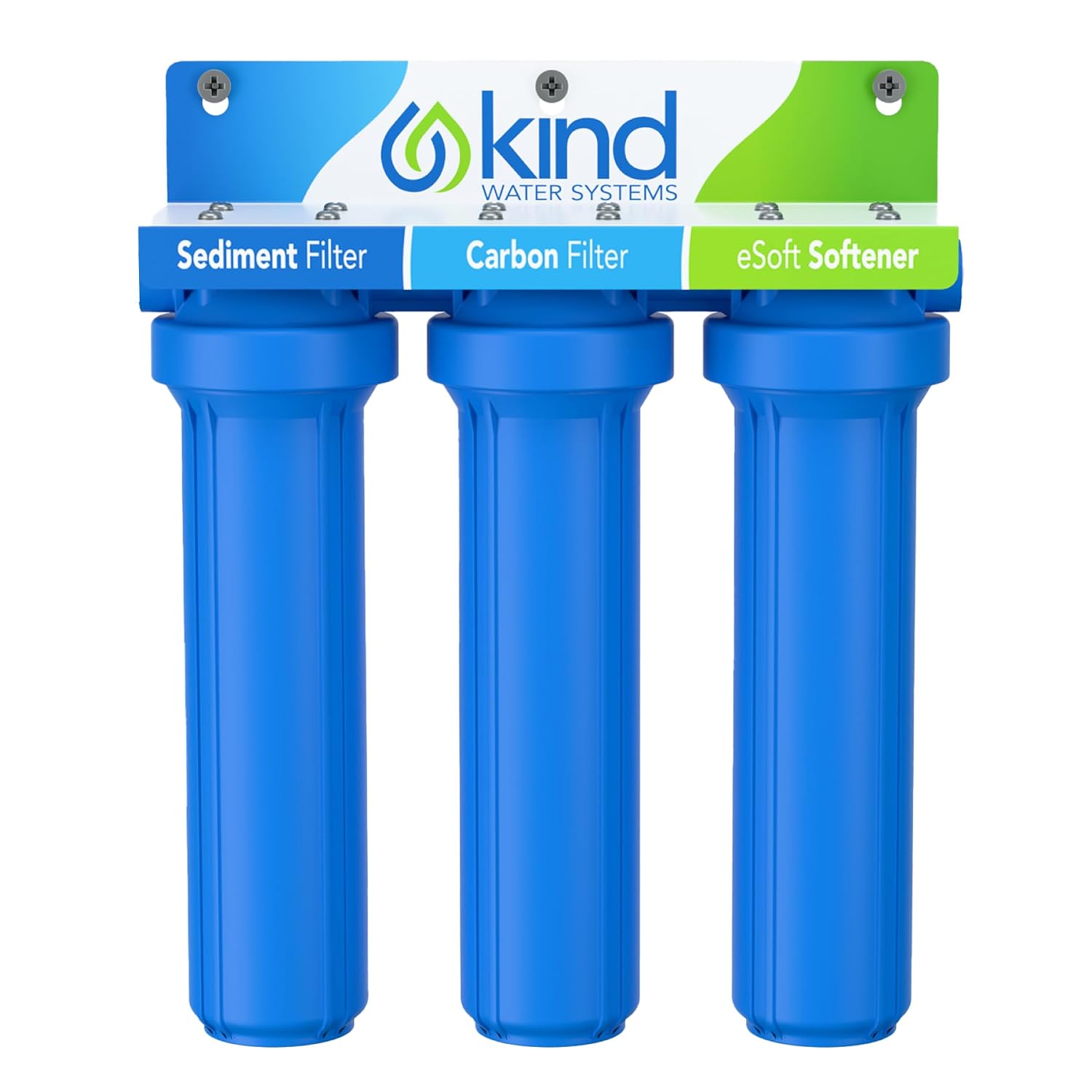
The Kind Water Systems E-3000 stacks sediment filtration, carbon filtration, and a salt-free conditioning cartridge into one compact triple-housing unit built specifically for city water. Kind says it targets roughly 95% of sediment and 155+ contaminants including chlorine, chloramine, VOCs, and pesticides while retaining natural minerals, and the filtration stages use NSF-certified components — though the conditioning stage itself carries no NSF/ANSI 44 certification, since it isn’t removing hardness ions.
At $1,884.69 it’s priced closer to a full iron-filtration system than a basic conditioner, but its 4.6-star average across 61 ratings is the highest of any salt-free product here, and its compact footprint with no drain line or electricity requirement suits a small utility closet better than a two-tank softener.
Why Reverse Osmosis Isn’t the Answer for Whole-House Hardness
To be direct about why RO isn’t on this list as a standalone option: reverse osmosis systems are sized in gallons per day (typically 50-100 GPD) and installed at a single point of use, almost always the kitchen sink, because the membrane is too slow and restrictive to supply a whole house. RO does remove dissolved hardness minerals along with other contaminants, which is why it shows up bundled with a softener in combo units like the Aquasure above — but buying a standalone RO system expecting it to fix hard water at your shower and washing machine will leave you disappointed and a few thousand dollars lighter. For better-tasting, purer drinking water specifically, see our reverse osmosis system guide.
How Much Should You Spend?
Whole house hard-water systems span from $140 to over $2,000, and the right budget depends on what you actually need fixed, not brand loyalty. Under $150 gets you an electronic descaler like the ED2000 — a low-risk first step, not a hardness fix. $300-$500 covers the AO Smith salt-free descaler or the WGB32BM if your problem is sediment and light iron rather than hardness. $600-$850 is the sweet spot for salt-based softening — the Harmony, SimplySoft, or Fleck 5600 SXT all live here and will genuinely soften a typical home’s water. $1,800 and up buys heavy-duty well water treatment (WCFM500K) or a compact all-in-one salt-free combo (Kind E-3000) — pay this much only when your water chemistry actually demands it.
FAQ
What’s the best whole house water filter for hard water — a softener or a filter?
If the goal is genuinely soft water, you need a salt-based ion-exchange softener, not a filter. A whole house filter removes sediment, chlorine, or iron, but none of that touches calcium and magnesium hardness. Many households need both: a pre-treatment filter for well water contaminants, and a softener for the hardness itself.
Does a salt-free conditioner or descaler actually soften water?
No. Salt-free systems condition or crystallize minerals so they’re less likely to form new scale, but they don’t remove calcium or magnesium, and your water will still test as “hard” afterward. If you want water that lathers differently and feels different on skin and hair, only ion exchange delivers that.
What size water softener do I need for my house?
Multiply your water’s hardness in grains per gallon by your household’s daily water usage and headcount to estimate the daily grain load, then pick a capacity that runs several days between regenerations. Most 2-3 bathroom homes on moderately hard water land in the 32,000-40,000 grain range; larger households or harder water push toward 48,000 grains or more. Our grain calculator does the math for you.
Will a water softener remove iron from well water?
A standard softener handles only a small amount of dissolved iron — the AO Smith unit caps it at 0.3 ppm. Beyond that, iron fouls the resin and stains fixtures. You need a dedicated iron/manganese filter like the iSpring WCFM500K or WGB32BM ahead of the softener if your well water tests higher.
Is softened water safe to drink?
Yes, for the vast majority of people — the sodium added through ion exchange is modest, far less than a slice of bread per glass. People on strict sodium-restricted diets sometimes prefer a separate unsoftened tap or an RO system for drinking water, which is exactly why combo units like the Aquasure bundle pair a softener with an RO stage at the kitchen sink.
Do I need a professional to install a whole house softener?
Not necessarily. Most systems ship with the tank, resin, and control valve pre-assembled, and installation is mainly cutting into your main line, adding a bypass valve, and running a drain line — realistic as a weekend DIY project if you’re comfortable with basic plumbing. Otherwise budget $300-$600 for a plumber.
How long does a water softener last?
The resin bed typically lasts 10-15 years before replacement, though the control valve may need service sooner. Systems built around widely serviced valves, like the Fleck 5600 SXT, tend to be cheaper to keep running long-term simply because parts and technicians are easier to find.
Bottom Line
Start with a hardness test, not a shopping cart. If your water is genuinely hard and you want it actually fixed, buy the Aquasure Harmony 48,000 Grain softener — the best combination of real ion-exchange performance, price, and review volume here. Step up to the Aquasana SimplySoft for NSF/ANSI 44 paperwork, or the Fleck 5600 SXT if long-term serviceability matters more than upfront cost.
If you don’t want salt and your water falls within its stated limits, the AO Smith descaler or the budget ED2000 will control new scale without the maintenance — just know they won’t make your water test soft. If you’re on well water, solve iron and manganese with the WCFM500K or WGB32BM before installing a softener; skipping that step is the most expensive mistake in this category. Our broader best water softeners guide covers additional models beyond the hard-water angle.