
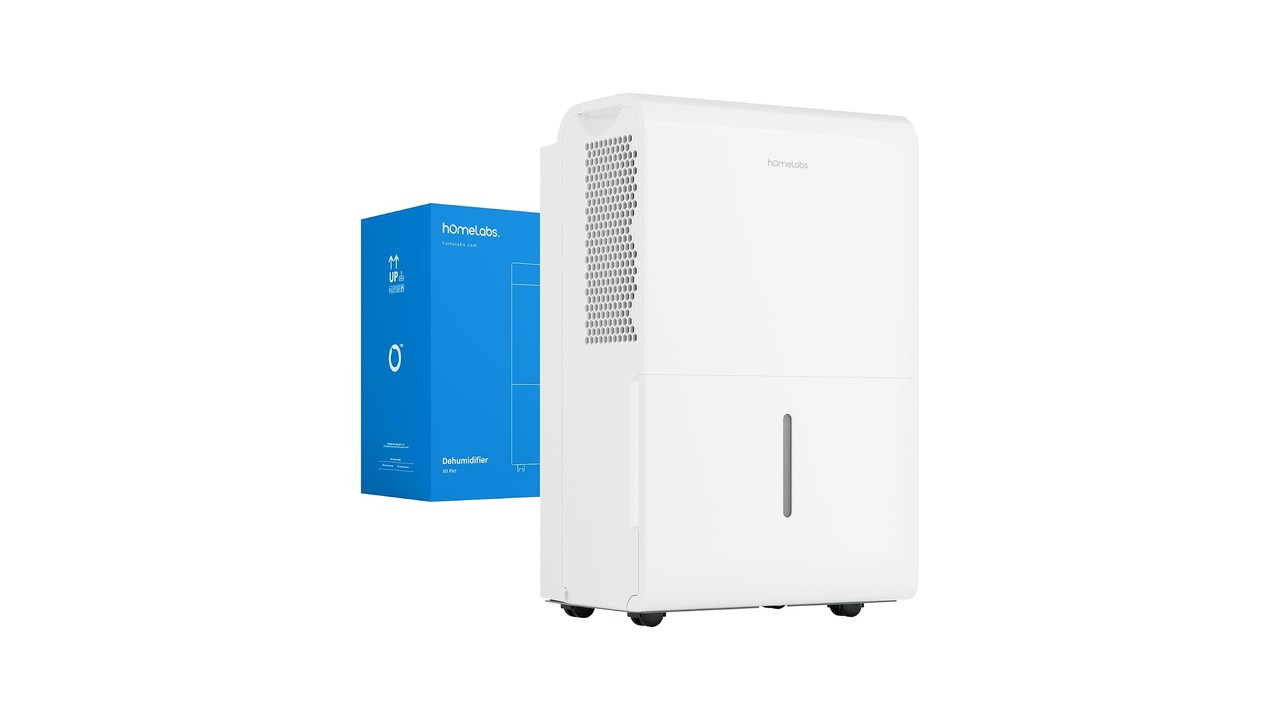
For a damp house, the fix depends on the map of the moisture. If several rooms feel muggy and windows sweat all over, a whole-house dehumidifier like the AprilAire E070 Pro, plumbed to a drain and run off a humidistat, is the real answer. If it is one damp level or a single room, a portable 50-pint unit such as the hOmeLabs 50 Pint costs a fraction as much and does the job.
Every pick here is checked against verified capacity ratings, current DOE test standards, live Amazon listings, and buyer feedback. Humidity targets follow EPA guidance. This guide does not involve hands-on lab testing.
A damp house is not just uncomfortable. Sustained humidity above 50% feeds dust mites, and above 60% it lets mold colonize walls, framing, and stored belongings. You smell it before you measure it: that basement or closet mustiness, clammy sheets, sticking doors, black speckling on a window frame.
The mistake most people make is buying a small portable, putting it in the worst room, and hoping. Sometimes that works. Often the moisture is coming from the whole building, the ground under it, or an air leak, and a single 30-pint unit runs non-stop and never wins. The right buy depends entirely on where the water is getting in and how much space you are actually trying to dry.
This guide splits the decision cleanly: how to tell whole-house damp from a local problem, then six dehumidifiers, three built to dry a whole home and three sized for a room or a level. If you want the pure sizing math first, our dehumidifier size guide and pint calculator do the arithmetic.
Affiliate disclosure: IndoorBreathing may earn a commission when you buy through links on this page, at no extra cost to you. Picks are chosen for capacity, drainage, cold-weather performance, and value, not commission rate.
Table of Contents
Is It One Damp Room, or a Damp House?
Buy a cheap hygrometer, or use an air quality monitor that reads humidity, and put it in three places: the basement or lowest level, a main-floor room, and an upstairs bedroom. Read them over a few humid days.
It is a local problem when only the lowest level reads high, say 60 to 70%, while the main floor sits at a comfortable 45 to 50%. That points to ground moisture, a cool slab, or poor basement ventilation, and a portable dehumidifier down there fixes it.
It is a whole-house problem when the main floor itself is above 55%, upstairs feels sticky, and you see condensation on windows in several rooms or musty smells that are not tied to one spot. Causes include a humid climate, an oversized or short-cycling air conditioner that cools the air without running long enough to wring moisture out of it, a damp crawl space feeding the whole structure through floor gaps, or too little ventilation in a tight modern build. A portable in one room cannot keep up with that, and running several of them is loud, ugly, and expensive. A whole-house unit tied into your ductwork or sitting in the crawl space, working off a humidistat, is the fix.
One more check before you spend anything: look at when the dampness spikes. If it is worst in humid summer weather, the source is outdoor air getting in. If it is worst in winter, with condensation on cold windows, the house is holding too much moisture from showers, cooking, and people, and better exhaust ventilation may matter as much as a dehumidifier. Year-round basement damp usually means ground moisture.
Whole-House vs. Room Dehumidifier: The Real Trade-Off
A whole-house dehumidifier costs roughly $1,000 to $2,500 plus install, moves 70 to 200 pints a day, connects to a permanent drain so there is no bucket, and runs automatically to hold the whole home at a set humidity. It is the correct tool for a genuinely damp house, a large finished basement, or a crawl space that needs sealing and drying. The downsides are the upfront cost, the need for a drain nearby, and usually a pro to duct it properly.
A portable room dehumidifier costs $150 to $350, pulls 20 to 50 pints a day on the current test, and covers one room or one open level. It is the right call for a single damp basement, a laundry room, or a bedroom that never dries out. You trade capacity and the automatic, out-of-sight operation for a much lower price and no installation. The catch is drainage: emptying a bucket twice a day gets old fast, so plan to run a hose.
The rough rule: if two or more separate living areas are damp, price out a whole-house unit. If it is one contiguous space, a portable is the better value every time.
How to Size a Dehumidifier for a Damp Home
Set your target first. The EPA recommends keeping indoor humidity between 30 and 50%, and below 60% at all times. For a damp house, aim the dehumidifier at 45 to 50% in summer; going lower wastes energy and can over-dry wood.
Understand the pint number. In 2019 the Department of Energy changed its test from 80°F to 65°F. Cooler air holds less water, so a machine that was sold as “70 pint” in 2018 is the same machine sold as “50 pint” today. When you compare a new unit to an old one, or to a listing that still quotes the warm-air number, you are not comparing like with like.
Watch for two capacity numbers. Crawl-space units often list both an AHAM or DOE figure and a much bigger “at saturation” figure measured in hot, soaking conditions. The AHAM number is the one that matters for your house. A unit advertised as “198 pints” may be a 90-pint machine by the standard that counts.
Match capacity to space and dampness. As a starting point, a moderately damp 1,500 square foot area needs about 45 to 50 pints a day on the current test; a wet basement or a 2,500 square foot damp house needs 70 or more. Cold spaces below 65°F need a unit specifically rated for low temperatures, or it will frost over and stall. Our dehumidifier buying guide covers the rest.
Best Dehumidifiers for Damp Homes: Comparison Table
Capacity is pints per day; where a listing quotes the older warm-air test, the current-standard figure is noted. Prices and ratings are current Amazon figures and will move.
Whole-House and Crawl-Space Picks
These three are for a damp whole house, a large finished basement, or a crawl space that needs to stay dry year-round. They drain continuously and run off a humidistat, so once they are set up you leave them alone.
AprilAire E070 Pro — Best Whole-House Dehumidifier
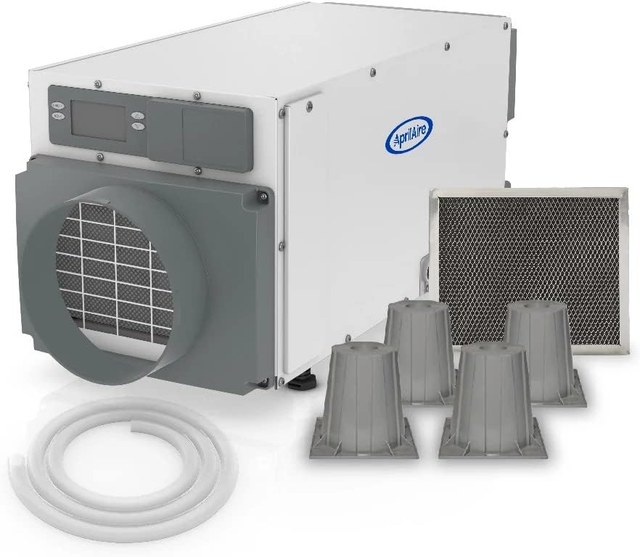
The E070 is the unit for a house that is damp everywhere. It pulls 70 pints a day on the current DOE test, is rated for up to 2,800 square feet, and is Energy Star certified, so it removes more water per watt than a stack of portables. Smart sensing starts it automatically when humidity climbs past your target, and there is no water tray: you run a hose to a floor drain or a condensate pump and forget it exists. The bundle ships with the drain hose, two filters, and mounting risers, and AprilAire backs it with a 5-year warranty.
You can free-stand it in a basement or crawl space, or a HVAC pro can duct it to your return so it dries the whole house through the existing vents. The cost is the obvious drawback, around $1,770 before any install labor, and it needs a nearby drain. But for a genuinely damp home it is cheaper over five years than running three portables and replacing them.
Pros
- 70 pints/day, Energy Star efficient
- Ducts into HVAC or free-stands
- No bucket, fully automatic
- Ships as a complete kit
- 5-year warranty
Cons
- Around $1,770 before install
- Needs a drain within reach
- Ducting is a job for a pro
- Overkill for a single room
Looking ahead, expect humidity control to move from a basement problem to a whole-home one, as wetter weather and tighter houses trap more moisture. The catch is that a bigger machine does not fix a leak.
AlorAir 198 PPD — Best High-Capacity Unit for Big Crawl Spaces
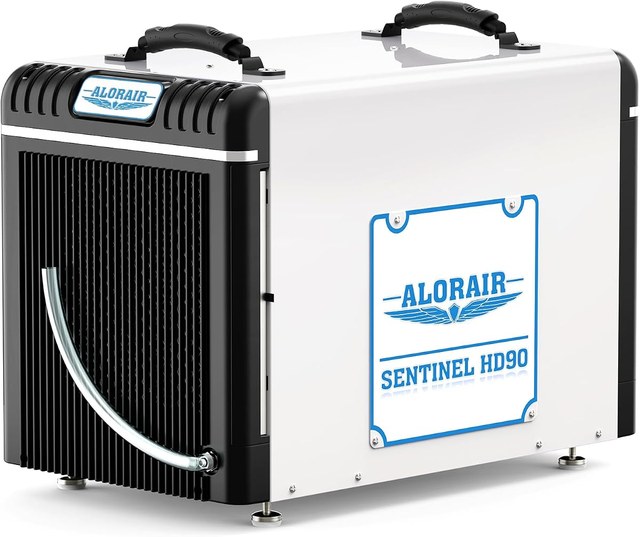
When the wet space is large, a full crawl space, a warehouse-style basement, an unfinished lower level over 2,000 square feet, this AlorAir has the raw capacity: 90 pints a day on the AHAM test, and a much larger figure in soaking conditions. It has an automatic defrost system for cold operation, corrosion-protected coils that resist the leaks that kill cheaper units in humid duty, and continuous gravity drainage. It is compact and light for its output, with carry handles.
Two honest caveats. Its Amazon rating sits around 3.5 stars, with the complaints centered on units that failed early and on customer support, so buy from a seller with a clear return path and register the warranty. And it is a bare machine, not a finished-room appliance: no app, a basic control panel, and looks that belong under the house, not in it. For its intended job, drying a big raw space, it is a lot of dehumidifier for the money.
Pros
- 90 pints/day AHAM, high real capacity
- Auto defrost for cold crawl spaces
- Corrosion-protected coils
- Compact and portable for its output
Cons
- Around 3.5-star rating, early-failure reports
- No app, utilitarian design
- Support experiences are mixed
- Gravity drain only, no built-in pump
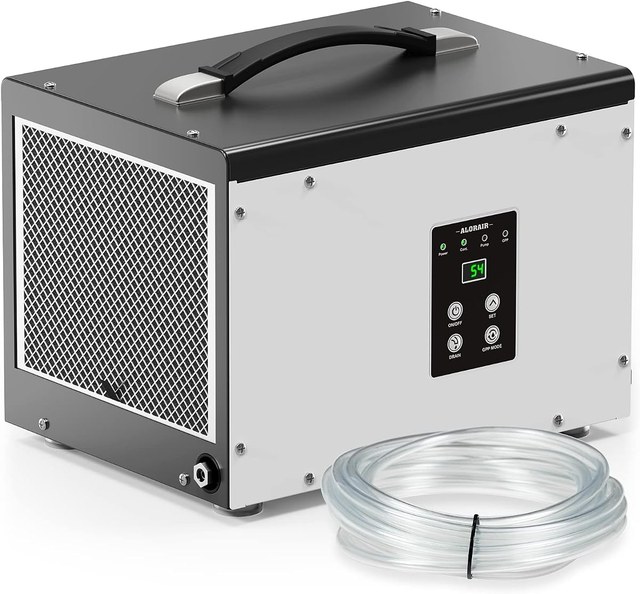
AlorAir 70 PPD with Pump — Best Small Crawl-Space and Basement Unit
Most crawl spaces are not huge, they are just cold, tight, and awkward to drain. This smaller AlorAir is built for exactly that: 35 pints a day on the AHAM test, coverage to about 1,000 square feet, an automatic low-temperature defrost so it keeps working down into the 40s, and a genuinely useful built-in condensate pump that lifts water almost 20 feet, up out of the crawl space and to a drain or outside. A MERV-1 filter keeps the coil clean, and it runs under 50 decibels.
At around $400 it sits between a cheap portable and a true whole-house unit, and for a damp crawl space under an average home it is the sensible middle. It will not dry a whole damp house, and the pump, like all condensate pumps, is the part most likely to need service in a few years. Pair it with a vapor barrier on the crawl-space floor and it holds humidity in check with little attention.
Pros
- Built-in pump lifts water ~20 ft
- Low-temperature defrost for cold crawl spaces
- Priced between portable and whole-house
- Quiet, under 50 dB
Cons
- 35 pints/day, not for a whole house
- Pump is a long-term wear item
- Basic controls, no smart features
- Best paired with a vapor barrier
Room and Portable Picks
These three are for a single damp level or room: a basement, a laundry area, a ground-floor bedroom, a garage gym. All three can run to a hose for hands-off operation.
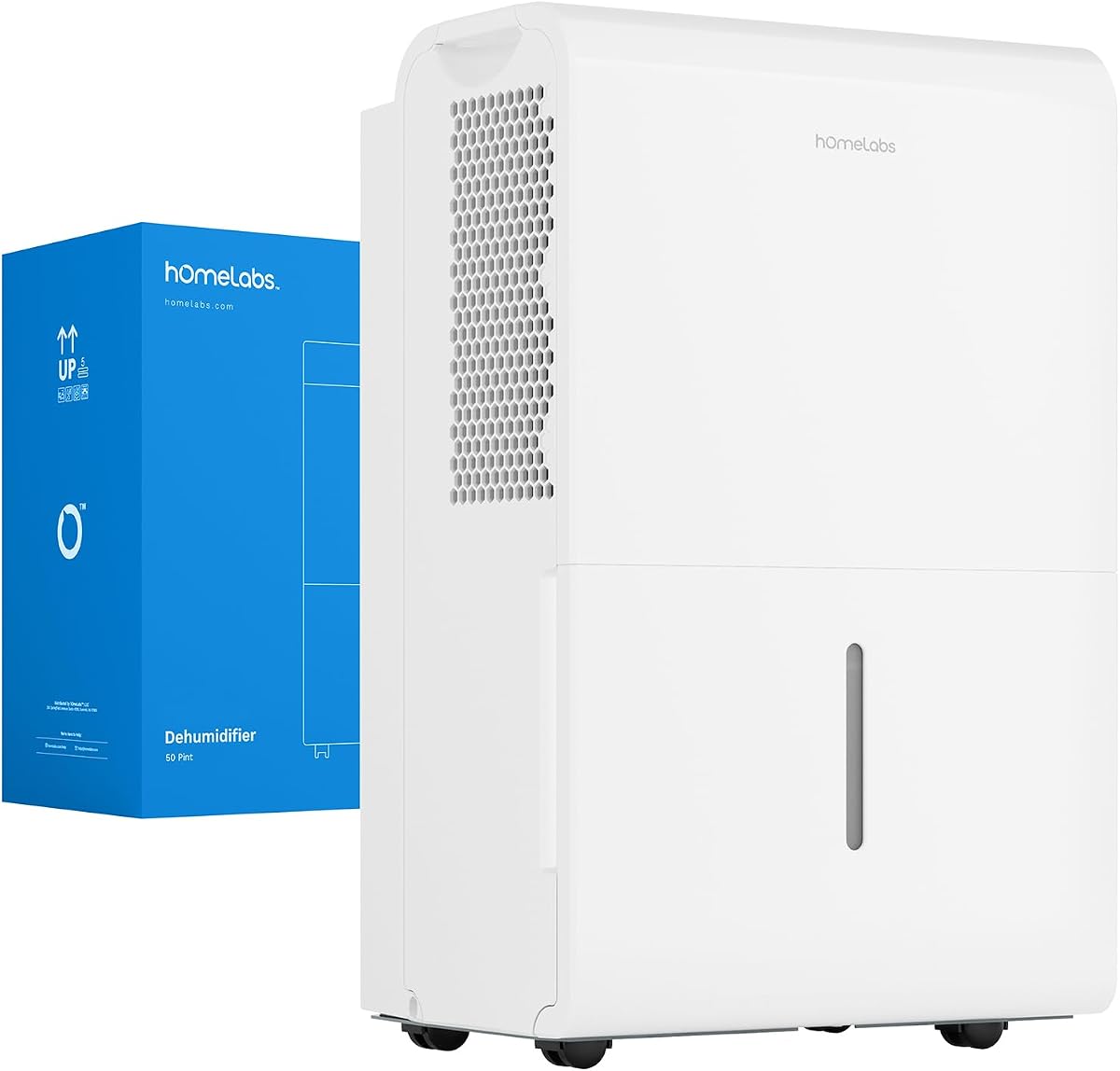
hOmeLabs 50 Pint — Best Portable for Most Damp Homes
The hOmeLabs 50 Pint has been the default recommendation in this category for years, and its pump version has more than 15,000 ratings behind it. That model has a true built-in condensate pump alongside standard gravity drainage, so it can push water up into a sink or out a window without a separate accessory; the cheaper non-pump version drains by gravity only. It is Wi-Fi enabled, rolls on casters, and is quieter than most.
One thing to size correctly: hOmeLabs still advertises “50 pints” using the older 80°F test and mentions a “7,500 square foot” ceiling that assumes light dampness. On the current DOE standard it is closer to a 35-pint machine, and for a genuinely wet basement its honest coverage is closer to 1,500 square feet. Within that range it is reliable, well supported, and the easiest portable to live with.
Pros
- Built-in pump plus gravity drain
- Huge, consistent owner track record
- Wi-Fi, casters, relatively quiet
- Widely available and well supported
Cons
- Capacity quoted on the older warm-air test
- Coverage claim assumes light dampness
- Pump can get noisy as it ages
- Not enough for a whole damp house
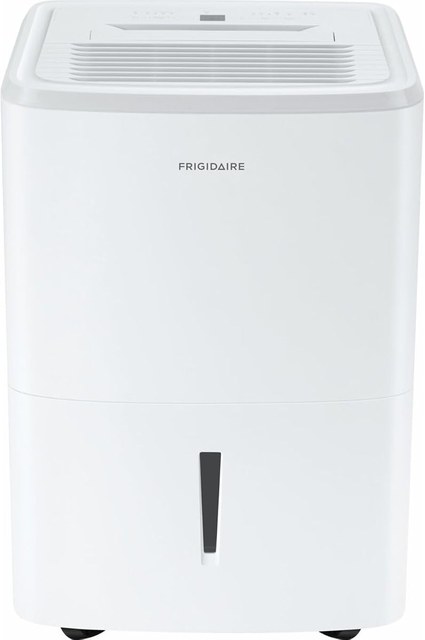
Frigidaire 50 Pint Wi-Fi — Best for a Damp Main-Floor Room
Frigidaire’s 50-pint unit is rated on the current DOE test, so its number is honest, and it is a clean, quiet fit for a living space rather than a mechanical room. It has a washable filter, custom humidity control in 5% steps, a full-tank auto shutoff, and a Wi-Fi app with Alexa support so you can check the room from your phone. Owners consistently praise how steadily it holds a set point.
The gap in the spec is drainage: it supports a gravity hose but has no built-in pump, so the drain has to be at or below the unit, which rules out some basements. It is also a true 50-pint machine on the strict test, which means it draws real power, plan for $8 to $12 a month if it runs most of the day. For a damp family room, finished basement, or bedroom with a floor drain, it is the tidiest option here.
Pros
- Honest 50-pint current-test rating
- Quiet, living-space looks
- Washable filter, 5% humidity steps
- Wi-Fi app with Alexa
Cons
- No built-in pump, gravity drain only
- Real power draw at full capacity
- Tank is smallish for unattended runs
- App setup can be fiddly
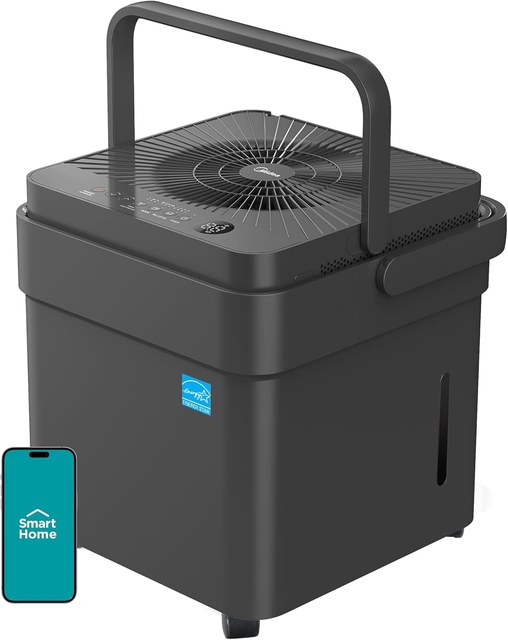
Midea Cube 35 Pint — Best for Tight Spaces and Long Unattended Runs
The Midea Cube solves the two everyday annoyances of a portable: the tiny bucket and the bulk. It nests down to a shorter shape for storage, then extends to add a 4.2-gallon internal reservoir, more than three times a normal tank, so it can run for days between emptyings even without a hose. Rated at 35 pints on the current test and Energy Star certified, it covers about 3,500 square feet of light dampness, and it has Wi-Fi with Alexa and Google support.
It is the pick for a spot where a hose is impractical and you do not want to babysit a bucket: a closet, a small cellar, a boat, a seasonal cabin. Drainage is gravity only through the included hose, there is no pump, and the folding design is a little more fragile than a plain box. But for set-it-and-leave-it in a small damp space, nothing else here comes close on runtime.
Pros
- 4.2-gallon tank, runs for days
- Nests small for storage
- Energy Star, honest 35-pint rating
- Wi-Fi with Alexa and Google
Cons
- Gravity drain only, no pump
- Folding design feels less rugged
- Light-dampness coverage claim
- Not for a large wet basement
Drainage: Bucket, Gravity, or Pump
Drainage decides whether you actually keep using a dehumidifier. A 50-pint unit in a damp basement fills its bucket once or twice a day, and nobody keeps that up. You have three options. Gravity runs a hose from the unit to a floor drain, sump, or lower sink; it is free and reliable but only works if the drain is below the outlet. A built-in pump, like the ones on the hOmeLabs and the small AlorAir, lifts water up and out to a higher sink or a window, which is what most basements and crawl spaces need. An external condensate pump is a $40 add-on that gives any gravity-only unit the same ability. If your only drain is above the machine, buy pump capability one way or the other; do not plan to carry buckets.
Running Costs and Energy Use
A portable 50-pint dehumidifier draws roughly 500 to 700 watts while the compressor runs. In a damp basement where it cycles most of the day, that is about $15 to $35 a month, more in a very wet space, less once the room dries out and it idles. Energy Star models, and the whole-house AprilAire, remove more water per watt, so a house-wide unit is not the energy hog it looks like: it replaces several portables and runs each cycle more efficiently. Set a realistic target, 45 to 50%, not 35%, and the unit runs far less. Our note on basement air quality covers pairing a dehumidifier with better ventilation.
Placement and Settings
Put a portable near the dampest spot but with at least a foot of clearance around the intake and exhaust, off carpet if you can, and near your chosen drain. Keep doors and windows to the damp area closed while it runs; you are drying that space, not the outdoors. Set the humidistat to 45 to 50% and use continuous mode only when you are actively drying out after a flood. Clean the filter monthly, since a clogged filter quietly cuts capacity, and if the coils frost up on a cool day the unit is not rated cold enough for that space. A dehumidifier that is not collecting water is usually a temperature or drainage problem, not a broken machine.
What a Dehumidifier Cannot Fix
A dehumidifier manages humidity in the air. It does not stop water coming in. If your basement is damp because of bad grading, clogged gutters, a downspout dumping at the foundation, a cracked wall, or a plumbing leak, fix that first, or the machine runs forever and you still get efflorescence and mold. In a crawl space, a sealed vapor barrier on the floor does more than any dehumidifier and makes the one you buy work far less. And a dehumidifier does not remove existing mold; it only stops new growth. For active mold you need cleanup, and our piece on whether air purifiers help with mold explains where filtration fits in.
The downside of over-drying: running a dehumidifier too low can crack wood and dry out skin. Expect more models with auto-humidity targets, and keep the goal near 45 to 50 percent.
FAQ
What humidity should a dehumidifier be set to in a damp house?
45 to 50% in humid weather. The EPA’s healthy range is 30 to 50%, and you want to stay comfortably under 60% at all times. Setting it lower than 45% just burns energy and can dry out wood floors and trim.
Is a whole-house dehumidifier worth it?
If two or more separate living areas are damp, or your main floor sits above 55% humidity, yes. It costs more upfront but runs more efficiently than several portables, needs no emptying, and holds the whole house steady. For one damp room or basement, a portable is the better value.
Why does a dehumidifier run constantly and never fill up?
Usually one of three things: the space is colder than the unit is rated for and it is barely pulling moisture, the drain hose is kinked or the bucket switch is stuck, or the room is genuinely still very wet and it needs days to catch up. If the coils are iced over, the unit is not rated cold enough for that space.
Can one portable dehumidifier dry a whole basement?
An open, single-level basement up to about 1,500 square feet on the current test, yes, if it drains to a hose. A large or partitioned basement, or one with a serious moisture source, needs a bigger unit or a whole-house solution.
Is a dehumidifier with a pump needed?
Only if your drain is higher than the dehumidifier, which is common in basements and crawl spaces. If you have a floor drain or a lower sink, a plain gravity hose is simpler and has nothing to wear out. Otherwise, buy a unit with a built-in pump or add a $40 external one.
Will a dehumidifier get rid of a musty smell?
It removes the damp that causes new musty odor, and the smell fades over a week or two as materials dry. But if there is existing mold in carpet, drywall, or framing, the source has to be cleaned or removed; drying the air alone will not clear it.
Does a dehumidifier help with dust mites and allergies?
Yes. Dust mites need humidity above about 50% to survive, so holding a damp home at 45 to 50% steadily reduces the mite population over a few weeks, along with mold spores. It is one of the more effective allergy steps you can take in a damp house.
Should a dehumidifier and an air conditioner run at the same time?
In hot, humid weather, yes, they do different jobs: the AC handles temperature and some moisture, the dehumidifier handles the humidity the AC leaves behind, especially on mild days when the AC barely runs. In a cool basement you often need only the dehumidifier. Just avoid setting them to fight each other, keep the dehumidifier target at 45 to 50%.
What happens next: smarter whole-house systems will talk to the thermostat and ventilation. The trade-off is installation cost and more parts that need a pro. Expect humidity targets to get easier to hit as sensors improve, and do not be surprised if a few brands lock features behind apps.
Bottom Line
Map the moisture before you buy. If your whole house reads damp, above 55% on the main floor with condensation and musty air in more than one room, a whole-house dehumidifier is the real fix, and the AprilAire E070 Pro is the one to get. If it is one level or one room, a portable wins on value: the hOmeLabs 50 Pint for most damp basements, the Frigidaire 50 Pint for a living space, the Midea Cube 35 Pint for a tight spot, and the AlorAir units for crawl spaces. Whatever you buy, run it to a hose, set it to 45 to 50%, and fix any actual water intrusion first, or the machine will run forever.
Editorial note: Prices, ratings, capacity ratings, and availability change after publication — confirm the current listing before buying.