
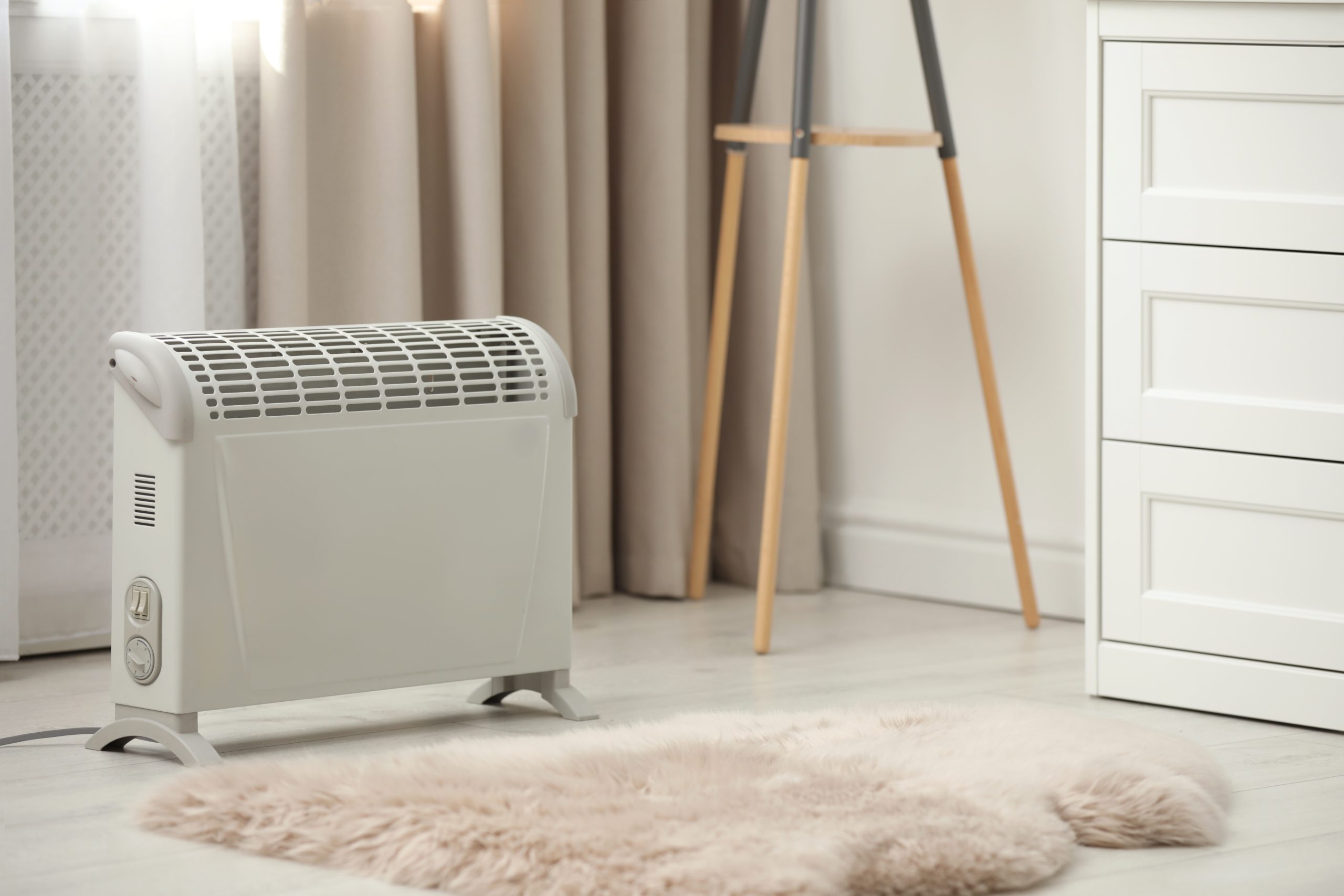
Choosing the right space heater size means matching wattage to your room’s real heat loss, not just picking whatever’s popular at the store. A 150 sq ft room in a moderate climate with average insulation needs about 1,500 watts — the maximum a standard household outlet safely supports — but the same room in a very cold climate with poor insulation can need nearly double that, pushing you past what any single plug-in heater can deliver.
This guide reflects the watts-per-square-foot sizing method commonly used for electric space heaters, cross-checked against manufacturer coverage guidance.
Most people buy a space heater based on room size alone and either freeze through winter or trip a breaker running it. The number that actually matters is watts, and it depends on your climate and insulation just as much as square footage.
Table of Contents
How Many Watts Per Square Foot Do You Actually Need?
Space heater sizing starts from watts per square foot, adjusted for how cold it gets outside. This is the opposite calculation from air conditioner sizing — instead of keeping heat out, you’re replacing heat that’s escaping through walls, windows, and the roof.
- Mild climate — rarely below freezing: about 7 watts per sq ft
- Moderate climate — typical four-season winters: about 10 watts per sq ft
- Cold climate — regular freezing temperatures: about 13 watts per sq ft
- Very cold climate — extended sub-freezing winters: about 17 watts per sq ft
A 150 sq ft room needs roughly 1,050-2,550 watts depending purely on climate zone, before insulation or ceiling height even enter the picture — which is why “just buy a 1,500W heater” works for some rooms and badly undershoots others.
Why Insulation and Ceiling Height Change the Math
Two rooms of identical size in the same climate can have very different real heat loss:
- Insulation quality — a poorly insulated space (older construction, drafty windows, an uninsulated garage or three-season room) loses heat roughly 25% faster than average, while a well-insulated space with modern windows holds heat about 20% better than average.
- Ceiling height — the same volume-of-air logic that applies to air conditioners applies here. A room with a 10-foot ceiling has 25% more air to heat than the same footprint at a standard 8 feet, and that extra volume needs proportionally more wattage.
Garages, basements, and sunrooms are the classic case where all three factors stack against you — cold-adjacent, poorly insulated, and often taller than a standard room — which is exactly why a “1,500W heater for a 150 sq ft garage” so often disappoints.
Calculate Your Exact Wattage
Generic square-footage charts skip climate, insulation, and ceiling height entirely. For an exact number based on your real room, use the calculator below:
Garages, basements, and three-season rooms usually fall under Poor insulation even in an otherwise well-insulated home.
Heater size you need
Square footage
150 sq ft
Watts per sq ft used
10
Climate / insulation
Moderate / Average
Real space heaters that clear this wattage
Ceiling Height ÷ 8. A standard 120V household outlet safely supports up to 1,500W continuously — anything higher needs either a dedicated 240V unit or a different heating solution entirely.
Space Heater Size Chart: Watts by Room Size and Climate
| Room Size | Mild | Moderate | Cold | Very Cold |
|---|---|---|---|---|
| 100 sq ft | 700W | 1,000W | 1,300W | 1,700W |
| 150 sq ft | 1,050W | 1,500W | 1,950W | 2,550W |
| 200 sq ft | 1,400W | 2,000W | 2,600W | 3,400W |
| 300 sq ft | 2,100W | 3,000W | 3,900W | 5,100W |
Assumes a standard 8-foot ceiling and average insulation. Add roughly 25% for poor insulation, subtract about 20% for good insulation, or run the calculator above with your exact numbers.
The 1,500-Watt Ceiling: When You Need a 240V Heater Instead
A standard U.S. household outlet runs on a 15-amp, 120V circuit, which caps continuous safe heater output at about 1,500 watts — this is why nearly every plug-in space heater on the market tops out at exactly that number, regardless of brand. Once your calculated wattage exceeds 1,500W, a bigger plug-in heater isn’t an option; you need either a dedicated 240V heater (common for garages and workshops) or a fundamentally different heating approach.
If your number is well beyond even a 240V unit’s range, that’s usually a sign the space needs real central heating rather than a space heater at all. A ductless mini-split with heat pump mode heats and cools the same space efficiently and is worth pricing out once you’re consistently needing multiple space heaters to keep a room warm.
Watts vs. Manufacturer “Room Size” Claims: Why the Numbers Don’t Match
A common point of confusion: two 1,500W heaters list different room-size coverage — one says “up to 150 sq ft,” another says “up to 300 sq ft” for the identical wattage. The reason is the same as it is across other sizing categories: manufacturers aren’t required to test against the same climate or insulation assumption. A brand assuming a mild climate and good insulation will claim double the coverage of one assuming a cold climate and average insulation, for the exact same 1,500 watts.
The fix is the same too: ignore the manufacturer’s headline square-footage claim and work from the wattage plus your own climate and insulation instead. That’s the only way to compare two heaters on equal footing.
A concrete example makes this easier to spot: a 150 sq ft home office in a moderate climate with average insulation needs about 1,500 watts — right at the standard outlet ceiling. The same room used as a converted garage office, with poor insulation and a colder climate zone, needs closer to 2,550 watts once both adjustments stack — already past what any single plug-in heater can safely deliver, even though the floor space never changed.
Best Space Heater by Use Case
Wattage and climate get you most of the way there, but the specific use case matters too:
- Bedrooms and offices: prioritize quiet operation and a real thermostat over raw wattage — most rooms this size fit comfortably under 1,500W
- Bathrooms: look for a unit rated for damp locations specifically — see our bathroom heater picks for models built for that environment
- Garages and workshops: budget for a 240V unit from the start rather than running several plug-in heaters at once, which strains household circuits
- Radiant/spot heating: an infrared heater warms objects and people directly rather than the whole room’s air, which can feel warmer at a lower wattage in a space you’re not fully insulating — see our infrared heater reviews
For more real product picks, see our most efficient space heaters roundup.
Running Cost: Bigger Isn’t Always More Expensive
A correctly sized heater often costs less to run than an oversized one left on low, since a properly matched unit reaches temperature and cycles off rather than running continuously. Our breakdown on how much electricity space heaters actually use and our tips to reduce your electric bill both cover this in more detail — sizing accuracy is usually a bigger lever on your bill than brand or “eco mode” marketing.
FAQ
Why do almost all space heaters max out at 1,500 watts?
Standard U.S. household outlets run on 15-amp, 120V circuits, which safely support about 1,500 watts of continuous load. Manufacturers build to that ceiling because it’s the practical limit for a plug-in appliance on a normal outlet — going higher requires a dedicated 240V circuit.
Can I just run two 1,500W heaters instead of finding a bigger one?
You can, but check what else is on the same circuit first — two 1,500W heaters together (3,000W) will trip a standard 15-amp breaker if they share a circuit with anything else drawing power. Confirm they’re on separate circuits before relying on this approach.
Does ceiling height really matter for a space heater?
Yes, the same way it matters for air conditioner sizing — a taller ceiling means more actual cubic feet of air to heat, even though the floor space hasn’t changed. See the calculator above for the exact adjustment.
Why do two heaters with the same wattage list different room-size coverage?
Different manufacturers assume different climate zones and insulation quality when calculating their advertised coverage number. Ignore the coverage claim and size from the wattage plus your own climate and insulation instead.
When should I stop looking at space heaters and consider central heating?
If your calculated wattage is consistently pushing past what a single 240V unit provides, or you find yourself running multiple heaters just to keep one space comfortable, that’s the point where a mini-split with heat pump mode or a proper HVAC upgrade usually costs less over time than fighting the problem with portable heaters.
Bottom Line
Choosing the right space heater size comes down to three numbers: your room’s square footage, your climate zone, and your insulation quality, all scaled for ceiling height. Use the calculator above to get an exact wattage target, then match it against real, currently-available units rather than a manufacturer’s marketing coverage claim.