

Prices and ratings were checked on Amazon on October 10, 2026. Two older picks changed: the iSpring WCFM500K is now the WF150K, and the Aquasana pick is replaced by the Tier1.
If you have ever noticed white crusty buildup around your faucets, or felt your skin go dry after a shower, you are probably dealing with hard water. Calcium and magnesium dissolve into groundwater as it moves through rock and soil. Once those minerals reach your home, they cause real problems: scale in pipes, shorter appliance life, and soap that never lathers right.
Hard water is more than a nuisance. Scale can quietly shorten the life of water heaters and washing machines. The fix depends on your water hardness, your household size, and whether you want salt-based or salt-free treatment. Below are eight options checked on Amazon, from salt-based whole-house softeners to electronic descalers, with honest pros and cons for each. For a deeper look at sizing, use our water softener sizing guide and grain calculator.
Table of Contents
Best Water Softeners
1. Best Overall for Scale Control: A. O. Smith Whole House Salt-Free Descaler
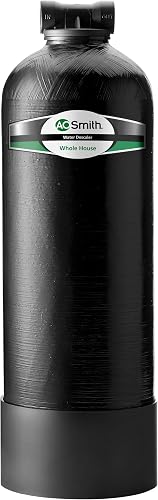
Price on Amazon: $399.99 | 4.3 stars from 1,979 ratings (checked October 10, 2026)
The A. O. Smith Whole House Salt-Free Scale Control is rated for 600,000 gallons or six years and works on both city and well water. It uses no salt and no electricity, and it sends no wastewater down the drain.
The maker is clear that it prevents scale but does not soften water. It is meant for moderate hardness, under 15 grains per gallon, and the listing says it suits households of four or more.
Pros
- No salt, no power, no drain
- City and well water
- Six-year cartridge life
- 4.3 stars from 1,979 ratings
Cons
- Prevents scale but does not soften
- Best for hardness under 15 gpg
Verdict: If scale is the main problem and you want an install-and-forget unit, this is the pick.
2. Best Salt-Based Softener: Aquasure Harmony Series 48,000 Grains Water Softener
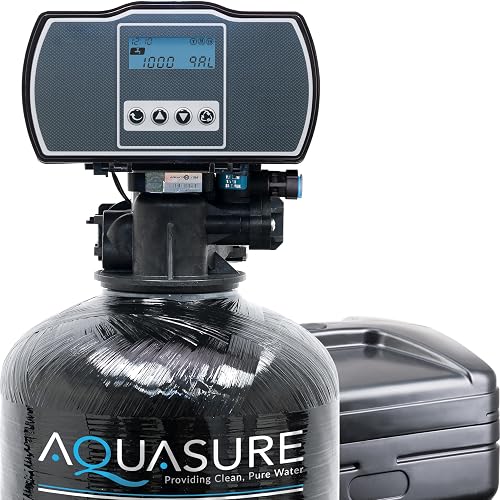
Price on Amazon: $629.99 | 4.4 stars from 3,209 ratings (checked October 10, 2026)
The Aquasure Harmony is a traditional ion-exchange softener rated at 48,000 grains for homes with three to four bathrooms. A digital metered control head regenerates the resin based on how much water you actually use, which saves salt and water compared with a timer.
It is the one to buy if you want true soft water throughout the house. Plan on adding salt to the brine tank every month or two.
Pros
- True ion-exchange softening
- Metered regeneration saves salt
- Programmable backlit display
- 4.4 stars from 3,209 ratings
Cons
- Needs salt refills
- Adds a little sodium to the water
Verdict: For hard water that scale-control units cannot handle, the Aquasure Harmony is the strongest value here.
3. Best Whole-House Filter to Pair With a Softener: iSpring WF150K Whole House Water Filtration System
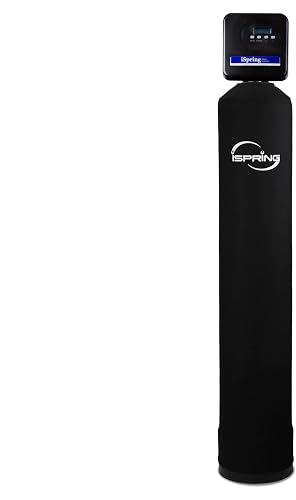
Price on Amazon: $1,673.70 | 4.5 stars from 203 ratings (checked October 10, 2026)
The iSpring WF150K is a whole-house filter, not a softener. The maker says it removes chlorine, lead, heavy metals, pesticides, herbicides and VOCs, and that it meets NSF/ANSI 42 and 53 standards.
A smart valve back-flushes the media on a schedule you set. The listing rates it for about 10 years in a home with 2-3 bathrooms, or 5 years with 4-5 bathrooms. This is the newer listing for the model we used to call the WCFM500K, which Amazon no longer shows.
Pros
- Meets NSF/ANSI 42 and 53 (per listing)
- Set-and-forget smart valve
- Large household capacity
- 10-year warranty
Cons
- High upfront cost
- Does not soften hard water
Verdict: Pair it with a softener if you want filtered water and soft water. For iron or sulfur smell on well water, see our well water guides.
4. Best Softener and Drinking Water Bundle: Aquasure 32,000 Grains Water Softener with RO Drinking System Bundle
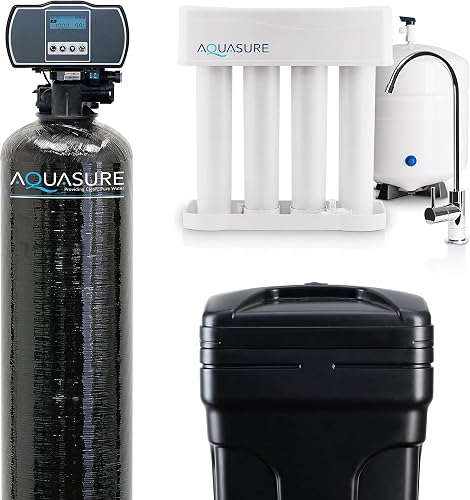
Price on Amazon: $676.79 | 4.4 stars from 324 ratings (checked October 10, 2026)
This Aquasure bundle pairs a 32,000-grain softener with a 75 GPD reverse osmosis drinking system. It is built for homes with one or two bathrooms and up to three people.
The softener uses the same metered control head idea as the Harmony, and the RO system handles the glass of water at the kitchen tap.
Pros
- Softener and RO in one purchase
- Metered control head
- Priced below most standalone softeners
- 4.4 stars from 324 ratings
Cons
- Smaller 32,000-grain capacity
- Needs salt and more floor space
Verdict: If you are a small household that wants both soft water and clean drinking water, this bundle is the one-box answer.
Looking ahead, expect more homes to move from salt-based softeners toward salt-free conditioners and combo systems, because some towns and states limit the brine that softeners send down the drain. The catch is that salt-free units reduce scale but do not give the slick, soft feel of ion-exchange water, so some buyers will be disappointed.
5. Best for an Easy-to-Service Valve: Fleck 5600 SXT 48,000 Grain Water Softener
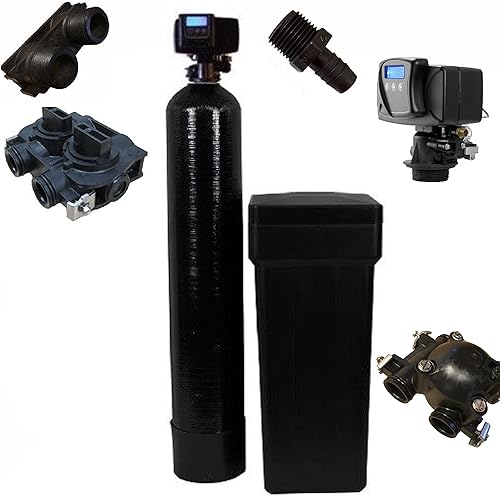
Price on Amazon: $825.00 | 4.6 stars from 371 ratings (checked October 10, 2026)
The Fleck 5600 SXT is a 48,000-grain softener that ships loaded with 1.5 cubic feet of high-capacity resin. It comes with the mineral tank, a bypass valve and a 14 by 36 inch brine tank with a safety float.
It regenerates on demand using a meter, and the Fleck valve is known to be easy to service. At $825.00, it costs more than the Aquasure Harmony, so choose it for the valve, not the price.
Pros
- On-demand metered regeneration
- Ships loaded with resin
- Complete system included
- 4.6 stars from 371 ratings
Cons
- Costs more than the Aquasure
- Needs space for two tanks and salt
Verdict: A good pick if you like a valve that any plumber can service, but it is not the budget choice.
6. Best Salt-Free Alternative With Large Capacity: Tier1 900,000 Gallon Salt-Free Whole House TAC Scale Prevention System
Price on Amazon: $554.59 | 4.1 stars from 23 ratings (checked October 10, 2026)
The Tier1 uses template-assisted crystallization (TAC) media to turn hardness minerals into inactive crystals that do not stick to pipes. It is rated for 900,000 gallons and works with no salt, no electricity, no backwashing and no drain.
Like all salt-free units, it reduces scale rather than removing hardness. The listing also says it can help loosen some existing buildup over time. This replaces the old Aquasana pick, which Amazon now sells only as a replacement tank.
Pros
- No salt, power or drain
- 900,000-gallon rating
- 10-year limited warranty (authorized sellers)
- Lower price than most conditioners
Cons
- Only 23 ratings so far
- Does not soften water
Verdict: A fair salt-free pick for scale prevention, with the caveat that it has few reviews so far.
7. Best Electronic Descaler: iSpring EDV2 Whole House Electronic Water Descaler
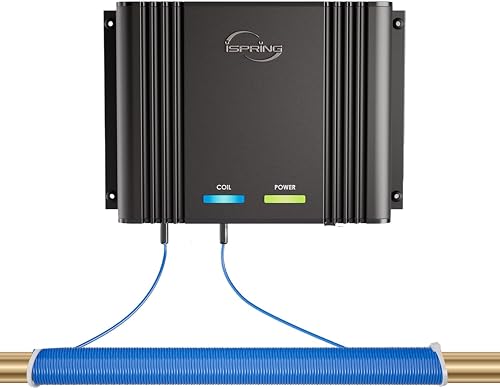
Price on Amazon: $225.99 | 4.1 stars from 2,190 ratings (checked October 10, 2026)
The iSpring EDV2 clamps around your main pipe, so there is nothing to cut and no plumber needed. It is salt-free and uses a 12-watt signal to change how minerals behave, which the maker says reduces limescale.
Evidence for electronic descalers is mixed, and the water will not feel soft or slippery. Think of it as a low-cost way to try to cut scale, not a replacement for a softener.
Pros
- Lowest price on the list
- Clamp-on install, no cutting
- No salt or water waste
- 4.1 stars from 2,190 ratings
Cons
- Does not soften water
- Results vary and proof is mixed
Verdict: If your budget is tight and scale is the only problem, the EDV2 is the cheapest way to try.
8. Best Salt-Free Filter Combo for City Water: Kind Water Systems E-3000 Whole House Salt-Free Water Softener and Filter for City Water
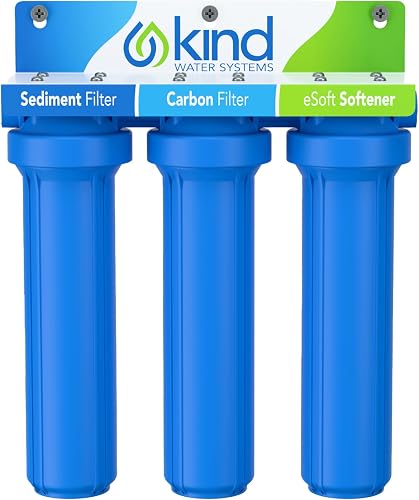
Price on Amazon: $1,738.11 | 4.5 stars from 66 ratings (checked October 10, 2026)
The Kind Water Systems E-3000 combines sediment filtration, carbon block filtration and salt-free scale control in one system. The listing says it targets up to 95% of sediment and over 155 chemical contaminants including chlorine, chloramine, VOCs and pesticides.
It is designed for city water, not wells, and it uses no salt, no electricity and no drain line.
Pros
- Filter and salt-free conditioner in one
- No salt, power or drain
- Compact for a whole-house unit
- 4.5 stars from 66 ratings
Cons
- Highest price on the list
- City water only
Verdict: If you are on city water and want chlorine removal and scale control in one box, this is the combo to look at.
Water Softeners Buying Guide
With so many water softeners available today, you need to determine the best one for your requirement. Every water softener has a specific capacity in grains per gallon or GPG. A small system for a kitchen starts at a capacity of 24,000 GPG, while a bigger one can cost 64,000 GPG.
The size of the water softener highly influences your choices. Choosing a water softener as per your requirement is crucial because of 2 basic reasons. A bigger water softener tank that isn’t used frequently would become a ground for bacteria growth inside the resin tank. This would increase the maintenance and replacement costs. A smaller water softener system used frequently would work rigorously to meet your needs. That would mean a continuous and generous supply of salt even before the schedule for regeneration.
To pick the best water softener for your requirement, you only need to know two things. First, find out the hardness of water and water consumption every day. When these numbers are multiplied, you get the daily requirement for water softening. To get the value for a week, multiply this by 7, and you can easily pick a water softener based on this number. This is the grains per gallon capacity that you have to pick.
Water Softener Definition & How It Works
A water softener is a special system that fits the plumbing system or comes as an attachment to the waterline. It aims to remove the hardness from water and reduce scaling caused by hard water. Hard water tends to cause a lot of scaling and damage to appliances or faucets. Too much exposure to hard water can cause dryness to the skin and hair. Hard water is not recommended for cooking and laundering also. It may cause damage to clothes, food, and utensils too.
Water softener helps eliminate this hardness from water by treating water with one of the softening technologies. A softener is built for hardness only. For chlorine, lead or other contaminants, you need a separate filter.
When You Need a Water Softener
Before buying a water softener, you need to be sure that it is essential for your home. A basic water hardness test will reveal if this is needed or not. To determine the hardness, you have to check the GPG of water. GPG stands for grains of hardness per gallon/ grains per gallon. It indicates the concentration of magnesium and calcium in the water.
Test kits are easily available in the market that can indicate the water hardness level. Alternatively, if you see scales on your faucets, laundry, or dishes, it is a sign of hard water.
Some other contaminants can also cause an imbalance in water chemistry. Be sure that you have an issue with hard water and not just any other kind of contamination. To be 100% sure, check with a water testing lab near you.
Once you have determined the cause, you can opt for a water softener if the water is hard or any other kind of filtration system, depending on the contamination.
Hard Water Definition & Causes
Water that has a high quantity of minerals present in it is termed hard water. This is because water gets deposited in the earth’s crust, exposed to calcareous, chalk, or gypsum deposits. When water is in contact with these deposits for a long duration, many calcium or magnesium carbonate, bicarbonate compounds, and sulfates dissolve in water. This forms hard water.
While a little quantity of calcium and magnesium can be consumed daily, large quantities can change the taste of water. It will also lead to the formation of scales on electrical appliances that regularly come in contact with hard water.
Signs And Problems of Having Hard Water
If you have shifted to a new place or suddenly feel a strange change in water, look for these signs to figure out if you are exposed to hard water.
– If the taste and smell of water have changed. A metallic taste or smell of rotten eggs can indicate the presence of hardness causing metals in water
– Unusual stains on sinks, toilet pots, vessels indicate hard water. Water scales can form on faucets, showerheads indicating excessive calcium. These scales are very hard to clean. Calcium deposits stay back on the faucets after the water has evaporated.
– Hard water does not let soap form foam. If you face this issue, you are likely in contact with hard water
– It also leaves soapy residue during a bath on the skin. This happens because hard water does not let soap wash off the body.
– Hard water deposits can also clog the showerhead, which can lower water pressure during showers.
Clogging water pipes and faucets is also a common problem you face with hard water.
– If you notice your washed laundry is not clean enough, it is likely that hard water isn’t cleaning out all the detergent from your laundry. This leftover detergent in the clothes is inviting more dirt on the clothes.
– Hard water can also dry out skin and may worsen eczema in some people.
– Hard water can also cause your electrical appliances to wear off quickly.
Types of Water Softeners
-
-
Salt-Based Water Softeners
- Pros:
- They are the traditional water softening system that is the most effective.
- A simple exchange of hardness-causing ions, i.e., magnesium and calcium, are replaced with sodium ions from salt.
- It has a regeneration process to flush the hard minerals automatically within a set period
- Cons:
- It wastes a lot of water
- Increases the water salinity
- Not eco-friendly and environment friendly
- Pros:
-
Dual Tank Water Softeners
- Pros:
- It uses two tanks to treat hard water, continuously producing soft water.
- No downtime even during regeneration
- Suitable for commercial business and homes as well
- Cons:
- Expensive than single-tank systems. These cost almost twice the single tank systems.
- Pros:
-
Salt-Free Water Softeners
- Pros:
- It does not strip the essential minerals completely from water
- Can easily remove the limescale formation issue
- It uses an efficient crystallization method to prevent hardness-causing minerals from sticking to the surfaces.
- The most eco-friendly option available does not include wastewater.
- Cons:
- It does not remove the hardness of water
- It cannot work with water having a high GPG value
- Expensive for tackling just the limescale issue.
- Pros:
-
Electronic Water Descalers
- Pros:
- Uses electromagnetic waves to change the composition of minerals in hard water
- Effective in preventing the formation of scales
- Uses magnets or coils of wire instead of salt and water. This means less cost and less wastage of water.
- Low maintenance
- Cheap
- Cons:
- They do not soften water. It only helps in descaling.
- Independent proof is mixed, so treat the claims with care
- Pros:
-
Things To Consider When Buying Water Softener for Home
- Technology Type of Water Softener
There are 3 kinds of technologies currently in the market for water softening.
– Descalers – These electronic devices are attached to the plumbing line of the water supply. It uses electromagnetic waves that prevent scaling. If you only need to get rid of the scales, this is the option. Hard minerals in water are not removed from this system.
– Conditioners – Most water conditioners use crystallization technology to change hard minerals like calcium and magnesium so they do not stick to pipes. The minerals stay in the water; they just do not form scale.
– Ion-exchange – This is a traditional form of softening hard water. It uses sodium from salt to exchange the calcium and magnesium ions in hard water. Ion exchange technology easily turns hard water into soft water and prevents scaling.
- Cost
The budget has a great influence when considering buying a water softener. A smaller budget means that the search is limited to a few options. It also means that you can specifically look into the systems available along with their monthly maintenance cost. It is ideal to understand and collect the 3 basic expenses with the water softener.
– Initial cost of the softener
– Installation charges
– Maintenance cost in the long run, which included replacing internal parts as well as cost for salts
Water softeners that don’t work using salt are the most affordable. You can use conditioners or descalers to improve the water quality. Some of these units cost less than $600, and they have no salt costs.
Salt-based ion-exchange softeners on Amazon today run from about $630 to $825 for a 48,000-grain unit, more for larger sets. They will also need a salt top up every month and wastewater during the regeneration process.
Most water softener systems need professional installation as they need to be fixed in the waterline. Electronic descalers are an exception. So if you do not have experience, this will come as an added charge of around $200.
- Flow Rate
Water softening is a time-consuming process. It takes a specific time for the system to produce soft water ready for use. The amount of water in gallons per minute that the system can generate soft water is known as its flow rate. This also depends on the type of technology being used for softening water. For example, Resin-based technology needs the water to be in touch with resin for a long. This will also depend on the number of faucets being used simultaneously, the size of the house, and other factors. The hardness of water is another factor that needs to be accounted for. A larger resin will ensure that the flow rate is high. Many water softeners do not affect the flow rate.
Water Softener Regeneration Methods
The kind of regeneration methods used by a water softener depends on their technology. Descalers do not regenerate themselves as they use magnets or coils to condition the hard water.
Ion-exchange filters use resin beads to soften water. After a specific time, these resin beads regenerate themselves by flushing out the toxins and unwanted minerals. They waste a good amount of water which costs a lot on your water bill.
There are single-tank water softeners that can use time-based or demand-initiated regeneration methods. Demand-initiated or metered regeneration gets triggered when as per the water usage. A digital meter on the tank records the water usage and time of regeneration. It also indicates when salt needs to be added to the system.
The time-based regeneration method lets the user set a specific time when the system can regenerate.
- Certifications
There are government regulations with a pre-determined safe level of contaminants in water. Independent companies like NSF or ANSI have certifications that manufacturers can apply for. These companies check water quality from the water softener systems and ensure safety.
NSF Standard 44 certification is specific to water softening systems. Any water softener that has this certification can effectively remove hardness causing minerals less than 1 GPG.
It is better to pick a certified system, but uncertified systems do not mean they are ineffective. You can separately test the water from these systems to be safe.
- Installation and Maintenance Costs
As mentioned above, installation costs depend on your ability to fix the water softener in the plumbing line. Many available water softeners come with a DIY instruction manual, while a few will need professional plumbing from the manufacturer.
If you can install the water softener by yourself, it will save you anywhere around $200 of installation charges.
Maintenance cost depends on the kind of water softener you are using. An ion-exchange traditional filter needs the highest maintenance. In terms of cleaning, it will require regularly adding salt to the brine tank. These systems also need replacing resin beads after 10 years. This isn’t frequent but can cost you a good amount depending on the manufacturer. Since this is a practical and preferred system by many, people are happy spending the extra money and effort on this system.
Water conditioners are the cheapest and maintenance-free systems. They only need the TAC media to be replaced every 6 to 8 years. If you do not want to spend your time maintaining the system, then this is your pick.
The parts of the water softeners may wear out or tear after regular use. It is inevitable. Most parts will cost you from a dollar to $500, depending on the size of the part and its importance.
- Bypass Valve
A bypass valve is essential and should be installed with any water softener system unless it is a Descaler. All water softener systems (except descaler) are installed after cutting into the water plumbing system. This means the water enters the home after passing through the water softener.
A bypass valve is an alternate route for the water to enter the home when the water softener system is at fault or regenerating. However, it will send hard water into your home, which is better than hanging in without water.
When they are shipped, many water softeners have this bypass valve in their kit. Sometimes you need to purchase it at an additional cost.
- Initial Price
The unit’s initial price decides which systems are affordable and within your budget. Over time you may be able to afford the maintenance cost for the system, but the initial price is the first investment you need to make to buy the water softener.
The initial price varies on the technology and type of water softener is used. On Amazon today, descalers start near $226, salt-free conditioners run from about $400 to $1,700, and salt-based softeners from about $630 to $825.
Benefits of Using Water Softener
There are many benefits of using water softener, but the two main benefits are
– Soft water for consumption
– No more scaling in water piper, clogged showerheads, and faucets
How To Choose Water Softener for Your Home and Needs
1. Determine Your Water Hardness
The foremost thing to determine is whether you have a hard water supply or not. Once you have established that you are receiving hard water, you need to check the hardness level. Depending on the hardness level, there are different water softener systems that you can pick.
A higher hardness level will need you to pick a resin tank with a higher GPG unit.
2. Select System Type
Whether you want to pick a system that can be easily attached to the water line or needs to be installed along the entire plumbing system is another critical consideration.
You can also have systems that can soften just the drinking water or the entire house water. Another consideration here would be based on the problem if you want to eliminate the limescale formation problem on the faucets and appliances or do you want to get the supply of soft water for drinking.
3. Determine the Appropriate System Size
System size depends on the size of the house, the number of people in the house, and the flow rate requirement. All these factors will play a vital role when picking the best system for your home. Keep these answers in mind while checking different systems. There are online calculators available that can determine the size requirement after you answer a few simple questions.
People Also Ask
What type of water softener is best?
There is no correct answer to this question. It depends on your budget and problem. If limescale is your only issue, then a cheap electrical descaler is enough to solve your problem. But if you need soft water for the entire house for every purpose, then the traditional ion-exchange filters are the best option to pick.
How much does a whole house water softener cost?
Based on the listings above, descalers run from about $226 to $400. Salt-free conditioners run from about $555 to $1,740, and salt-based whole-house softeners from about $630 to $825, before installation.
The cost depends on the size of additional parts needed during setup.
What are the pros and Cons of a water softener?
Pros:
- Softens hard water for drinking, and other daily activities
- Reduces the formation of scales in the pipes and additional water exposed appliances.
Cons:
- Long-term expense on maintenance of water softeners
Can you install a water softener yourself?
Yes, there are many water softeners available in the market with a DIY instructions manual. These can be installed easily into the water plumbing system if you know plumbing basics.
Is a soft water system worth it?
Hard water can leave scale on appliances and fixtures and make soap work poorly. If your hardness is above about 7 grains per gallon, a softener or conditioner is usually worth the cost.
Is it better to drink hard water or soft water?
Hard water has traces of magnesium and calcium dissolved in it. These minerals are fine to drink in normal amounts. Softened water has a little added sodium, so people on low-sodium diets should check with their doctor, or keep one tap unsoftened for drinking.
Is distilled water the same as soft water?
Distilled water is water formed after collecting water vapors by evaporating water. Hence distilled water does not have any impurities or minerals. It is the most purified form of water. On the other hand, soft water is just water that isn’t hard. Soft water may contain traces of minerals in a minute and acceptable quantities.
Related Water Guides
If your water comes from a well, start with our water softeners for well water and iron filters for well water. Compare options in our salt-free water softener systems and dual-tank water softeners, and read water conditioning vs. water softening. Check your area in water hardness by state. For filtered drinking water, see whole-house water filter systems, whole-house filters for hard water, shower filters and water filter pitchers.
The risk to watch is the sodium and the wastewater from salt systems, plus the claims on electronic descalers, which still have mixed proof. Expect clearer labels and more independent testing, and do not be surprised if the cheapest descalers lose ground as buyers ask for certification, not just a marketing line.
Final Word
Hard water causes real problems, and the right system handles them. Test your water, match the unit to your hardness and household size, and decide whether you want true softening (salt-based) or scale control (salt-free). Then budget for salt, filters and installation over the next ten years.
What happens next: water hardness is not going down, and prices for whole-house systems are not either. The smart move is to test your water first, size the unit to your hardness and household, and budget for filters or salt over ten years, not just the box price.